



Simulated vs Live Funded Accounts: What Prop Firms Are Actually Giving You and Why It Matters
Overview #
Here's a question that separates informed traders from everyone else: when you pass a prop firm evaluation and get "funded," are your orders hitting the exchange? For most firms, the answer is no. Not even close.
The funded trading industry has evolved into something that looks nothing like traditional proprietary trading. Most modern prop firms operate on a simulated execution model — your "funded" account runs on the same sim infrastructure you used during the evaluation. Some firms mirror select trades to live markets through copy-trading systems. A handful actually route your orders directly to CME or ICE.
This distinction matters because it changes everything about your relationship with the firm. It determines whether the firm profits when you profit, or profits when you fail. It affects your fills, your slippage, your psychology, and ultimately whether the rules you're trading under are designed to help you succeed or designed to protect the firm's balance sheet.
The industry uses terms like "simulated," "livesim," and "live" — but these labels mean different things at different firms. Some firms call accounts "live" when they're connected to a live data feed but orders never touch an exchange. Others are transparent about running sim but structure payouts identically to a live broker arrangement.
What follows is a structural breakdown of how these account types actually work, why they're structured the way they are, and how to evaluate firms based on execution reality rather than marketing language.
Key Concepts #
Before diving in, here are the terms as they're used in this article:
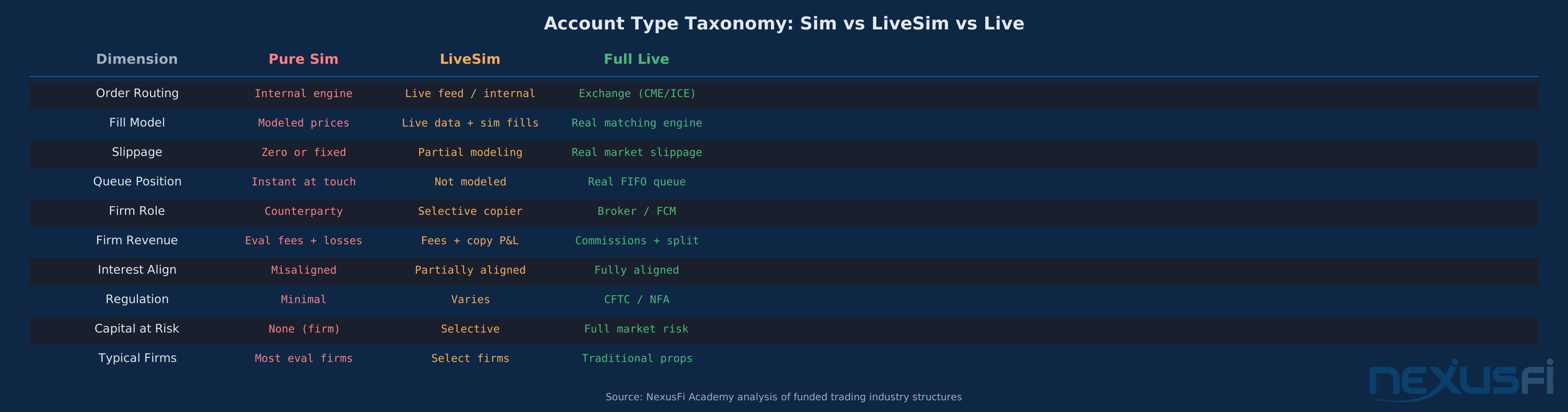
Pure Simulated Account — Orders are matched against an internal engine. Price fills are modeled, not executed. The account exists entirely within the firm's software infrastructure. This is what you trade during most evaluations.
LiveSim (Hybrid) Account — The account connects to real-time market data and may use a live order routing system, but your specific orders are internalized. The firm's risk system tracks your positions on a simulated ledger. Some firms selectively copy profitable trader activity to live markets — a practice known as shadow execution.
Full Live Account — Your orders route directly to the exchange (CME Globex, ICE, etc.) through a clearing firm. You have real exchange execution, real market impact, and real clearing lifecycle. The firm carries actual market risk on your position.
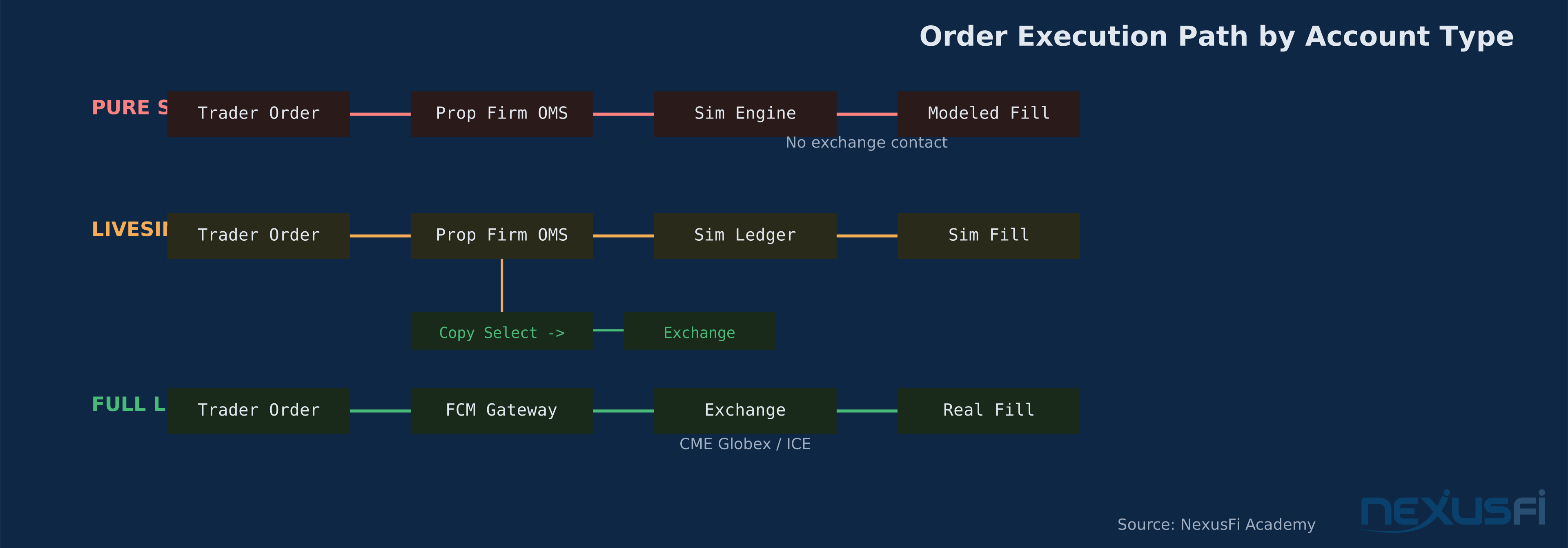
B-Book Model — The firm acts as counterparty to the trader's positions. Trader losses become firm revenue. This is the dominant model in the funded trading space.
A-Book Model — The firm routes orders to the exchange and earns revenue through commissions, spreads, or profit splits on real P&L. The firm and trader interests are aligned — both benefit when the trader profits.
Copy Trading / Shadow Execution — The firm selectively mirrors trader orders to a live master account, usually at the firm's discretion. The trader may not know which of their trades are copied.
How It Actually Works: The Three Account Types #
Pure Simulated — The Default #
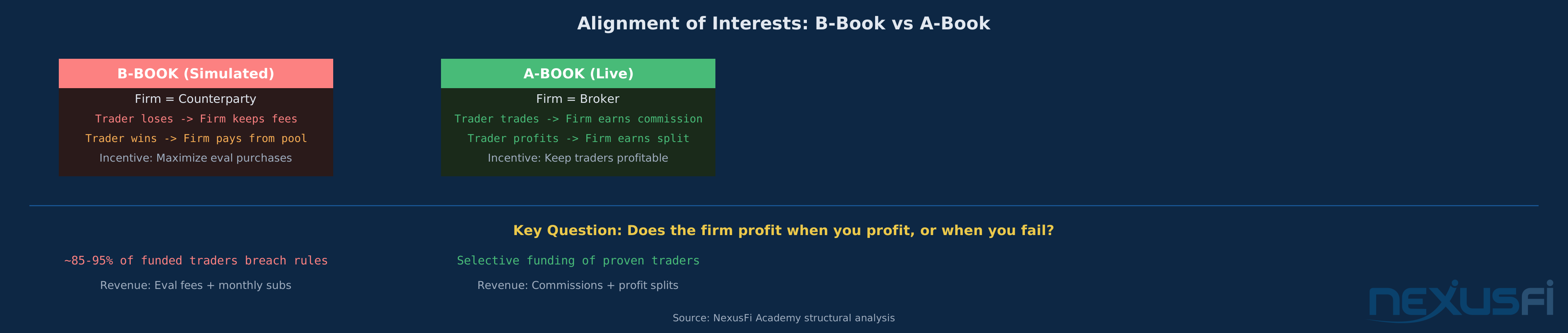
Most prop firms operate what's effectively a B-Book. When you pass the evaluation and receive your "funded" account, you're still trading in simulation. Your orders are filled against modeled prices derived from the real market feed. The fills look realistic because they're tied to live data — but no order ever reaches an exchange matching engine.
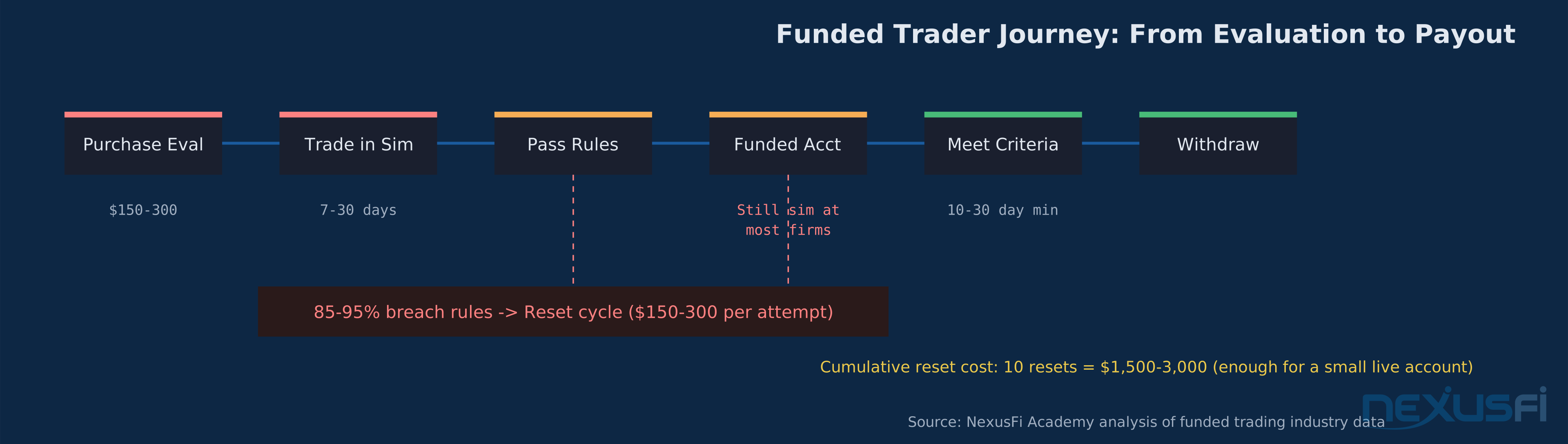
The economics are straightforward: if most traders lose their accounts (and they do — industry estimates suggest 85-95% of funded accounts eventually breach rules), the firm keeps the evaluation fees and monthly data fees while paying out nothing. The small percentage who trade profitably represent a cost to the firm, paid from the revenue pool generated by the majority who don't.
As @Phoenixoboros pointed out on NexusFi when comparing firm models:
Firms that put you on a livesim account? Thoughts? (@VirtualMark)
The distinction between firms that make money on profit splits (live accounts) versus firms that make money primarily on evaluation fees (sim accounts) changes the entire incentive structure.
There's nothing naturally wrong with this model — it's disclosed in the terms of service of most reputable firms. The issue is when traders don't understand what "funded" actually means and make assumptions about execution quality based on that misunderstanding.
LiveSim — The Hybrid Zone #
LiveSim occupies a middle ground that confuses a lot of traders. The account connects to real market infrastructure — live data feeds, real-time DOM, sometimes even a live order routing gateway. But the position accounting, risk management, and P&L calculation happen on a simulated ledger.
Some firms use livesim as a screening phase. Traders who demonstrate consistent profitability in livesim may have their orders selectively copied to a live master account. This is shadow execution — the firm's algorithm decides which trades (or which traders) to mirror in real markets.
The copy-trading mechanics introduce their own set of issues:
- Latency gap: There's always a delay between your simulated fill and the firm's live execution. In fast-moving futures markets, this means the firm's fill price differs from yours. On ES during a news release, even 50 milliseconds can mean multiple ticks of slippage.
- Partial fill asymmetry: Your sim account might show a full fill at your limit price, but the firm's live copy only gets a partial. Who absorbs the difference? In most structures, the firm does — which means they bear execution risk on your "best" trades.
- Size scaling: If you're trading 10 contracts in your sim account, the firm might copy 2 contracts to live. The scaling math changes the risk profile of every position.
- Selection bias: Firms copy the traders and trades they believe will be profitable. This means the copy-trading system is basically the firm making a trading decision based on your signals. You're running the strategy; they're choosing how much to bet on it.
As @bobwest noted in a detailed analysis of funded account structures:
ApexTraderFunding.com experience and review (@Merkd1904)
The psychological gap between sim and real money is significant, and the prop firm model deliberately blurs this line.
Full Live — The Rare Exception #
A genuinely live funded account means your orders clear through an FCM (Futures Commission Merchant), hit the CME or ICE matching engine, and your P&L reflects actual market execution with real slippage, real partial fills, and real queue position effects.
Traditional proprietary trading firms — the ones that existed before the retail evaluation model — operated this way by default. Traders sat in an office, traded the firm's capital through the firm's clearing relationship, and split real profits. The firm's risk came from actual market exposure.
In the modern funded trading environment, truly live accounts are rare because they require:
- FCM clearing relationships — Expensive to establish and maintain. Requires NFA registration.
- Real capital at risk — The firm must actually put money behind every position.
- Regulatory compliance — Live execution triggers a cascade of regulatory obligations around customer funds, reporting, and supervision.
- Sophisticated risk management — Real-time position monitoring, automated liquidation, and capital allocation systems.
The few firms offering genuine live execution typically charge higher fees, impose stricter evaluation criteria, and maintain smaller trader rosters. The economics don't support evaluating thousands of traders with real capital — only the firms that are selective about who gets funded can afford to run A-Book.
The Alignment of Interests Problem #
This is the structural truth that every funded trader needs to understand: the account type determines whether the firm's interests align with yours.
B-Book (Simulated): Firm Is Your Counterparty #
In a pure sim or livesim setup, your P&L is an internal accounting entry. When you lose $5,000, the firm doesn't gain $5,000 from an exchange — they just erase the ledger entry. But they also don't need to fund your $5,000 loss. The firm's revenue comes from evaluation fees, monthly subscriptions, and data fees. Your profitability is a cost center, not a revenue driver.
This creates a subtle but important misalignment. The firm profits most when:
- Traders keep purchasing evaluations (recurring fee revenue)
- Traders fail funded accounts and reset (more fee revenue)
- The few profitable traders withdraw slowly or in small amounts (minimizes payout costs)
This doesn't mean the firm is actively trying to make you fail. Most reputable firms genuinely want some traders to succeed — success stories drive marketing and new signups. But the structural incentive is toward rules that limit payout velocity and size.
As @shokunin documented on NexusFi when a $22,000 payout request was denied due to the DCA (Dollar Cost Averaging) rule:
ApexTraderFunding.com experience and review (@Merkd1904)
Rules like these exist at the intersection of risk management and business model protection. Whether they protect the trader or the firm depends on which account model the firm runs.
A-Book (Live): Firm Is Your Broker #
When orders hit the exchange, the firm earns revenue from commissions and profit splits on real P&L. The more you trade and the more you profit, the more the firm earns. Alignment is direct — your success is the firm's revenue.
This model incentivizes the firm to:
- Fund traders who are likely to be profitable (higher selectivity)
- Provide good execution infrastructure (better fills = more trading)
- Support trader development (longer trader tenure = more commissions)
- Process payouts quickly (happy traders trade more)
The tradeoff is higher barriers to entry and stricter risk controls. A firm risking real capital will impose tighter drawdowns, require longer track records, and fund fewer traders overall.
Execution Reality: What Changes Between Sim and Live #
For futures traders, execution quality isn't academic — it directly affects whether your strategy works. Here's what changes across account types:
Fill Quality #
Sim accounts typically fill market orders at the current bid/ask with zero or modeled slippage. Limit orders often fill at the limit price the moment it's touched. In reality, on CME Globex, your limit order sits in a queue behind every order placed before yours at that price level. During active sessions on ES, you might need the market to trade through your price by several ticks before your limit gets filled.
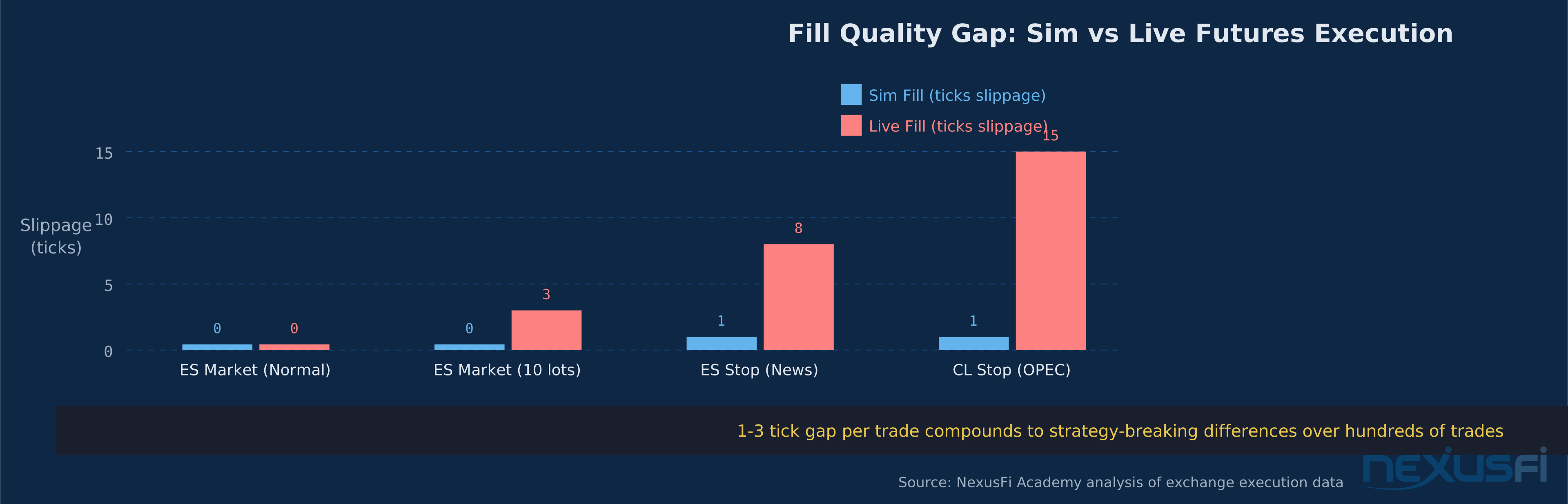
This means strategies that depend on limit order fills at exact levels — especially reversal entries at support/resistance — will show much better performance in sim than in live. The difference can be 1-3 ticks per trade on ES, which on a scalping strategy running 10+ trades per day is the difference between profitable and unprofitable.
Slippage #
Simulated environments handle slippage inconsistently. Some firms model zero slippage on market orders during regular hours. Others apply a fixed slippage model (e.g., 1 tick). Real slippage on futures varies dramatically based on time of day, liquidity conditions, and order size.
During normal RTH (Regular Trading Hours) on ES, a 1-lot market order typically fills at the bid/ask with zero slippage. But scale that to 10 contracts during a fast move, and you're looking at 1-4 ticks of slippage depending on book depth. During news events (NFP, FOMC, CPI), even 1-lot orders can see 5-10 ticks of slippage.
If your sim fills don't model these scenarios, your backtest and live performance will diverge — sometimes catastrophically.
Latency and Rejects #
Live order routing introduces latency that sim environments don't have. Your platform sends the order to the gateway (Rithmic, CQG, TT), which routes to the exchange, which processes the match, which sends the confirmation back. Round-trip time is 5-50 milliseconds depending on infrastructure.
In sim, this roundtrip is basically zero — the fill comes back as fast as your local software can process it. For most swing and position traders, this doesn't matter. For scalpers working the DOM, those milliseconds change your queue position and your fill probability.
Live accounts also introduce order rejects — something sim traders rarely encounter. Insufficient margin, exceeded position limits, exchange maintenance windows, or even CME circuit breakers can reject orders that would fill instantly in sim.
Stop Execution #
Here's where the gap between sim and live hurts most traders. In sim, stop-market orders execute at the stop price (plus modeled slippage, if any). In live, a stop-market order becomes a market order when triggered, and you get whatever price the matching engine gives you.
On CL (crude oil) during an OPEC headline, a stop-market set at $68.50 might fill at $68.35 — 15 ticks of slippage on a single contract. In sim, that same stop likely fills at $68.49 or $68.50. Over hundreds of trades, this compounds into a material P&L difference.
Psychology: The Hidden Variable #
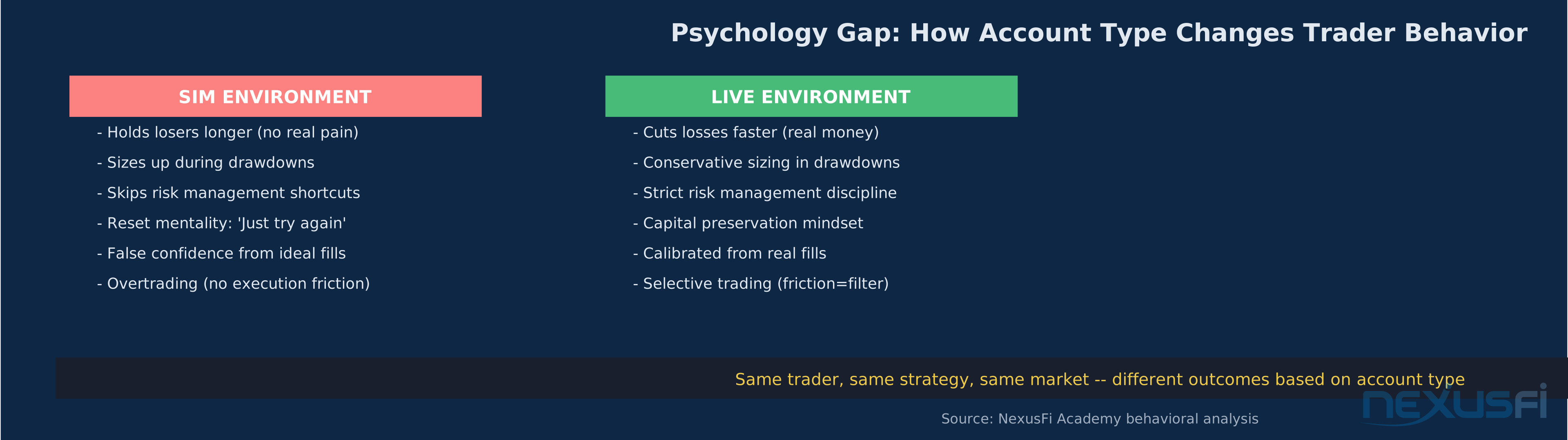
The difference between sim and live execution creates a psychological gap that most traders underestimate.
False Confidence #
Sim trading — even months of it — builds confidence based on idealized execution. When you've been profitably trading ES for 90 days in a sim-funded account, you've internalized patterns about how your stops get filled, how your limits get hit, and how the market responds to your entries. Move those same strategies to a live environment and every one of those assumptions changes.
As @bobwest explained in a forum discussion about the psychology of funded accounts:
ApexTraderFunding.com experience and review (@Merkd1904)
The gap between sim and real money creates measurable behavioral changes that most traders don't recognize until they're already losing.
The Accountability Illusion #
Sim accounts create what psychologists call "moral hazard" — when you're insulated from the full consequences of your decisions, you take different risks than you would otherwise. A trader who knows (consciously or not) that their account is simulated may hold losing positions longer, size up more aggressively during drawdowns, or skip the discipline required for risk management.
This works in both directions. Some traders are more aggressive in sim (leading to inflated performance). Others are more conservative in live (leading to missed opportunities from the strategies that made them profitable in the evaluation).
The Reset Trap #
At most firms, blowing a funded account means you can purchase another evaluation and start over. This creates a reset mentality — "I'll just try again" — that doesn't exist when trading real capital. As @Baudo noted on NexusFi:
ApexTraderFunding.com experience and review (@Merkd1904)
The ease of passing evaluations (especially with generous rules and discount pricing) can actually set traders up for failure in the funded stage, where the same aggressive approach hits stricter rule structures.
The compounding cost of resets is something traders don't track well. At $150-300 per evaluation (with typical promotions), a trader who fails and resets 10 times has spent $1,500-3,000 — money that could have funded a small personal trading account at a futures broker with real capital at risk.
Regulatory Reality #
The regulatory environment for funded trading firms is more subtle than most traders realize.
Who Is Regulated and How #
Traditional proprietary trading firms that provide capital for live trading through FCMs are subject to CFTC oversight and NFA membership requirements. The regulatory framework assumes the firm is bearing real market risk and the trader is handling real customer funds.
Most modern evaluation-based prop firms structure themselves differently. Since the "funded" accounts are simulated, the firm argues it's not providing trading capital — it's licensing access to a simulated trading environment with a payout structure. This distinction has allowed most firms to operate outside the traditional CFTC/NFA regulatory framework.
This isn't necessarily problematic — but it means the protections that come with regulated entities (segregated customer funds, audit requirements, dispute resolution through NFA) may not apply. When a regulated broker goes bankrupt, CME's guarantee fund provides some protection. When an unregulated prop firm stops paying out, you're left with contract law and small claims court.
Your Status with the Firm #
Depending on the firm's structure, you might be classified as:
- A customer purchasing access to a simulated trading platform
- An independent contractor trading the firm's capital (rare in modern firms)
- A subscriber to a software service with performance-based payouts
Each classification carries different legal rights and obligations. Most evaluation-based firms use the first model — you're buying a service, not entering an employment or trading arrangement. Read the terms of service carefully. The language around "funded account" is often aspirational marketing rather than a legal description of your relationship with the firm.
How to Evaluate a Firm: The Due Diligence Checklist #
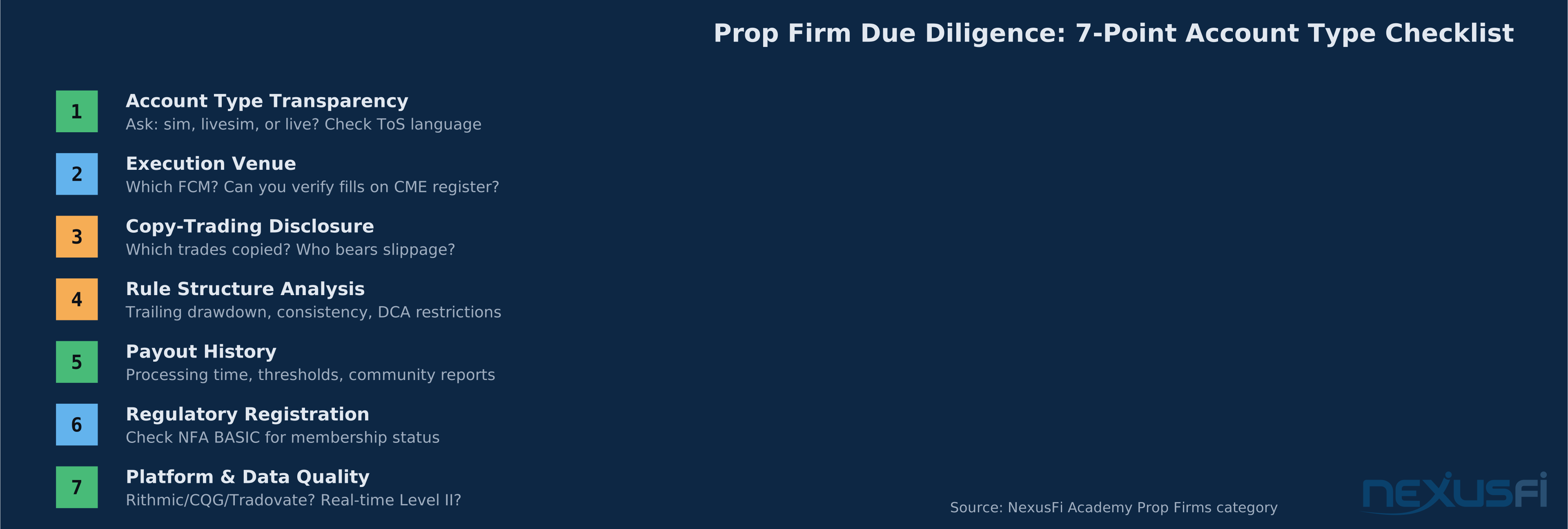
Based on everything above, here's what to ask and verify before committing to any prop firm:
1. Account Type Transparency #
Ask directly: "After I pass the evaluation, am I trading on a simulated account, a livesim account, or a fully live account with exchange execution?" If the firm won't answer clearly, that's your answer.
Check the terms of service for language like "simulated trading environment," "virtual account," or "paper trading." These phrases tell you more than the marketing page.
2. Execution Venue #
For live accounts: which FCM clears your trades? What exchange connectivity do they use? Can you verify your fills on the CME's trade register?
For sim/livesim accounts: how are fills modeled? Does the sim account for queue position? Is slippage applied to stop orders?
3. Copy-Trading Disclosure #
If the firm uses copy-trading: which trades are copied? Do you know when your orders are being mirrored to live? Who bears the slippage between your sim fill and the live fill?
4. Rule Structure Analysis #
Examine the rules through the lens of business model protection vs trader protection:
- Trailing drawdown — Protects the firm's maximum payout liability. Does it trail from your high watermark in real-time (aggressive) or end-of-day (trader-friendly)?
- Consistency rules — Limits outsized single-day gains. As documented on NexusFi, these rules can retroactively affect payout eligibility months after the trades were made.
- Minimum trading days — Prevents "lucky streak" payouts. Reasonable at 10-15 days; excessive above 30.
- DCA/position sizing restrictions — May limit specific strategies (scaling in, averaging). Understand what's restricted before you start.
5. Payout History and Process #
How long does withdrawal processing take? Are there minimum withdrawal thresholds? Maximum withdrawal percentages? How many traders have received payouts, and what's the average size?
Some firms publish payout data. Cross-reference what you find with community reports on forums. As @dredmond19800 noted on NexusFi:
Funded Trader platforms (@Big Mike)
The headline "$50K account" doesn't mean what most traders assume — the real constraint is the maximum loss limit, which often means you're operating with $2,500-5,000 of effective trading capital.
6. Regulatory Registration #
Check NFA BASIC (nfa.futures.org/basicnet) for the firm's registration status. If they're registered as a member, they're subject to regulatory oversight. If they're not, understand what protections you're giving up.
7. Platform and Data Feed Quality #
Which platforms does the firm support? Do they provide Rithmic, CQG, or Tradovate connectivity? Is the market data real-time Level II, or is it delayed or synthetic?
A firm that uses established exchange-connected platforms (NinjaTrader with Rithmic, Sierra Chart with CQG) provides more execution transparency than one running a proprietary platform where you can't independently verify fill quality.
Making the Decision #
The sim-vs-live distinction isn't a binary good-or-bad judgment. Each model serves different trader profiles:
Sim-funded accounts work well when:
- You're developing a strategy and need screen time without risking personal capital
- You treat the monthly fee as the cost of a structured trading education
- You understand the execution differences and don't extrapolate sim results to live performance
- Your strategy doesn't depend on precise limit fills or minimal slippage
Live-funded accounts are worth pursuing when:
- You have a proven track record and need capital beyond your personal means
- Execution quality is critical to your strategy (scalping, DOM trading, spread trading)
- You want regulatory protections and transparent clearing
- You're willing to meet stricter evaluation criteria
For most traders, the honest answer is that a small personal account at a regulated futures broker gives you better execution, full transparency, no arbitrary rules, and complete alignment of interests. A $5,000 account trading 1-2 MES contracts teaches you more about real market behavior than a $150,000 sim-funded account ever will.
But if capital access is genuinely the constraint, prop firms fill a real need — just go in with eyes open about what you're actually getting.
Knowledge Map
References This Article
Articles that build on this topicCitations
- — Firms that put you on a livesim account? Thoughts? (2022) 👍 2“I have two funded accounts for now with one of the livesim firms, although I have not made a withdrawal yet because of their minimum active trading days rules, once I'll make a withdrawal I will report back.”
- — ApexTraderFunding.com experience and review (2022) 👍 8“Without offering an opinion on Apex or any other firm, I think that many people are probably better off just trading their own money in the micros, and having the inevitable losses that are the price of admission, and learn about real risk management...”
- — ApexTraderFunding.com experience and review (2024) 👍 3“At least with what I was talking about, there are generally two levels of sim trading, then a full real-market account after that. I haven't kept up with what is out there, and have only a little knowledge of what Topstep does.”
- — ApexTraderFunding.com experience and review (2024) 👍 7“I want to give a heads-up on the Apex DCA rule. My recent payout request of $22k was denied due to DCA. All my trades are logged on my journal at https://ticks-in-flow.blogspot.com/ where I have documented my entries, exits and trade reason.”
- — ApexTraderFunding.com experience and review (2022) 👍 17“Here is my promised REVIEW on customer experience and passing the evaluation account with APEX very swift transition to paid account Finished the eval account and the 10th trading day last Friday very quick follow-up by Apex, received notice on Satur...”
- — Funded Trader platforms (2024) 👍 2“I was always the first guy to stand up and call these prop firms out as being absolute scams. And by "these" prop firms I mean the latest wave of pay for a monthly evaluation for an account called something like "$50k Account" when in reality it's a...”