



Expectancy: The Single Number That Tells You Whether Your Trading System Actually Works
Overview #
The Formula That Replaces Everything You Think You Know About Win Rate #
Here's the formula:
Expectancy = (Win Rate x Average Win) - (Loss Rate x Average Loss)
That's it. One number. Positive means the system makes money over a large sample of trades. Negative means it doesn't, regardless of how good individual trades feel, regardless of how impressive your win rate looks, regardless of what your trading buddy thinks about your setups.
"I won 8 out of 10 trades" sounds great until you run the math: if those 8 wins averaged $100 each and the 2 losses averaged $500 each, your expectancy is (0.80 x $100) - (0.20 x $500) = $80 - $100 = -$20 per trade.
Most traders obsess over win rate because it feels like the right metric. "I won 8 out of 10 trades" sounds great until you run the math: if those 8 wins averaged $100 each and the 2 losses averaged $500 each, your expectancy is (0.80 x $100) - (0.20 x $500) = $80 - $100 = -$20 per trade. You're losing money. Consistently. And it feels like you're winning.
Expectancy captures the complete picture by combining two dimensions that win rate alone ignores: how often you win and how much you win relative to how much you lose. It's the mathematical summary of your edge, expressed as dollars per trade (or ticks, or R-multiples, depending on your framework).
Why Win Rate Lies to You #
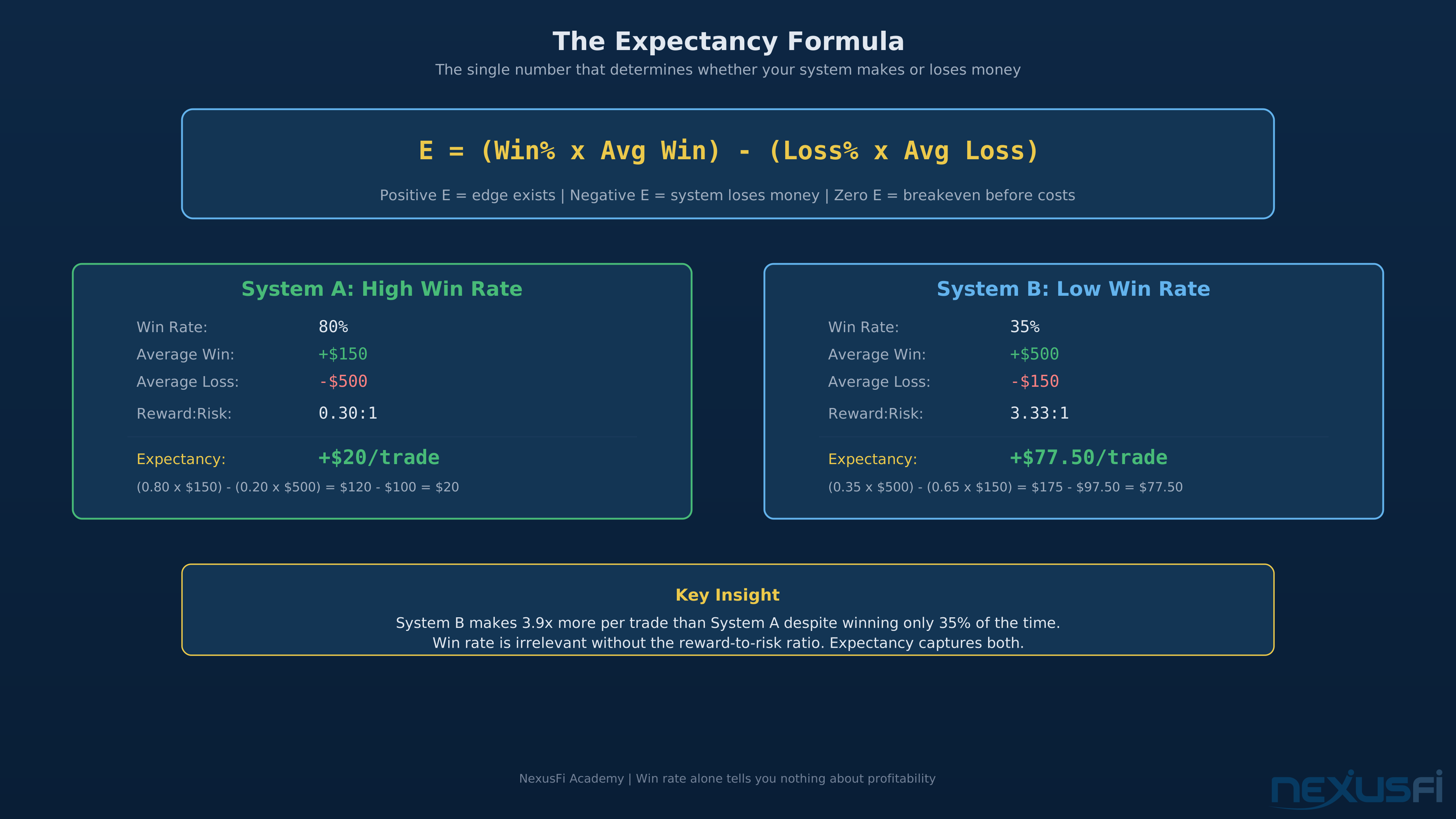
A 35% win rate sounds terrible. But consider a system where the average win is $500 and the average loss is $150:
Expectancy = (0.35 x $500) - (0.65 x $150) = $175 - $97.50 = +$77.50 per trade
Now consider an 80% win rate system where the average win is $150 and the average loss is $500:
Expectancy = (0.80 x $150) - (0.20 x $500) = $120 - $100 = +$20 per trade
The 35% system makes 3.9 times more per trade than the 80% system. The trader with the "bad" win rate retires comfortably while the trader with the "good" win rate wonders why the account isn't growing.
This isn't a hypothetical. NexusFi community member DarkPoolTrading documented exactly this pattern: a 35% win rate with $237.14 average wins versus -$85.19 average losses, producing $27.63 expectancy per trade. His profits came overwhelmingly from a few large winners, not from a high batting average.
The insight is counterintuitive but mathematically airtight: reward-to-risk ratio matters at least as much as win rate, and usually more. A system with a low win rate but high reward-to-risk can dramatically outperform a high win rate system with poor reward-to-risk.
The Breakeven Equation: Know Your Minimum #
Before trading any system, you need to know the breakeven win rate — the minimum win rate required for positive expectancy at your reward-to-risk ratio.
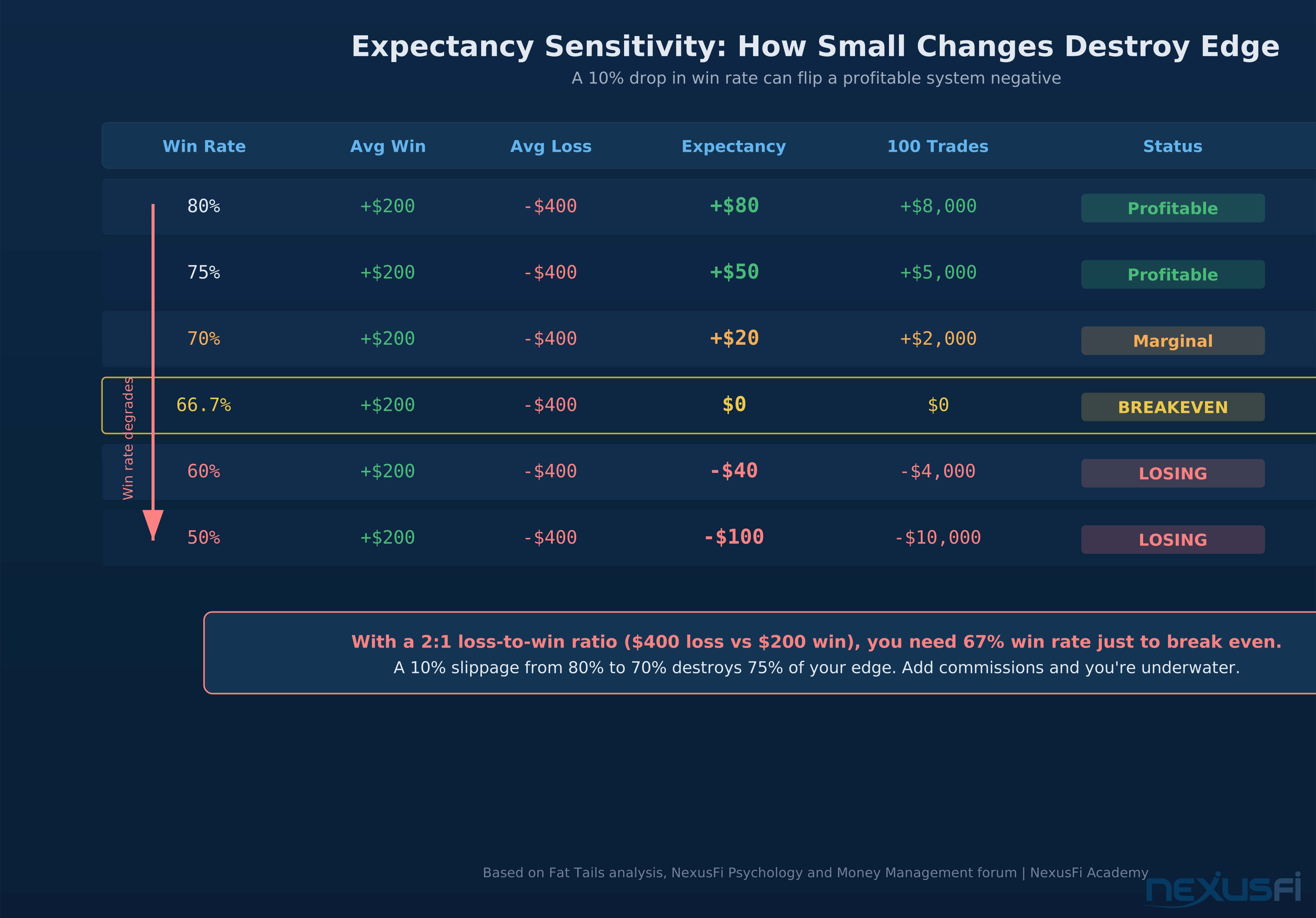
Breakeven Win Rate = 1 / (1 + Reward:Risk Ratio)
The math is clean:
- At 0.5:1 R:R (risking $200 to make $100): breakeven = 67%. You need to win two-thirds of your trades just to stay flat.
- At 1:1 R:R: breakeven = 50%. Coin-flip territory.
- At 2:1 R:R: breakeven = 33%. Now you only need one-third of trades to work.
- At 3:1 R:R: breakeven = 25%. One in four trades can carry the entire portfolio.
This table is the most important thing most traders never calculate. If your average loss is twice your average win (R:R of 0.5:1), you need 67% accuracy just to break even — before commissions, before slippage, before the psychological cost of holding losers. That's a razor-thin margin. A 10% performance degradation from 80% to 70% win rate destroys 75% of your edge.
Conversely, if you structure trades with 3:1 reward-to-risk, you can be wrong 75% of the time and still break even. Every win above 25% is pure profit. The system is structurally forgiving of imperfect execution.
Sensitivity Analysis: How Fast Edge Disappears #
Fat Tails, one of NexusFi's most prolific quantitative contributors, demonstrated something critical: small changes in win rate can flip a system from profitable to catastrophic.
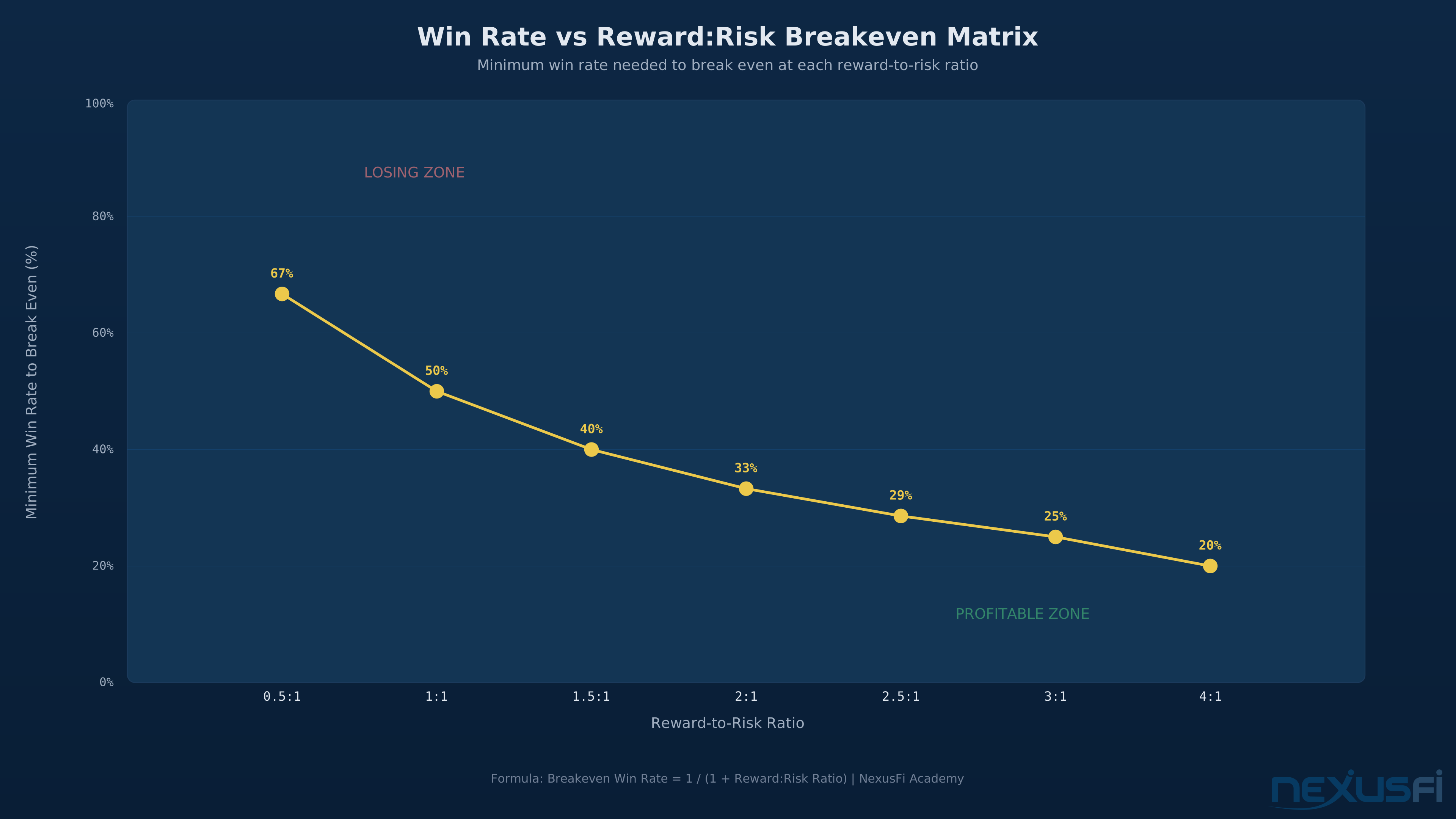
Take a system with $200 average wins and $400 average losses (0.5:1 R:R):
- At 80% win rate: expectancy = +$80/trade. Over 100 trades, that's +$8,000.
- At 75% win rate: expectancy = +$50/trade. Still profitable, but $3,000 less.
- At 70% win rate: expectancy = +$20/trade. Barely covering commissions.
- At 66.7% win rate: expectancy = $0. Breakeven.
- At 60% win rate: expectancy = -$40/trade. Now you're losing $4,000 per 100 trades.
A 20-point drop in win rate (80% to 60%) didn't just reduce profits — it flipped the system from making $8,000 to losing $4,000. That's a $12,000 swing from a change that's invisible on any individual trade.
This is why high win rate, low R:R systems are structurally fragile. They depend on maintaining near-perfect accuracy, and any degradation — from changing market conditions, execution slippage, or psychological drift — can push them underwater fast. Systems with higher R:R have more room to absorb performance degradation without turning negative.
Real-World Expectancy Across Trading Styles #
Different trading styles produce different expectancy profiles, and understanding yours determines whether you're fighting your own system or working with it.
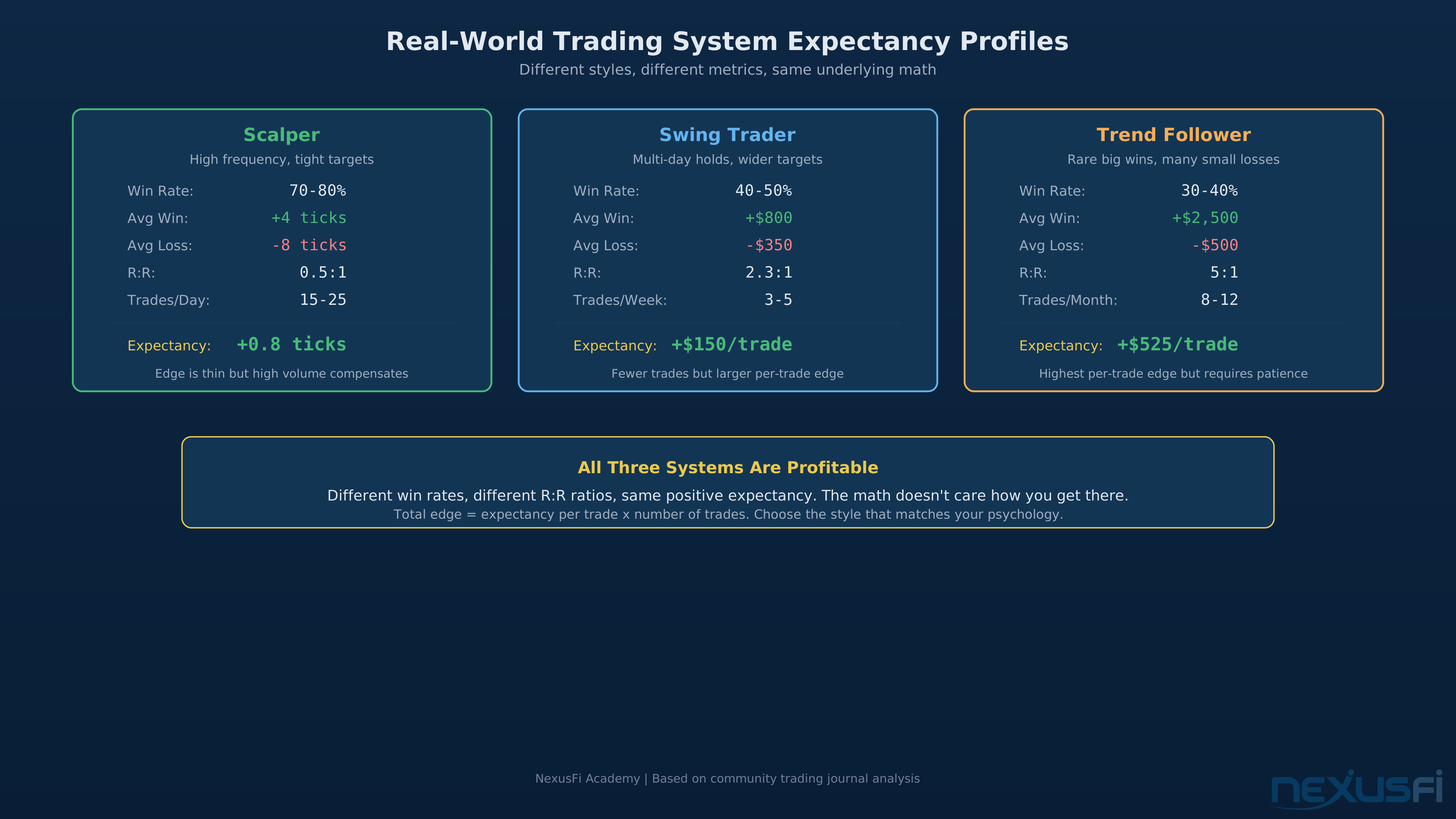
Scalping systems typically run 70-80% win rates with low R:R (0.3:1 to 0.8:1). Individual trade expectancy is thin — often less than a tick per trade. The edge comes from volume: 15-25 trades per day turns a 0.8-tick expectancy into meaningful daily P&L. The fragility is in execution: slippage of half a tick can cut expectancy in half. Commission-sensitive.
Swing trading runs 40-50% win rates with moderate R:R (1.5:1 to 3:1). Per-trade expectancy is larger, typically $100-$300 depending on account size and instrument. Fewer trades (3-5 per week) means you need larger per-trade edge to compensate. More forgiving of execution imperfections but requires patience through losing streaks.
Trend following runs 30-40% win rates with high R:R (3:1 to 10:1). The majority of trades are small losses. Profit comes from the occasional large winner that covers dozens of small losses. Per-trade expectancy can be very high ($300-$1000+), but the psychological cost of frequent losing is brutal. Most traders quit trend-following systems during the inevitable drawdowns — before the big winners arrive.
All three styles are mathematically viable. The choice between them is psychological, not mathematical. Which loss pattern can you endure? Frequent small losses? Rare large losses? That answer determines which expectancy profile fits.
Calculating Your Own Expectancy #
Pull your last 100 trades (at minimum — more is better, 200+ is ideal for statistical significance). Calculate four numbers:
- Win rate: winning trades / total trades
- Average win: sum of all winning trades / number of winning trades
- Average loss: sum of all losing trades / number of losing trades (express as positive)
- Loss rate: 1 - win rate
Plug into the formula: E = (Win% x Avg Win) - (Loss% x Avg Loss)
One NexusFi trader shared his VWAP system results: 69.84% win rate, $402.75 average win, $295.95 average loss. Expectancy = (0.6984 x $402.75) - (0.3016 x $295.95) = $281.44 - $89.26 = +$192.18 per trade. That's a tradeable edge with structural cushion.
Fat Tails formalized this as the edge equation: winning percentage x average winner must exceed losing percentage x average loser. Simple, but most traders never run the calculation on their own data.
Expectancy and Position Sizing: The Multiplier Effect #
Expectancy per trade is only half the equation. Total system performance is:
Total Edge = Expectancy Per Trade x Number of Trades
A system with $20 expectancy taking 500 trades per year produces $10,000. A system with $200 expectancy taking 50 trades per year also produces $10,000. Same result, completely different trading styles.
This is where position sizing enters. The Kelly Criterion and its derivatives improve position size based on expectancy. The simplified version: bet more when expectancy is higher relative to variance, less when it's lower. But the practical version is simpler — risk a fixed percentage of capital per trade (1-2% is standard for futures), and let expectancy compound naturally.
The critical mistake is over-sizing positions in a high-expectancy system. Expectancy describes the average outcome over many trades. Any individual trade can and will lose. The math of ruin says that even a positive-expectancy system will blow up if position sizes are too large relative to the drawdown profile. Fat Tails' Risk of Ruin analysis on NexusFi demonstrates this quantitatively: two systems with identical expectancy but different loss sizes have dramatically different survival rates.
Five Ways Traders Sabotage Their Expectancy #
1. Cutting winners, holding losers. This is the classic prospect theory trap. The natural human instinct is to take profits quickly (reducing average win) and delay cutting losses (increasing average loss). Both actions compress the reward-to-risk ratio and destroy expectancy. A system that should produce +$50 per trade on paper produces -$20 in practice because the trader can't let winners run.
2. Ignoring commissions and slippage. A system with +$15 expectancy per trade sounds positive until you add $8 round-trip commissions and $5 average slippage. Now expectancy is +$2 — one bad day erases a week of edge. For scalping systems especially, gross expectancy must exceed friction costs by a comfortable margin.
3. Optimizing win rate instead of expectancy. Tighter stops increase win rate (by avoiding small losses that would later recover) but decrease average win and increase average loss. The net effect on expectancy is often negative. The trader feels better — "I'm winning more!" — while making less money. Improve the formula, not one component of it.
4. Insufficient sample size. Expectancy calculated from 20 trades is noise, not signal. You need at least 100 trades (ideally 200+) before the number stabilizes. A 20-trade streak with 90% wins can easily be random variance in a 55% system. Making strategy changes based on small-sample expectancy is curve-fitting in disguise.
5. Confusing past expectancy with future expectancy. Markets change. A system that produced +$100 expectancy in low-volatility conditions may produce -$50 in high-volatility conditions. Expectancy must be recalculated periodically and segmented by market regime. The number from last year's backtest is a hypothesis, not a guarantee.
Expressing Expectancy in R-Multiples #
Many systematic traders express expectancy in R-multiples rather than dollars. R is the initial risk per trade (your stop distance in dollars). A 2R winner means you made twice your initial risk. A 1R loser means you lost exactly your initial risk.
In R-multiple terms:
Expectancy (R) = (Win% x Average Win in R) - (Loss% x Average Loss in R)
If your average win is 1.5R and your average loss is 1.0R with a 50% win rate: E = (0.50 x 1.5R) - (0.50 x 1.0R) = 0.75R - 0.50R = +0.25R per trade. For every dollar risked, you make 25 cents on average.
The R-multiple framework normalizes expectancy across different account sizes, instruments, and position sizes. A +0.25R system is the same edge whether you're trading 1 ES contract or 50 — the percentage return per unit of risk is identical. This makes it the preferred metric for comparing systems across different capital bases.
Tracking Expectancy Over Time #
Expectancy isn't a static number. It fluctuates with market conditions, execution quality, and the trader's own psychological state. Tracking it continuously reveals three critical patterns:
Regime shifts. If your 90-day rolling expectancy drops from +$80 to +$20, the market has probably changed character. Volatility regime shifts, trending-to-ranging transitions, and sector rotation can all compress edge. The correct response is to reduce size, not to force the same system harder.
Execution degradation. If your backtest expectancy is +$100 but live expectancy is +$30, the gap is execution. Slippage, late entries, early exits, and commission impact all erode theoretical edge. Fixing the gap between theoretical and realized expectancy is often more valuable than finding a better system.
Psychological drift. If expectancy was +$60 for six months and suddenly drops to +$10 with no market change, the trader is the variable. Overtrading, revenge trading, tilt, fatigue, and overconfidence all manifest as declining expectancy before they show up as obvious losses.
The practical recommendation: calculate your rolling 50-trade expectancy weekly. Plot it. When it drifts below half your long-term average, reduce size. When it goes negative, stop trading and diagnose the cause.
The Bottom Line #
Expectancy is the single most honest metric in trading. It doesn't care about your narrative, your strategy name, or your favorite indicator. It asks one question: when you execute this system over hundreds of trades, do you make money or lose money?
The formula is simple: (Win% x Average Win) - (Loss% x Average Loss). The implications are profound: win rate alone is meaningless without reward-to-risk context. High win rate systems can lose money. Low win rate systems can be extremely profitable. The breakeven equation (1 / (1 + R:R)) tells you your minimum viable win rate before you take a single trade.
Calculate your expectancy from your actual trade data. If it's negative, no amount of better entries, fancier indicators, or motivational psychology will fix it — the system is broken and needs restructuring. If it's positive but thin, focus on reducing friction (commissions, slippage) and improving execution rather than finding a "better" system. If it's solidly positive, your job is to protect it: trade the system, manage position sizes, and resist the urge to improve individual components at the expense of the whole.
Win rate pays the ego. Expectancy pays the bills.
Knowledge Map
Prerequisites
Understand these firstGo Deeper
Build on this knowledgeReferences This Article
Articles that build on this topicCitations
- — Risk of Ruin (2012) 👍 24“Now let us play a little with the Excel application and compare three different trading systems that have exactly the same expectancy per trade! System 1: - Average Win : 30 points - Average Loss : 10 points - Winning Percentage: 40% Expectancy per c...”
- — Trading Metrics for journals/record keeping (2010) 👍 32“One trade For one trade the expectancy is a theoretical value, as it assumes probabilities for losing and winning.”
- — Why 7% is the Difference between Failure and Success in Trading (2012) 👍 11“Anagami: Very dangerous conclusion: You have a nice system and you hope to make a win rate of 80%. If the win rate drops by 10% to 72%, your expectancy drops to zero. Expectancy at 80% : 0.8 * (10 - 1.8) * $ 5 - 0.2 *(20 +1.8) * $5 = $ 32.80 - $ 21.”
- — Most of your profits come from ... (base hits vs homeruns) (2013) 👍 7“I have changed my approach drastically since the beginning of April and my stats (and resulting equity curve) now speak for themselves. I use to be obsessed over win rate. I just hated taking losses.”
- — VWAP for stock index futures trading? (2020) 👍 13“That is a fair question to ask but I don't know if I can give you a fair answer to it. In fact, the more I think about this the more I don't feel there is one, mainly because of the assumptions and context required to do it.”
- — Path to mastery (2016) 👍 10“Psychology does not matter if your trading does not have a positive expectancy. At any given time, you can look on the internet for trading systems and find hordes of them. Very few will actually be profitable going forward.”