



Bitcoin Market Cycles and the Halving: A Trader's Guide
Overview #
Every four years, give or take, the Bitcoin network automatically cuts its block reward in half. This is the halving — a protocol-embedded supply shock built into Bitcoin's DNA since Satoshi wrote the original code. It's not a policy decision, not a committee vote, not a central bank maneuver. It's code. Block 840,000 was reached on April 19, 2024, and the reward dropped from 6.25 BTC to 3.125 BTC. The next halving will occur around 2028 at block 1,050,000.
Traders pay attention to halvings because history shows a consistent pattern: each one has preceded a significant bull market. But the mechanics of why, and how to actually trade around them, deserve more careful treatment than the typical "number go up after halving" narrative. Supply reduction is only half the story. The other half is demand, and demand is driven by macro conditions, liquidity, institutional flows, and the reflexive dynamics of a market that knows the supply shock is coming.
This article is a technical deep-dive for traders who want to understand the full cycle framework — the four phases, the indicators that signal transitions, the altcoin rotation patterns, the macro overlay, and how the emergence of spot Bitcoin ETFs in 2024 has changed some of the rules. The goal isn't to give you a trading signal. It's to give you the structural context to interpret the signals you're already watching.
Halving Mechanics #
Bitcoin's total supply is capped at 21 million coins. New coins enter circulation only through mining — validators who process transactions and secure the network receive block rewards. Satoshi designed a deflationary schedule: every 210,000 blocks (roughly every four years), the block reward halves.
The supply schedule:
- Genesis to block 210,000: 50 BTC per block
- Blocks 210,000--420,000: 25 BTC (November 2012)
- Blocks 420,000--630,000: 12.5 BTC (July 2016)
- Blocks 630,000--840,000: 6.25 BTC (May 2020)
- Blocks 840,000--1,050,000: 3.125 BTC (April 2024)
- Continuing to halve until ~2140, when the last fraction of a bitcoin is mined
At current prices, 3.125 BTC per block translates to roughly $5-6 million in daily miner revenue from block rewards alone (fee revenue adds to this). Post-halving, this revenue drops in half overnight. The miners who were profitable before may not be after — creating immediate selling pressure from weaker miners liquidating holdings and, in some cases, shutting down equipment.
The critical point: the halving is not a surprise. The exact block number has been known since Bitcoin's inception. Markets are forward-looking, meaning price action typically begins well before the actual event. Historically, the run-up starts 6-12 months before the halving as anticipation builds. The halving itself often sees muted price action — "buy the rumor, sell the news" dynamics. The actual supply impact takes months to manifest in price as the reduced issuance slowly tightens the market.
At current production rates, roughly 450 BTC per day enter circulation post-2024 halving (down from 900/day pre-halving). Annual new supply is approximately 164,250 BTC — about 0.78% of the existing supply. This is lower than gold's annual supply growth rate of ~1.5-2%, which is the basis of the "digital gold" scarcity narrative.
Historical Halvings: 2012--2024 #
Four halvings have occurred. Each one has been followed by a significant bull market, though the magnitude and timing have varied considerably.
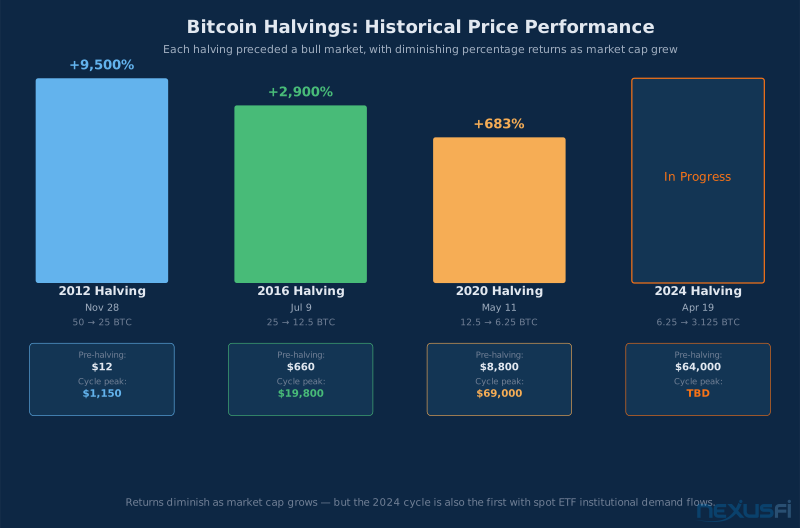
2012 Halving (November 28, 2012): Block reward: 50 → 25 BTC. Pre-halving price: ~$12. Bitcoin was barely three years old, with minimal institutional interest and no futures market. Price action was dominated by retail speculation. Twelve months post-halving, BTC hit $1,150 — a 9,500% gain. The percentage move sounds extraordinary, but the dollar values were tiny. This was the cycle that established the halving → bull market narrative in the first place.
2016 Halving (July 9, 2016): Block reward: 25 → 12.5 BTC. Pre-halving price: ~$660. The Bitcoin network was maturing, with exchanges like Coinbase launching retail onramps and mining becoming a professional operation. Price was relatively flat for months after the halving before launching in late 2016. The bull peak came in December 2017 at ~$20,000 — a 2,900% gain from halving-day price. The 2018 bear market took BTC from $20,000 to under $4,000.
2020 Halving (May 11, 2020): Block reward: 12.5 → 6.25 BTC. Pre-halving price: ~$8,800. This halving had the clearest macro tailwind of any: COVID monetary response was in full effect, with the Fed cutting to zero and launching unprecedented QE. Real yields went deeply negative. In this environment, the "hard money" narrative for Bitcoin resonated strongly with institutional investors. BTC peaked at ~$69,000 in November 2021 — a 683% gain over 18 months. [7] The subsequent bear market (2022) was driven primarily by Fed tightening rather than cycle mechanics, with BTC crashing ~77% from peak.
2024 Halving (April 19, 2024): Block reward: 6.25 → 3.125 BTC. Pre-halving price: ~$64,000. This was the first halving to occur after spot Bitcoin ETF approvals in the US (January 2024). BlackRock's iShares Bitcoin Trust (IBIT) and competing ETFs brought institutional capital flows that didn't exist in previous cycles. Combined spot ETF AUM reached ~$85.5 billion holding approximately 1.26 million BTC — representing 6.4% of total supply. [1] This structural demand change makes the 2024 cycle the hardest to forecast using historical patterns alone.
Market Cycle Phases #
The four phases of a Bitcoin market cycle map roughly to classical market structure theory, though crypto has its own flavor due to leverage, 24/7 trading, and retail-dominated participation.
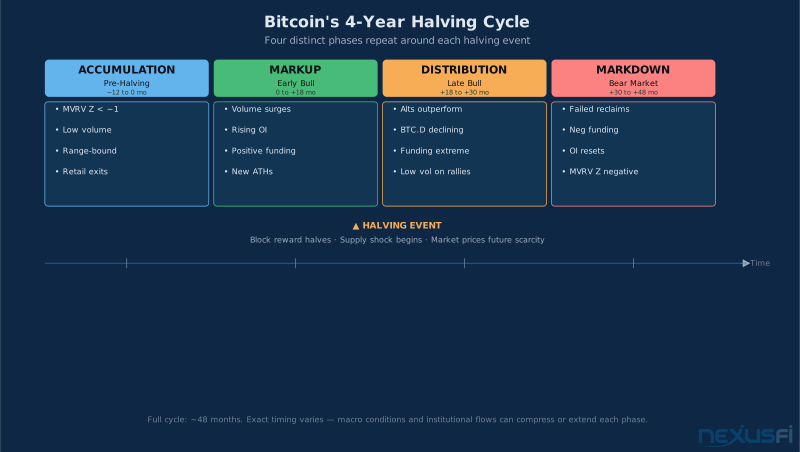
Phase 1: Accumulation (Pre-Halving, ~-12 to 0 months)
Accumulation occurs when price has stabilized after a prolonged bear market. Sentiment is negative or neutral. The traders who survived the bear are cautious. Retail has largely exited. This is where informed buyers quietly build positions at depressed prices.
On-chain signatures: MVRV Z-Score below -1 (market value trading at discount to realized value), exchange outflows picking up as coins move to cold storage, declining spot selling pressure. Price action: narrow ranges, periodic "spring" tests where price briefly dips below key support before recovering, low volume.
The pre-halving period combines natural accumulation dynamics with growing anticipation of the supply shock. This period is often where the best risk/reward entries exist — the narrative is building but the crowd hasn't piled in yet.
Phase 2: Markup (Post-Halving, ~0 to +18 months)
The markup phase is the bull market. Price trends consistently higher, volume expands, and each higher high is confirmed by participation metrics. On-chain, exchange inflows from miners slow (less supply to sell at reduced reward), wallet counts grow, and derivatives markets see rising open interest with positive funding rates.
This is the phase where the halving narrative gets amplified in media coverage, retail FOMO accelerates, and leverage builds in the system. As @FluidFox documented from following experienced BTC cycle traders in 2021: "They tend to think that right now BTC is in a similar position" to prior cycle markup phases. [1] The community watching these cycles closely was positioned well ahead of the mainstream narrative.
Phase 3: Distribution (~+18 to +30 months)
Distribution is the bull market peak period — often extended and difficult to identify in real time. Price may print new all-time highs but with weakening momentum, more frequent sharp pullbacks, and declining participation on up moves. Long-term holders begin exiting. Leverage in the system reaches extreme levels.
Bitcoin dominance typically peaks in the early markup phase and then starts declining as capital rotates into altcoins. By the distribution phase, dominance often falls sharply as retail chases higher-beta alts. In May 2021, altcoin dominance reached 60% vs BTC's 40% market share — a classic distribution-phase rotation pattern. [3]
Phase 4: Markdown (~+30 to +48 months)
The bear market. Price declines persistently, bounces fail at resistance levels, and sentiment deteriorates. Leverage is systematically flushed through liquidation cascades. In the 2022 bear market, Bitcoin crashed from $69,000 to under $16,000 — a 77% decline. Altcoins suffered even worse, with many losing 90%+ of their value.
[8] That comment captures how Bitcoin had become an institutional-grade risk proxy by that cycle — watched not just as a crypto signal but as a barometer for broader market appetite.
Wyckoff Applied to Crypto #
Richard Wyckoff's market cycle theory — developed in the early 20th century for equities — maps surprisingly well to Bitcoin and crypto markets. The reason isn't mystical; it's structural. Crypto markets exhibit exactly the conditions Wyckoff described: information asymmetry, accumulated supply at certain price levels, and the mechanics of how large players enter and exit without moving price against themselves.
Accumulation Structure (Wyckoff Phase A-E):
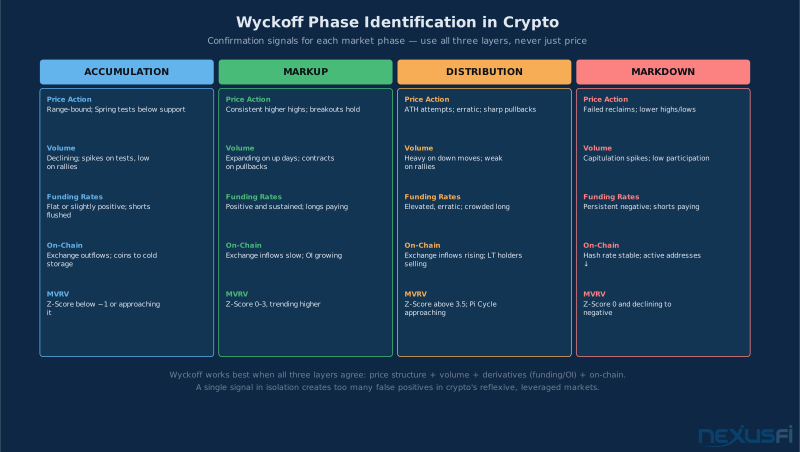
The Wyckoff accumulation ranges from Preliminary Support (PS) through Spring to the Sign of Strength (SOS). In crypto terms, PS often comes after a violent liquidation cascade — the kind that triggers cascading stop-losses on leveraged positions. The "Spring" — a brief dip below support designed to stop out late bears — is one of the most reliable patterns in the pre-halving period.
Confirming signals in derivatives: funding rates flatten or briefly go positive as the last shorts are squeezed. On-chain: exchange outflows accelerate as coins move to long-term cold storage.
Distribution Structure:
Distribution in crypto is harder to identify than accumulation because the bull market narrative is loudest during distribution. Price often makes new ATHs while the underlying structure is deteriorating. Classic warning signs: heavy volume on pullbacks, rallies on declining volume, and erratic price action at ATH levels.
Critical Caveat: Wyckoff analysis in crypto requires confirmation beyond candles. Pattern recognition alone generates too many false signals. Confirm phase transitions with: volatility regime (contracting or expanding?), derivatives positioning (longs or shorts accumulating?), and on-chain signatures (coins moving to or from exchanges?).
Altcoin Seasons and Bitcoin Dominance #
Bitcoin dominance — BTC's market capitalization as a percentage of total crypto market cap — is one of the most useful macro indicators for timing altcoin exposure.
Reading the Dominance Chart:
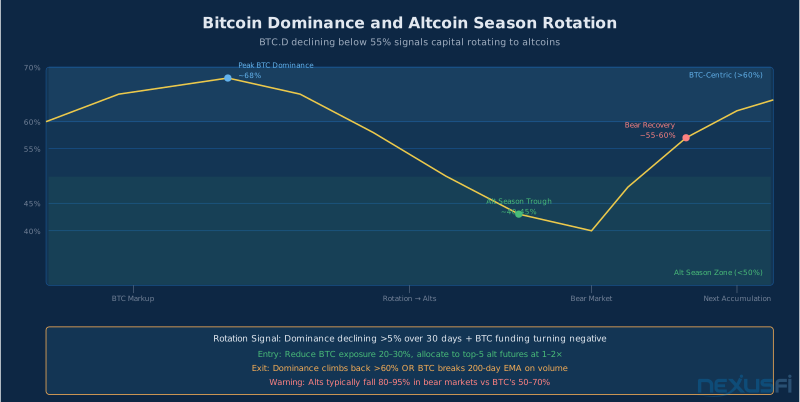
- Dominance >70%: Capital concentrated in BTC. Alts underperform. Typically occurs in early markup (when BTC is leading) and late markdown (when alts are bleeding harder than BTC).
- Dominance 50-60%: Transition zone. BTC may be plateauing; alt season building.
- Dominance <45%: Classic alt season. Capital has rotated from BTC into higher-beta assets. In the 2021 cycle, dominance fell from ~70% in January to below 40% by May as altcoins massively outperformed. [2]
The Rotation Sequence:
- BTC leads the markup phase (dominance rises or holds high)
- BTC starts to consolidate near ATH (dominance plateaus)
- Capital flows into large-cap alts (ETH, SOL, etc.) — dominance starts declining
- Capital flows into mid and small-cap alts — dominance drops sharply
- BTC correction triggers: alts dump harder than BTC (dominance spikes back up)
Experienced traders watch for Step 3 as the actionable signal. When BTC dominance starts declining steadily after a sustained BTC rally, and when ETH/BTC ratio starts outperforming, the alt rotation is in early stages.
Timing Reality:
Alt seasons typically begin 12-18 months post-halving. But the relationship isn't mechanical. The 2022 bear market showed that altcoins can underperform throughout an entire period if macro conditions turn hostile. Fed tightening compressed both BTC and alts, with no meaningful alt season occurring because the overall market regime was risk-off.
Altcoin seasons can be vicious on the exit. The same leverage and reflexivity that drives alts 10x in weeks can take them down 90%+ when sentiment shifts. Bitcoin typically draws down 50-70% in bear markets; altcoins typically draw down 80-95%. Position sizing discipline is non-negotiable — as
[9]
Cycle Indicators #
Several on-chain and technical indicators have been developed specifically to help identify where in the cycle Bitcoin sits.
MVRV Z-Score
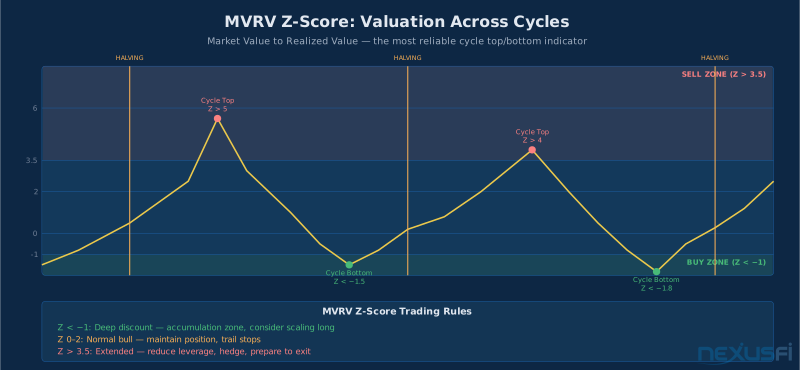
Market Value to Realized Value (MVRV) measures how far current price deviates from the aggregate cost basis of all coins in circulation. The Z-Score normalizes this deviation by historical standard deviation.
- MVRV Z > 3.5: Price much above realized value. Historically coincides with cycle tops. High probability of price decline toward realized value.
- MVRV Z 0 to 2: Normal bull market territory. Price above cost basis but not extreme.
- MVRV Z < -1: Price below realized value. Deep discount to cost basis. Historically marks major bottom zones.
The practical application: use MVRV as a risk management overlay. When Z-Score enters extreme territory (>3.5), reduce leverage and consider hedges regardless of price momentum. When Z-Score goes deeply negative (<-1), consider accumulation regardless of sentiment.
Limitation: regime changes affect the distribution. In cycles with heavy institutional participation, Z-Score readings that previously marked tops may be sustained longer. The 2024-2025 cycle with ETF flows may exhibit higher extended Z-Score ranges before reverting.
Pi Cycle Top Indicator
The Pi Cycle Top uses two moving averages: the 111-day SMA and the 350-day SMA multiplied by 2. When the 111-day SMA crosses above 2× the 350-day SMA, the indicator fires. Historically, it has preceded the last three cycle tops by 1-3 days, making it one of the more accurate peak indicators in crypto's short history.
The limitation is sample size: three data points is not a statistically strong sample. The indicator has no prior theory behind it — it's a pattern that happened to work. In changed market structures (ETF flows, institutional hedging), it may not fire cleanly.
Stock-to-Flow (S2F)
S2F models Bitcoin's price as a function of its scarcity: how many years of current production would equal the existing supply. By this metric, Bitcoin is among the scarcest assets in existence, and S2F predicts price should correlate with scarcity over the long term.
The model was created by PlanB and gained enormous traction during the 2020-2021 cycle when it accurately forecast the bull run. It then became controversial when the 2022 bear market saw BTC trade well below model predictions.
The honest assessment: S2F is useful for confirming the long-term scarcity thesis and for understanding why the halving matters structurally. It is not a reliable timing tool. Demand shocks (Fed tightening, exchange collapses like FTX) can push price far below model levels regardless of supply dynamics. Use it for directional bias, not price targets.
On-Chain Multi-Factor Approach
The most actionable approach combines multiple on-chain metrics rather than relying on any single indicator. @rleplae demonstrated this practically: a simple MACD/SMA trading system on Bitcoin 5-year data returned 140%. Adding an on-chain metric filter as a regime selector boosted that to 450%. [11] The on-chain layer filters out trades during bear market regimes when technical signals generate false positives.
Specific metrics to combine: MVRV Z-Score (valuation), exchange flows (supply/demand pressure), active addresses (network adoption), and derivatives funding rates (leverage sentiment).
Macro Factors and Fed Policy #
Bitcoin has transitioned from a gold-analog "store of value" narrative to something more subtle: a risk asset with a scarcity premium. This evolution has made macro factors increasingly important for cycle timing.
The Fed Policy Connection:
The 2020-2021 bull market coincided with the most aggressive monetary easing in Federal Reserve history. The 2022 bear market coincided with the fastest rate hiking cycle since the 1980s. This isn't coincidence — it reflects how institutional capital flows into and out of risk assets based on the real yield environment.
When real yields (nominal rates minus inflation) are negative or declining, capital flows into assets that offer inflation protection or growth — Bitcoin benefits. When real yields are rising sharply, risk capital flees to safety — Bitcoin suffers. @Fi's Weekly FRED Series documented this clearly: when CPI comes in elevated, the Fed may pause — and crypto would sell off. [6]
BTC-S&P 500 Correlation:
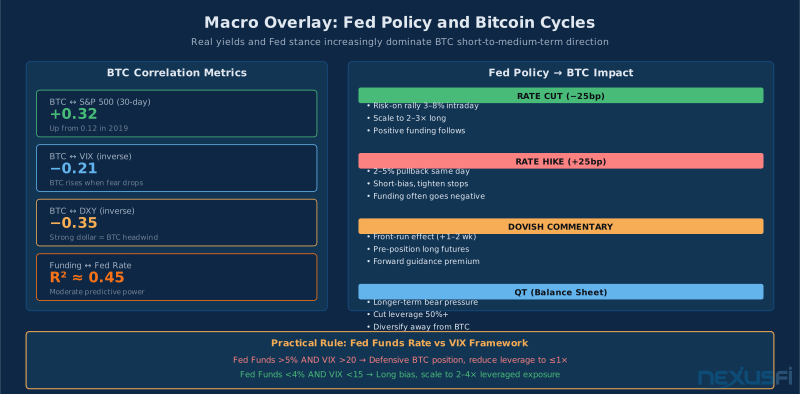
One of the more significant structural changes in Bitcoin markets is the rising correlation with equities. In 2019, BTC-S&P 500 30-day correlation was approximately 0.12 — basically uncorrelated. By 2022-2024, that correlation had risen to 0.32-0.45. Bitcoin had become part of the institutional risk-on/risk-off framework.
The practical implication: trading Bitcoin in isolation from macro context is increasingly dangerous. When equity volatility spikes (VIX >25), crypto leverage tends to unwind rapidly. In 2026, analysis showed that in risk-off environments, Bitcoin fails as a store of value — gold wins, and the dollar strengthens while BTC suffers. [4] [5]
FOMC Calendar Overlay:
Experienced crypto traders use the FOMC calendar as a risk management tool:
- Rate hike announcements: short-term BTC selling pressure, typically 2-5% pullbacks on the day
- Rate cut announcements: short-term BTC buying, 3-8% intraday gains
- Dovish commentary (hawkish pause signals): front-run effect — crypto often rallies 1-2 weeks before actual policy change
The macro overlay rule: when Fed Funds Rate is above 5% and VIX is above 20, bias toward defensive crypto positioning. When Fed Funds drops below 4% and VIX is below 15, bias toward long exposure.
Bear Market Characteristics #
Bear markets in crypto are characterized by a specific set of conditions that compound each other — leverage unwinds feed into lower prices, which trigger more leverage unwinds, which creates the liquidation cascades that define crypto bear markets.
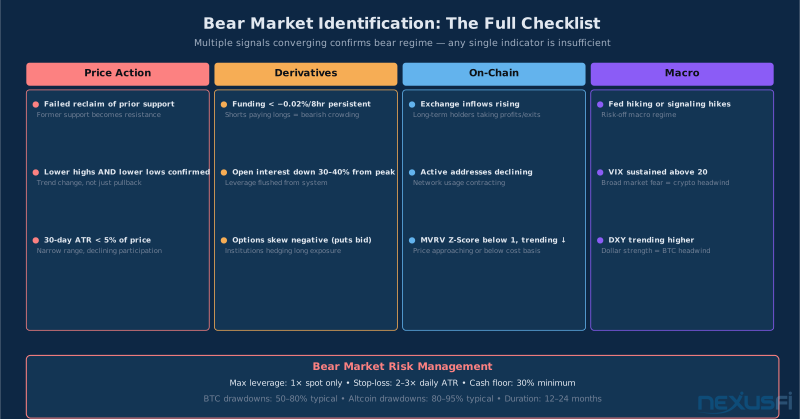
Price Action: Failed reclaims of prior support, higher downside convexity (crashes faster than recoveries), volume spikes on down moves, volume dries up on bounces, ATR contracts.
Derivatives: Funding rates persistent negative (<-0.02%/8hr), open interest down 30-40% from peak, options skew negative (puts bid), basis flipping from contango to backwardation.
On-Chain: MVRV Z-Score declining below 1 toward negative, exchange inflows rising (holders selling bounces), active addresses declining, hash rate stability.
Bitcoin's 2025-2026 bear market saw BTC drop much from its 2025 peak — by February 2026, BTC had fallen to $64,478, a 50% decline from the $126,272 cycle peak. [7] A separate drawdown below $80,000 marked BTC's fourth consecutive monthly decline — the longest losing streak since 2018. [10] These drawdowns, while severe, are consistent with the historical range: Bitcoin typically declines 50-80% from cycle peak. Altcoins typically decline 80-95%.
Risk Management During Bear Markets:
The minimum viable position sizing approach during a bear market:
- Maximum leverage: 1× (spot only, or very limited futures exposure)
- Stop-loss sizing: based on 2-3× daily ATR, not arbitrary round numbers
- Cash allocation: maintain at minimum 30% for opportunistic accumulation
- Hedging instruments: inverse futures or puts on any remaining long exposure
ETF Impact on BTC Cycles #
The January 2024 SEC approval of spot Bitcoin ETFs in the United States represents the most significant structural change to Bitcoin markets since the CME launched BTC futures in December 2017.
What Changed:
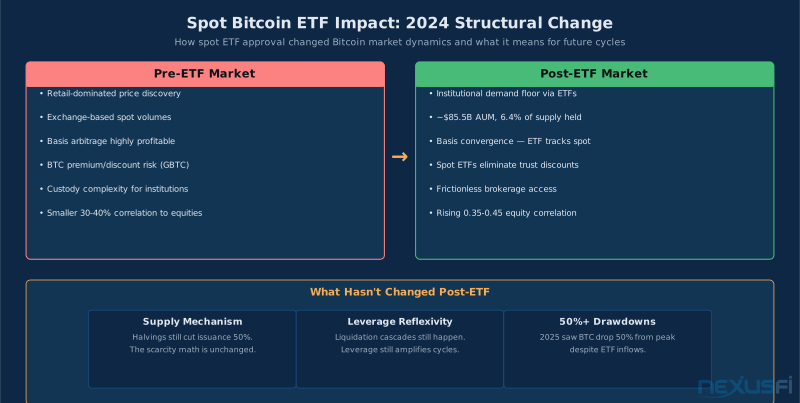
Prior to ETF approval, institutional Bitcoin exposure required direct custody (complex), futures-based products (basis risk), or trust products like GBTC (premium/discount risk). Spot ETFs eliminated all of these frictions. Any traditional investor with a brokerage account can now access Bitcoin at spot price with institutional-grade custody.
BlackRock's IBIT, Fidelity's FBTC, and eight other approved ETFs collectively accumulated ~1.26 million BTC (6.4% of total supply) within months of launch. Daily trading volume for these ETFs regularly exceeds $2-3 billion. [1] This is a structural demand change, not a speculative one — these flows represent long-term institutional allocation decisions.
How It Changes Cycle Dynamics:
- Demand smoothing: ETF flows provide more continuous institutional demand than the boom-bust retail cycles of previous halvings. This may raise the price floor during distribution and markdown phases.
- Basis convergence: With spot ETFs tracking Bitcoin price directly, the arbitrage gap between futures and spot has narrowed. Calendar spreads and basis trades are less profitable. CME BTC futures increasingly function as hedging instruments for ETF exposure rather than speculative vehicles.
- Macro sensitivity increases: ETF buyers include traditional institutional investors who manage positions relative to macro benchmarks. This deepens Bitcoin's correlation with the broader risk-asset framework — the same macro forces that move equities increasingly move Bitcoin.
- Modified drawdown behavior: When institutional ETF investors need liquidity (risk-off events, margin calls elsewhere), they sell Bitcoin ETFs. But they also buy on dips within their allocation frameworks. This creates a "buy-the-dip" dynamic that didn't exist in previous cycles when drawdowns were dominated by liquidating retail leverage.
What Hasn't Changed:
The fundamentals of cycle mechanics — supply reduction, leverage reflexivity, FOMO/panic dynamics — still apply. ETFs don't eliminate volatility; they change its character. The 2025 drawdown showed that even with ETF flows, Bitcoin can still correct 50%+ when macro conditions turn hostile. The cycle phases still exist; they just have a more institutional dimension.
Is the 4-Year Cycle Changing? #
The honest answer is: we don't have enough data to know. Four halvings, four cycles — that's not a statistical sample from which to derive strong conclusions. What we can say:
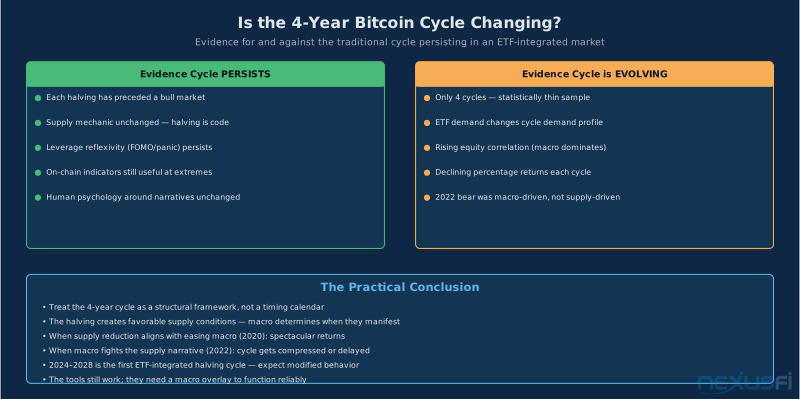
Evidence the cycle persists:
- Each halving has been followed by a bull market
- The supply mechanism hasn't changed — each halving literally halves issuance
- The reflexivity dynamics (leverage builds in bull, gets flushed in bear) are still present
- Human psychology around narratives and FOMO hasn't changed
Evidence the cycle is evolving:
- ETF approval creates structural demand that didn't exist before 2024
- Spot markets now dwarf futures in institutional terms (where previously futures dominated price discovery)
- Bitcoin correlation with equities has risen substantially, making macro policy more dominant
- Each successive cycle has produced lower percentage returns as market cap grows
- The 2022 bear was more macro-driven than supply-driven, suggesting the 4-year supply cycle can be overwhelmed by liquidity conditions
The practical conclusion:
Treat the 4-year halving cycle as a structural framework — a backdrop that creates supply conditions favorable for a bull market. But don't use it as a timing calendar. The actual bull market timing depends on macro: the Fed cutting cycle, real yields declining, and risk-on conditions aligning with the post-halving supply reduction.
When macro tailwinds and supply reduction align (2020), cycles produce spectacular returns. When macro headwinds fight the supply narrative (2022), the cycle can be muted or delayed. The 2024-2028 cycle will be the clearest test yet of whether the 4-year framework persists in an ETF-integrated, institutionally-dominated market.
Practical Framework #
Putting this together into an actionable approach:
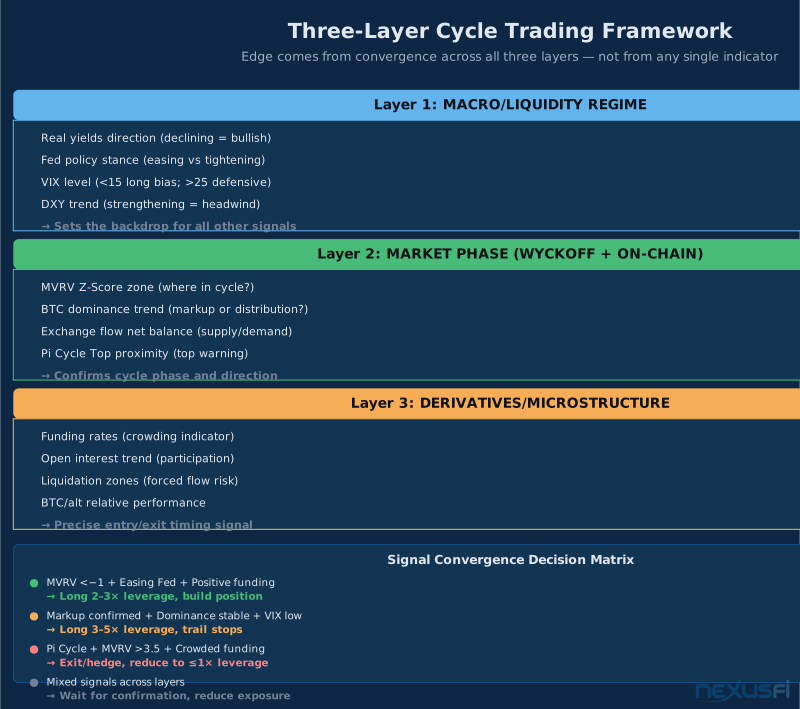
The Three-Layer Check:
Before sizing any Bitcoin position, check three layers:
Layer 1 — Macro/Liquidity Regime:
- Direction of real yields (nominal rates minus inflation)
- Fed policy stance (tightening vs. easing cycle)
- VIX level (>25 = defensive, <15 = risk-on)
- DXY trend (strengthening dollar = headwind for BTC)
Layer 2 — Cycle Phase (Wyckoff + On-Chain):
- MVRV Z-Score zone (where in the valuation range?)
- BTC dominance trend (markup or distribution?)
- Exchange flow net balance (coins moving to or from cold storage?)
- Halving timing (pre, post, distribution phase, markdown?)
Layer 3 — Derivatives/Microstructure:
- Funding rates (positive = longs paying, crowded long; negative = shorts paying, potential squeeze)
- Open interest trend (growing = participation building; declining = leverage flushing)
- Bitcoin/alt relative performance (rotation signal)
Position Sizing by Phase:
| Phase | Timing | Max Leverage | Strategy |
|---|---|---|---|
| Accumulation | Pre-halving -12 to 0 months | 1-2× | Build core, add on MVRV dips below -1 |
| Early Markup | Post-halving 0-12 months | 2-4× | Scale in as confirmation builds |
| Late Markup | Post-halving 12-18 months | 2-3× | Tighten stops, monitor Pi Cycle Top |
| Distribution | Post-halving 18-30 months | 1-2× | Rotate 20-30% to alts, hedge BTC |
| Markdown | Post-halving 30-48 months | ≤1× | Inverse futures, ≥30% cash reserve |
Warning Signs to Watch:
The combination of multiple indicators converging on the same signal is far more reliable than any single indicator alone. The sell signal is not just MVRV Z > 3.5 — it's MVRV Z > 3.5 AND Pi Cycle Top approaching AND BTC dominance declining AND funding rates persistently elevated AND macro regime showing tightening signals. That convergence is the exit signal.
Conversely, the accumulation signal is MVRV Z < -1 AND exchange outflows increasing AND funding rates neutral or slightly positive AND macro regime pivoting toward easing. Multiple signals in agreement dramatically improve signal quality — as @rleplae's on-chain research demonstrated, adding the regime filter to a basic technical system more than tripled the 5-year return. [11]
The Cycle Is a Framework, Not a Clock:
The most important mindset shift for trading crypto market cycles: the halving creates the conditions for a bull market, not a guaranteed one. The 4-year cycle is a structural backdrop. Macro determines whether and when that backdrop translates to price. The tools in this article — Wyckoff phases, MVRV, Pi Cycle Top, dominance, ETF flows — are instruments for reading where you are within that backdrop. Use them together, with confirmation, and maintain the position discipline that lets you stay in the game to reach the next cycle.
Related Academy articles: Cryptocurrency Trading Fundamentals | On-Chain Analysis for Traders | Crypto Derivatives Trading | Tokenomics: Understanding Crypto Supply and Demand
Knowledge Map
Go Deeper
Build on this knowledgeReferences This Article
Articles that build on this topicCitations
- — NexusFi Discussion“BTC cycle expectations”
- — NexusFi Discussion“Bitcoin dominance chart and altcoin rotation analysis”
- — NexusFi Discussion“Altcoin dominance at 60% vs BTC 40%”
- — NexusFi Discussion“BTC correlation in risk-off environments”
- — NexusFi Discussion“Crypto as risk asset and correlation to broader markets”
- — NexusFi Discussion“Fed pause impact on crypto -- CPI and key BTC levels”
- — NexusFi Discussion“Bitcoin 50% crash from 2025 peak”
- — NexusFi Discussion“Bitcoin as risk-on/risk-off signal”
- — NexusFi Discussion“Position sizing during crypto volatility”
- — NexusFi Discussion“Bitcoin 40% drawdown -- longest losing streak since 2018”
- — NexusFi Discussion“On-chain metric filter boosted BTC backtest 140% to 450%”
- Glassnode — Glassnode.com