



Cocoa Futures (CC): The Complete Trading Guide to the World's Most Supply-Constrained Soft Commodity
Overview #
Cocoa futures (CC) — the benchmark contract on ICE Futures U.S. — don't trade like most commodity markets. The price of cocoa responds to rainfall in Côte d'Ivoire, disease pressure in Ghana's aging cocoa groves, and the age of trees planted thirty years ago that are now past peak production. That's what makes it unique. And that's what makes it tradeable for people willing to do the fundamental work.
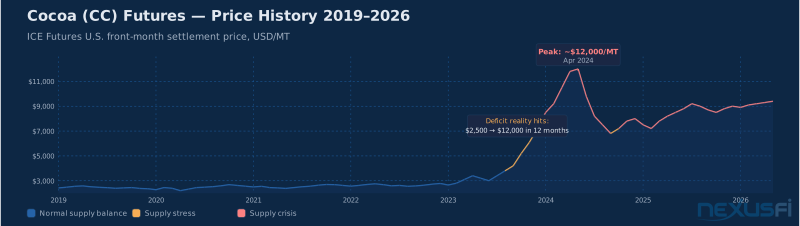
The 2024 price crisis put cocoa on the radar of traders who'd never given it a second thought. From roughly $2,500 per metric ton in mid-2023, CC futures surged past $12,000 per metric ton by April 2024 — a nearly 400% rally driven by back-to-back supply deficits, the worst West African harvest in decades, and the structural consequence of aging cocoa trees that can't be replaced overnight. This wasn't a speculative bubble. It was a physical supply crisis playing out in a terminal market with mandatory delivery mechanics.
This guide covers the complete trading picture: contract mechanics, the West Africa concentration risk that defines every cocoa fundamental analysis, seasonal patterns tied to the main crop and mid-crop harvest cycles, the Harmattan wind phenomenon, calendar spread structures, and position sizing for a market where volatility can rival what most traders see in a year of ES trading compressed into a single month.
See also: Commitment of Traders (COT) Report, Spread Trading in Futures Markets, Contango and Backwardation.
Key Concepts #
Cocoa "C" Contract (CC) — The benchmark global cocoa futures contract traded on ICE Futures U.S. Physically deliverable, standardized to exchange-licensed warehouse grades. The "C" designates grade specifications applicable to beans from approved origins, primarily West Africa.
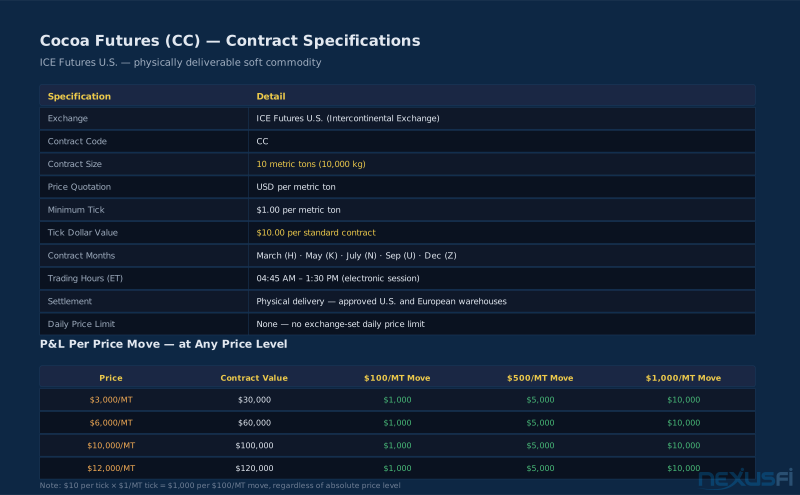
Contract Size — 10 metric tons (10,000 kg) of cocoa beans per standard contract. At $8,000/MT, one contract represents $80,000 of notional exposure. At the 2024 peak of $12,000/MT, a single lot carried $120,000 notional.
Tick Size and Dollar Value — Prices quote in USD per metric ton. The minimum tick is $1 per metric ton, translating to $10 per standard contract. A $1,000/MT move equals $10,000 per contract — which happens regularly in active markets.
Main Crop — West Africa's primary cocoa harvest, accounting for 70-80% of annual production. Runs approximately October through March, with peak collection from October through January. The main crop's size and quality determine the year's fundamental supply picture.
Mid Crop — The smaller secondary harvest, running approximately April through September, typically representing 20-30% of annual production. The mid crop cannot compensate for a poor main crop — the volumes are simply too small.
Harmattan — Dry, dusty trade winds blowing from the Sahara Desert through West Africa, typically from November through March. Severe Harmattan conditions during critical pod development can dehydrate cocoa pods, accelerate bean maturation abnormally, and reduce both yield and quality.
Swollen Shoot Virus (CSSV) — A debilitating viral disease spread by mealybug vectors that kills cocoa trees within a few years of infection. The Ghanaian government estimates roughly 590 million infected trees in Ghana alone. Infected trees must be felled and destroyed — there is no cure.
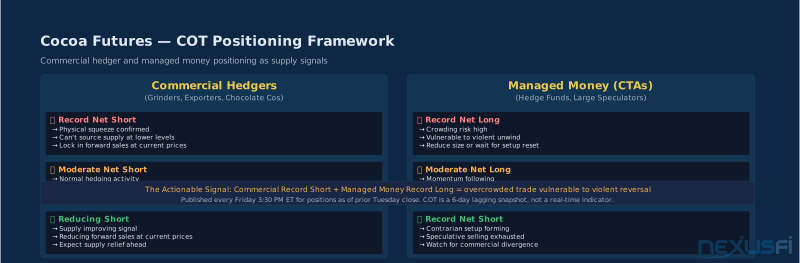
COT Report (Commitment of Traders) — Weekly CFTC report breaking open interest into commercial hedgers, managed money, and small speculators. For cocoa, commercial positioning is the most useful signal — especially when processor/merchant hedgers go heavily net short during rising prices, confirming they can't source physical supply at lower levels.
ICCO (International Cocoa Organization) — Publishes quarterly supply/demand balance data, production forecasts, and grinding statistics. The ICCO quarterly forecasts are the most watched official estimates for the global cocoa balance.
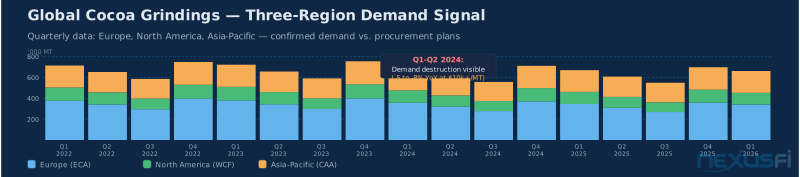
Grindings — The industrial processing of cocoa beans into cocoa liquor, butter, and powder. Published quarterly by regional associations. Grindings measure actual demand — a 5% decline confirms that high prices are forcing chocolate manufacturers to reduce intake.
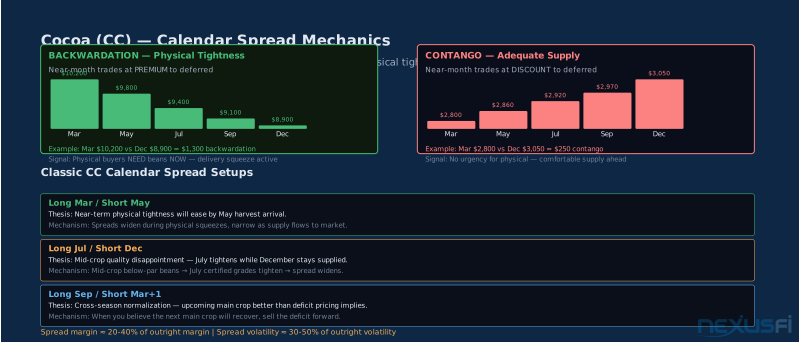
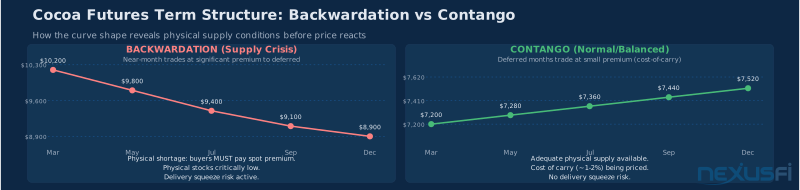
Term Structure — The price relationship across the five CC contract months (March, May, July, September, December). Backwardation (near month at a premium to deferred months) signals immediate physical tightness. Cocoa's term structure shifted into extreme backwardation during the 2023-2024 supply crisis.
The CC Contract: What You're Actually Trading #
| Specification | Standard CC |
|---|---|
| Exchange | ICE Futures U.S. |
| Contract Size | 10 metric tons |
| Price Quote | USD per metric ton |
| Tick Size | $1 per metric ton |
| Tick Dollar Value | $10 per contract |
| Contract Months | March (H), May (K), July (N), September (U), December (Z) |
| Trading Hours | 04:45 AM — 1:30 PM ET (electronic) |
| Settlement | Physical delivery (approved U.S. and European warehouses) |
| Initial Margin | ~$8,000-$15,000 per contract (varies with volatility) |
| Daily Price Limit | None |
The five delivery months reflect cocoa's harvest and pipeline dynamics. March and May capture post-main crop delivery timing. July and September span the mid-crop and pre-main crop periods. December bridges to new main crop positioning.
Physical delivery is not a technicality. When exchange-licensed warehouse stocks decline to critically low levels — as occurred in 2023-2024 — the delivery squeeze mechanism becomes an active market force. Processors who need physical beans must either take delivery on futures contracts or pay spot premiums. This is why front-month futures can trade at significant premiums to deferred months even without speculative buying pressure.
Dollar Value at Various Price Levels
| Price Level | Contract Value | $100/MT Move | $500/MT Move |
|---|---|---|---|
| $3,000/MT | $30,000 | $1,000 | $5,000 |
| $6,000/MT | $60,000 | $1,000 | $5,000 |
| $10,000/MT | $100,000 | $1,000 | $5,000 |
The P&L per $100/MT move is always $1,000 per contract. What changes at higher price levels is the margin-to-notional ratio and the percentage magnitude of normal daily moves.
The West Africa Concentration Problem #
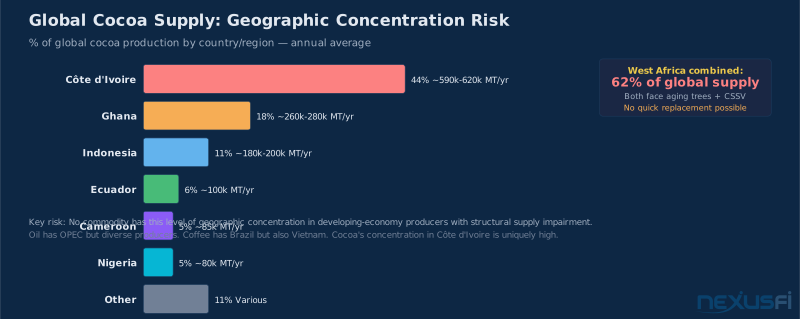
Over 60% of global cocoa supply originates from Côte d'Ivoire (roughly 45%) and Ghana (roughly 15-20%). No other major commodity has this level of geographic concentration from developing-economy producers. What happens on farms in Abidjan and Kumasi determines whether the global cocoa market runs a surplus or a deficit.
The Aging Tree Problem
Most of West Africa's cocoa trees were planted in the 1960s-1980s during cocoa's expansion era. A cocoa tree reaches peak production at 10-25 years of age. Trees older than 30 years produce much less and are more susceptible to disease and weather stress. Replacing aging groves requires farmers to give up income for 5-7 years during the establishment period. Replanting programs exist but are chronically underfunded relative to the scale of the problem.
Swollen Shoot Virus (CSSV)
CSSV is the most serious disease threat in West African cocoa and there is no cure. The Ghanaian government estimates 590 million infected trees — roughly 17% of the country's cocoa acreage. Côte d'Ivoire faces similar pressure. This is a structural supply impairment that takes decades to address. A trader cannot solve this by waiting for a weather pattern to normalize.
The 2023-2024 Price Crisis in Context
Main crop production in Côte d'Ivoire for the 2022-2023 season fell approximately 20% below the prior year. Ghana's crop came in similarly weak. The ICCO estimated the global supply deficit at roughly 400,000-500,000 metric tons — against total annual consumption of approximately 5 million metric tons, that's a near-10% shortage. The result: CC rallied from $2,500 to $12,000/MT in under 12 months. Market-clearing required prices that rationed existing inventory and encouraged demand destruction through reformulation and substitution.
What Moves CC: The Fundamental Stack #
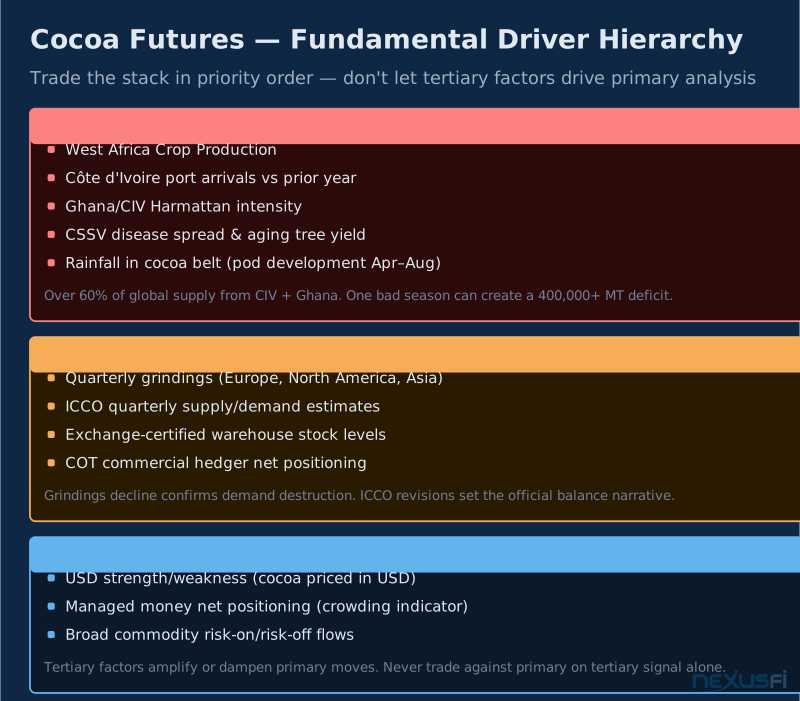
Primary Driver: West African Production Conditions #
Rainfall and Growing Conditions
Cocoa trees need consistent rainfall of 1,500-2,000mm annually without extended dry periods. Drought stress during critical pod development (April-August) reduces bean size and cherry set. The critical weather windows:
- Pod development (April-August): drought stress reduces bean count per pod and individual bean weight
- Pre-harvest (September-October): excess rainfall causes pod rot and fermentation problems
- Main harvest (October-January): Harmattan intensity determines drying quality and post-harvest losses
Monitoring rainfall patterns in the cocoa belt — using NOAA ENSO forecasts, regional meteorological data, and field reports from producer country agencies — is a required analytical step, not optional.
Harmattan Wind Events
The Harmattan's desiccating effect runs November-March and can work both ways. Moderate Harmattan promotes good cocoa drying. But severe Harmattan periods cause excessive moisture loss from developing pods, reduce bean size, and can push cocoa quality below certifiable grades. Severe Harmattan in the first quarter is a price-bullish trigger.
Disease and Quality Pressure
Beyond CSSV, black pod disease (Phytophthora species) is a major seasonal threat, especially in years with excessive rainfall. Infection can destroy 20-30% of a local crop in severe outbreaks. No satellite can perfectly measure infection rates — cocoa fundamental analysts must rely on anecdotal reporting from cooperatives, government inspectors, and the export arrival data flowing through Abidjan and Accra ports.
Secondary Driver: Grindings Data #
Quarterly grindings measure industrial cocoa consumption across three blocs: Europe, North America, and Asia. A synchronized decline across all three regions confirms demand destruction. During the 2023-2024 price crisis, European grindings fell 5-7% as manufacturers reduced intake at $8,000-$12,000/MT prices — the market was watching whether demand destruction was moderate or severe, since that determined how long the deficit would persist.
Tertiary Driver: COT Positioning #
The Commitment of Traders report separates CC positions into commercial hedgers (chocolate companies, grinders, exporters), managed money (CTAs), and small speculators. The commercial positioning is the most actionable signal.
When commercial hedgers are heavily net short during rising prices, it typically confirms they can't source physical supply at lower levels — they're locking in forward sales because the market is structurally tight. When commercials reduce net shorts or go net long, it signals they believe forward supply will be adequate.
Seasonality: Main Crop, Mid Crop, and the Harmattan #
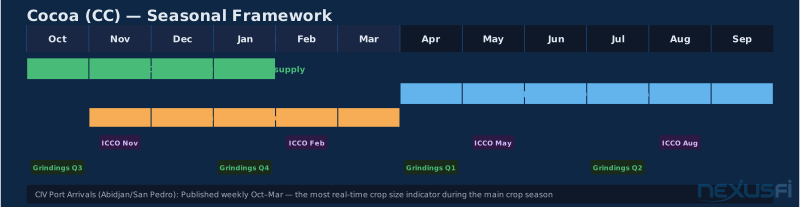
Phase 1: October — January (Main Crop Harvest)
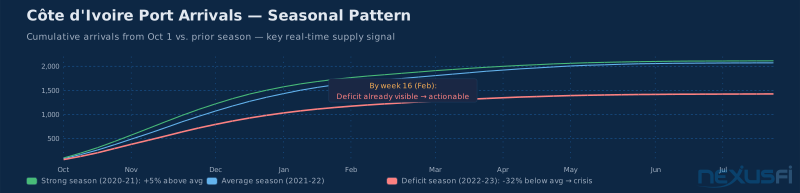
The most important supply period. The main crop accounts for 70-80% of Côte d'Ivoire's annual production. Port arrivals data from Abidjan, San Pedro, and Takoradi begin flowing in early October, providing real-time evidence of crop size. Traders watch cumulative arrival data against prior-year comparisons through this entire window. This is when the year's fundamental supply picture crystallizes.
Phase 2: February — April (Post-Harvest Transition)
Main crop arrivals are tapering. The mid crop's size depends on flowering conditions that began 5-6 months earlier. ICCO quarterly estimates — typically published in February/March — can trigger repricing if they deviate from market expectations.
Phase 3: April — September (Mid Crop and Dry Season)
The mid crop runs April through September. The dry season from June through September creates stress for pod development that affects next year's main crop. Quality statistics from export shipments in this window reveal whether Harmattan and post-harvest processing produced certifiable-grade beans.
Phase 4: September — October (Pre-Main Crop Positioning)
The market begins positioning for the upcoming main crop. Weather forecasts for the October flowering/pod-set period become price-relevant. ICCO preliminary estimates for the new season — published in September — set the initial fundamental framework the upcoming arrivals data will either confirm or contradict.
The Biennial Cycle
Unlike Arabica coffee with its clear biennial bearing cycle, cocoa doesn't follow a simple alternating year pattern. It follows a longer cycle tied to tree age cohorts and disease progression. Traders who look for a neat on-year/off-year pattern in cocoa are using the wrong model.
How to Trade CC Futures #
The Fundamentals-First Framework #
Professional cocoa trading is fundamentals-first, with technicals as execution tools. This isn't optional nuance. Cocoa has produced some of the largest fundamental-driven moves in commodity markets. Traders who approach it with chart-only methodology get wrong-footed by the physical supply reality.
Step 1: Establish the supply regime
At any given time, cocoa is in one of three states:
- Deficit — Production below consumption, drawing down inventory. Bullish. Rallies should be bought on weakness, not faded.
- Surplus — Production above consumption, building inventory. Bearish. Rallies should be sold.
- Balanced/uncertain — Near-equilibrium supply with high uncertainty. Wait for confirming data.
Step 2: Apply technical tools for timing
Within the established regime, technical levels provide entry precision:
200-day moving average — Long-term trend reference. In the 2023-2024 bull run, corrections to the rising 200-DMA were buying opportunities. The 200-DMA doesn't provide reversal signals in trending fundamental markets — it provides continuation entry signals.
ATR-based stops — The 14-day ATR for CC can range from $100-$300/MT ($1,000-$3,000 per contract) in normal conditions and expand to $500-$1,000/MT during active supply news. Set stops at 1.5-2× ATR.
Term structure confirmation — If buying CC on a fundamental bull thesis, the term structure should be in backwardation or trending toward it. Contango while outright prices are rising is a warning signal.
Strategy Types #
Outright Directional Trade
Direct long or short CC futures with a defined stop. Best for traders with high conviction on the supply regime and sufficient account size. The minimum viable account for a single CC contract in a volatile environment is approximately $50,000-$75,000 after initial margin — this allows ATR-based stop placement without getting stopped out by normal daily volatility.
Calendar Spreads — The Professional Structure
This is where serious cocoa traders concentrate their activity. A calendar spread buys one contract month and sells another, expressing a view on how supply conditions will evolve over time. The advantages:
- Margin efficiency: spread margin is typically 20-40% of outright margin
- Reduced volatility: spread volatility is approximately 30-50% of outright volatility
- Cleaner fundamental expression: the spread directly measures perceived tightness of near vs. deferred supply
- Partial macro noise cancellation
Classic CC spread setups:
Long March / Short May — Expresses the view that immediate physical supply is tight relative to availability in 2-3 months. This spread widens during physical squeezes and narrows as available supply catches up.
Long July / Short December — A mid-crop quality view. If mid-crop yields disappoint or quality falls below par, the July-December spread widens as July physically tightens relative to the next main crop.
Long September / Short March (next year) — A cross-season normalization trade. When you believe the upcoming main crop will improve much relative to current deficit pricing.
The term structure leads the outright price during supply narrative shifts. When a market in contango shifts to backwardation on increasing volume, it often precedes a much larger outright price move. Professional cocoa traders watch the spread as a leading indicator.
Event-Driven Trading
Quarterly grindings releases, ICCO quarterly reports, and weather events create binary-risk opportunities. Using options or reduced-size outright positions ahead of these releases allows participation without catastrophic exposure if the market gaps the wrong way.
Position Sizing for CC: The Required Math #
Why CC Position Sizing Is Non-Trivial #
At elevated price levels (above $6,000/MT), a single CC contract represents $60,000-$120,000 of notional exposure. "Normal" volatility in cocoa — say, 2% daily — translates to $1,200-$2,400 per contract per day. During active news periods, 5-10% moves are common. This is a market where you can be right about the fundamental direction but still get stopped out multiple times during normal volatility before the trade works.
The Framework #
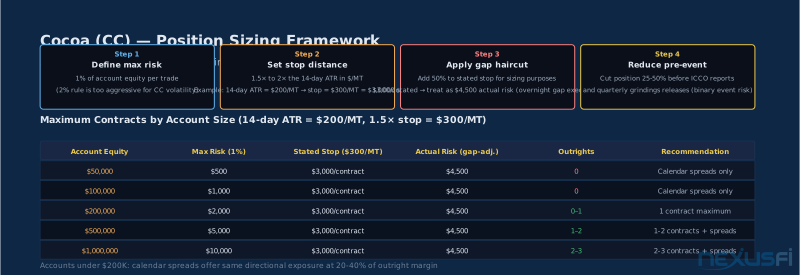
Step 1: Define maximum risk per trade
0.5-1.5% of account equity per trade. The standard 2% rule creates positions that are too large for cocoa's volatility profile. Using 1%:
| Account | Max Risk (1%) | Stop ($200/MT × 1.5× = $300/MT) | Contracts |
|---|---|---|---|
| $100,000 | $1,000 | $3,000 per contract | 0 (use spreads) |
| $200,000 | $2,000 | $3,000 per contract | 0-1 |
| $500,000 | $5,000 | $3,000 per contract | 1-2 |
| $1,000,000 | $10,000 | $3,000 per contract | 3-4 |
Traders with under $200,000 should default to calendar spreads (much reduced margin and daily P&L) rather than outright futures.
Step 2: Add the gap risk haircut
Cocoa gaps. Overnight news from West Africa — a revised production estimate, a weather bulletin, a port disruption — can gap CC futures $200-$500/MT on the open. Never size a cocoa position assuming your stop-market will execute at the stated level. Treat your actual risk as stop distance × 1.5 for sizing purposes. If your stop is $300/MT ($3,000 per contract), size as if the actual risk is $4,500 per contract.
Step 3: Reduce before binary events
The week of quarterly grindings releases and ICCO quarterly reports is a binary event risk window. Reduce position size by 25-50% ahead of these releases regardless of directional conviction. The market knows the release is coming, participants are often positioned the same way you are, and when they're wrong, the unwind is violent.
The Report Calendar: What Moves CC #
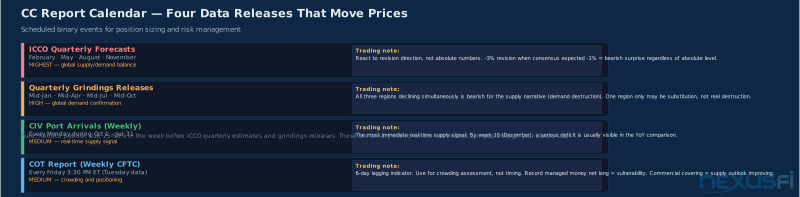
ICCO Quarterly Forecasts — The International Cocoa Organization's quarterly supply/demand estimates are the most watched fundamental release for CC. Published in February, May, August, and November. The market reacts to revision direction more than absolute numbers. A production estimate revised down 3% when consensus expected 1% down is a larger-than-expected bearish supply signal.
Quarterly Grindings Data — Published by three regional associations (European Cocoa Association, World Cocoa Foundation for North America, Cocoa Association of Asia) on a quarterly schedule. Watch for synchronized declines across all three regions, confirming global demand destruction rather than regional substitution.
Port Arrival Data (Côte d'Ivoire) — Weekly port arrival data from Abidjan and San Pedro is the most real-time supply indicator available during the main crop season. The Ivorian Cocoa and Coffee Board (CCC) publishes cumulative arrivals from October 1 through July 31. Comparing cumulative arrivals against prior-year levels gives a running assessment of whether the main crop is tracking above, below, or in line with expectations.
COT Report (Weekly) — Published every Friday at 3:30 PM ET for positions as of the prior Tuesday. Monitor managed money net positioning (extreme crowding = vulnerability to reversal) and commercial hedger net positioning (unusual net-short = confirmation of physical tightness).
USDA Annual Cocoa Report — Less watched than ICCO but useful for cross-referencing production estimates. Material discrepancies between ICCO and USDA carry signal when they diverge much.
CC vs. Financial Futures: The Adjustment Required #
Traders from ES, NQ, or other financial futures face a specific set of cognitive adjustments for cocoa. Getting these wrong is expensive.
| Dimension | Financial Futures (ES/NQ) | Cocoa Futures (CC) |
|---|---|---|
| Primary driver | Monetary policy, earnings, liquidity | West Africa crop supply, disease, weather |
| Volatility pattern | Policy-driven, mean-reverting | Seasonal, deficit-driven, can trend months |
| Gap risk | Moderate | High — weather/disease news gaps through stops |
| Stop reliability | Generally near intended price | Frequently worse during news events |
| Edge source | Macro models, flow data, earnings | Weather, crop arrivals, grindings, COT |
| Trend duration | Days-weeks | Months during supply crises |
Common mistakes applied to CC:
Using stops as if the market is frictionless. ES traders can rely on stop-markets executing within 1-2 ticks in normal sessions. CC stop-markets execute at materially worse prices during weather and report events. Sizing based on stated stop versus actual execution level is systematically wrong.
Treating the supply disruption as temporary. An oil supply disruption can be addressed in months through additional drilling. A cocoa supply disruption from aging trees and CSSV takes 5-10 years to recover. The timescale matters for position duration and patience.
Ignoring physical delivery mechanics. Exchange-certified warehouse stocks matter in cocoa in a way they don't for financial futures. When stocks decline to critical levels, the delivery squeeze mechanism drives front-month prices to levels that appear absurd on any chart — until you understand that buyers desperately need physical beans and must bid as high as necessary.
A Pre-Trade Checklist for CC #
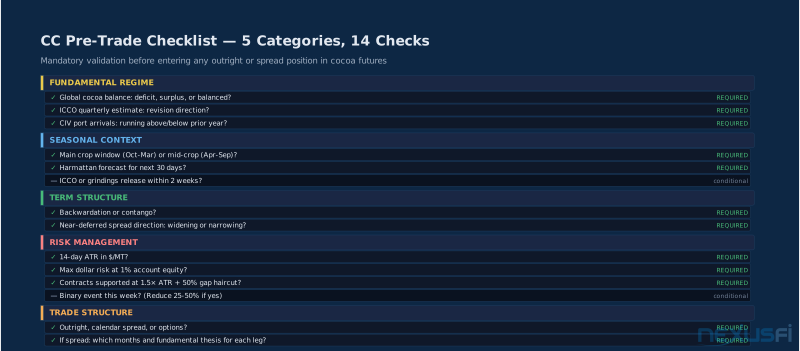
Before entering any CC position:
Fundamental regime:
- Is the global cocoa balance in deficit, surplus, or near-equilibrium?
- What direction are the ICCO's most recent quarterly estimate revisions?
- What is the running port arrival comparison for Côte d'Ivoire (year-over-year)?
Seasonal context:
- Are we approaching or in the main crop window (October-March)?
- What is the current Harmattan forecast?
- Is a quarterly grindings release or ICCO estimate within the next 2 weeks?
Term structure signal:
- Is CC trading in backwardation or contango?
- Is the near-deferred spread widening (tightening physical) or narrowing (normalizing)?
Risk management:
- What is the 14-day ATR in $/MT?
- What is my maximum dollar risk at 1% of account equity?
- How many contracts does that support at 1.5× ATR stop, plus 50% gap risk haircut?
- Is size reduced ahead of any upcoming binary event releases?
Trade structure:
- Outright, calendar spread, or options?
- If calendar spread: which months and what is the fundamental thesis for each leg?
Soft Commodity Portfolio Context #
CC fits naturally within a diversified soft commodity portfolio alongside Coffee Futures (KC) and Sugar Futures (SB). The correlations between softs are meaningful but not lockstep — KC responds primarily to Brazil weather, CC to West Africa, and SB to India/Brazil cane production. This geographic diversification provides portfolio-level risk reduction when building a multi-market soft commodity book.
The NexusFi community thread Softs (Fundamentals) by @myrrdin (thread 40400 in the Commodities forum) contains years of real-money soft commodity fundamental analysis from an experienced practitioner. It's the best single community resource for understanding how practitioners approach cocoa, coffee, and sugar fundamental analysis together.
Key Takeaways #
Cocoa is a physically constrained, supply-driven market with geographic concentration risk that has no equivalent in financial futures. Over 60% of global supply comes from Côte d'Ivoire and Ghana, two countries managing simultaneous crises in tree age, disease pressure, and infrastructure limitations. This isn't a temporary disruption — the structural supply impairment from aging trees and Swollen Shoot Virus plays out over decades.
The contract structure (10 metric tons, $10 per tick) is deceptively simple. The real complexity is in the dollar exposure at elevated price levels and the gap risk from overnight fundamental news. Position sizes that feel appropriate by tick count become dangerous when calculated against account equity at $8,000-$12,000/MT prices.
Calendar spreads are the professional tool. They express the fundamental view with lower margin, lower volatility, and reduced gap risk. The term structure often leads the outright price — use the near-month vs. deferred spread as a leading indicator of the physical supply reality.
Fundamentals first — always. The 2023-2024 price crisis was not predicted by any chart pattern. It was predicted by traders who understood that aging trees, accelerating CSSV infection, and consecutive adverse weather created a structural deficit that would take years to resolve. Those traders were long. Chart-only traders got short when the market went vertical.
Know the report calendar. ICCO quarterly estimates, regional grindings, and Côte d'Ivoire port arrival data drive CC. Trade around binary events with reduced size. Use the data to validate or challenge your fundamental thesis — not to confirm preexisting bias.
Knowledge Map
Prerequisites
Understand these firstGo Deeper
Build on this knowledgeCitations
- — Softs (Fundamentals) (2017) 👍 3“The ICE Monthly Softs Fast Facts remain essential reading for anyone trading cocoa, coffee, and sugar seriously.”
- — Commitment of traders (2010) 👍 5“Commitment of Traders is extremely useful, as it shows the market positions of different groups of traders. You want to know what the commercials are doing, because they have physical market knowledge that speculative traders simply do not have access to.”
- — commodity spreads (2015) 👍 6“There are effective trading strategies that focus specifically on the spread dynamics between contract months. The roll yield -- what you earn or pay as the curve shifts -- is part of the return, not just an afterthought.”
- — Diversified Option Selling Portfolio (2017) 👍 2“It is not as easy to get supply information for cocoa as for grains or beans. COT data is extremely bullish, and large traders will cover their shorts as soon as there is some bullish news.”
- — futures-convergence to the physical market? (2015) 👍 8“Arbitrage opportunities between physical commodity and paper contracts make prices converge. Market access constraints in physically-deliverable contracts can allow squeeze conditions that defy normal fundamental analysis.”
- — Softs (Fundamentals) (2019) 👍 2“COT data for Cocoa are bearish. I will enter CC from the long side after a severe washout -- not before.”
- — Diversified Option Selling Portfolio (2017) 👍 3“Asian first quarter cocoa grindings were 19.2% above year ago levels -- trade was looking for a 10% increase. Many beans from Ivory Coast did not meet size and quality standards for export.”
- — Softs (Fundamentals) (2017) 👍 2“I hold a long position in cocoa for months, covered by calls above the market. The expected move upwards of the underlying does not happen, but the option premium provides a cushion.”
- — commodity spreads (2018) 👍 5“When executing commodity calendar spreads, you will be paying the bid-ask spread on both outright contracts. Using the exchange-listed spread instrument typically results in better execution than legging in separately.”
- — commodity spreads (2014) 👍 4“When you look at a spread like this you have to look at the deliverable stocks vs. open interest. Physical delivery constraints are what give commodity spreads their unique risk profile.”