



Commitment of Traders (COT) Report: The Weekly Positioning Intelligence Every Futures Trader Needs
Overview #
The Commitment of Traders (COT) report is one of the most powerful — and most misused — tools available to futures traders. Published every Friday by the U.S. Commodity Futures Trading Commission (CFTC), it reveals how three distinct groups of market participants are positioned across every major futures market. Used correctly, it can tell you when speculative money has become dangerously crowded on one side of a trade. Used incorrectly, it can cost you real money by triggering premature reversals.
This guide explains exactly how the COT report works, what each trader category actually signals, how to normalize raw positioning data into actionable intelligence, and how to integrate it with price action for high-probability trade setups.
What Is the COT Report and Why Does It Exist? #
Every Tuesday, futures traders holding positions above the CFTC's reporting thresholds must disclose their positions. The CFTC aggregates this data, classifies traders into categories, and publishes the results every Friday. The data is available for free at the CFTC website and covers every major futures market — from S&P 500 futures and crude oil to gold, corn, and currencies.
The report was originally designed for market transparency and regulatory oversight, not trading analysis. But traders quickly realized that knowing who holds what positions provides a structural view of market sentiment that price charts alone cannot show.
The fundamental insight: different participant groups trade for at the core different reasons. Commercials hedge business risk. Speculators chase returns. Understanding who is crowded into what position — and to what extreme — creates the foundation for identifying when markets are vulnerable to sharp reversals.
The report is released with a 3-day lag (data as of Tuesday, published Friday). This makes it useless as a timing tool but extremely useful as a positioning filter when integrated with current price analysis.
The Three Trader Categories #
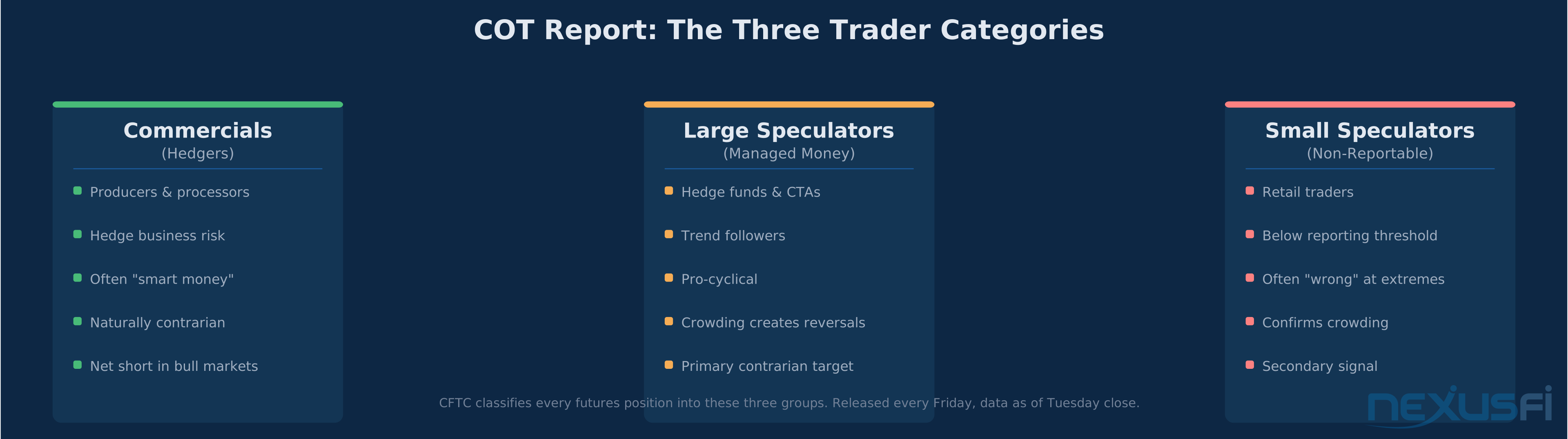
The standard (Legacy) COT report classifies every position into one of three groups:
Commercials (Hedgers)
These are the producers, processors, merchants, and manufacturers who use futures to hedge their physical business exposure. An oil producer selling crude oil futures to lock in future revenue. A corn processor buying corn futures to guarantee input costs. A gold mining company selling futures against production.
Commercials are often described as "smart money" — not because they predict price direction, but because they have superior fundamental knowledge of their specific market's supply and demand dynamics. They trade futures to manage risk, not to speculate on direction.
Their positioning is naturally contrarian to price: when prices are high, commercials increase their net short positions (locking in favorable prices); when prices are low, they reduce shorts or go net long (hedging against future price increases). This systematic hedging behavior creates a mirror image of price in their positioning data.
NexusFi member Fat Tails captured this in the Elite Circle: "Commitment of Trader is extremely useful, as it shows the market positions of different groups of traders. You want to know what the commercials are doing because they know the fundamental picture of their commodity."
Large Speculators (Managed Money / Non-Commercial)
This group includes hedge funds, commodity trading advisors (CTAs), and other large speculative funds. They trade purely for profit with no physical commodity exposure.
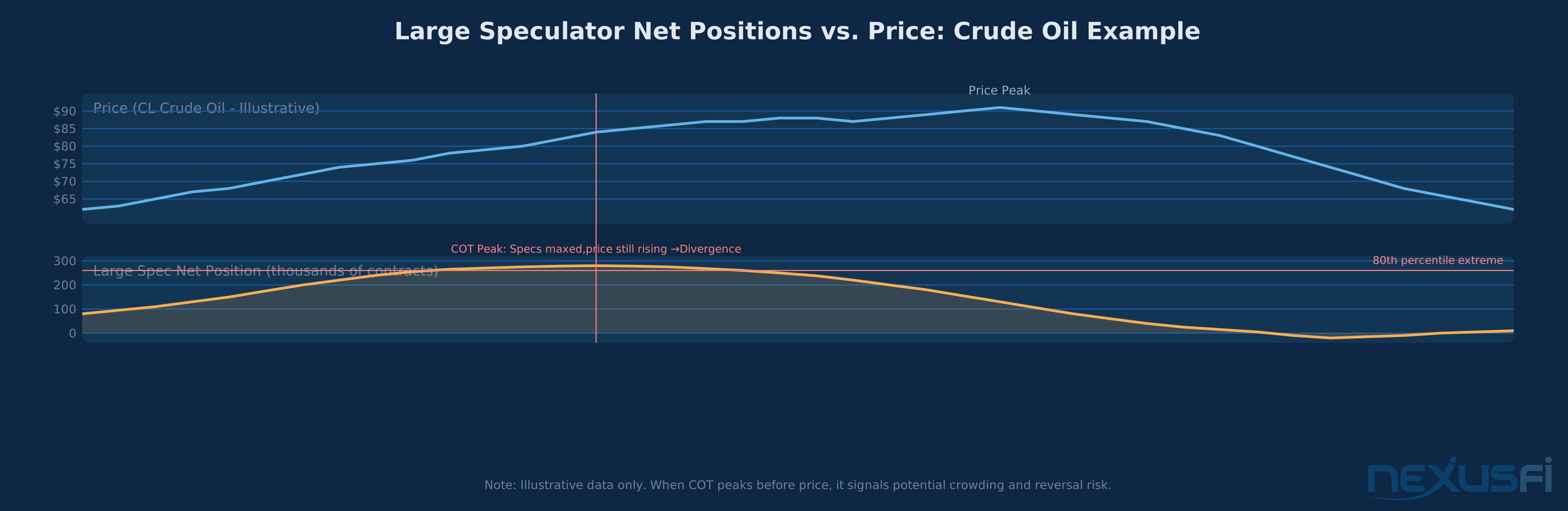
Large speculators are trend followers by nature. They build positions in the direction of the prevailing trend, increasing exposure as the trend extends. This systematic behavior means that their positioning reaches extremes at the worst possible moments — maximum net longs occur near price peaks; maximum net shorts occur near price troughs.
This makes them the primary target for contrarian analysis. When managed money is historically crowded on one side, the market becomes vulnerable to sharp liquidation if the trend stalls. As Lemmy Caution noted in Traders Hideout: "If Nasdaq moved enough against those specs, they might rush to the exits forcing a large price move down."
Small Speculators (Non-Reportable)
These are traders holding positions below the CFTC's reporting thresholds — largely retail participants. Because they are aggregated from the residual after commercials and large specs are classified, they are the least analytically useful group in isolation.
Small spec extremes occasionally confirm the broader crowding signal, but most actionable analysis focuses on the Commercial/Large Spec dynamic.
Legacy vs. Disaggregated: Choosing the Right Format #
The CFTC publishes two versions of the COT report:
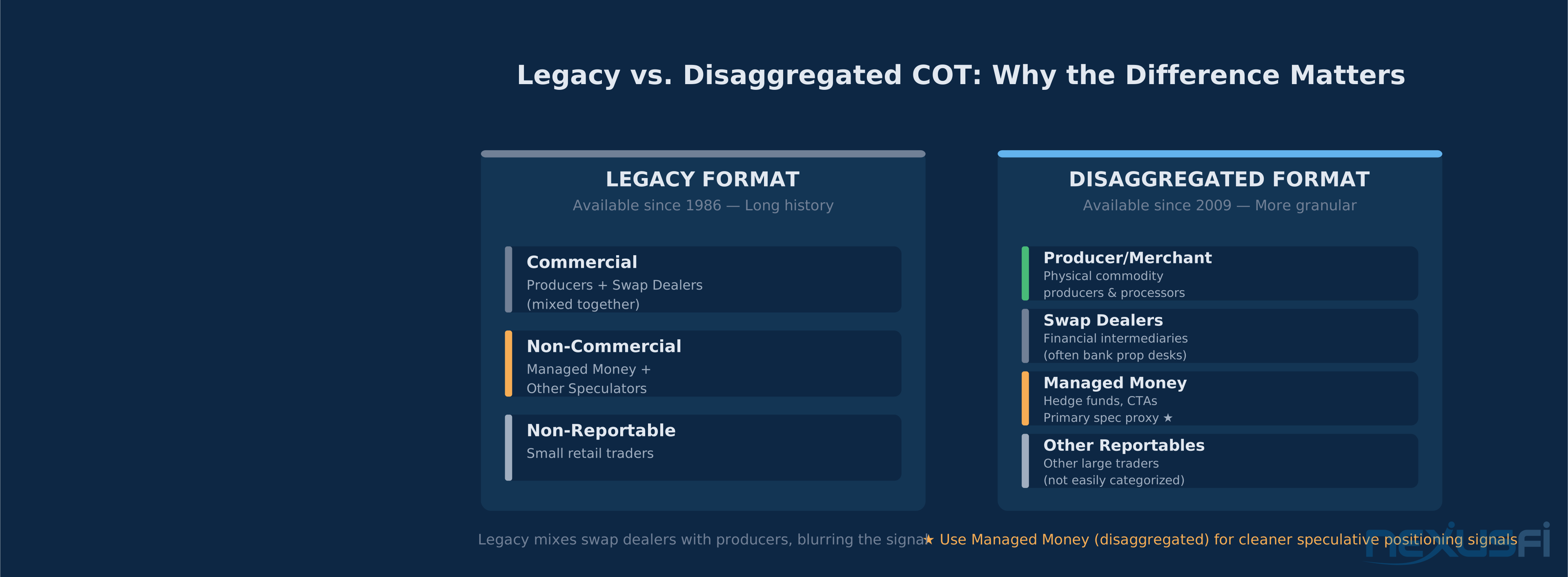
Legacy Format (available since 1986): Splits positions into Commercial and Non-Commercial (Large Specs), plus Non-Reportable. The key limitation: "Commercial" in the Legacy format lumps together genuine physical hedgers (producers, processors) with swap dealers — financial intermediaries who often behave more like speculators than hedgers.
Disaggregated Format (available since 2009): Breaks the Legacy categories into four more granular groups:
- Producer/Merchant/Processor/User: Physical commodity hedgers
- Swap Dealers: Financial intermediaries (banks, swap dealers)
- Managed Money: Hedge funds, CTAs — the clearest speculative signal
- Other Reportables: Large traders not fitting other categories
The disaggregated format is almost always preferable for analysis. By separating Managed Money from swap dealers, it provides the cleanest read on speculative positioning. The legacy format can obscure signals by mixing financial speculators (swap dealers) into the "commercial" category, making commercials look less bullish or bearish than they actually are.
NexusFi member Schnook summarized the practical implication: "In metals, ags, softs and energy the COT data tells a big part of the positioning story. In financial futures (equity index, bonds, currencies) the picture is more complex because there are more participants with different motivations."
Rule of thumb: Use disaggregated when available. For historical analysis pre-2009, use Legacy. When reading disaggregated data, focus on Managed Money for speculative positioning signals, not the broader Non-Commercial category.
Reading Net Positions: The Core Data #
Every COT report provides, for each trader category:
- Long contracts: Number of contracts held long
- Short contracts: Number of contracts held short
- Spreading: Non-directional positions (less relevant for sentiment analysis)
The primary metric is the net position:
Net Position = Long Contracts − Short Contracts
A positive net means the category is net long; negative means net short. This is the number to track over time.
Weekly changes matter as much as levels. The direction of the trend in net positioning provides momentum signals:
- Price rising + Managed Money adding longs → Trend confirmation. The crowd is building exposure. Watch for crowding risk.
- Price rising + Managed Money reducing longs → Possible de-risking. Smart money may be quietly exiting while retail chases.
- Rapid decline in net positioning (20-30% over 2-3 weeks) → Capitulation signal. The crowd is unwinding. Look for price stabilization and potential reversal.
As ron99 noted when analyzing crude oil positioning: "The big number is the specs/hedge funds (managed money) added 66k to their net long position." Tracking these week-over-week changes reveals whether crowding is building or resolving.
Open interest context: Normalize net positions as a percentage of total open interest to compare across time periods where overall market participation varied. A 200,000-contract net long position means something very different in a market where total open interest is 400,000 versus 2,000,000.
The COT Index: Normalizing Positioning for Context #
Raw net position numbers are difficult to interpret without historical context. A 200,000-contract net long position sounds extreme — but is it? How does it compare to the last three years? Is this near the all-time maximum, or merely average?
The COT Index solves this by converting the raw net position into a percentile rank:
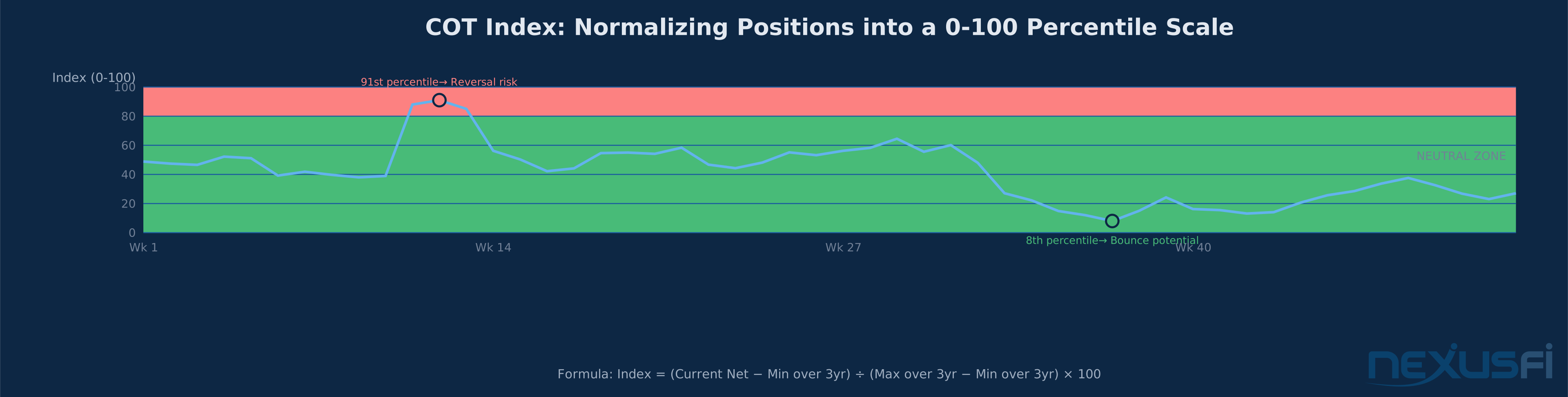
COT Index = (Current Net Position − Minimum Net over Lookback) ÷ (Maximum Net − Minimum Net over Lookback) × 100
The result is a number from 0 to 100:
- Index near 100: Current positioning near the historic maximum (most net long over the lookback period) — extreme bullish spec crowding
- Index near 0: Current positioning near the historic minimum (most net short over the lookback period) — extreme bearish spec crowding
- Index 40-60: Neutral range — no meaningful positioning signal from COT alone
Recommended parameters:
- Lookback period: 2-3 years (104-156 weeks). Shorter periods overfit recent market regimes; longer periods may include structural shifts that are no longer relevant.
- Extreme thresholds: Index > 80 = potential crowding risk (bullish); Index < 20 = potential crowding risk (bearish). Some traders use 90/10 for higher-conviction signals with lower frequency.
- Alternative: Z-score normalization ((Current − Mean) / Standard Deviation) works similarly. Percentile rank is generally preferred because it handles non-normal distributions and is more intuitive to communicate.
Critical implementation note: Compute the index on the net position (not on long and short positions separately). Net position captures directional crowding — which is what drives contrarian signals.
When the COT Index reaches an extreme, it identifies a market where speculative money has become heavily concentrated. This is not a timing signal — it's an environmental condition. Markets can remain at extreme positioning for weeks or months before the trigger arrives that forces liquidation.
Commercials vs. Large Specs: The Counterpart Relationship #
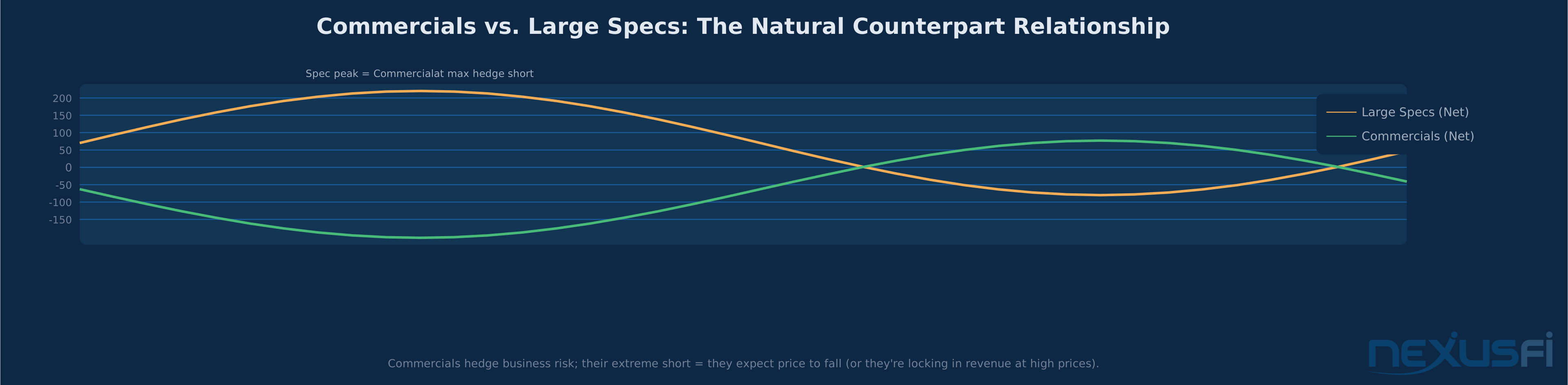
One of the most insightful aspects of COT analysis is the systematic opposition between commercials and large speculators. Because the futures market is zero-sum, the sum of all net positions across all categories must equal zero. Every long must be matched by a short somewhere.
In practice, this creates a natural counterpart relationship: when large specs reach maximum net longs, commercials are typically at their maximum net shorts (maximum hedging). When specs are at maximum net shorts, commercials are at maximum net longs (maximum inventory protection).
This dynamic reveals something important: when large specs are maximally bullish, commercials — the group with the deepest fundamental knowledge of their market — are on the opposite side. They are betting that current prices are favorable to lock in through hedging. This divergence in conviction between informed hedgers and trend-following speculators is the core mechanism behind COT-based contrarian signals.
Fi explained this relationship in response to a forum member asking why large traders and commercial hedgers always seem to go in opposite directions: "Commercials tend to have deep fundamental knowledge of supply and demand in their industry. When they're at extreme net short positions, some traders watch for potential inflection points since commercials tend to have superior fundamental knowledge."
The key insight: extreme commercial short positioning doesn't necessarily mean they expect prices to fall immediately. It means they have enough fundamental information to confidently hedge at current price levels — which signals those prices may be near a ceiling for the current cycle.
COT Extremes as Contrarian Signals #
When the COT Index for Managed Money reaches an extreme — especially above 80 or below 20 — the market is in what traders call a "crowded trade." The speculative community has reached maximum directional exposure. Understanding what happens next is the core value proposition of COT analysis.
The mechanism of crowded trade unwinding:
- Managed Money reaches maximum net long (COT Index near 100)
- A trigger arrives — could be economic data, geopolitical shock, technical breakdown, or simply a lack of new buyers
- Even a modest price decline creates mark-to-market losses for long holders
- Some funds begin to exit; their selling creates more price decline
- Stop-loss orders are triggered; more mechanical selling follows
- The liquidation cascade accelerates far beyond the initial trigger
This is why COT extremes can produce sharp, violent reversals — the market isn't just reversing on fundamentals. It's unwinding a crowded position with everyone rushing for the same exit.
Critical nuance: COT extremes are risk zones, not reversal commands. Markets can remain at extreme positioning for months during strong fundamental trends. A commodity in a genuine supply crisis can sustain extreme speculative longs for an extended period. The COT extreme tells you the market is vulnerable; it does not tell you the reversal will happen now.
The best setups combine:
- COT Index at historical extreme (>80 or <20)
- Price near technical support/resistance (major highs/lows, value area boundaries)
- Momentum divergence (price making new highs while COT Index declining)
- Clear price action confirmation (failed breakout, reversal pattern, structure break)
Without at least one form of price action confirmation, COT extremes are background information only.
The Capitulation Pattern: When Positioning Rapidly Unwinds #
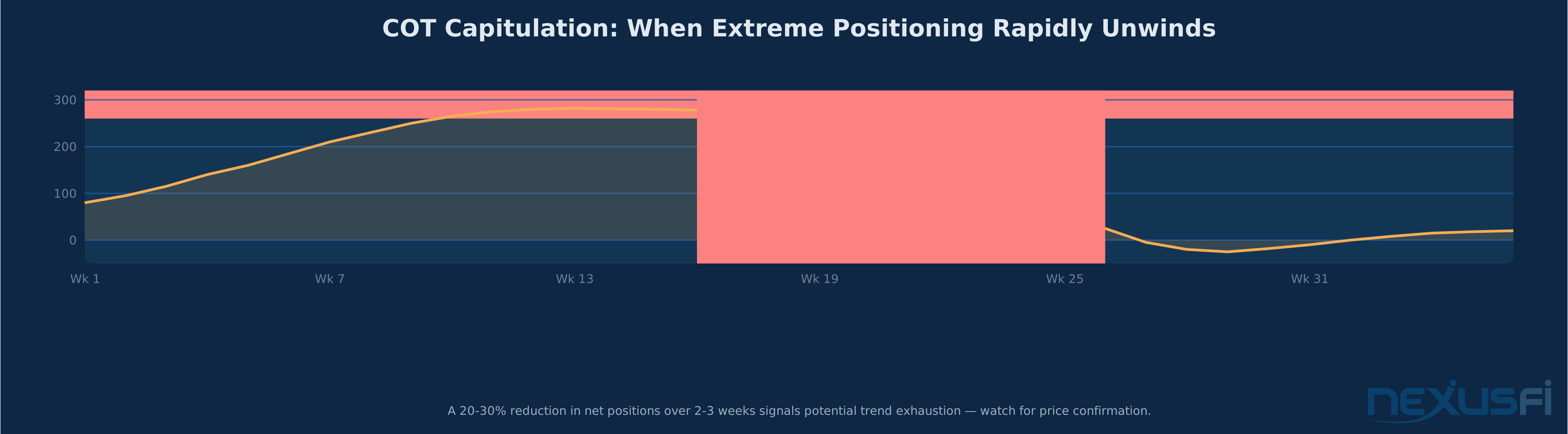
The most tradeable COT signal isn't the extreme itself — it's the rapid unwinding that follows. A sharp 20-30% reduction in Managed Money net positions over 2-3 consecutive weeks is called the capitulation pattern.
What it looks like:
- Week 1: COT extreme, net long at 95th percentile
- Week 2: Net long drops 25%, COT Index falls to 75th percentile
- Week 3: Net long drops another 20%, COT Index now at 55th percentile
- Price: Initially still near highs, then gaps or cascades lower as selling intensifies
Why it matters: The capitulation isn't the selling pressure you can see in the price chart. It's the forced liquidation of positions that weren't counted as "market participants" by conventional sentiment indicators. When this money leaves, price must adjust to find new buyers at lower levels.
The capitulation pattern works in reverse for short-side crowding: when extreme spec shorts rapidly cover over 2-3 weeks, a short squeeze / bounce often follows regardless of the fundamental picture.
Practical threshold: A drop of more than 20% in net position within a single weekly report (approximately 1 million contracts in a highly liquid market) can signal intraday volatility spikes as the CFTC release triggers algorithmic responses to the data.
The Four-Step COT Integration Workflow #
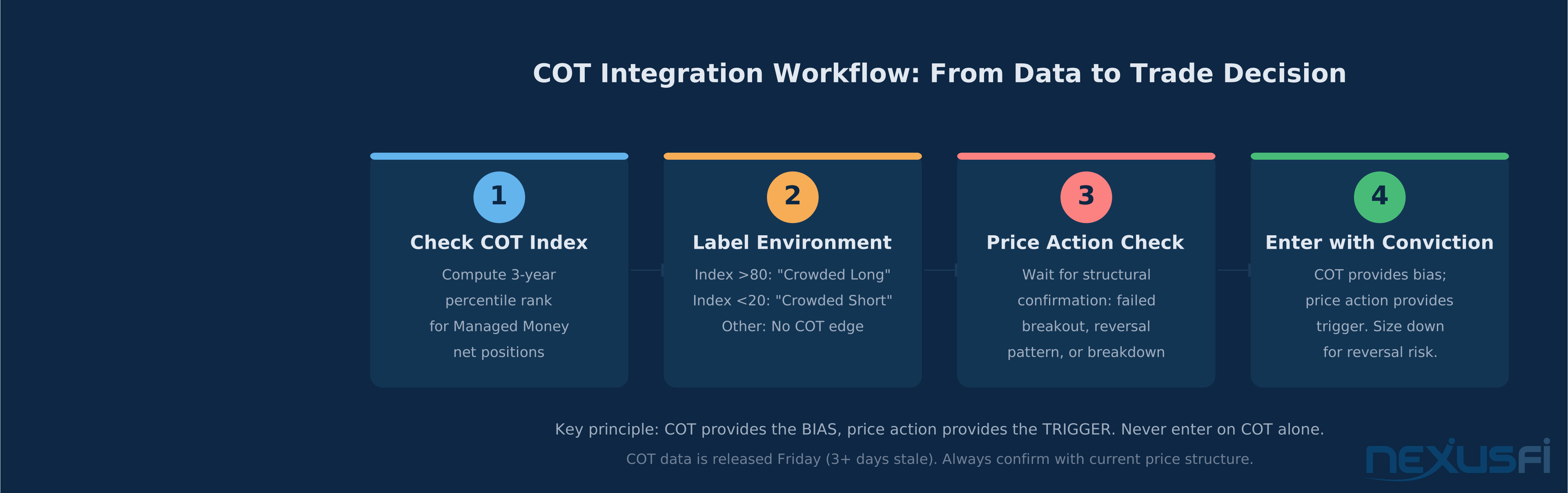
COT data is strategic intelligence. Price action is the tactical entry. Combining both requires a disciplined four-step workflow:
Step 1: Check the COT Index (Weekly)
Every Friday after the CFTC release, calculate or obtain the COT Index for your target markets. Record whether each market is at an extreme, neutral, or somewhere in between.
Markets at extremes: Flag for active monitoring. Markets in neutral range: No COT-based edge; rely on other analysis.
Step 2: Label the Environment
- COT Index > 80 (Managed Money): Label as "Crowded Long" — favor setups that benefit from long liquidation
- COT Index < 20 (Managed Money): Label as "Crowded Short" — favor mean-reversion bounces
- COT Index 20-80: No COT environmental signal
Step 3: Wait for Price Action Confirmation (Daily/4H)
Do not act on COT alone. Wait for:
- Structural break: Trendline breach, failure to make new highs/lows, breakdown of key support
- Reversal pattern: Bearish engulfing, key resistance rejection with volume expansion
- Momentum divergence: Price makes new high but RSI, MACD, or order flow shows declining strength
- Failed breakout: Price breaks to new high, then reverses sharply back below prior resistance
The longer the time spent at an extreme without price action confirmation, the more cautious you should be about fading the crowding.
Step 4: Enter with Defined Risk
COT-based trades carry a specific risk: markets can liquidate violently. The exit of crowded positions creates fast, non-linear moves. Manage this with:
- Reduce position size versus your normal sizing (expect larger moves)
- Use wider stops (above/below the key structural level)
- Take partial profits early — liquidation-driven moves often overshoot and then retrace
- Never average into a COT fade unless the index has moved meaningfully toward neutral
Market-Specific Applications #
Crude Oil (CL): COT extremes in crude have historically preceded some of the most dramatic trend reversals. When Managed Money net longs reach the 85th percentile or higher, crude oil is statistically vulnerable to sharp sell-offs — especially when geopolitical premiums begin to deflate or when demand data disappoints. The capitulation pattern in crude can produce 15-20% price swings.
Gold (GC): Gold has a distinctive commercial hedging structure. Mining companies hedge future production by selling futures; this creates persistent commercial short pressure that must be interpreted in the context of production levels. Look for periods where Managed Money is extreme long AND commercials are at historically elevated short hedges — the combination suggests the market is pricing in a level producers find attractive to lock in.
Agricultural Markets (Corn, Soybeans, Wheat): COT is arguably most powerful in the agricultural futures complex. Seasonal planting and harvest patterns create systematic positioning cycles that repeat annually. Speculative crowding around planting reports or harvest season often sets up high-probability fade trades when confirmed by weather forecasts or USDA report surprises.
Equity Index Futures (ES, NQ): COT in equity futures is more complex. The "commercial" category includes index arbitrageurs and ETF rebalancers — participants who mechanically short futures against long equity positions, creating structural commercial shorts that don't signal bearishness. Use disaggregated data and focus specifically on Managed Money positioning. When hedge funds are at maximum net short in equity futures, short squeezes can be violent and swift.
Currency Futures (6E, 6J, 6B): Currency COT analysis benefits from comparing positioning across multiple pairs to identify relative crowding. When specs are maximally long EUR/USD AND simultaneously short JPY/USD, a macro shock that triggers risk-off sentiment can create synchronized liquidation across both positions — amplifying the currency moves.
Limitations and Warning Signs #
The lagging problem: COT data is always stale. Published Friday, reflecting Tuesday positions. In fast-moving markets, three to four days of price action may have already begun unwinding the positions you're analyzing. The signal may be partially realized before you can act on it.
Markets can stay extreme: The most common and costly COT mistake is assuming that an extreme reading guarantees an imminent reversal. During strong fundamental trends — a commodity supply shock, a central bank policy pivot, a geopolitical crisis — speculative positioning can remain extreme for months. "Markets can remain irrational longer than you can remain solvent" applies directly to COT fading.
Structural shifts change signals: COT data from pre-2008 may not be fully comparable to post-2008 data. The explosion in ETF products, passive investing, and algorithmic trading changed the behavior of the "managed money" category much. What constituted an extreme in 2003 may be routine today.
Financial vs. commodity markets: COT works best in commodity futures (energy, metals, agricultural products) where commercial hedgers have genuine physical market knowledge. In financial futures (equity indices, interest rates, currencies), the "commercial" category is murkier and the contrarian signal is weaker.
Not a standalone system: COT extremes generate false signals regularly. Used in isolation, the COT Index has a poor track record as a timing tool. Its value is as a filter — identifying environments where contrarian setups have elevated probability — not as a signal generator.
Common Mistakes COT Traders Make #
Treating the extreme as the entry signal: The COT Index at 95 is a flag to watch, not a signal to sell. Wait for confirmation.
Using Legacy when Disaggregated is available: The granularity matters. Legacy's commercial category includes swap dealers who behave like speculators. Use disaggregated data for any market where it's available.
Ignoring weekly changes: The absolute level tells you where positioning stands. The rate of change tells you whether the crowd is building or dissolving. A declining extreme is often more tradeable than a static extreme.
Overfitting the lookback: Running the COT Index over 52 weeks vs. 156 weeks can produce dramatically different readings. Validate your parameters out-of-sample before committing capital. The most common approach — 2-3 year rolling windows — exists because it balances recency against sample size, not because it's been optimized.
Applying it without understanding the specific market: Corn and crude oil have very different commercial hedging profiles. Don't assume that a commercial extreme in one market means the same thing as in another. Learn the specific hedging dynamics of each market you trade.
Expecting symmetry: COT extremes on the long side don't always produce mirror-image reversals on the short side, and vice versa. Market structure, seasonality, and the specific trigger environment all influence how positioning extremes resolve.
Where to Find COT Data #
Primary source: The CFTC publishes COT reports every Friday afternoon at cftc.gov/MarketReports/CommitmentsofTraders/. Downloads are available in CSV format, covering all major futures markets. The data is free and complete.
Third-party visualization tools: Multiple services provide pre-computed COT Index charts, net position overlays, and historical databases. Look for tools that automatically compute the percentile rank and display historical positioning relative to price.
Publication schedule: Data is published every Friday afternoon (U.S. Eastern Time), typically between 3:30 PM and 4:30 PM. The data reflects positions as of the prior Tuesday's close.
Historical data: CFTC provides data back to 1986 for Legacy format, 2009 for Disaggregated. For backtesting, download the full historical files and compute rolling indices offline.
Release market impact: In some markets — especially crude oil, gold, and currencies — the Friday COT release itself can trigger brief volatility as algorithmic systems parse the data and reposition. This effect is most pronounced when the data much deviates from analyst expectations based on price movement during the reporting period.
Key Takeaways #
The Commitment of Traders report provides a window into market positioning that price charts cannot offer. Here is the framework to take away:
The COT report is a sentiment filter, not a timing signal. Use it to identify crowded markets where the risk/reward favors contrarian setups. Never use it as a standalone trigger.
Use Disaggregated when available. Managed Money is your primary speculative positioning proxy. Legacy's non-commercial category is too broad.
Build the COT Index. Raw net positions are meaningless without historical context. The percentile rank — computed over a 2-3 year rolling lookback — tells you where positioning stands relative to recent history.
Wait for price action confirmation. COT extremes can persist for months. A structural break, failed breakout, or momentum divergence is required before acting on the signal.
Track weekly changes. The rate of change in net positioning (the capitulation pattern) is often more tradeable than the absolute level.
Reduce position size at COT extremes. Liquidation-driven moves are faster and more volatile than trend-following moves. Size so.
Work with commercial behavior in commodities. In energy, metals, and agricultural markets, commercial positioning is at the core informed. When their positioning and speculative crowding align as contrarian signals, the setup has higher conviction.
NexusFi member Schnook summarized the balanced view after years of COT analysis: "Even for day-traders it can be useful to know how the crowd is positioned. It provides context. In metals, ags, softs and energy the COT data tells a big part of the positioning story."
Context is the right word. The COT report gives you the strategic context — the positioning environment — within which you make tactical decisions. That context, properly interpreted, is worth reading every Friday afternoon.
Knowledge Map
Prerequisites
Understand these firstGo Deeper
Build on this knowledgeReferences This Article
Articles that build on this topicCitations
- — Commitment of traders“Commitment of Trader is extremely useful, as it shows the market positions of different groups of traders.”
- — how do make use of COT to its best ability?“If Nasdaq moved enough against those specs, they might rush to the exits forcing a large price move down.”
- — COT Report?“Even for day-traders it can be useful to know how the crowd is positioned. It provides context.”
- — Selling Options on Futures?“The big number is the specs/hedge funds (managed money) added 66k to their net long position.”
- — Why do "large traders" and "commercial hedge traders" seem to go opposite directions“Commercials tend to have deep fundamental knowledge of supply and demand in their industry.”
- — Do large speculators buy from commercials?“The COT report shows gross and net positions by traders within these categories.”
- CFTC — Commitments of Traders - About the Reports