



Sugar Futures (SB): The Complete Trading Guide
Overview #
Sugar No. 11 (SB) futures are among the most volatile commodity contracts on the planet. A single cent-per-pound move — $1,120 per contract — can happen in minutes when Brazil announces ethanol policy changes or India restricts sugar exports. You're trading a market where a drought in São Paulo state and a monsoon in Maharashtra can move prices in opposite directions on the same week.
This isn't the ES or NQ where macro data and Fed policy drive everything. Sugar is a physical commodity with its own supply-demand calendar, its own weather windows, and its own parity dynamics that link it to crude oil through ethanol economics. Understanding those dynamics is the difference between trading SB intelligently and just staring at a chart hoping for direction.
SB trades on ICE Futures U.S. and draws in a mix of commercial hedgers (Brazilian mills, Indian refiners, global trading houses), trend-following commodity funds, and a smaller retail day-trading base. Liquidity is real — daily volume regularly exceeds 200,000 contracts — but it's concentrated in the front month and narrows sharply around the roll window. Spreads widen when news hits. You need to know the calendar.
The core education here covers what you're actually trading, what moves the price, how the seasonal calendar works, the correlation structure with crude oil and the Brazilian real, and how to build both intraday and multi-week strategies that fit the contract's specific behavior.
The SB Contract: What You're Actually Trading #
Sugar No. 11 is the global benchmark for raw cane sugar — the sweet stuff that leaves the mill and gets refined downstream. It's not white sugar (that's the London No. 5 contract), not domestic U.S. beet sugar. It's raw cane, mostly from Brazil, traded in U.S. cents per pound on ICE Futures U.S.
Contract specifications:
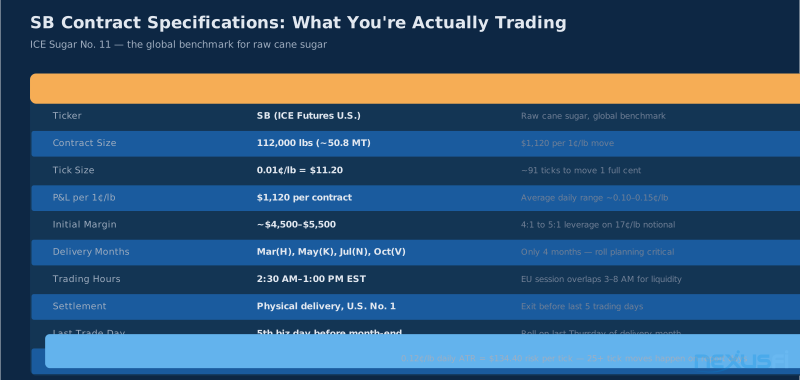
- Ticker: SB (ICE Futures U.S.)
- Contract size: 112,000 pounds (~50.8 metric tons)
- Price quotation: U.S. cents per pound (¢/lb)
- Tick size: 0.01¢/lb = $11.20 per contract
- P&L per 1¢/lb move: $1,120 per contract
- Trading hours: 2:30 AM -- 1:00 PM EST (electronic, ICE)
- Settlement: Physical delivery, U.S. No. 1 raw cane sugar
- Last trading day: 5th business day before the last business day of the delivery month
- Contract months: March (H), May (K), July (N), October (V)
- Initial margin: ~$4,500--$5,500 (varies with ICE's daily margin model)
- Maintenance margin: ~$4,000
The $1,120-per-cent calculation is the number you internalize first. A move from 18.50¢/lb to 20.00¢/lb — a 1.5-cent rally — means $1,680 per contract in your favor or against you. That's the daily range on a normal day in SB. On USDA report days or during El Niño news cycles, moves of 0.50¢/lb to 1.00¢/lb in a single session aren't unusual. Position sizing against this volatility is non-negotiable.
The four delivery months (March, May, July, October) reflect the global harvest calendar. Brazilian crop data dominates the October and March contracts; Asian demand tends to drive the May and July cycles. Roll activity concentrates in the final two weeks before the last trading day, with most participants moving to the next liquid month on the last Thursday of the delivery month.
in platform defaults — verify your platform's SB contract month settings directly against the ICE specifications before you trade.
At 17¢/lb, a single SB contract controls $19,040 in notional value. At 20¢/lb, that's $22,400. Margin is $4,500--$5,500, giving leverage of roughly 4:1 to 5:1 on margin. That leverage works both ways — which is why professional sugar traders treat SB more like a currency pair than a slow-moving agricultural market.
The Ethanol Parity Engine: Sugar's Dominant Driver #
If you learn one thing about sugar futures, make it this: Brazil controls the global raw sugar price through the ethanol-sugar parity mechanism, and that mechanism is unique to sugar among all commodity futures.
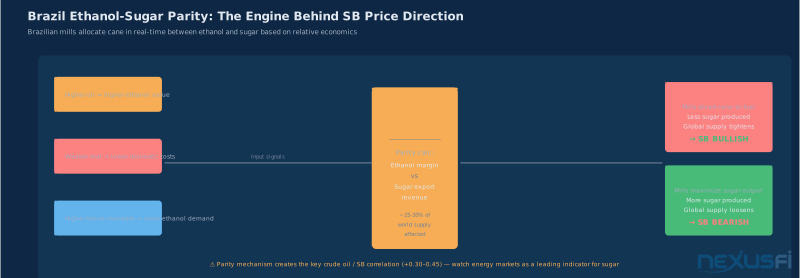
Brazil produces roughly 25--30% of the world's raw sugar, and Brazilian mills have a critical choice at harvest: crush the cane into sugar (export it globally) or convert it to hydrous or anhydrous ethanol (sell it domestically as fuel). The decision is purely economic — mills run the numbers and allocate so.
How parity works:
When ethanol prices are high relative to sugar prices (ethanol parity favors ethanol), Brazilian mills divert more cane toward fuel production. Less sugar reaches global markets. Supply tightens. SB prices rise. When sugar is more profitable than ethanol, mills shift the other way — more sugar, less ethanol — and global supply loosens.
This linkage connects SB directly to:
- WTI and Brent crude oil prices -- through ethanol blend economics (higher oil = higher ethanol value = mills favor ethanol = less sugar)
- Brazilian gasoline policy -- government blend mandates and pump price controls affect domestic ethanol demand
- BRL/USD exchange rate -- Brazilian mills sell sugar internationally in USD; a weaker real makes their costs cheaper and can affect export economics
The practical implication: when you see crude oil rally sharply on geopolitical news, check SB. If the ethanol parity calculation shifts toward ethanol, it's a bullish signal for sugar — not because of supply news, but because of the mill allocation math happening in the next harvest cycle. This is why SB traders who don't watch crude oil are missing a primary driver.
Parity doesn't reverse sugar immediately — mills commit their crush season allocation months in advance. But it feeds into forward months and shapes the futures curve. When ethanol parity is strongly bullish for months away from the current crop, you'll see contango compress or flip to backwardation in the July/October contracts while the front month appears range-bound.
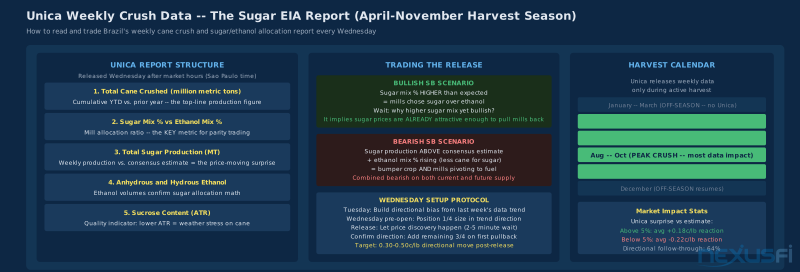
Monitoring tools: The key data series to watch are Brazil's Conab monthly supply-demand reports, Unica (Brazil's sugar cane industry association) weekly crush data during the April--November harvest season, and the hydrous ethanol vs. sugar price comparison that emerges from Brazilian domestic energy data. These are tracked by commodity analysts and flow into news feeds — when Conab revises its crush estimate, SB moves.
India: The Policy Wildcard #
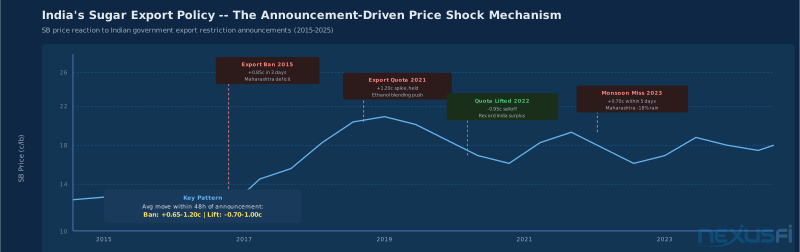
India is the world's largest sugar consumer and the second-largest producer. While Brazil dominates global trade flows, India dominates price shocks through government policy — because Indian export decisions are unpredictable and announcement-driven rather than market-driven.
The pattern is consistent: India's government periodically bans or restricts sugar exports when domestic stocks fall below comfortable levels, then lifts restrictions when overproduction threatens mill economics. Each announcement moves SB 0.50--1.50¢/lb in a session.
The monsoon variable: Indian cane yields depend heavily on the June--September southwest monsoon. A 15% rainfall deficit in Maharashtra (India's top producing state) can cut national output by 4--5 million metric tons — enough to shift the global balance from surplus to deficit. This is why May and June SB positioning often reflects monsoon forecast speculation as much as any other factor.
Ethanol diversion in India: Like Brazil, India has pushed domestic ethanol blending mandates aggressively since 2020. When Indian mills divert sugarcane to ethanol, it reduces available sugar supply. India's ethanol policy announcements have become secondary price drivers behind Brazil's parity mechanism.
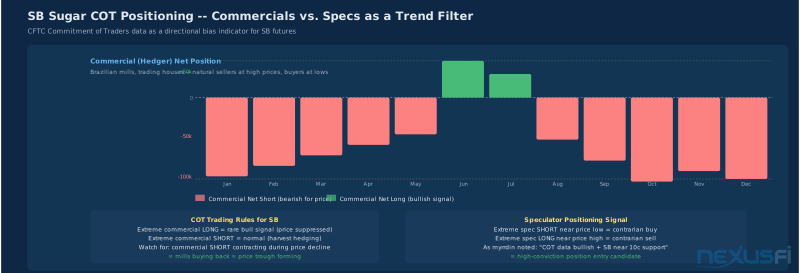
As @myrrdin noted in a NexusFi Softs analysis thread, when "COT data is bullish" in sugar with "prices close to round number supports (SB 10)," the combination of commercial hedger positioning and seasonal lows often sets up favorable risk/reward for position entries. India's export ban announcements, arriving during periods of commercial accumulation, are the trigger that can trigger the move off those lows.
Key Indian data to track: ISMA monthly production and stock data, India's Directorate of Sugar export quota announcements, India Meteorological Department monsoon updates (June--September).
Weather and El Niño: The Supply Shock Premium #
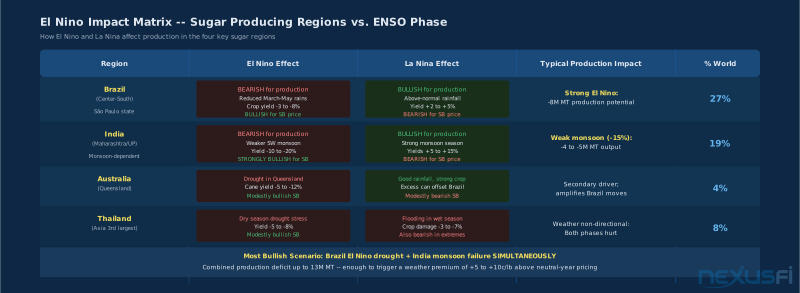
Sugar is more weather-sensitive than most commodity futures because both primary producing regions — Brazil's Center-South and India's Maharashtra — are vulnerable to precipitation anomalies, and both regions are affected by the El Niño Southern Oscillation (ENSO) in different and sometimes conflicting ways.
El Niño's impact on sugar:
- Brazil (Center-South): El Niño generally reduces rainfall during the critical March--May flowering period, lowering cane yield and sucrose content. A strong El Niño event can cut Brazilian production 3--8%.
- India: El Niño tends to weaken the Indian southwest monsoon, reducing Maharashtra's rainfall and cane yields by 10--20% in strong events.
- Australia: El Niño reduces rainfall in Queensland (Australia's main cane region), further tightening global supply.
- Thailand: La Niña, paradoxically, can harm Thai production through flooding, while El Niño causes drought stress in the dry season.
The net effect: a moderate-to-strong El Niño event that aligns with weak Brazil rains and a poor Indian monsoon is the most bullish scenario for SB prices. Weather-risk premiums of 5--10¢/lb are possible during peak El Niño periods (October--March), compared to neutral-year average price levels.
Trading the forecast, not the event: Markets don't wait for El Niño confirmation — they price probability distributions. The key signal is the NOAA ENSO forecast ensemble shift from "neutral" to "El Niño watch" or "El Niño advisory." When ensemble model agreement for El Niño crosses 70%, SB typically begins building a weather premium 3--6 months before the actual crop impact.
Reversals are sharp. When ensemble models downgrade El Niño probability or Brazil receives above-normal rains in January--February (the critical sugarcane growth window), weather premium unwinds quickly. Day traders who missed the reversal signal find themselves holding long positions into a fast 2--3¢/lb selloff.
Monitoring resources: NOAA's weekly ENSO update, Brazil's INPE precipitation data for São Paulo state, and the Australian Bureau of Meteorology's ENSO Wrap-Up.
Seasonal Patterns: When Sugar Runs #
Sugar has one of the most consistent seasonal patterns in the futures universe — not because it's mechanical, but because the underlying supply calendar is predictable. Understanding this calendar doesn't tell you where price will be; it tells you which direction to bet when the setup aligns.
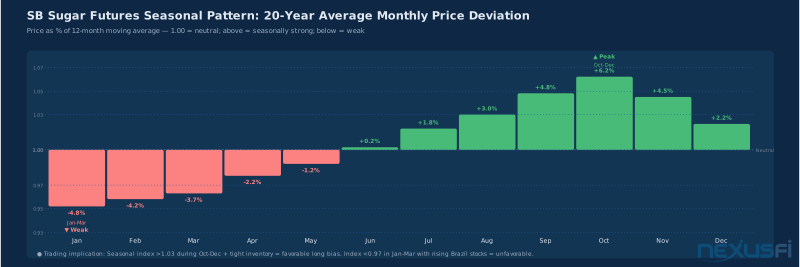
20-year average seasonal pattern:
| Period | Historical Bias | Primary Driver |
|---|---|---|
| January--March | Weak/declining | Post-harvest inventory buildup; Brazil and India in delivery mode |
| April--June | Base-building/gradual recovery | Brazil Center-South crush season begins April; weather speculation starts |
| July--September | Upward bias | Peak Brazilian crush; India pre-monsoon positioning; Asian demand pickup |
| October--December | Strongest seasonally | End-of-year inventory draws; El Niño premium builds; holiday demand |
How to quantify the seasonal: Build a seasonal index by dividing monthly price by the 12-month moving average. When the index is above 1.03 during October--December and global inventory levels are tight, the seasonal setup is favorable. When the index is below 0.95 in January--March, the seasonal headwind is working against any long thesis unless a major supply shock appears.
The seasonal doesn't trade itself. In 2015--2016, the October rally failed spectacularly because global inventory was at a 5-year high, overwhelming any seasonal tendency. In 2021--2022, the seasonal was amplified by Brazilian drought and strong ethanol parity — SB ran from 14¢/lb to 20¢/lb between May and October 2021.
The Brazil crush calendar specifically:
- April--May: Crush season begins in Center-South Brazil; first production estimates from Unica
- June--October: Peak crush season; weekly Unica data drives sentiment
- November--March: Off-season; India and Thailand dominate flow data
Unica releases weekly crush data every Wednesday during the season — the SB equivalent of an EIA petroleum report, consistently market-moving and tradeable on the surprise vs. expectation.
Correlations That Matter: Crude Oil and BRL/USD #
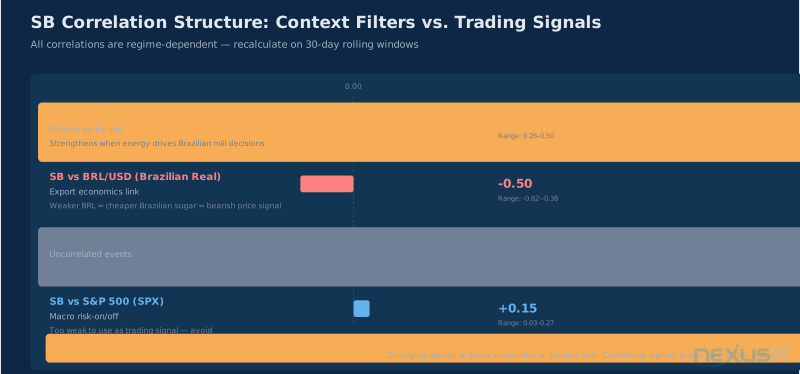
Sugar has meaningful correlations with two other markets: WTI crude oil and the Brazilian real/U.S. dollar exchange rate (BRL/USD). Neither is static, and neither is a direct causal relationship — they both work through the ethanol parity mechanism described above.
SB vs. WTI Crude Oil:
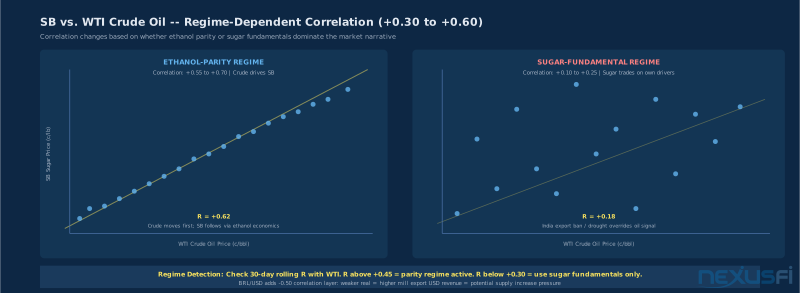
Correlation coefficient typically ranges +0.30 to +0.45 over 6-month rolling windows, but can spike to +0.60 or higher during periods when energy policy dominates Brazilian mill decisions. The mechanism: higher oil prices strengthen ethanol economics in Brazil, pulling mill output away from sugar, tightening supply, and lifting SB.
This correlation fails during sugar-specific news events (Indian export bans, Brazilian droughts) when sugar's fundamentals diverge from energy markets. Use crude as a context filter: if SB is rallying but crude is falling hard, the sugar move is likely supply-shock driven (more durable) rather than ethanol-parity driven (potentially reversible).
SB vs. BRL/USD:
The correlation with BRL/USD is negative and typically stronger (-0.45 to -0.55). When the Brazilian real weakens against the dollar, Brazilian sugar becomes cheaper in dollar terms, which should increase export competitiveness and push prices down. Conversely, a stronger real (BRL appreciation) makes Brazilian exports more expensive and can support global prices.
This relationship also works through mill economics: when the real weakens, Brazilian producer revenue in local currency increases even without any change in dollar-denominated prices, which can reduce selling urgency and allow prices to drift higher.
Practical use: Before entering SB, check crude and BRL/USD direction. Both confirming = higher conviction. Diverging = smaller size or wait. Use 30-day rolling windows — annual correlations mask regime changes. Crude and BRL are filters, not entry signals.
As @razorbuzz noted in a NexusFi SB thread, technical strategies in sugar need to account for the fundamental noise layer — "in Traders magazine there were published an article of my strategy trading SB" that specifically addressed the challenge of filtering fundamental-driven moves from technical noise in this contract.
Day Trading SB Futures #
Day trading SB is different from day trading equity index futures in three important ways: the market is thinner, news is less predictable, and the fundamental calendar creates regime shifts that technical-only approaches miss entirely.
That said, SB has consistent intraday patterns that experienced traders exploit. The key is respecting the context — what's the underlying fundamental narrative, is this a trending or range-bound week, and are we approaching a major report or Brazilian crush data release?
Optimal timeframes: 5-minute and 15-minute charts for entry timing; 1-hour and daily for trend context. The 1-minute chart is useful during news events but generates too much noise for systematic setups.
Primary setups for SB day trading:
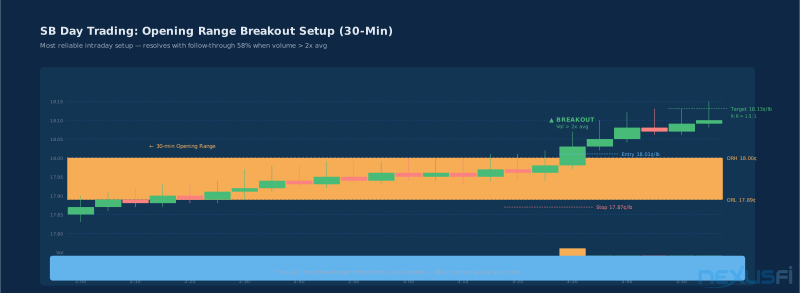
1. Opening Range Breakout (30-minute)
Define the high and low of the first 30 minutes of the ICE session (2:30--3:00 AM EST). Enter long on a sustained close above the high, short on a sustained close below the low, with volume greater than 2x the average 30-minute volume. Stop at the opposite end of the opening range. Target 1.5--2x the range width.
Works best during trending weeks with a clear fundamental bias. Fails in choppy, range-bound conditions — which occur frequently when no major news is pending.
2. VWAP Rejection
Price breaks above or below VWAP with conviction (volume spike), then pulls back and finds support/resistance at VWAP on lower volume. Enter on the first bounce at VWAP with a stop 2--3 ticks beyond it. Target the prior session's VAH or VAL depending on direction.
Sugar's institutional order flow frequently anchors to VWAP. Commercial hedgers often execute against VWAP during crush season, creating reliable reference levels.
3. 20-EMA Pullback (5-minute)
Price establishes a trend (at least 3 bars moving in one direction with momentum), pulls back to the 20-period EMA on declining volume, and shows a reversal candle (hammer, engulfing) with volume picking up. Enter at the close of the reversal candle. Stop 2--3 ticks below the EMA swing low. Target 3x risk.
This is the cleanest setup when SB is trending on a specific news trigger — Brazilian crush data, Indian export news, or weather forecast updates.
4. Gap Fill
When SB opens substantially above or below the prior session close (gaps >$0.15¢/lb in either direction), look for gap-fill opportunities if the initial momentum exhausts. Requires confirmation from order flow — declining volume on the initial impulse, DOM showing resistance at the gap origin. Stop at the session extreme. Target the prior close.
Works more reliably when the gap is driven by overnight news that's already been fully digested vs. news that's still developing.
Day trading risk management: 1% equity max per trade. Stops: 2--3 ticks ($22--$34) for scalps, 0.5x ATR(14) for trend trades. Activate trailing stops after 4+ ticks profit. Time exit: no follow-through in 20--30 min = exit. Blackout: no new positions 15 min around WASDE/Unica releases.
The most important day-trading rule for SB: know when NOT to trade. During roll week (last 5 trading days of the front month), spreads widen and volume shifts to the next contract. Slippage on entry and exit increases by 30--50%. Reduce size or sit out entirely unless you're working with institutional-grade execution.
Position Trading: The Multi-Month Framework #
Position trading SB — holding weeks to months — is where fundamental research pays off. Fewer setups (4--6 per year), but larger moves and more defensible edge because you're trading supply-demand narrative, not just price patterns.
Building the position-trading framework:
Step 1: Build the fundamental matrix. Monthly update: Brazilian production estimate (Conab/Unica), Indian production and export quota status, global stocks-to-use ratio (WASDE), ethanol parity calculation, ENSO status, and seasonal index. This gives directional bias — "lean long" or "lean short" for 1--3 months — not a precise entry.
Step 2: Wait for technical confirmation. Even with a strong fundamental thesis, don't enter into an ongoing move. Wait for: price testing the 200-day EMA with a daily reversal candle, a 38.2%--50% Fibonacci pullback with reversal pattern, weekly MACD histogram turn, or a multi-month consolidation breakout with volume.
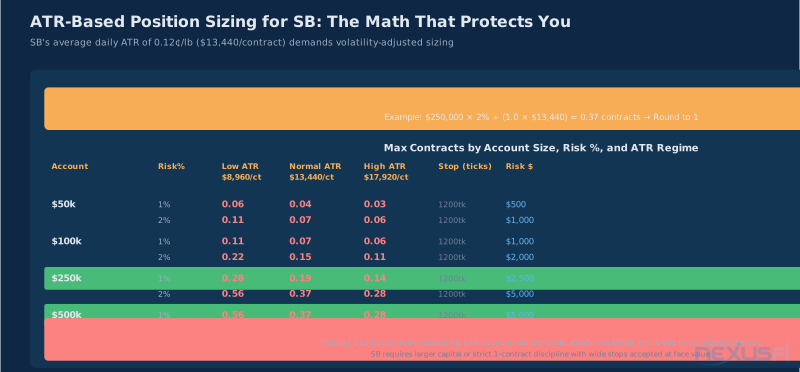
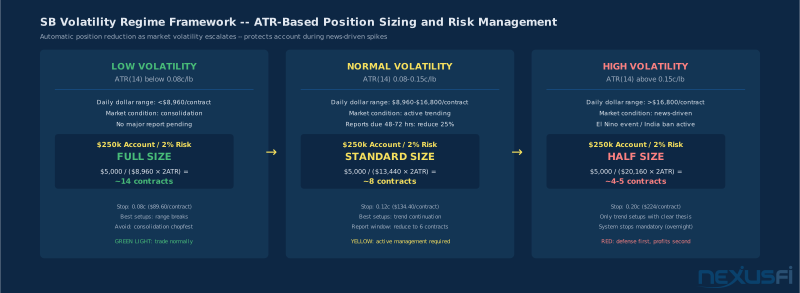
Step 3: Size using ATR-based volatility adjustment. SB's daily ATR averages 0.10--0.15¢/lb ($11,200--$16,800/contract/day). Framework: risk 1--2% of account equity. At $5,000 risk on $250k (2%) with a 2x ATR stop: $5,000 / (2 × $13,440) = 0.19 contracts — round to 1, accept the higher risk percentage on a single contract.
Sample position trade setup:
Setting: November, ENSO forecast shows moderate El Niño developing. Conab revises Brazilian production down 4%. India restricts exports through March. Seasonal index is 1.04 (above neutral). Global stocks-to-use ratio drops below 30% for the first time in 3 years.
Technical: SB March contract at 18.45¢/lb, testing the 200-day EMA at 18.30¢/lb. Daily shows a bullish engulfing candle on above-average volume. Weekly MACD histogram turned positive last week.
Trade structure:
- Entry: 18.50¢/lb (breakout of engulfing candle high)
- Stop: 18.20¢/lb (below 200-day EMA and swing low) = 0.30¢/lb = $336 per contract
- Target: 20.00¢/lb (prior resistance level) = 1.50¢/lb = $1,680 per contract
- Risk/reward: 1:5
- Size on $250,000 account (2% risk = $5,000): $5,000 / $336 = ~14 contracts
This is a high-conviction setup because all four fundamental factors align with the seasonal and technical confirmation. The thesis invalidation is clear: if India lifts export restrictions or Brazilian production estimates stabilize, the fundamental basis for the trade disappears and you exit regardless of price level.
Roll Management: Avoiding the Liquidity Cliff #
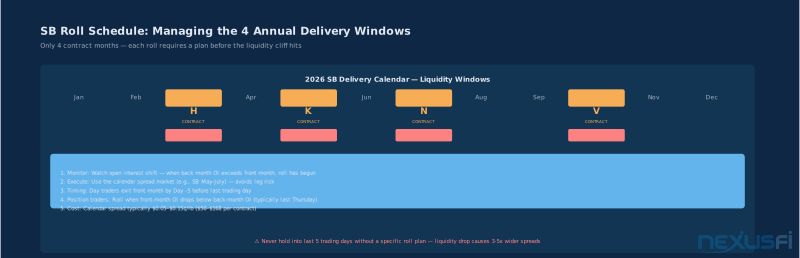
SB has only four delivery months (March, May, July, October), which means each roll cycle is significant — you're moving from one liquid month to the next across a 2--3 month gap. Get the roll wrong and you're trading into thin liquidity with wide spreads at exactly the wrong time.
The roll window: Most participants roll during the final 5--7 trading days before the last trading day, with the bulk of volume shift typically happening on the last Thursday of the delivery month. In practice, watch open interest: when the front month's open interest drops below the back month's, the roll is underway regardless of the calendar date.
Roll Timing Signal: Watch open interest, not just the calendar. When the front-month OI drops below the back-month OI, the roll is already underway — regardless of the official roll date. For SB, this typically happens 10-15 trading days before expiry. Mark your calendar 3 weeks ahead and monitor OI shifts starting 15 days out.
How to execute the roll: Use the calendar spread market (e.g., SB March-May) rather than legging in the outright. Calendar spread between adjacent months typically $0.05--$0.15¢/lb. Contango (back month higher) = carry opportunity. Backwardation (front month higher) = physical tightness signal.
Roll timing by trader type:
- Day traders: Stay in the front month until the last 5 trading days. Then either exit entirely or move to the back month. Don't straddle the roll week in the expiring contract -- liquidity problems compound slippage.
- Position traders: Monitor open interest starting 15 days before last trading day. When front-month OI falls below back-month, execute the roll. Don't wait for the last day.
- Both: Never hold into physical delivery unless you specifically trade delivery month contracts and have the logistics infrastructure. Delivery costs and penalties are significant.
As @Fat Tails highlighted in a NexusFi thread on SB mechanics, platform-supplied contract month data for commodities is frequently incorrect — "be aware that NT developers are not traders." Verify the roll dates manually against ICE's contract calendar before each cycle.
Risk Management for SB #
Sugar's volatility isn't constant — it spikes around report releases and weather events, compresses during quiet periods. Risk management must account for this regime-switching behavior.
Core framework:
- Maximum SB allocation: 20% of total futures capital. SB correlates with crude and BRL -- a macro shock hits all simultaneously.
- Volatility regime sizing: Low ATR (<0.08¢/lb) = full size. Normal (0.08--0.15¢/lb) = reduce 25% near report dates. High (>0.15¢/lb) = half size, wider stops.
- Report blackouts: No new positions 30 minutes before USDA WASDE, Conab, or Unica releases. Reduce size if already positioned.
- Overnight gap protection: Position traders must set system stop-loss orders -- not mental stops. SB can gap 0.30--0.50¢/lb before a manual stop can be entered.
- Correlation warning: If long SB and crude breaks --3% in a session, the ethanol parity link means SB weakness can follow. Reassess the position -- not an automatic exit, but a warning.
The ATR framework forces automatic position reduction when markets get dangerous. At 0.12¢/lb normal ATR, a $250k account (2% risk) supports 14--15 contracts; at 0.20¢/lb high-volatility ATR, the same account drops to 8--9 contracts. The math does the risk management.
Report Calendar and Key Releases #
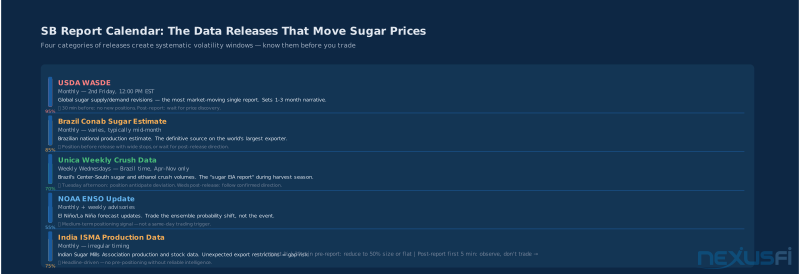
Four categories of releases create systematic volatility windows in SB:
| Report | When | Impact |
|---|---|---|
| USDA WASDE | 2nd Friday, 12 PM EST monthly | Very High -- sets 1-3 month supply/demand narrative |
| Conab Sugar Estimate | Monthly, mid-month | High -- Brazil production revisions, the world's largest exporter |
| Unica Crush Data | Weekly Wednesdays (April--November) | High -- the "sugar EIA report" during harvest season |
| NOAA ENSO Update | Monthly + weekly advisories | Medium -- weather premium trigger for multi-month positioning |
| India ISMA Data | Monthly, irregular timing | Medium-High -- Indian export restrictions cause gap risk |
Report Blackout Protocol: No new SB positions 30 minutes before USDA WASDE, Conab, or Unica releases. Reduce size if already positioned. Sugar gaps 0.30-0.50c/lb around major report surprises — that is $336-$560 per contract in seconds, before you can react. The weekly Unica release (every Wednesday during the April-November harvest) is the most consistently tradeable trigger: position Tuesday afternoon, react Wednesday morning.
Pre-report protocol: No new positions 30 minutes before WASDE. Reduce size before Conab and Unica releases if positioned. Post-WASDE: wait for price discovery before adding.
The weekly Unica release (Wednesday during harvest) is the most actionable trigger. The surprise vs. expectation gap — more sugar production than expected (bearish) vs. more ethanol allocation (bullish) — drives the Wednesday morning directional move. Position Tuesday afternoon, react Wednesday morning.
What SB Requires From You #
SB isn't a chart-only contract. Success requires fundamental calendar awareness, patience during consolidation, and exit discipline when thesis changes — three traits that pure technical traders struggle to build.
- Fundamental calendar: Know the weekly Unica schedule, monthly WASDE date, ENSO cycle. Mark them before you trade. Know what reports are due in 48--72 hours before entering positions.
- Patience during range-bound periods: Forcing setups in low-volatility windows leads to repeated small losses. The profitable play is to wait for trigger-driven setups -- sometimes days away.
- Thesis invalidation discipline: If you're long on Brazil drought expectations and Conab revises estimates upward, exit. Don't hold invalidated positions because you're not at your target yet.
- Roll discipline: Mark your calendar 3 weeks before each delivery month. Roll by the last Thursday before expiry. Panicked day-of rolls cost 0.05--0.15¢/lb in avoidable slippage.
Key Takeaways #
- Contract basics: 112,000 lbs, $11.20/tick, $1,120 per 1¢/lb move. Four annual delivery months: March, May, July, October.
- Primary driver: Brazil's ethanol-sugar parity mechanism is the dominant macro force. When ethanol economics favor diverting cane away from sugar production, global supply tightens and SB rallies. Watch crude oil and Brazilian government energy policy as leading indicators.
- Secondary drivers: India's export policy (announcement-driven, unpredictable), El Niño/La Niña weather patterns (trade the forecast revisions), and global stocks-to-use ratio from USDA WASDE data.
- Seasonal bias: Jan--Mar weak, Oct--Dec strong. Build a seasonal index (price / 12-month MA) to quantify deviation. Use as a directional filter, not a standalone signal.
- Correlations: +0.30 to +0.45 with WTI crude (through ethanol), --0.45 to --0.55 with BRL/USD. Both correlations are regime-dependent -- use as context filters, not entry triggers.
- Day trading: 5-min chart, ORB and VWAP setups, 1--2 tick stops, no new positions around WASDE/Unica releases.
- Position trading: Monthly fundamental matrix, technical entry confirmation, ATR-based sizing, exit on thesis invalidation.
- Roll management: Roll on calendar spread when OI shifts, never hold into last 5 trading days without a plan.
- Risk management: 20% max capital, ATR-regime sizing, report blackouts, overnight system stops.
Sugar is a serious commodity contract for traders willing to do the fundamental research and maintain the discipline the market demands. The parity mechanism, the weather dynamics, and the geopolitical supply structure create edges that pure technical approaches can't reliably capture. Build the fundamental framework first, add the technical discipline second, and you'll find SB to be a contract with genuine, durable trading opportunities across both intraday and multi-week timeframes.
Related Resources
- Coffee Futures (KC): The Complete Trading Guide -- Sister soft commodity with similar seasonal structure and weather-driven volatility
- Crude Oil (CL) Futures: The Complete Trading Guide -- Primary correlation market through the ethanol-energy link
- Commitment of Traders (COT) Report -- Essential positioning intelligence for soft commodity analysis
- Volatility-Based Position Sizing -- ATR-based position sizing framework critical for SB's variable volatility
- Fundamental Data for Commodity Futures -- USDA WASDE, Conab, and other supply-demand reports that move SB
- Overnight Risk and Gap Management -- Protecting positions in a 24-hour electronic market
Knowledge Map
Prerequisites
Understand these firstGo Deeper
Build on this knowledgeReferences This Article
Articles that build on this topicCitations
- — Trading SB - Sugar No.11 (2010) 👍 1“Sugar is the most liquid of the softs contracts with about 50,000 contracts traded per day.”
- — InteractiveBrokers IB data feed error with SB (sugar) (2010) 👍 2“Be aware that NT developers are not traders. For commodities the contract months and/or rollover dates are typically false.”
- — InteractiveBrokers IB data feed error with SB (sugar) (2010) 👍 1“Volume for SB shifts about 10 to 15 days prior to expiry from the old to the new contract.”
- — Trading SB - Sugar No.11 (2010) 👍 3“It's an absolute trending market. 1 tick $11.20 and a good stop takes 40-50 ticks and more. Works perfect in hourly/daily for trending.”
- — Softs (Fundamentals) (2019) 👍 2“For all these commodities COT data is bullish. Prices are close to round number supports (SB 10). Seasonals for sugar are bullish after early June.”
- — Softs (Fundamentals) (2019) 👍 1“I sold my sugar position a couple of days ago with a small profit when Crude Oil price came down.”
- — Trading ratios long term (2020) 👍 4“ICE Sugar and CME Wheat -- Autospreader makes cross-exchange spreads easier but tends to be expensive for the retail trader.”
- — Muttoez Trading Journal (2016) 👍 1“SB Sugar Trade: Long 1 contract of October Sugar. Prices penetrated the 61.8% retracement. A deficit in supply is expected this year.”
- ICE Futures U.S. — ICE Sugar No. 11 Futures Contract Specifications (2025)
- USDA Foreign Agricultural Service — USDA PSD Online - Sugar Production and Trade Data (2025)
- — Where to learn how to trade Commodities. (2014) 👍 1“My favorites are Corn, Wheat, Soybeans, and Sugar (/ZC, /ZW, /ZS, /SB). Stay away from Coffee -- at $18/tick, it is not for a new trader.”