



COT Report Trading Strategy: From Positioning Data to Executed Trades
Overview #
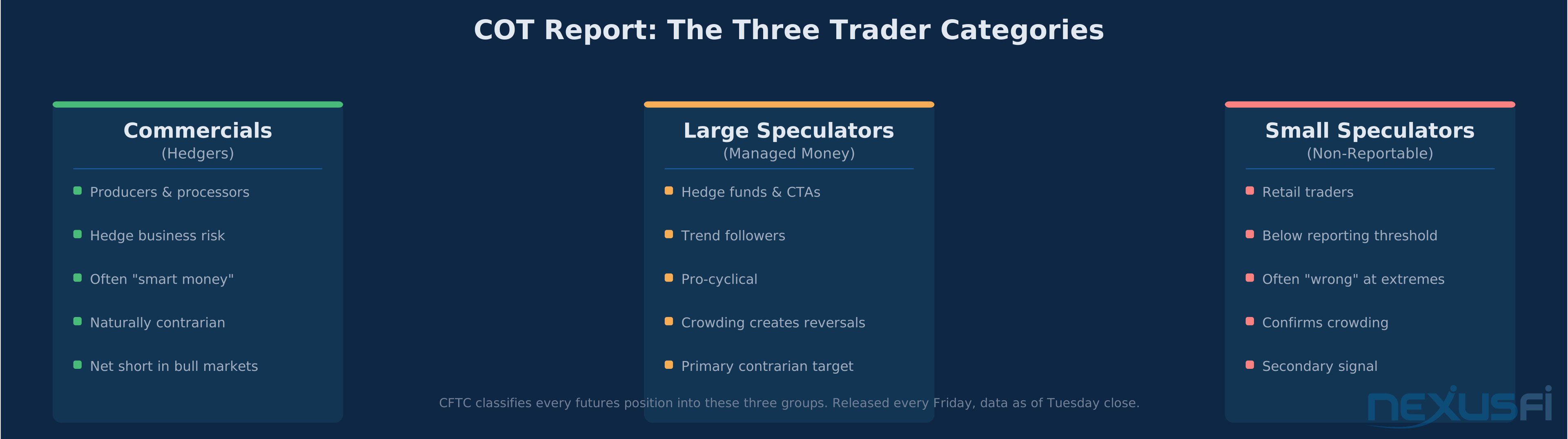
The Commitment of Traders (COT) report gives futures traders something most indicators can't: a direct window into the actual positions held by the largest market participants, categorized by their trading purpose. Commercial hedgers, large speculators, and small speculators report their positions to the CFTC weekly, creating a dataset that reveals when speculative money has become so concentrated in one direction that a forced unwind could generate violent, non-linear price moves.
This article covers the execution side of COT-based trading — how to build a systematic positioning filter, identify high-probability setups using the Shapiro contrarian framework, and manage positions when crowded trades begin to unwind. For the foundational guide on what the COT report contains, how the categories work, and where to access the data, see COT Report: Understanding the Commitment of Traders Data in the Data section. For combining COT signals with structural analysis, see Volume Profile Trading and Order Flow Analysis.
The COT report is most reliable in energy, metals, and agricultural futures — markets where commercial hedgers have genuine fundamental knowledge. Its signals are weaker and require different frameworks for equity index and Treasury futures. Understanding which markets generate reliable signals, and which require skepticism, is half the battle before a single trade is placed.
The Structural Edge: Why COT Works #
Most sentiment indicators are derived from price — they tell you how past price action has shaped market psychology. COT data is different. It measures actual positions held by actual market participants, categorized by their trading purpose.
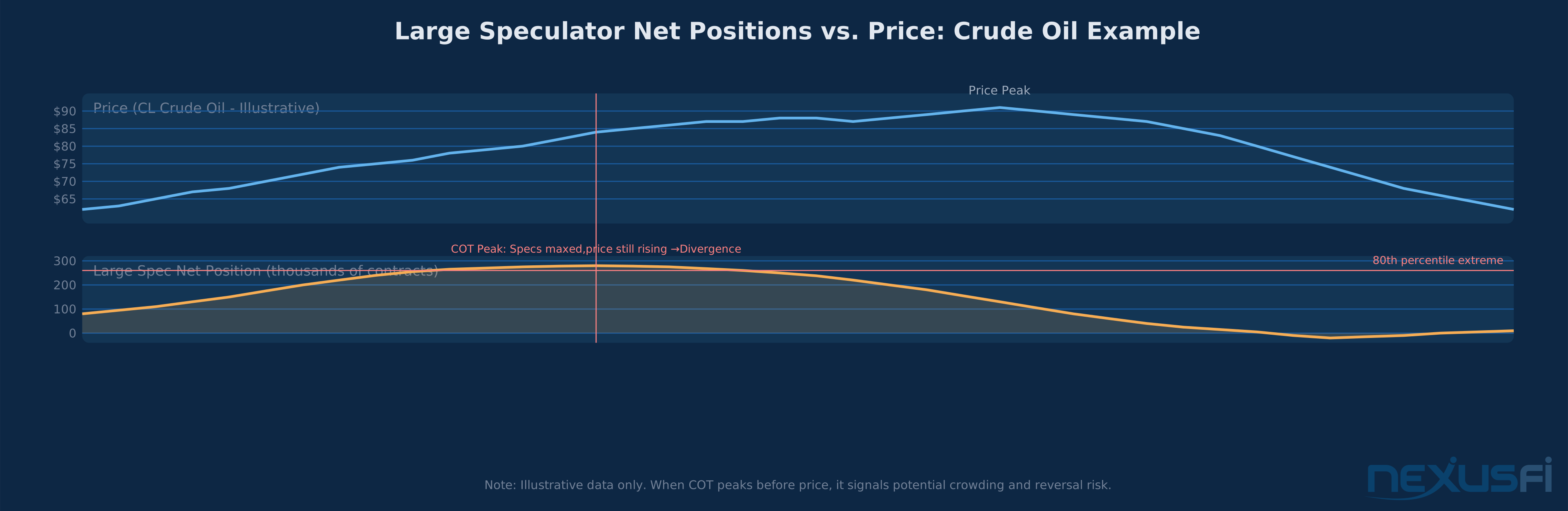
This creates a structural edge that no price-derived indicator can replicate. When the COT Index for Managed Money hits 90 — meaning speculative positioning is in the 90th percentile of the last three years — you know something price charts can't tell you: the people who typically lead price moves have already committed. The fuel is largely spent.
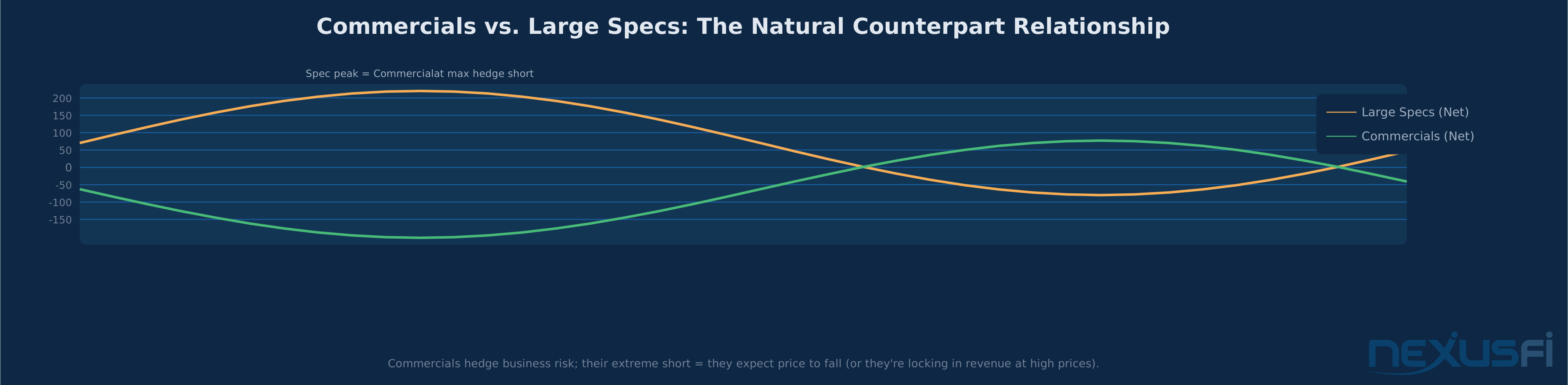
The mechanism is straightforward. Managed money (hedge funds, CTAs) builds positions in trend directions. They are systematic trend followers by nature. As a trend matures, they accumulate. At some point, their net position reaches a historical extreme. At that moment:
- The universe of potential buyers (for long extremes) has shrunk. The biggest momentum players are already max long.
- Any negative trigger forces simultaneous exits. Everyone rushes the same door.
- The exit pressure generates a price decline that triggers stop-losses in other trend-following systems.
- The cascade accelerates the move far beyond the original trigger.
This mechanism explains why COT extremes sometimes produce 15-30% moves in commodity futures within weeks. You're not seeing normal price discovery. You're watching a crowded trade liquidate.
The COT Index as a Strategy Filter #
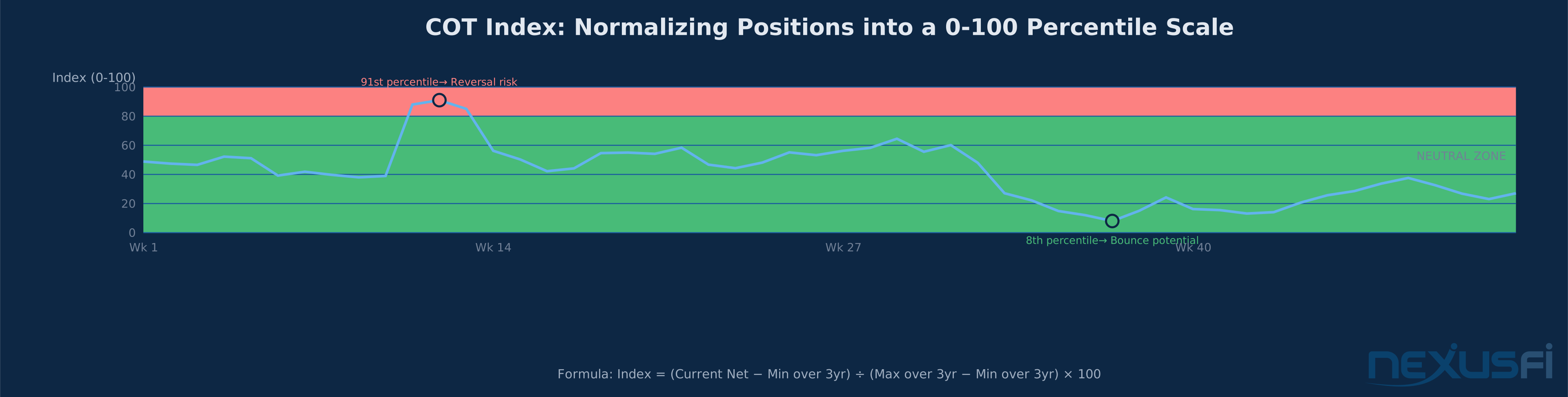
Before executing any COT-based trade, you need to know where current positioning sits relative to history. Raw net position numbers are meaningless without context — 200,000 net contracts long sounds extreme until you realize it's below the three-year average.
The COT Index solves this by converting the current net position into a percentile rank over a rolling lookback period. An index reading of 85 means current Managed Money positioning is more net long than 85% of all weekly readings in the lookback period.
For trading strategy purposes, use these thresholds:
- Index > 80: Watch list. Speculative crowding elevated. Begin monitoring for confirmation signals.
- Index > 90: Active watch. Serious crowding. Any momentum stall merits attention.
- Index > 95: High-alert zone. Historical data shows this level precedes the most violent reversals in commodity markets.
- Index < 20: Reverse of above — watch for short-squeeze potential.
- Index < 10: Short-side crowding extreme. Potential for violent short squeeze.
The critical distinction: these thresholds tell you the ENVIRONMENT, not the ENTRY. A market can sit at 90+ for months during a genuine fundamental trend. The COT Index by itself is a filter — never a trigger.
Use a 2-year rolling lookback (104 weeks) as your base. Some traders extend to 3 years for more context, but anything over 4 years risks including data from structurally different market regimes. Recalculate weekly and maintain a dashboard across your target markets.
As NexusFi member Fat Tails explained in an early analysis of the COT categories (The Elite Circle, 2010): "For trading you should not use the absolute figures of the different positions, but the relative position of a group compared to their usual max and min positions." That is the COT Index in one sentence — what matters is where current positioning sits within its historical range, not the raw number.
NexusFi member aventeren built an indicator around exactly this concept, implementing Larry Williams' 80/20 threshold logic: when Commercials hit 80% of their historical range, bullish bias; at 20% or below, bearish bias. The practical point is that the index concept has been validated by multiple independent practitioners using different implementation approaches.
The Shapiro Contrarian Method #
Jason Shapiro — profiled in Jack Schwager's Unknown Market Wizards as "The Contrarian" — runs one of the most systematized COT-based strategies in the industry. His methodology gives the clearest framework for how to operationalize COT data into actual trade decisions.
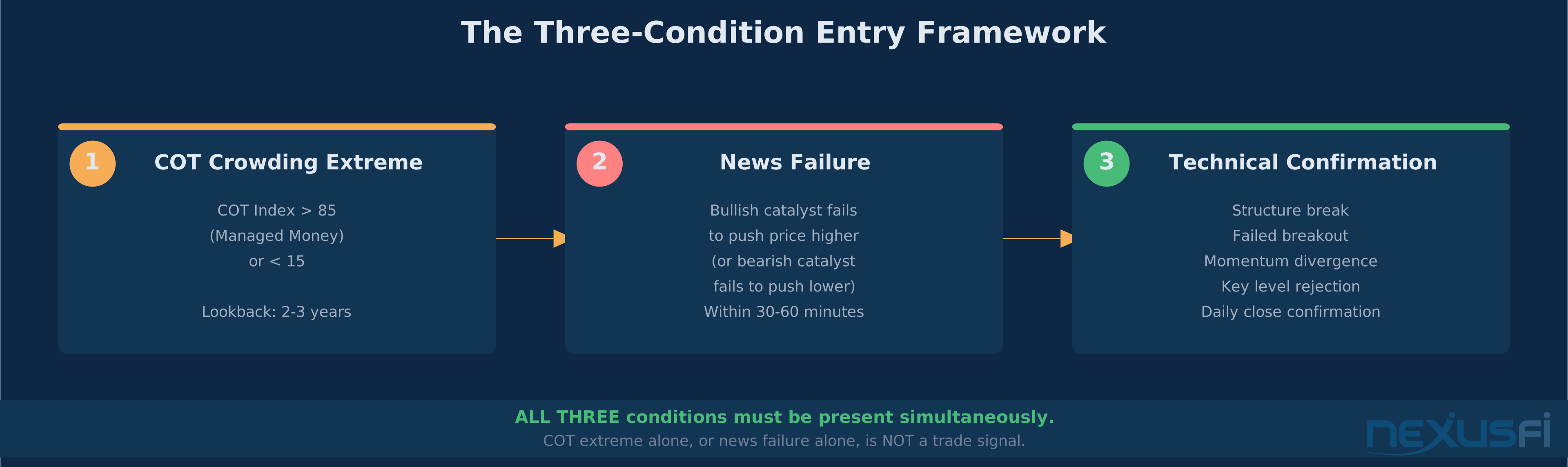
The foundation is three simultaneous conditions, all required before a trade is valid:
Condition 1: COT Crowding Extreme
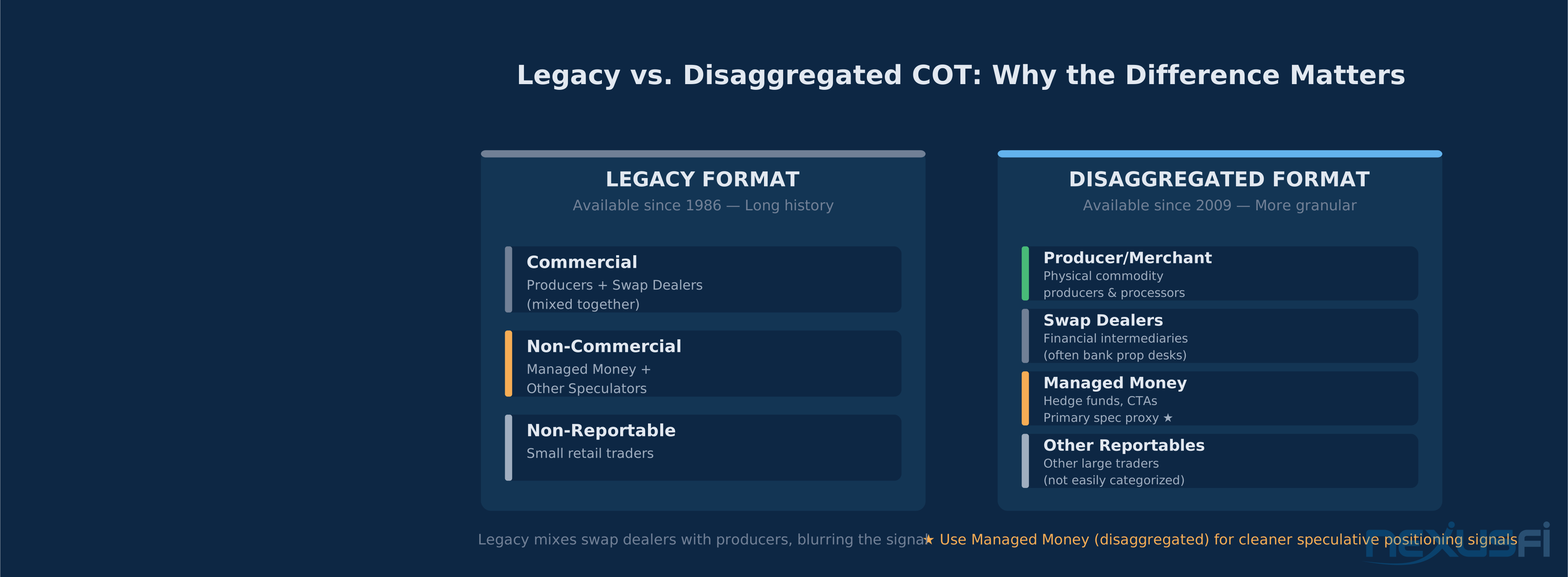
Managed Money (or Non-Commercial in Legacy format) must be at a historical extreme. Shapiro works with Legacy format, not Disaggregated — his experience shows that the broader Non-Commercial category sometimes provides clearer crowding signals than the more granular Managed Money breakout.
The threshold he uses: roughly the 90th percentile or higher for long extremes, 10th percentile or lower for short extremes. But he doesn't use a mechanical cutoff — he's looking for extremes that are visually obvious when you plot net positioning against price history.
Condition 2: News Failure
This is Shapiro's most distinctive filter and the one most traders underestimate. A news failure occurs when a market's price response to a significant event is the opposite of what the positioning predicts.
The logic: if Nasdaq futures have record speculative longs, a bullish Nvidia earnings report should rocket price higher. If instead price rises briefly and then collapses — the "good news" couldn't sustain a move in the direction of the crowded trade — it means buyers are exhausted. The bullish trigger revealed the lack of additional buying power.
Conversely, if specs are heavily short a commodity and a bearish supply report (which should have pushed prices lower) is absorbed without a meaningful decline, the sellers are exhausted. Shorts can't capitalize on their expected trigger. That's a news failure — and it signals potential violent short-covering.
News failures don't require major economic releases. Any event that should logically move price in the direction of the crowded position — and fails to — qualifies. Earnings releases, USDA crop reports, inventory data, central bank statements.
As Lemmy Caution described Shapiro's approach: "He'll often look to the major economic releases as news, to see how markets react. So like, News Event A should have been bad for Commodity B, but Commodity B rose instead — news failure — and it's crowded with shorts, so he'll look to go long, trying to ride a sharp move higher as speculators are forced to cover."
Condition 3: Technical Confirmation
After the news failure, Shapiro waits for price action to confirm the directional bias. A single day that closes below a key support level after a news failure in a crowded-long market is often sufficient. He's not waiting for elaborate technical setups — just confirmation that the trend has broken.
Legacy COT vs. Disaggregated: Shapiro uses Legacy format. His empirical experience is that the broader Non-Commercial category sometimes captures crowding more clearly than Managed Money alone. For your own testing, run both and compare historical signal quality in your specific markets.
All three conditions must align simultaneously. COT extreme alone, or news failure alone, is not a trade. The combination creates conviction.
The News Failure Signal in Detail #
The news failure is worth spending time on because it's counterintuitive to most technical traders. Your instinct is to buy a bullish report. The COT-informed contrarian is watching for what happens AFTER the report.
The setup:
- Identify a market with COT Index > 85 (heavily net long speculative positioning)
- A scheduled event occurs that should be bullish: strong economic data, better-than-expected earnings for an equity-linked commodity, a bullish USDA crop estimate
- Price initially rises on the release — or doesn't fall — but then reverses within 30 to 60 minutes (or by end of day)
- The close is below where price was before the event, or at best flat despite a genuinely bullish report
That's the signal. The bullish trigger hit a wall of selling pressure from longs who used the brief strength as an exit opportunity.
This is the inverse of what most traders watch. Most traders see a bullish report, see price briefly pop, and buy the momentum. The COT-informed trader sees the same pop and asks: "With all these longs already on board, why isn't this running? Who's selling into this strength?"
The answer: the longs are selling. They loaded up expecting the move, and when the trigger arrives, they take the exit — because there aren't enough new buyers to drive price further.
NexusFi member Salao captured the passive nature of this selling in Gold: "The COT information sort of advertised the fact that some huge positions were going to get un-wound one way or another. Rally's didn't really go very far because more liquidity was being provided only as the market went lower." That's what a news failure on a COT extreme looks like at the order flow level — passive selling into every uptick, no aggression needed.
Timing COT Entries: The Practical Workflow #
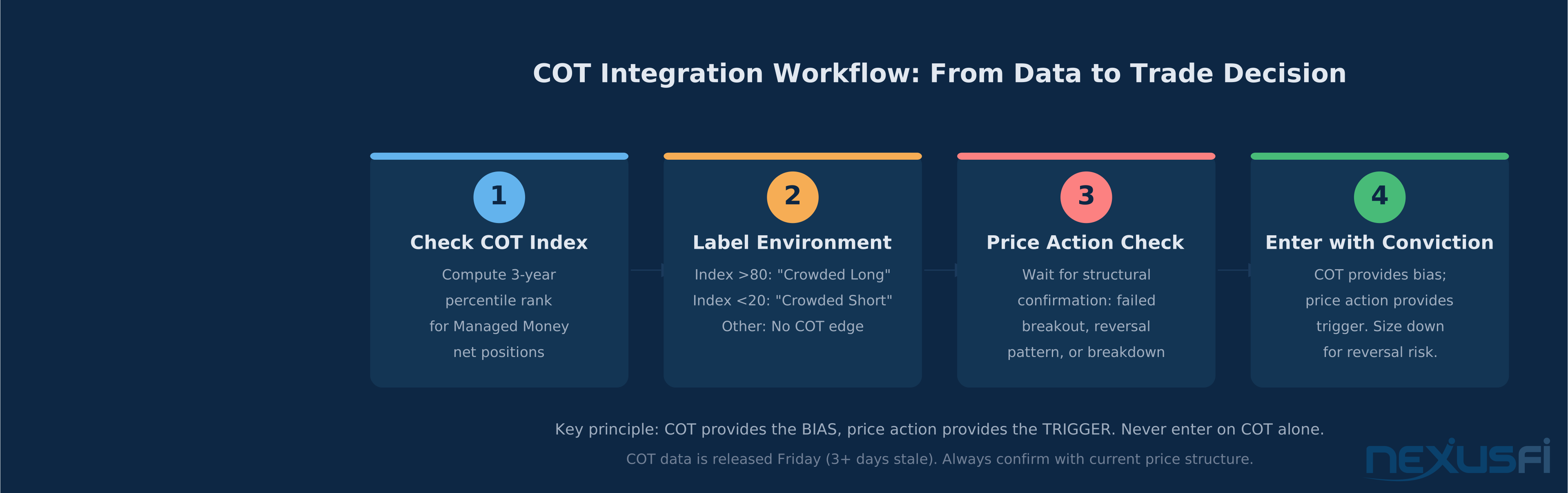
The four-step workflow for taking COT-based positions:
Step 1: Weekly COT Screening (Friday afternoon)
After the CFTC releases Friday's data (typically 3:30-4:00 PM ET), run through your market watchlist. For each market, note:
- Current COT Index reading
- Week-over-week change in net positioning
- Whether the market is at a new positioning extreme or retreating from one
Markets newly hitting the 80+ threshold: add to active monitoring. Markets already at 90+ for multiple weeks: assess whether positioning is building or flattening. A market that has been at 90+ for 8 consecutive weeks with no significant weekly decline is more dangerous to fade than one just reaching the threshold.
Step 2: Identify the Trigger Window (Daily, Monday-Thursday)
Once a market is on active monitoring (COT Index 80+), define the next week's trigger events. Check the economic calendar for scheduled releases relevant to your market. These are your news failure candidate windows.
If there are no relevant catalysts in the next two weeks, the trade may need to wait. Shapiro specifically targets events — he's not just fading random price action. The news failure mechanism requires a genuine fundamental trigger to create the "buying should have worked" setup.
Step 3: Trade the News Failure (Intraday or Daily)
When a trigger event occurs:
- Monitor price closely during the 30-60 minutes following the release
- If price initially moves in the direction consistent with the crowded position (bullish news + brief pop in a crowded-long market), watch the response
- If price can't sustain the initial move and reverses — close below the pre-release level, or sharply from intraday high — this is the news failure signal
- Enter on the close of the reversal bar, or at the break of intraday support if you're using daily timeframe
Step 4: Define Risk and Take Partial Profits
Position sizing at COT extremes requires adjustments:
- Reduce position size by 30-50% versus your normal allocation. Crowded unwinds create gap risk and fast moves that can exceed normal stop levels.
- Place stops above/below the key technical level that represents the entry context (the intraday news failure high, key resistance that failed to break)
- Target partial profit at a 2:1 reward-to-risk level, leave the remainder for the larger unwind
- If position is stopped out and the COT extreme remains intact (extreme hasn't moved to neutral), the setup remains valid for the next trigger
Combining COT with Volume Profile and Order Flow #
COT analysis tells you the strategic environment — who is crowded, to what degree, in what direction. Volume profile and order flow analysis tell you where price is likely to react and when the institutional order flow is confirming the COT thesis.
The combination creates a high-conviction three-layer framework:
Layer 1: COT (Weekly)
Sets the environmental bias. COT Index > 80 means the bias is toward fading the trend when triggered. This is the strategic context layer — it doesn't change intraday.
Layer 2: Volume Profile (Daily or Weekly)
After the COT bias is established, use volume profile to identify the structural levels where the trade is most likely to resolve. In a crowded-long scenario, look for:
- Price near the top of the weekly value area or at value area high
- POC (Point of Control) much below current price — price is trading far away from equilibrium
- Single prints or low-volume nodes immediately below current price that will be filled if the liquidation starts
The value area context tells you whether the current price is structurally justified or auction-extended. A COT extreme with price trading well above value is a compounded signal.
Layer 3: Order Flow (Intraday)
After COT and volume profile alignment, use footprint charts or DOM tape to time the entry. In a news failure scenario, look for:
- Delta divergence on the news event: price makes new highs but cumulative delta (aggressive buying vs. aggressive selling) fails to confirm
- Absorption patterns: large sell orders absorbing buying pressure at resistance
- Volume exhaustion: the initial spike on the trigger shows declining volume as the move attempts to extend
The three-layer approach filters aggressively. Not every COT extreme will have volume profile confirmation. Not every news failure will show order flow confirmation. But when all three align, the probability of a sustained move is meaningfully elevated.
Market Selection: Where COT Works #
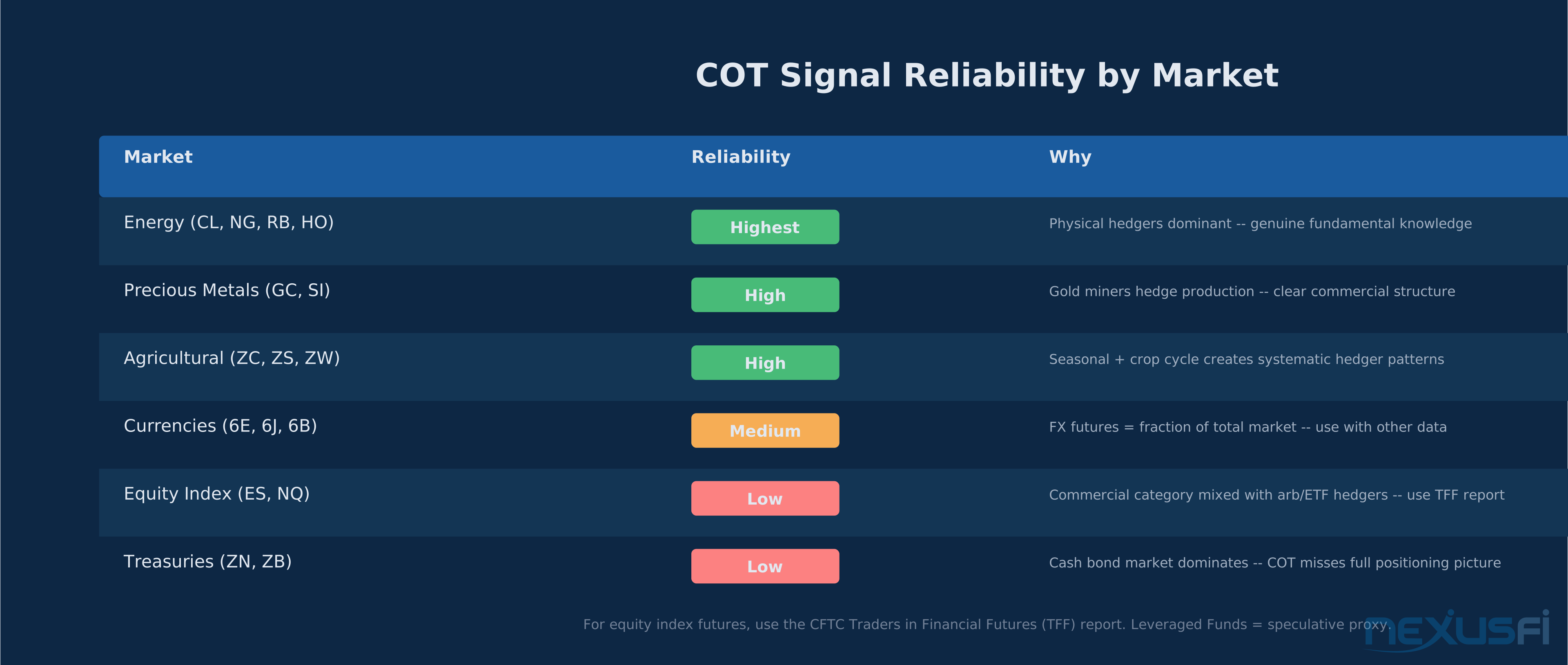
COT signals are not equal across markets. Understanding which markets provide reliable signals — and which require skepticism — is critical to avoiding poor applications.
High-Reliability Markets
Energy (CL, NG, RB, HO): Crude oil, natural gas, and the refined products show strong COT relationships because commercial hedgers (producers, refineries) have genuine fundamental knowledge of supply and demand. When commercials hedge aggressively (net short at extremes), it often signals they view current prices as favorable to lock in. Speculative crowding in energy consistently precedes major reversals.
Precious Metals (GC, SI): Gold and silver have well-defined COT patterns. Gold mining companies are persistent futures sellers, creating a steady hedging baseline. When Managed Money reaches extremes, especially when combined with gold's typical seasonal patterns, the signals are historically reliable.
Agricultural Markets (ZC, ZS, ZW, ZM, ZL): Grains and oilseeds are arguably the strongest COT market. The commercials — grain elevators, processors, exporters — have intimate knowledge of the crop cycle. Speculative crowding around USDA report dates creates some of the cleanest news failure setups available.
Currencies (6E, 6J, 6B, 6C): Currency futures show COT patterns but require additional context. The futures market is a fraction of the total FX market, so positioning in futures may not represent overall institutional exposure. Use COT as one signal among several in currencies, not as the primary filter.
Lower-Reliability Markets
Equity Index Futures (ES, NQ): As Fat Tails explained in the NexusFi Elite Circle: "The breakdown of traders into commercial and non-commercial positions is inaccurate, if not contradictory" for financial futures. In equity index futures, the Legacy "commercial" category includes index arbitrageurs, ETF rebalancers, and pension funds with complex structural hedges — not the fundamental supply/demand knowledge that makes commercials informative in commodity markets.
For equity futures, Fat Tails recommends the Traders in Financial Futures (TFF) report, which uses different categories (Dealer/Intermediary, Asset Manager/Institutional, Leveraged Funds). Leveraged Fund positioning is the clearest speculative proxy in this format.
Even with TFF data, equity index COT signals are weaker and more prone to false positives. The cash equity market dwarfs the futures market, and true institutional positioning is better captured through options flow, broker-dealer order flow, and margin data.
Treasury Futures (ZN, ZB): Similar concerns to equity index futures. The "commercial" category includes dealers and asset managers who are managing interest rate risk across enormous cash bond portfolios. A pension fund with a massive long bond portfolio may appear as a short in Treasury futures — which is just their hedge, not a bearish bet.
As Schnook observed after years of COT analysis: "In metals, ags, softs and energy the COT data tells a big part of the positioning story. In financials, however, the COT data has only limited value, as the underlying cash markets typically capture far more of the overall volume."
Position Sizing and Risk Management for COT Trades #
COT-based trades have specific risk characteristics that require adjustments to normal position sizing and stop-loss logic.
Reduce Size for Volatility Expansion
When a crowded position begins to unwind, the price moves are non-linear. Gaps and cascades are common. A typical trend-following trade might see 10-15 point moves over several days; a crowded trade liquidation can produce 50-100 points of movement within 24-48 hours. Your stop-loss strategy must account for this speed.
Standard approach: use 50-75% of your normal position size for COT-based trades. The larger-than-normal move potential allows you to capture meaningful P&L even at reduced size, while the smaller size protects against the gap risk that's inherent when crowded positions unwind.
Wider Stops Are Required
The entry point in a news failure setup often sits at a structural support/resistance level that represents the thesis boundary. If price breaks back above the pre-news high (in a short-side COT fade), the thesis is compromised. Stops should be placed above/below these structural levels, not based on fixed point amounts.
This means your dollar risk per trade may be higher in absolute terms even at reduced size. That's appropriate — the expected R-multiple is also larger when the setup fully triggers.
Partial Profit Strategy
The most practical approach:
- Take 40-50% off the position at 1.5-2:1 reward-to-risk
- Hold the remainder for the larger thesis (full unwind of the crowded position)
- Trail stops on the remainder below newly established structure
The reason for early partials: COT fades often have sharp initial moves that retrace before the full unwind occurs. Taking partials captures the first phase while keeping exposure for the larger move if it develops.
The Capitulation Signal and Re-Entry
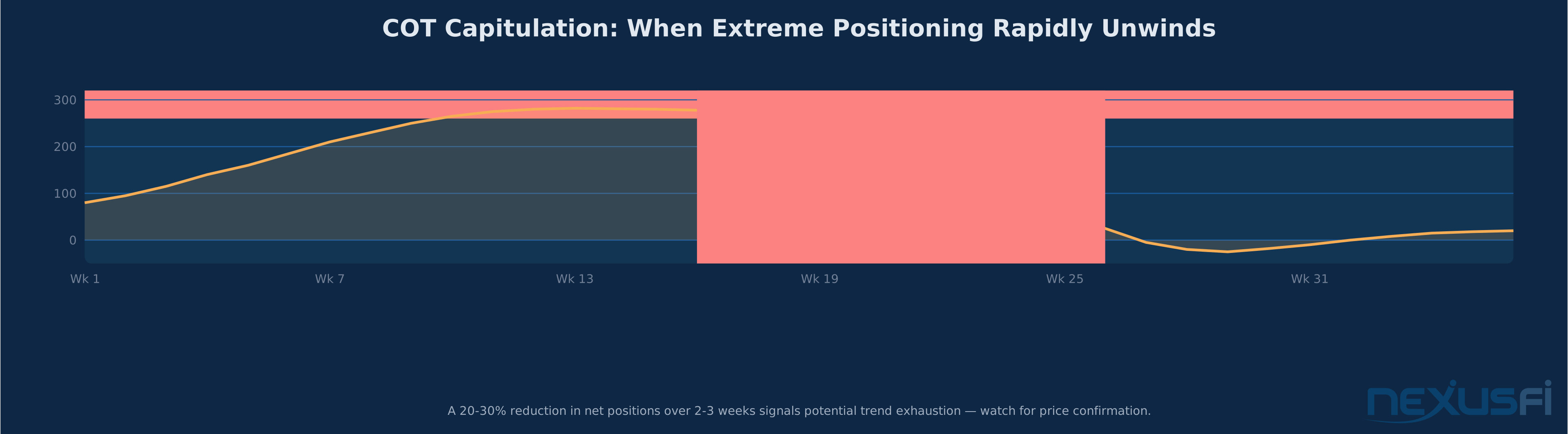
When a crowded position begins to unwind rapidly — Managed Money net position drops 20-30% in a single week, or 40-50% over two to three consecutive weeks — this is the capitulation signal. The crowd isn't just reducing exposure, it's fleeing.
Capitulation weeks often produce the most extreme intraday price moves. If you're already positioned from a news failure entry, this is the moment to hold aggressively and not take profits prematurely. If you missed the initial entry, the capitulation week often presents a secondary entry opportunity as the first sharp move stabilizes and consolidates.
Track the weekly change in net positioning alongside the absolute COT Index level. A declining extreme (index moving from 92 to 85 to 76 over consecutive weeks) is often more tradeable than a static extreme at 92. The declining phase means the unwind is in progress — not just a risk.
Building the Weekly COT Routine #
Consistency in COT analysis requires a structured weekly routine. Ad hoc review leads to missed signals and confirmation bias.
Friday: COT Data Release (15-20 minutes)
- Download or access the new weekly COT data for your market universe (typically 8-15 markets)
- Update your COT Index spreadsheet or tool with the new readings
- Flag any markets that crossed meaningful thresholds (80, 90, 20, 10) this week
- Note direction of weekly change for all markets — which extremes are building vs. declining?
- For markets already at extremes: assess whether the thesis remains valid or is beginning to resolve
Weekend: Context Building (20-30 minutes)
- Review weekly price charts for flagged markets
- Check the upcoming week's economic calendar for trigger candidates
- Identify key support/resistance levels relevant to the COT thesis in each flagged market
- Note any fundamental developments (crop reports, energy inventory data, central bank events)
Monday-Thursday: Active Monitoring
For markets on the active watch list:
- Monitor price behavior around trigger events
- Watch for news failure setups
- Check order flow during significant price moves (are large specs visibly reducing?)
- Avoid forcing trades during quiet periods — COT setups require catalysts
Discipline Check
The biggest discipline failure in COT trading is acting on the COT signal alone. Markets can remain at extreme positioning for 10-16 weeks before an unwind. Most of those weeks will be frustrating — price continues in the direction of the crowd, your fade is wrong, you take losses.
The patience required for COT-based trading is unusual compared to technical trading. Set a maximum holding period for positions at extremes without the news failure trigger (typically 4-6 weeks). If the thesis doesn't trigger, take a small loss and wait for the next setup — don't double down on a static extreme.
What Doesn't Work: Common Failures #
Fading Every High COT Reading
The most common and expensive mistake. COT Index at 85 is context, not a trade signal. Markets can sustain extreme positioning for months during genuine fundamental trends. Commodity supercycles, central bank policy pivots, geopolitical supply disruptions — all can keep speculative positioning elevated for extended periods.
Without the news failure or price action confirmation, the COT extreme is background information only. Acting on it directly is trend-fighting at random — which is unprofitable over any meaningful sample.
Using COT for Intraday Trading
COT data is weekly. Its signals play out over days to weeks, occasionally months. Day traders can use COT as a broad context filter — knowing whether they're trading with or against the speculative crowd — but not as an entry signal. "I'm fading this 5-minute candle because the COT index is 87" is a category error.
Applying Commodity COT Logic to Equity Futures
COT interpretation for equity index futures requires the Traders in Financial Futures report and entirely different category logic. Applying commodity-style contrarian analysis to ES or NQ using the Legacy report produces unreliable signals because the "commercial" category is structurally contaminated with hedgers who are net long equities.
Expecting Mirror-Image Reversals
COT long-side extremes and short-side extremes don't always resolve symmetrically. Long liquidations can be more violent than short-covering rallies, and vice versa, depending on the specific market and leverage structure. Don't assume that because a 90th percentile long extreme preceded a 20% decline, a 10th percentile short extreme will produce a 20% rally.
Single-Market Focus Without Context
COT in isolation misses correlated positioning. When analyzing EUR/USD, also check USD/JPY positioning — if specs are net long EUR and net short JPY simultaneously, a risk-off event forces simultaneous unwinds across both, which amplifies each move.
Key Takeaways #
The COT report is a positioning intelligence tool, not a trading system. Use it as a filter to identify markets where the speculative community has become dangerously concentrated — and then wait for the market to tell you the unwind has started.
The Shapiro method works: COT extreme + news failure + technical confirmation is a disciplined, proven framework for fading crowded positions. All three conditions must be present. None substitutes for the others.
Market selection is half the battle: High-reliability markets (energy, metals, agricultural futures) provide consistently interpretable COT signals. Lower-reliability markets (equity index, Treasury futures) require different report formats and additional skepticism.
Size down, be patient: COT-based trades need wider stops and smaller initial sizing to accommodate the volatility they generate when they work. The patience requirement is extreme — sometimes weeks pass between setups in a single market.
Track the change, not just the level: The rate of decline in an extreme (capitulation) is often more tradeable than the static high reading. A declining COT Index from 90 to 70 in two weeks signals an unwind is in progress — sometimes the best entry is on confirmation of this decline, not at the initial extreme.
The COT edge is real but narrow: The trades are infrequent (perhaps 3-8 quality setups per market per year), the required holding period is long, and false signals are common. Position it as one specialized component of your trading — not the primary strategy. The traders who use it best combine it with other edge sources, especially volume profile and order flow analysis.
COT data has been public since 1986. The traders who have built lasting edges from it — Shapiro being the most documented example — didn't just read the report. They built specific frameworks, tested those frameworks against history, and traded with discipline when the conditions aligned. That is the only path to extracting the edge the data contains.
Knowledge Map
Prerequisites
Understand these firstGo Deeper
Build on this knowledgeReferences This Article
Articles that build on this topicCitations
- — how do make use of COT to its best ability? (2025) 👍 4“He's looking for crowded trades where there are many speculative bets in the same direction so that a forced unwind in the opposite direction could be pronounced.”
- — Why are S&P and EMini S&P COT reports so different? (2011) 👍 4“The breakdown of traders into commercial and non-commercial positions is inaccurate, if not contradictory. I suggest to use the Traders in Financial Futures Report.”
- — COT Report? (2022) 👍 2“In metals, ags, softs and energy the COT data tells a big part of the positioning story. In financials, however, the COT data has only limited value, as the underlying cash markets typically capture far more of the overall volume.”
- — COT Report? (2022) 👍 3“The COT information sort of advertised the fact that some huge positions were going to get un-wound one way or another. Rally's didn't really go very far because more liquidity was being provided only as the market went lower.”
- — Commitment of traders (2010) 👍 5“Extreme readings of the COT figure can be used as a sentiment indicator for countertrades. For trading you should not use the absolute figures of the different positions, but the relative position of a group compared to their usual max and min positions.”
- — Commitment of Traders ("COT") Report: NinjaTrader Tools and Discussion (2014) 👍 4“Williams's theory is that the Commercials create trends, the Non Commercials pick them up and the Non Reportables come to the party late. When the Commercials hit 80% on a 3-year lookback scale -- buy bias. 20% or lower -- sell bias.”
- — Salao's Trading System Design Journal (2022) 👍 5“These reports tend to show that markets move when one side becomes more motivated to get into or out of a position. 'Motivation' is a little more ephemeral than simple supply and demand, which is probably why a reliable edge is difficult to come by.”
- Jack Schwager — Unknown Market Wizards: The Best Traders You've Never Heard Of (2020)
- CFTC — Commitments of Traders - About the Reports (2024)