



Trailing Drawdown Mechanics in Prop Firm Trading: How Dynamic Risk Limits Reshape Your Strategy
The floor beneath your account is moving. Most traders don't notice until it's too late.
Overview #
Most funded traders understand the daily loss limit. It's a simple hard stop — you lose too much today, the account shuts down for the session. What trips traders up is the other constraint: the trailing drawdown.
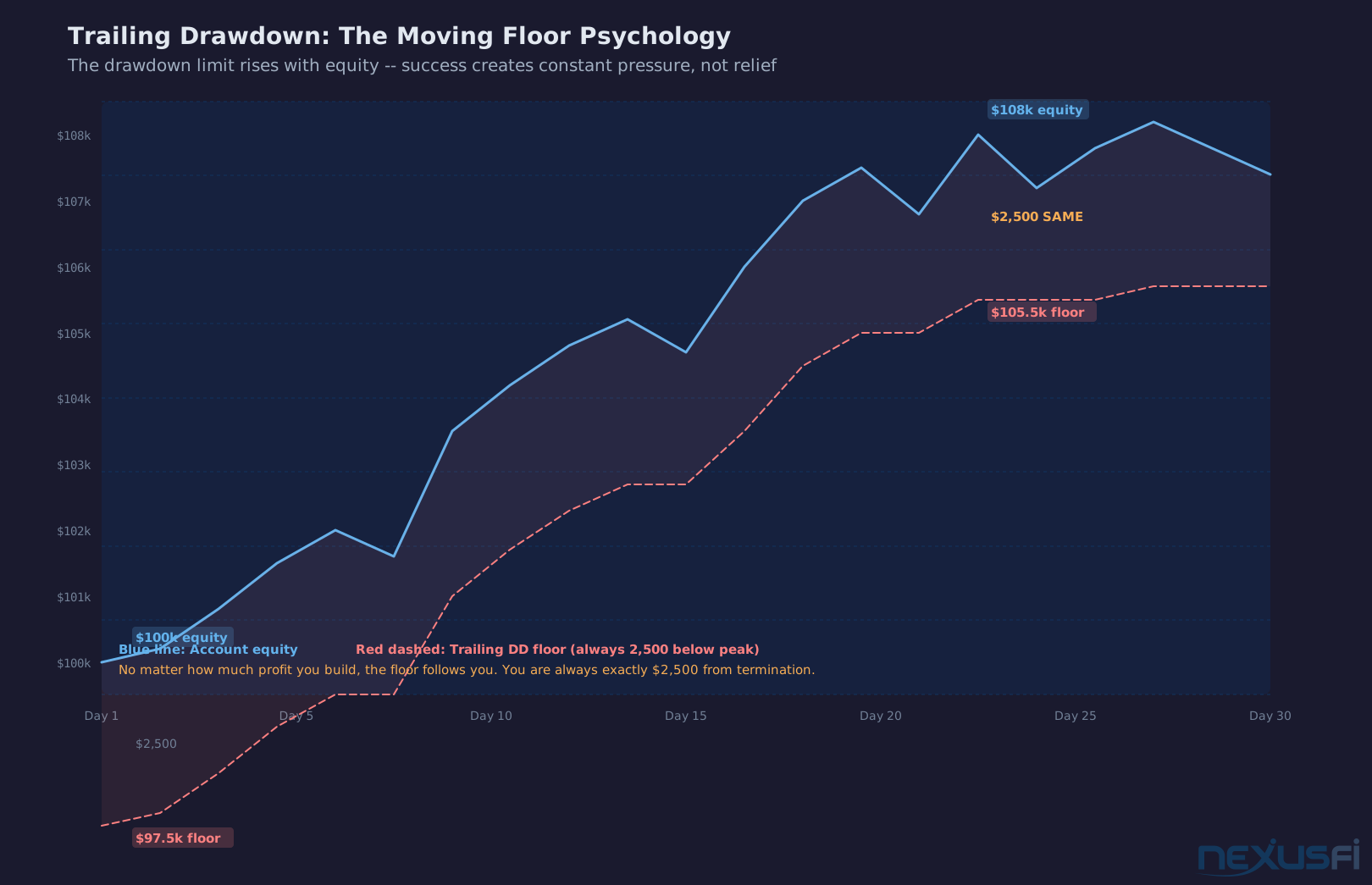
Unlike a static floor anchored to your starting balance, trailing drawdown ratchets upward with every new equity peak your account hits. The moment you have a profitable trade, that profit raises the floor you need to stay above — permanently. Give back what you gained and you're not back to where you started, you're closer to termination.
That distinction breaks strategies that look perfectly fine on paper. Positive expectancy, disciplined stops, reasonable position sizing — none of that protects you if the mechanics of trailing drawdown are working against your trading patterns.
This article breaks down how trailing drawdown actually calculates, why the open P&L question matters more than most traders realize, how EOD variants change everything for intraday traders, and what position sizing and strategy design look like when trailing drawdown is the primary constraint.
For the comparison between trailing and static drawdown rules, see Trailing Drawdown vs Static Drawdown. For the broader overview of how prop firm risk rules reshape strategy, see Prop Firm Risk Rules and Drawdown Mechanics. This article goes deeper on the mechanics themselves.
The Open P&L Question: What Your Drawdown Actually Tracks #
This is the thing that surprises traders most, and understanding it changes how you think about every trade.
Most prop firm trailing drawdown calculations don't use your closed equity to move the floor. They use your open equity — your account balance including unrealized gains on any open positions.
@josh explained this precisely in a NexusFi discussion on evaluation mechanics:
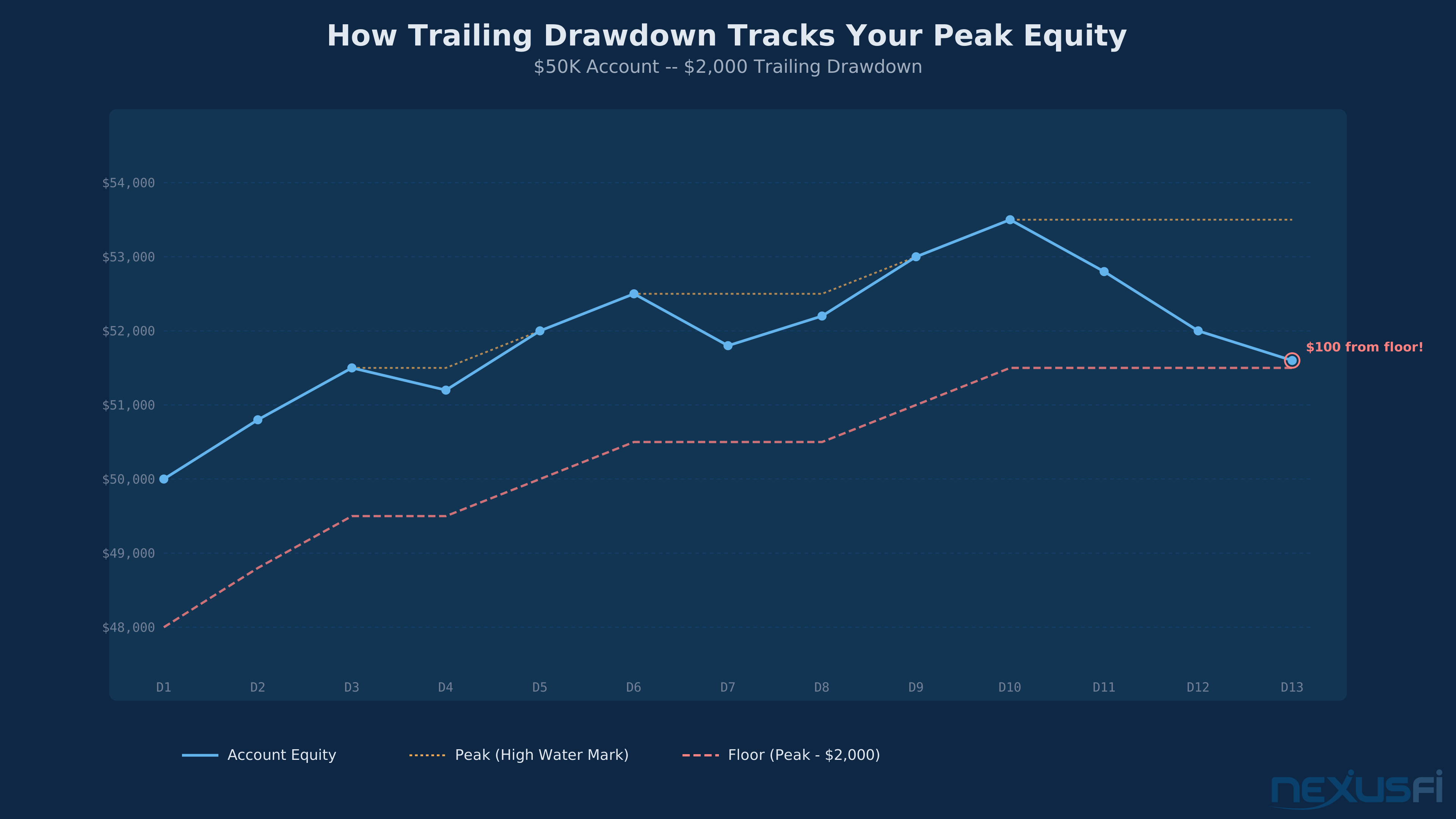
What that means in practice: the moment your open position shows a profit, your drawdown floor moves up — even if you haven't closed the trade. If you're up $1,000 on an ES position that's still open and the market reverses through your stop, your floor is now $1,000 higher than it was before that trade.
The trade that gave back everything — the one you thought was just a wash — actually consumed $1,000 of your drawdown buffer. You started the day with $2,500 of buffer. You now have $1,500.
This isn't a quirk. It's the fundamental design. As @canoekoh noted in a broader discussion of the prop firm business model:
The business argument is straightforward from the firm's perspective: if drawdown only tracked closed trades, a trader could be net profitable overall while having massive unrealized swings. The open P&L floor prevents that.
But for the trader, the implication is clear: unrealized profits raise your kill line. Letting a winning trade breathe isn't free. Every additional tick the market moves in your favor tightens the rope around your account.
How Real-Time Trailing Drawdown Calculates #
The mechanics are straightforward once you see them clearly. Walk through a single account lifecycle:
Starting state: $50,000 account, $2,500 trailing drawdown. Floor is $47,500.
Trade 1: Enter long on ES with 2 contracts. ES moves up 10 points — open P&L is $1,000. Your account's running value is now $51,000. The trailing drawdown floor ratchets to $48,500 ($51,000 - $2,500). The market reverses and you close at breakeven. Account is back to $50,000. Floor is still $48,500.
That's the key move. You didn't make or lose anything on a closed-trade basis. But your trailing drawdown floor moved up $1,000.
Trade 2: Same setup. Up $1,000 in open P&L again, floor moves to $48,500 (it was already there from Trade 1, so no change this time since peak didn't move). Close at breakeven. No change.
Trade 3: Up $2,500 in open P&L. Floor moves to $50,000 ($52,500 - $2,500). You've only got $2,500 of buffer from your current $50,000 balance to the floor.
Trade 4: You enter, take a $500 loss. Balance is now $49,500. Floor is $50,000. Account terminated.
You never had a losing day on a net basis (all breakeven) until that last trade, yet the account blew. The trailing high water mark from Trade 3 created the trap.
@bobwest's detailed walkthrough captures this from the EOD perspective, but the math applies equally to real-time tracking:
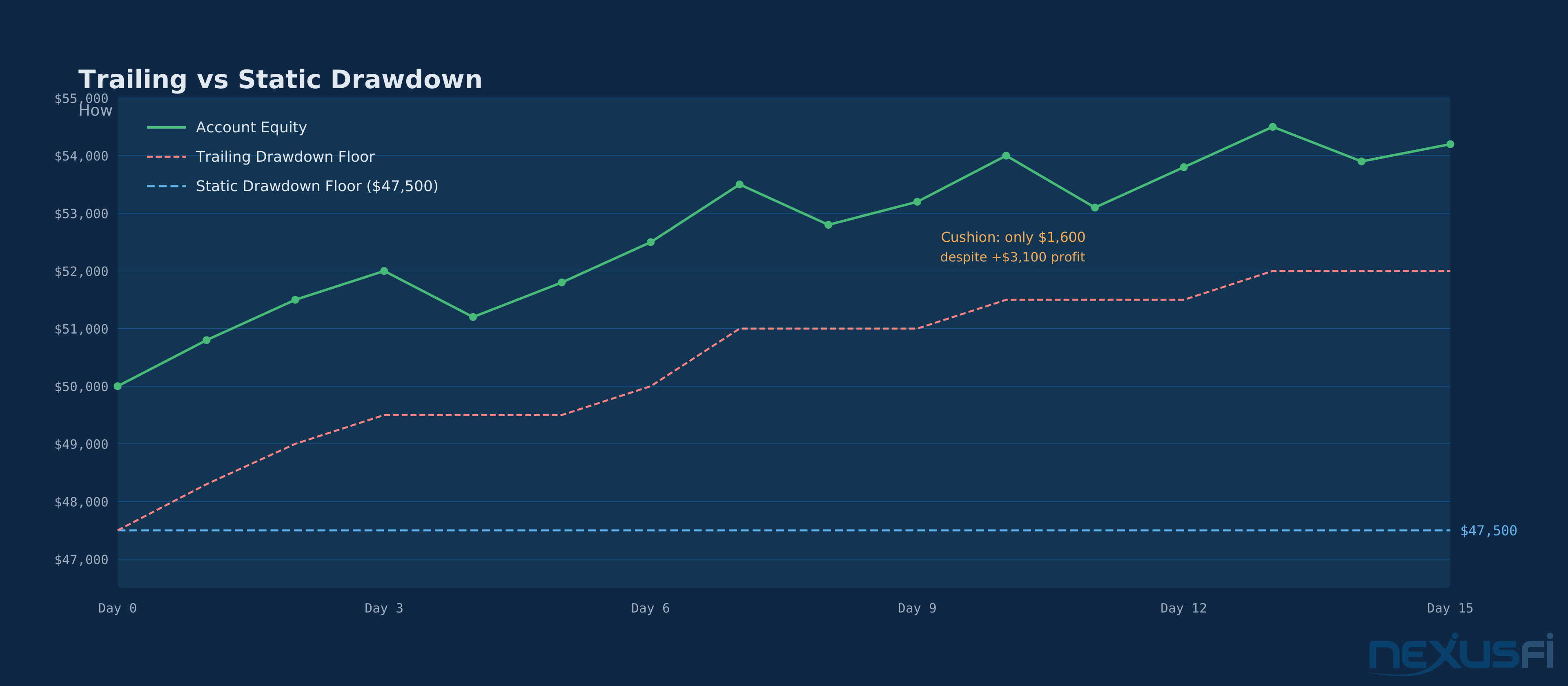
That last sentence is the silver lining: once your account grows high enough that the trailing floor equals your starting balance, the drawdown locks at a fixed number. The trailing mechanic effectively stops working in your favor once you've "locked in" your full drawdown buffer. Before that point, every new peak moves the goalposts.
The Three Drawdown Variants: Live, EOT, and EOD #
The prop firm space has converged on three distinct calculation timing mechanisms. Understanding which one your firm uses changes your entire risk model.
@idude catalogued the three types in a comparison thread:
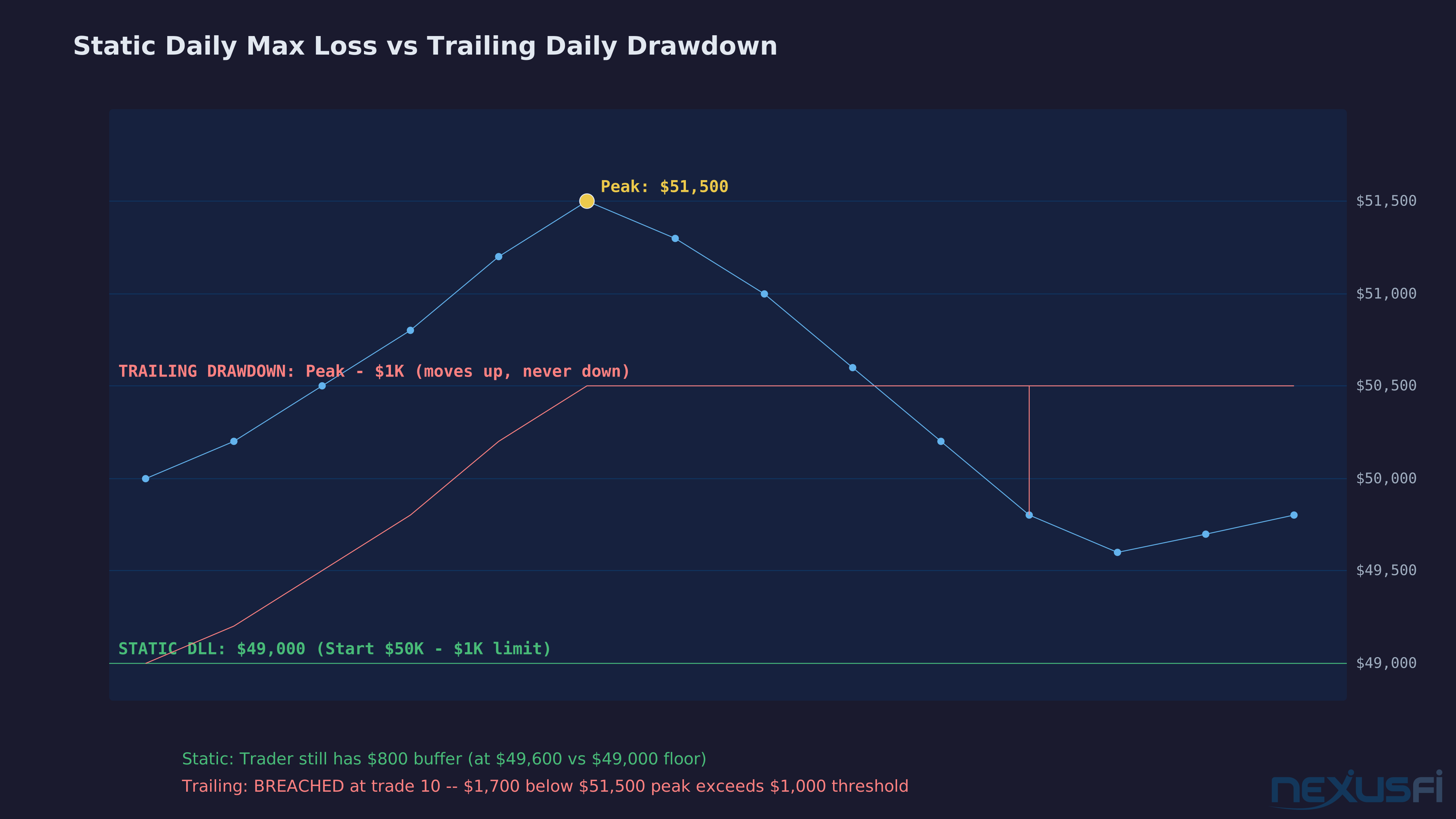
Live (Real-Time) Trailing Drawdown: The floor updates continuously as your open equity changes. The example in the previous section uses live trailing drawdown. Every tick that moves against you after a new high represents real risk — even mid-trade, even intraday.
End of Trade (EOT) Trailing Drawdown: The floor only updates when you close a position. Unrealized P&L doesn't move the floor. This is less punishing for traders who actively manage positions and may let winners run. The floor adjusts when you exit, based on your closed P&L at that moment.
End of Day (EOD) Trailing Drawdown: The floor updates once per day at session close. Intraday, you have full flexibility — your floor won't move until the day ends and your closing equity becomes the new reference point. This is what TopStep uses in their funded accounts. Some evaluation programs use EOD during the eval phase but switch to live TDD once you're funded.
The practical difference between live and EOD TDD is enormous for intraday traders:
Under live TDD: You enter at 9:30, it goes $1,500 in your favor by 11:00, you're managing the trade, and it reverses to your stop at breakeven by 1:00 PM. Result: $1,500 consumed from your drawdown buffer.
Under EOD TDD: Same scenario, same trade, same outcome. Result: zero drawdown consumed. Your floor doesn't move because you didn't close the day above your previous high.
The Trailing Paradox #
This is the scenario that breaks traders who haven't thought through the mechanics:
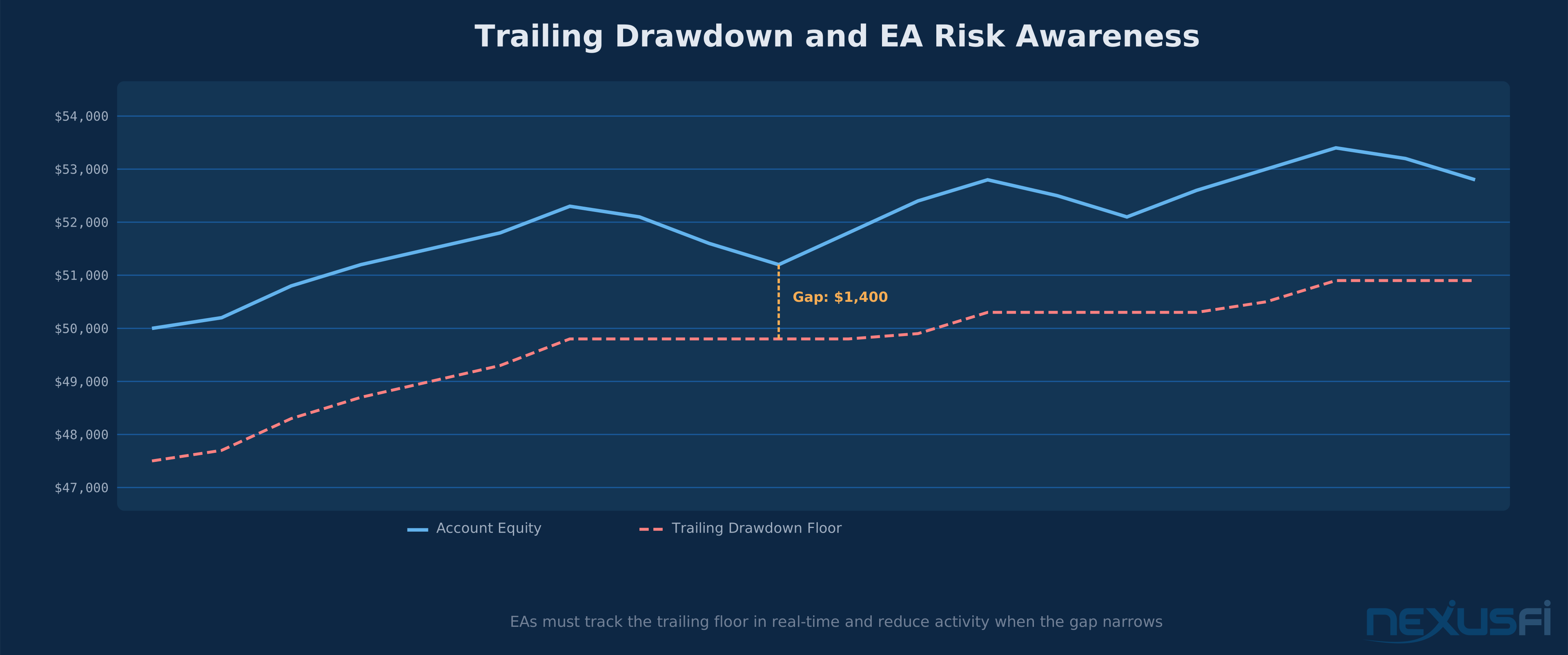
You pass the evaluation. You're funded. You run up a $6,000 cushion over three weeks of profitable trading. The trailing floor has ratcheted up so. Then you have a difficult week — three losing days. You end the week down $800 net for the period, but still net positive for the entire funded period. Your account shows $5,200 in profits since funded.
Account terminated.
How? The three losing days took you below the floor that was set during your best streak. The floor didn't retreat when you gave back profits — it locked in at the high water mark of that earlier streak. Profitable on a net basis, failed on a drawdown basis.
This isn't a hypothetical. It's the primary failure mode for funded traders who have learned to trade but haven't learned to manage trailing drawdown.
@RobWa documented this frustration directly:
The paradox resolves when you shift your mental model. Trailing drawdown doesn't measure "how bad can I get from here?" It measures "how far below my best performance can I get?" These are very different questions, and only the second one is what the firm actually cares about.
A trader running live TDD who reaches their peak equity has effectively converted their drawdown buffer into a momentum constraint. They must keep performing at or near their peak, or the floor catches them.
The trailing paradox kills accounts that are performing reasonably, not just accounts that are losing badly. A trader with a winning strategy can fail a funded evaluation because they had a $3,500 up week followed by a $1,200 down week — net positive for the month, but the down week breached the floor set during the up week.
Your Remaining Buffer: The Only Number That Matters #
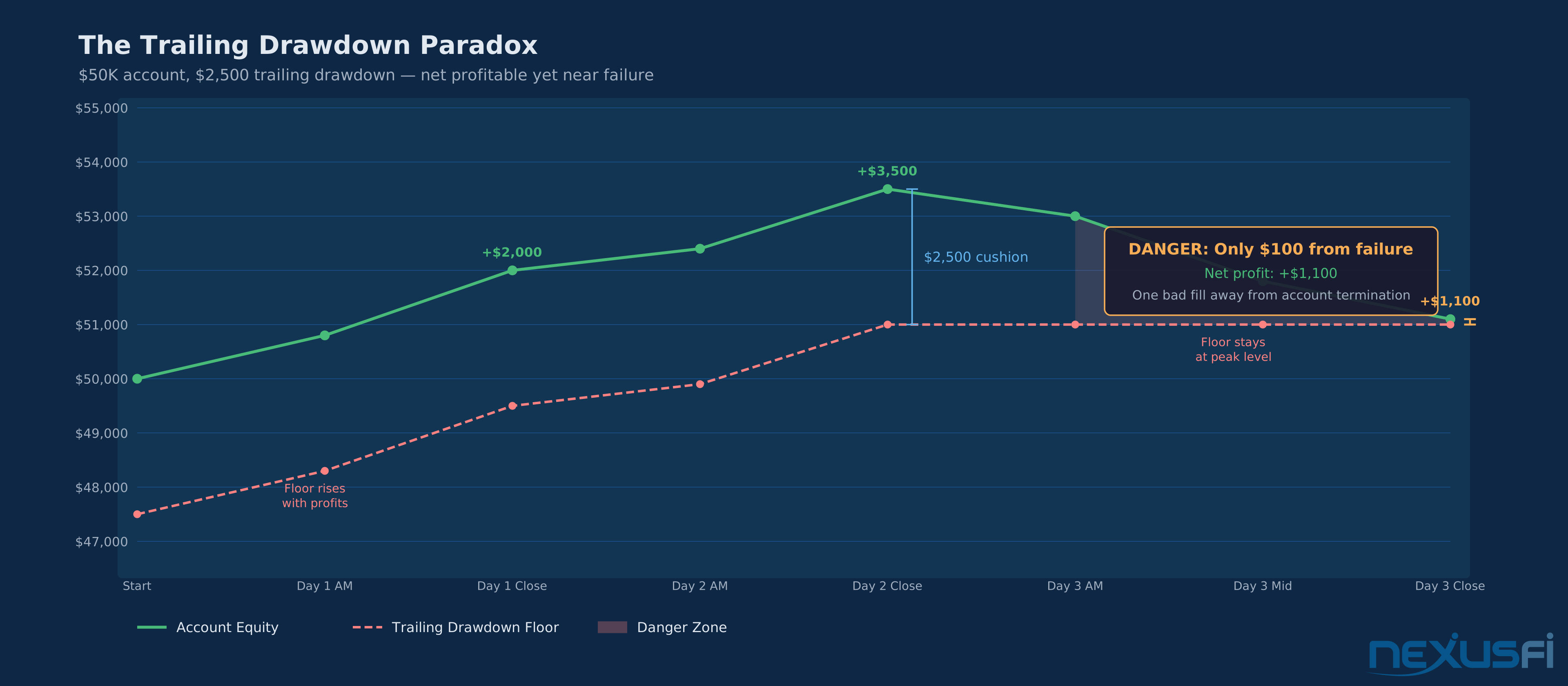
Most prop firm dashboards display your current balance and your profit target progress. The number you actually need to watch is neither of those. It's your remaining drawdown buffer.
Remaining buffer = current balance - current trailing floor
This number changes every time:
- Your balance increases (buffer may stay same or shrink, depending on whether a new peak is set)
- Your balance decreases (buffer shrinks)
- A new equity peak is set (floor rises, buffer shrinks if your balance is at the new peak)
When your buffer is at its maximum (starting value), you have maximum risk capacity. When your buffer has been eroded — either by losses or by the floor chasing your peaks — every trade is operating with less room.
Tracking this number daily changes how you size and how you risk. A day where your buffer dropped from $2,500 to $1,800 isn't just "a loss day" — it's a day where your available risk capital dropped 28%.
The critical threshold most traders identify is 50% of maximum buffer. Below that, defensiveness is appropriate: reduce position size, avoid high-volatility periods, don't fight marginal setups. At or above 75% of maximum buffer, normal sizing is sustainable.
@trekke described a systematic approach to buffer-based sizing:
The logic: when buffer is large, the math supports larger sizing. When buffer erodes toward the floor, sizing must contract to keep each trade's potential loss within a safe fraction of remaining buffer.
Position Sizing Under Trailing Drawdown #
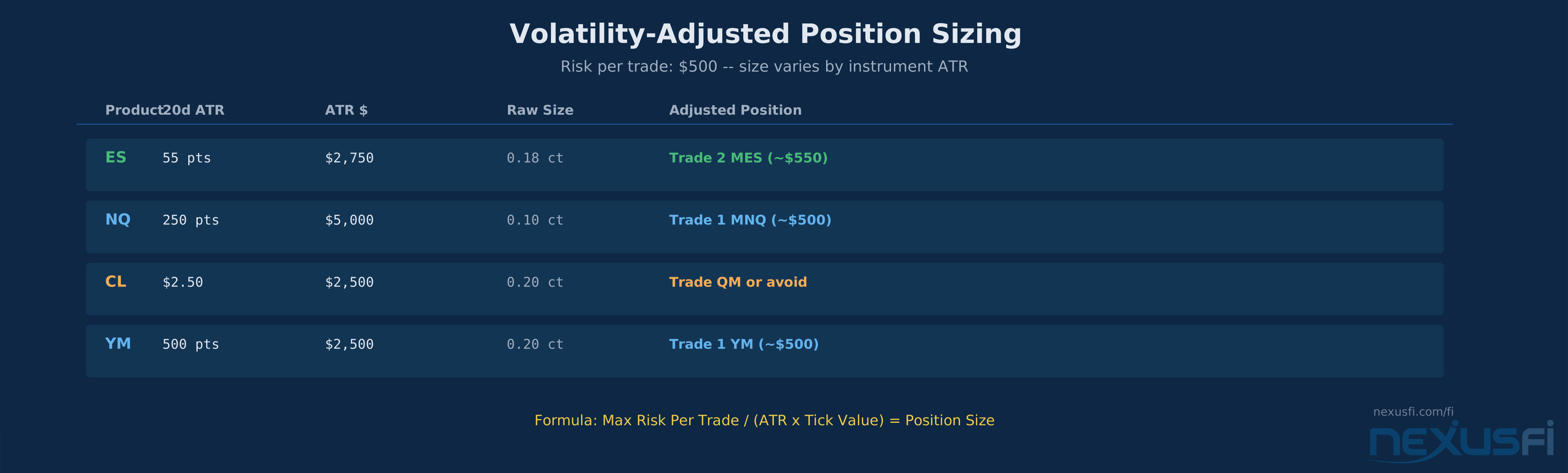
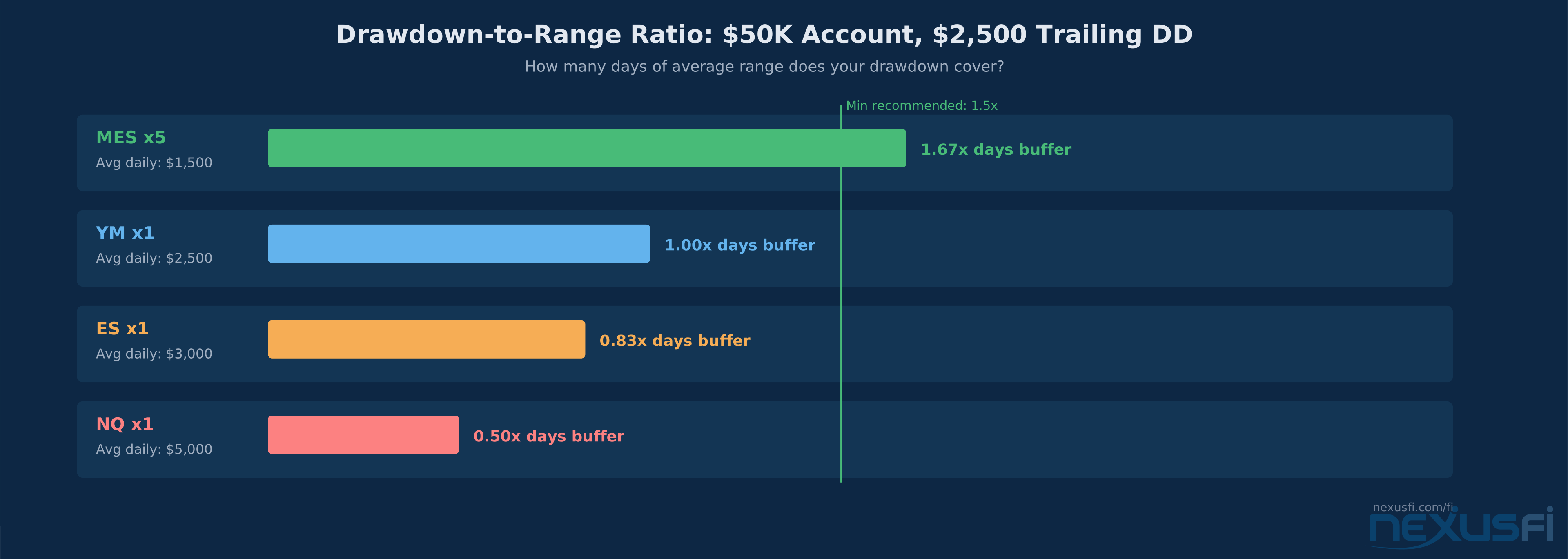
The standard position sizing framework — size based on account equity — breaks down under trailing drawdown. Your "effective account equity" for risk purposes isn't your total balance. It's your remaining buffer.
Here's the framework that actually applies:
Safe risk per trade = f × remaining buffer
Where f is your risk fraction. Most funded traders use 10-25% of remaining buffer per trade as a maximum single-trade risk.
Example: $50K account, $2,500 trailing drawdown, buffer currently at $1,800.
At 15% of remaining buffer: max risk per trade = $270.
On ES (1 point = $50), with a 4-point stop, that's 1 contract maximum ($200 risk). On NQ (1 point = $20), with a 10-point stop, that's 1 contract maximum ($200 risk).
Compare this to the typical recommendation of "risk 1% of account" — 1% of $50K is $500. That sizing ignores the trailing drawdown constraint entirely and will produce a sequence of losses that terminates the account faster than the expected value math would suggest.
As @josh pointed out, the leverage problem is often where this breaks down:
The key insight: oversizing doesn't just risk a loss. Under real-time TDD, oversizing risks a phantom loss — a trade that produces no net P&L but permanently consumes drawdown buffer through the open P&L ratchet.
Stage-based sizing under TDD:
Fresh account (buffer at 100%): Normal sizing, up to 15-20% of buffer per trade. Buffer at 75-100%: Standard sizing, no changes needed. Buffer at 50-75%: Reduce sizing by 25-30%. Avoid news and volatile periods. Buffer at 25-50%: Reduce sizing by 50%. Only take highest-confidence setups. Buffer below 25%: Minimum viable size only. Preserve the account, don't try to recover.
Which Strategies Survive Trailing Drawdown #
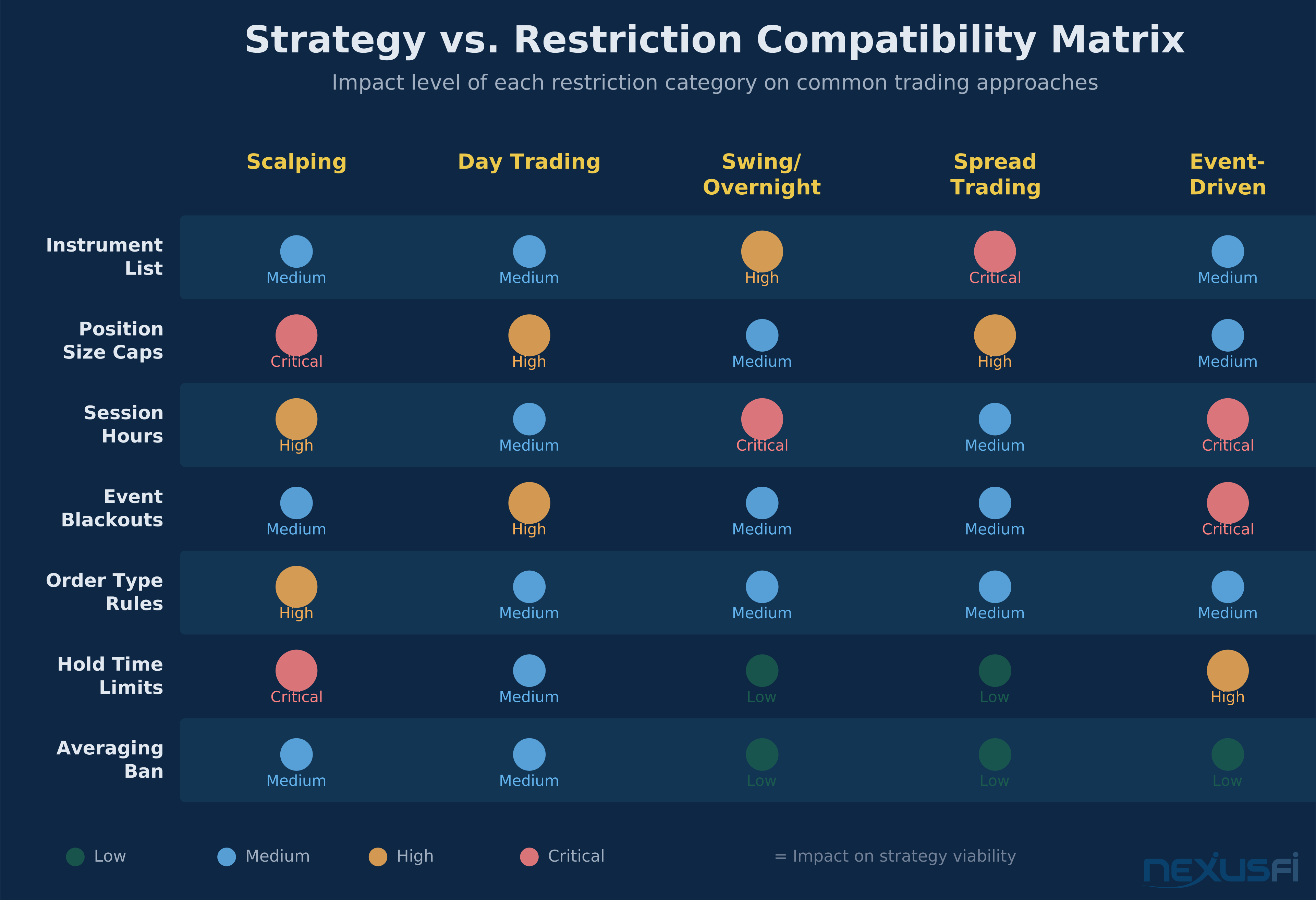
Not all strategy types are equally compatible with trailing drawdown. The mechanics create natural selection — some approaches that generate positive expectancy in your own account will fail consistently in a TDD environment.
High-compatibility strategies:
- Tight-stop scalping: Small wins, small losses, stops placed within the daily loss limit budget. No large open profits to ratchet the floor up unintentionally.
- Defined-risk spreads (where applicable): Controlled max loss upfront.
- Mean-reversion intraday: Entries at extremes with clear targets before the next volatility burst.
Low-compatibility strategies under real-time TDD:
- Trend following with wide stops: A trade that goes $1,500 in your favor before hitting a $500 stop produces a net $500 gain on your P&L — and $1,500 of consumed drawdown buffer. The expected value math looks good; the drawdown mechanics don't agree.
- Letting winners run: Unrealized profits are the enemy under real-time TDD. Letting a trade run beyond its first target while keeping a breakeven stop is a common pattern that looks smart in your own account and is dangerous under live TDD.
- High-volatility news trading: Gap risk on open or close, plus the potential for large intraday swings that never materialize as closed profits.
@Merkd1904 described this discovery firsthand:
The honest assessment: if your strategy requires letting trades breathe and accepting heat, real-time TDD will be a persistent friction. EOD TDD or static drawdown is a better mechanical fit. If your strategy runs tight stops and books profits quickly, real-time TDD is manageable.
@shokunin documented the strategy adaptation approach explicitly:
The adaptation is real: funded traders should audit their strategy against the trailing drawdown mechanics before going live. Not whether it makes money — whether the pattern of open P&L peaks is compatible with the available buffer.
The EOD Transition Problem #
Some programs use EOD drawdown for the evaluation phase and switch to real-time TDD for the funded account. This is a significant trap.
The mechanics you master during evaluation — the ability to hold positions through intraday heat, let runners develop, manage with wide stops — stop working the moment you get funded. Your funded account now uses the stricter real-time calculation.
Traders who pass evaluations with EOD drawdown and then blow funded accounts within two weeks aren't failing because they suddenly can't trade. They're failing because the rules changed and they didn't adapt their strategy, sizing, or stop management.
Before accepting a funded account, verify:
- Does the drawdown calculation change between evaluation and funded phases?
- If yes, what changes exactly (EOD to live, EOT to live, etc.)?
- Does your strategy still work under the funded account's specific rules?
This isn't a theoretical concern. Multiple programs have different drawdown rules for evaluation vs. funded status. The evaluation is a controlled test. The funded account is where you actually need to manage to the tighter constraint.
When evaluating any funded program, the question "what type of drawdown do they use?" isn't enough. You need to ask that question separately for the evaluation phase and the funded phase. Many traders are surprised to discover these differ.
The Overnight Hold Problem #
Under real-time TDD, holding positions overnight introduces a risk that doesn't exist in standard trading: your open P&L at the prior day's close sets your current drawdown floor, and any gap against you at the next day's open can terminate the account before you can act.
Scenario: You close the day up $1,200 on an open position (you decided to hold overnight). Your trailing floor ratcheted up $1,200 during the session. Overnight, news hits. The instrument gaps down at the open by 4 points on ES. Before you can hit a button, you've lost $800 on the gap. Total floor movement from the prior close: $1,200. Your balance is now down $800 from close. Your remaining buffer: $1,200 (floor increase) - $800 (gap loss) = net buffer consumed = $2,000. If your buffer was $2,200, you now have $200 left.
EOD drawdown handles this better — the overnight hold that gaps against you is just a regular loss from your EOD balance, not an amplified loss from a ratcheted floor. But real-time TDD treats the overnight P&L change as a floor ratchet from the prior close position, creating leverage on the downside.
Most prop firms restrict overnight holds entirely, partly for this reason. Where overnight holds are permitted under real-time TDD, the risk management protocol should be explicit: any open position held overnight should be sized at 50% or less of normal size to account for gap risk against a ratcheted floor.
Platform Calculation Discrepancies #
This is the one that gets traders in trouble with real-time TDD specifically. The firm's server and your trading platform are calculating your P&L and your drawdown floor in real-time — but they're doing so with different data feeds.
Platform P&L rounding, data feed latency, and timestamp differences can cause your platform to show you at $X while the firm's server has you at $X minus $50-100. On small drawdown accounts, this difference can matter.
The practical reality: if your platform shows your remaining buffer as $150, you've already lost. Any movement can trigger the firm's floor, even if your platform doesn't agree in the moment.
The rules are straightforward here: when in doubt, go by the firm's calculation, not your platform's. This means:
- Give yourself a buffer beyond what your platform shows
- Don't trade when remaining buffer is below 10% of maximum
- If you think you're safe based on your platform and get terminated anyway, the firm's data is what governs
Firms that use Rithmic infrastructure generally provide dashboard access to your actual drawdown levels as the server calculates them. Where that's available, use it over your platform's version.
The Risk Budget Framework Under TDD #
Standard risk management frameworks are built around the idea that you have a consistent risk capacity. Trailing drawdown makes that capacity dynamic — it shrinks with every peak you set and every loss you take.
The practical tool is a daily TDD risk budget. Before each session, calculate:
- Current remaining buffer (balance minus trailing floor)
- Maximum acceptable buffer consumption for today (typically 20-30% of remaining buffer)
- Maximum risk per trade that stays within that budget
This creates a hard ceiling on today's losses that accounts for the trailing mechanic, not just the raw balance.
Why this matters over raw daily loss limits: Firms impose daily loss limits as a hard floor. Your TDD risk budget is your self-imposed soft floor that protects you from the trailing mechanic. If you hit your daily loss limit, the firm ends your day. If you hit your TDD risk budget, you end your day voluntarily.
Traders who survive long-term in funded environments almost always have this additional layer of self-regulation. The firm's daily limit is the last resort. The TDD budget is the first line.
The three-layer risk framework that works: (1) firm's daily loss limit is the hard absolute stop, (2) your personal TDD risk budget is your first self-imposed stop before that, (3) individual trade risk is sized as a fraction of your TDD budget, not as a fraction of your total account balance.
Common Failure Modes #
Failure Mode 1: The Successful Trade Trap Trader enters, has a large unrealized gain, manages the trade well, exits with a good profit. Months later, a losing streak terminates the account. The connection: the successful trade ratcheted the floor, and the losing streak that would have been survivable from the starting floor is no longer survivable from the ratcheted floor.
Failure Mode 2: Scale-In Gone Wrong Trader adds to a winning position (scales in). Multiple lots are now running open P&L. If the trade reverses, not only is there a loss — the peak P&L of all those lots together created a floor that's much higher than any single-lot trade would have generated. Scaling in under real-time TDD is a compounding multiplier on floor movement.
Failure Mode 3: News Day Surprise Markets are moving well. Trader is positioned correctly. Major news hits unexpectedly. Price whipsaws — first big in favor (ratchets floor up), then hard against. The whipsaw nets roughly zero in the final trade, but the floor moved with the initial spike.
Failure Mode 4: Recovery Mode Trader has a bad session. Buffer is now at 40% of max. Pressure to recover leads to larger sizing on the next trade "to make it back." Larger sizing means a larger peak P&L when it goes in favor, which means a larger floor ratchet — which means even less buffer if the trade doesn't close at the peak.
Failure Mode 5: EOD to Live Transition Detailed above. Strategy mastered on EOD mechanics doesn't survive the switch to live TDD. The pattern is consistent enough that it's worth its own failure mode category.
Choosing Your Drawdown Structure #
If you have the option to choose between real-time TDD, EOT, EOD, or static drawdown, the decision should be made on strategy fit, not on which sounds better in marketing language.
Choose real-time TDD if:
- You scalp tight with small stops
- You take profits quickly at specific targets
- You rarely let unrealized P&L run beyond 40-50% of your buffer
- Your strategy has low variance and consistent results
Choose EOD trailing drawdown if:
- You trade intraday but manage positions that can have significant unrealized swings before resolving
- You trade through normal intraday volatility on a directional bias
- Your daily close equity is more consistent than your intraday swings
Choose static drawdown if:
- You hold positions overnight or across sessions
- Your strategy has high variance — big winners and defined losers
- You explicitly need to let winners run beyond any reasonable buffer percentage
The pricing differences between programs offering different drawdown types often reflect the market's understanding that EOD and static drawdown are genuinely more trader-friendly. The lower failure rate under those structures translates into lower revenue for firms that depend on evaluation fees. EOD and static programs may be priced higher, have stricter profit targets, or limit contract sizes to compensate.
Knowledge Map
Prerequisites
Understand these firstGo Deeper
Build on this knowledgeReferences This Article
Articles that build on this topicCitations
- — Funded Trader platforms (2024) 👍 8“The high water mark of your account, determined using open P/L (not closed P/L), less the max drawdown for the account size.”
- — Most Funding Firms are a Scam (2022) 👍 5“The trailing DD based on unrealized PnL is the one thing these companies ABSOLUTELY CANNOT COMPROMISE ON.”
- — Topstep AMA (2015) 👍 10“If your Account Balance High keeps going up, which you hope it does, then the Balance you have to stay above goes up too, until it reaches the original balance. Then it doesn't trail any more.”
- — TST/OneUp/LeeLoo/Earn2Trade (2022) 👍 5“They all use 3 different types of drawdowns: Live drawdown, End of Trade (EOT) drawdown, End of Day (EOD) drawdown. The most dangerous is the Live one.”
- — Funded Trader platforms (2024) 👍 4“Their trailing drawdown works from the MAX ACCOUNT VALUE and is a meager $2500 on a $50k account.”
- — TST/OneUp/LeeLoo/Earn2Trade (2021) 👍 1“I originally grabbed the 150k account not grasping what exactly a 'live trailing drawdown' was but after taking a couple resets ended up picking up the 100k static.”
- — Earn2Trade Trader Career Path (2022) 👍 3“My strategy requires trading a position size based on the trailing drawdown available, not the margin available. So if I have a losing day, the following day requires trading a smaller size.”
- — My NQ Trading Journal (2024) 👍 4“My position sizing for the 50K accounts which start with a $2500 drawdown is fairly aggressive at the outset, but as my drawdown decreases I lower my overall risk of ruin by moving quickly to micros.”
- — Trade Journal (2016) 👍 9“That Max DD moves up, like a trailing stop, but never moves down. This is one way that a lot of people unexpectedly blow up the Combine.”
- — m28 End of Week Journal (2019) 👍 20“At each stage that is passed the risk limits are screwed down tighter and tighter and in the end it just felt like I couldn't take a trade unless I 'knew' it was going to work.”