



Pre-Market Mental Preparation: Cognitive Priming Protocols That Actually Work
Your morning routine is either your biggest edge or your most expensive blind spot. There's no neutral ground.
Overview #
Every futures trader has a charting routine before the open. Levels marked, ATM strategies loaded, economic calendar checked. But how many traders have a mental preparation routine that's equally structured?
The gap between "ready to trade" and "ready to execute" is where most P&L leaks hide. You can identify the perfect setup and still freeze on the entry. You can know your daily loss limit and still blow through it by 10:15 AM. The charts don't cause that. Your brain does
Pre-market mental preparation isn't meditation or motivational self-talk. It's system calibration. You're taking the most important piece of your trading infrastructure
He then laid out the contrast most traders live in
This article breaks down the evidence-based components of pre-market mental preparation, shows you how NexusFi traders actually implement them, and gives you a concrete protocol you can start using tomorrow morning.
The Six Components of Effective Pre-Market Preparation #
Research in performance psychology identifies six components that consistently improve execution quality in high-stakes decision environments. Not all carry equal weight. Here's the priority stack, ranked by evidence strength and practical impact on trading.
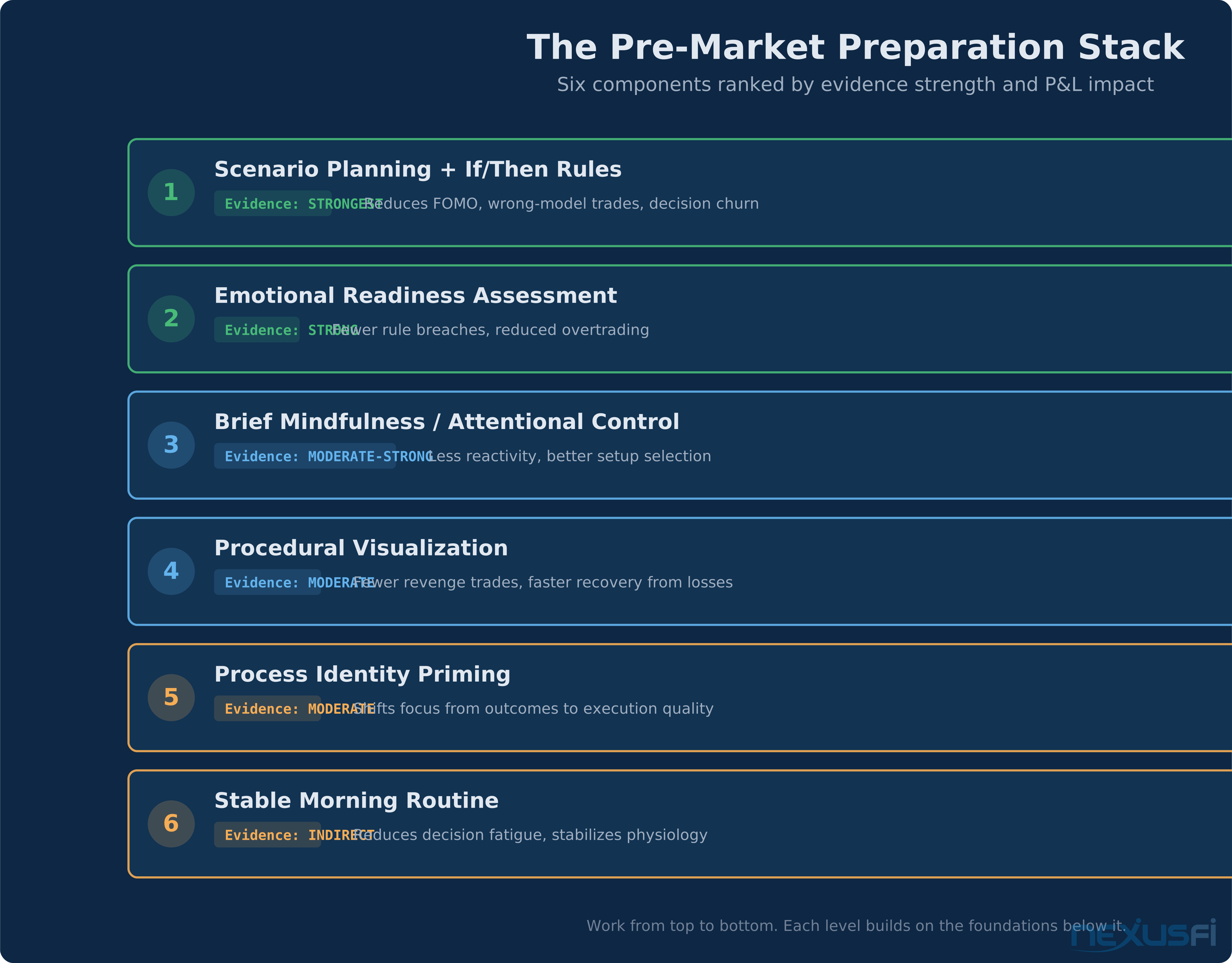
1. Scenario Planning with If/Then Rules #
This is the single highest-impact technique. Before the market opens, define 2-4 scenarios for the session and script your response to each one.
The concept comes from implementation intentions research
What this looks like in practice:
- "If the open breaks prior day high and holds, I look for pullbacks only
- "If volatility exceeds my threshold, I reduce size by 50% or wait 15 minutes."
- "If I miss the opening move, I do NOT chase. I wait for the next structure."
- "If I take two consecutive losses, I pause for 10 minutes before the next entry."
@SoftSoap built this into a structured pre-market routine in his NQ journal: "Lay out type of trades I will NOT take... Think of various scenarios... Lay out areas in NinjaTrader where I will likely enter a trade, as well as no trade zones." The key detail: he defined no-trade zones alongside trade zones. Knowing where you won't act is as important as knowing where you will.
The measured impact shows up as fewer FOMO entries, reduced "wrong-model" trading (treating a range like a trend day), and lower decision churn during the session. You're not making decisions in real time
2. Emotional Readiness Assessment #
Your brain's capacity for disciplined execution isn't constant. It fluctuates based on sleep, stress, physical state, and emotional residue from previous sessions. Trading while compromised is like driving while tired
A readiness assessment takes 60 seconds. Rate yourself on a 1-5 scale:
- Energy: Am I rested or running on caffeine and adrenaline?
- Focus: Can I sustain attention, or am I scattered?
- Emotional neutrality: Am I carrying anger from yesterday's session? Anxiety about the P&L?
- Patience: Am I willing to wait for my setups, or do I need action?
- Impulse risk: Am I likely to break a rule today?
Then add one diagnostic question: "What would cause me to violate my process today?"
The decision gate: If your readiness scores fall below your personal threshold, the professional response is to reduce position size, reduce trade count, or skip the open entirely. This isn't weakness. It's risk management applied to the most important variable in your P&L
3. Brief Mindfulness / Attentional Control #
Mindfulness for traders isn't about relaxation or spiritual practice. It's attentional deployment
A practical protocol takes 3-5 minutes:
- Breath regulation (2 minutes): Slow breathing at a 4-second inhale / 6-second exhale rhythm. This activates the parasympathetic nervous system and lowers arousal to the optimal zone.
- Process focus (1-2 minutes): Attention on your trading rules. Not the market. Not P&L targets. Just the process you're about to execute.
- Anchor statement (10 seconds): One sentence that recenters your identity: "I trade what I see, using my rules."
The critical instruction he added: "Do not focus on the market heading higher or lower. Do not focus on pullbacks or price hitting a certain S/R. No, the objective is to picture yourself simply 'trading' the best you can, which means following your rules."
The distinction matters. Visualizing outcomes creates attachment. Visualizing process creates readiness.
4. Procedural Visualization #
Visualization in trading works
Effective visualization has two layers:
**Layer 1
**Layer 2
This second layer is stress inoculation. When the adverse scenario actually happens during the session, your brain has already rehearsed the response. The reaction is familiar instead of novel, which means it's more likely to be executed correctly.
@shortcreeker tracked this formally in his journal challenge, combining visualization with a daily FOMO score: "On a scale of 1
5. The Stable Morning Routine #
The value of a morning routine isn't the specific activities. It's the repeatability. A consistent routine reduces decision fatigue before the market even opens and puts your brain into a predictable operating state.
@Big Mike outlined the baseline that most professionals share:
- Proper night's rest
- Wake up on time
- Shower, dress
- Breakfast
"Then you prepare yourself to trade, which includes: Clear your mind of any preconceptions. Focus on the specific task at hand. See nothing but your chart. No email, no website."
@bradyk2 built his own version: "Every night I set up the coffee machine. I wake up at 5:55, hit the 'on' button on the coffee machine, and get in the hot tub. I meditate there until I feel at peace with the day which helps me wake up. Then I pour myself a cup of coffee, get dressed in business clothes, turn on the market, and sit down."
The business clothes detail isn't trivial. It's a cognitive signal: this is work, not leisure. Your brain responds to environmental cues. If you trade in the same clothes you sleep in, from the same chair where you watch Netflix, your brain isn't in "high-performance decision mode." It's in "casual browsing mode."
Both failures share the same root
The no-news buffer deserves specific emphasis. @Big Mike flagged this directly: "If CNBC has a bunch of headlines saying negative news, you might be inclined to be bearish today... In either case, you are letting an outside influence guide you instead of focusing on your chart and your trading plan." Social media, financial news, and trading chat rooms before the open inject bias that contaminates your execution for the rest of the session.
6. Process Identity Priming #
The last component takes 30 seconds but anchors everything else. Before the first trade, remind yourself who you are as a trader
- "I am a risk manager first."
- "My job is disciplined execution, not prediction."
- "I do not need to trade every move."
Then confirm your operational constraints: max loss limit, max trade count, position size, and any skip criteria from your readiness assessment.
This shifts the brain from outcome fixation (how much will I make today?) to process fixation (how well will I execute today?). The research on goal-setting is clear: specific, process-oriented goals improve performance more reliably than outcome goals. In trading, outcome focus creates the exact emotional volatility that destroys execution quality.
Putting It Together #
Here's a complete pre-market protocol combining all six components. Total time: 12 minutes.
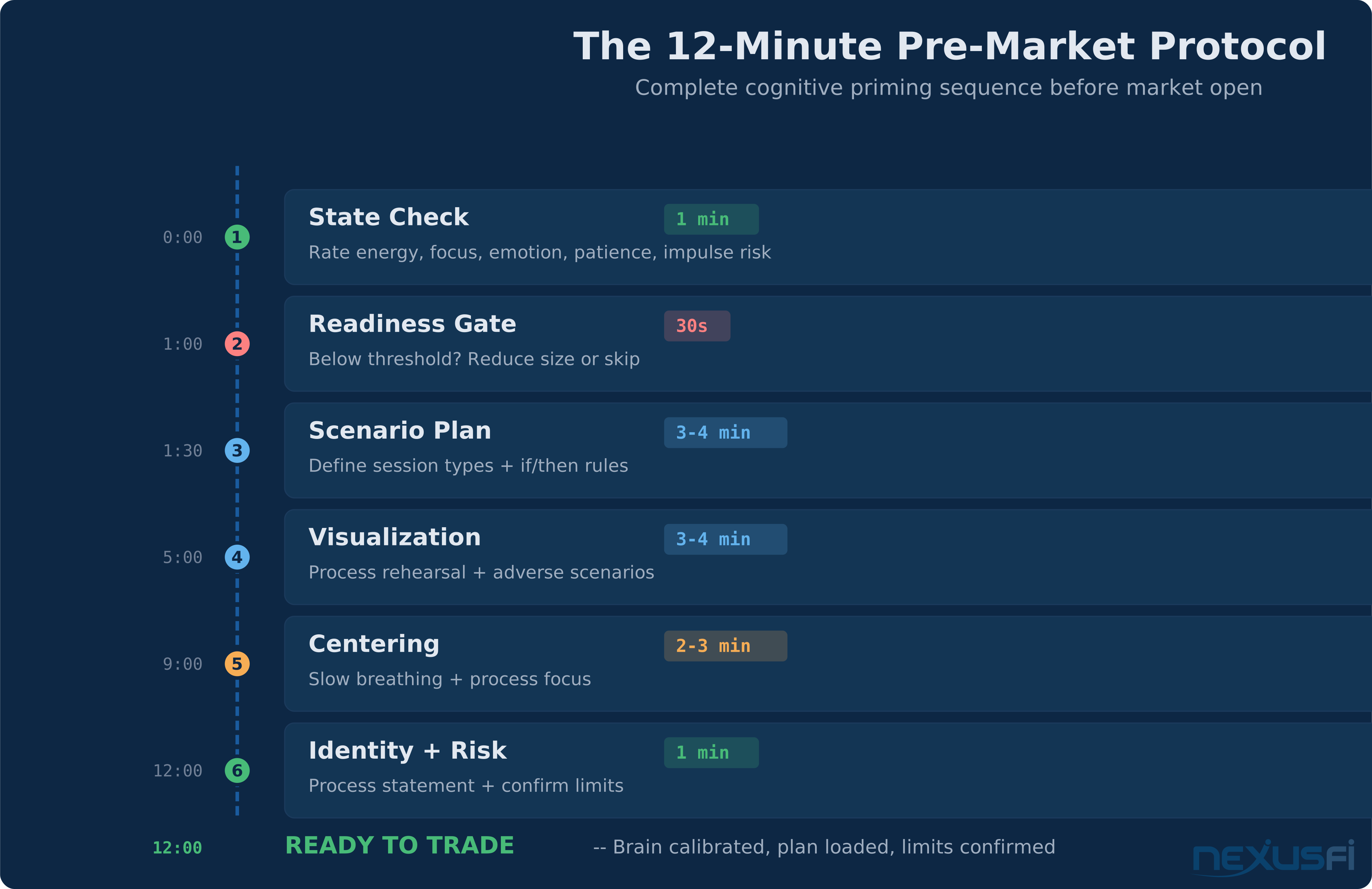
| Step | Time | What You Do |
|---|
|
| 1. State Check | 1 min | Rate energy, focus, emotion, patience, impulse risk (1-5 each) |
|---|---|---|
| 3. Scenario Planning | 3-4 min | Define 2-4 likely session types. Write if/then rules for each |
| 4. Visualization | 3-4 min | Rehearse clean execution + adverse scenario responses |
| 5. Centering | 2-3 min | Slow breathing + process focus |
| 6. Identity Anchor | 30 sec | One process statement + confirm risk limits |
| 7. Risk Gate | 30 sec | "Am I aligned with the plan? Is my next action specified?" |
@SoftSoap's complete framework built on this structure with additional layers
How to Know If Your Routine Works #
Don't measure your routine by how it makes you feel. Measure it by what it makes you do.
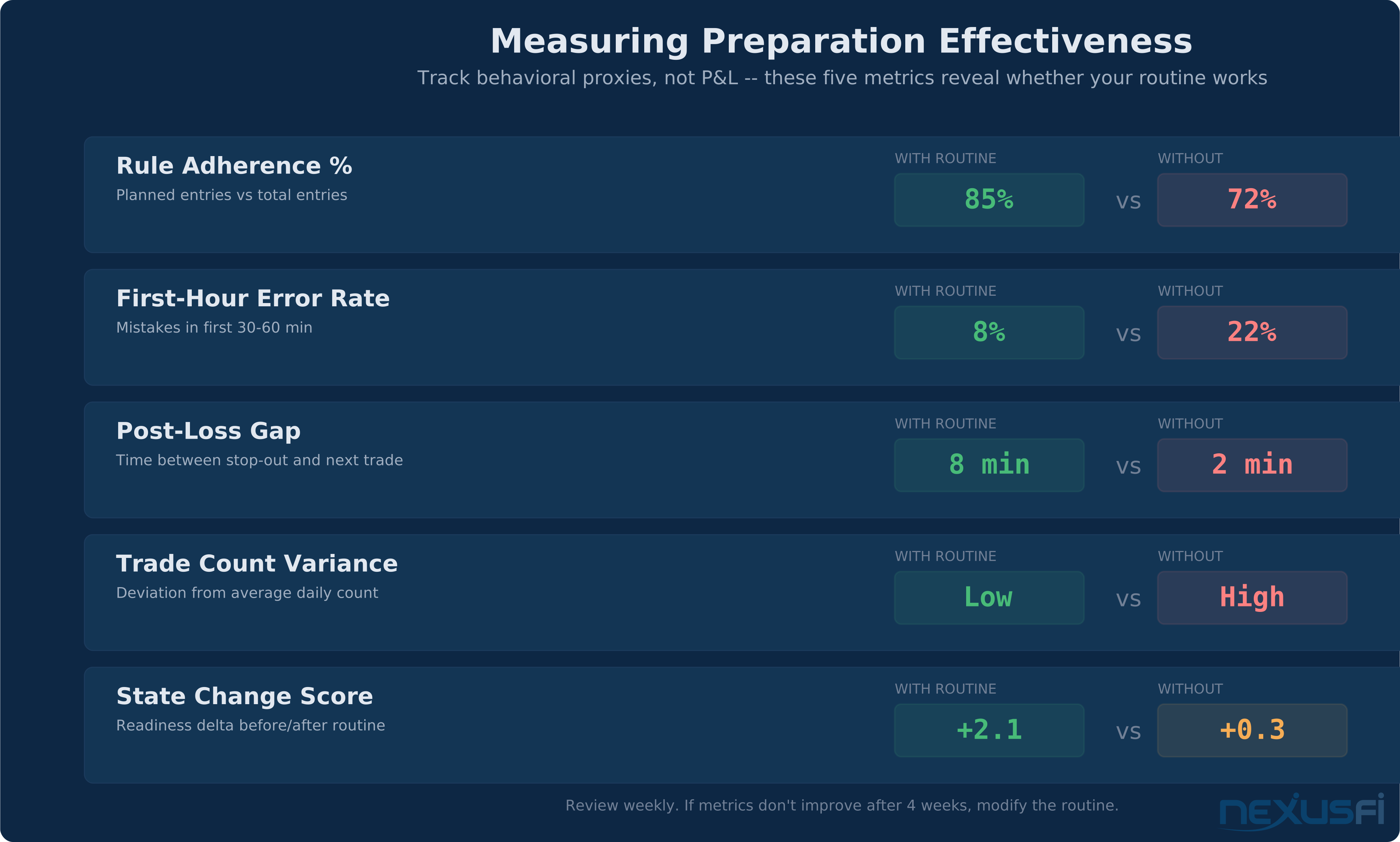
Track these behavioral proxies weekly:
Rule adherence rate: What percentage of your trades followed the plan? If your routine works, this number climbs over time. If it doesn't change, the routine is cosmetic.
First-hour discipline: Count your trades and their quality in the first 30-60 minutes. The open is where underprepared traders make the most mistakes. If your first-hour error rate drops, the routine is doing its job.
Post-loss behavior: After a stop-out, how quickly do you take the next trade? What's the quality of that next trade? Revenge trades cluster in the 2-5 minutes after a loss. If the routine is working, the gap between loss and next trade widens, and the next trade quality stays consistent.
Trade count variance: If your average is 4 trades per day but you logged 12 today, that's not the market offering more setups. That's overtrading
Pre/post state comparison: Rate your readiness before and after the routine. If it doesn't actually change your state, it's a ritual, not preparation. Modify it.
Common Mistakes #
Overcomplicating the routine. If your pre-market prep takes 45 minutes and requires 12 steps, you won't do it consistently. Consistency beats thoroughness. A 10-minute routine you do every day outperforms a 45-minute routine you do twice a week.
Visualizing only wins. If your mental rehearsal includes only smooth executions and green P&L, you're building a fantasy, not stress inoculation. The adverse scenarios are the important ones. That's where discipline is actually tested.
Outcome-based goals. "I want to make $2,000 today" is the worst possible goal to set before a session. It creates urgency, promotes overtrading, and makes you hold losers and cut winners to hit an arbitrary number. Process goals only: follow the plan, respect the limits, wait for setups.
News immersion before the open. Scrolling financial Twitter for 30 minutes before the bell doesn't count as preparation. It counts as contamination. You're loading your brain with narratives that create directional bias before you've looked at the actual structure.
Skipping the routine after winning streaks. The routine is most important when things are going well. Confidence erodes discipline faster than losses do. After three winning days, your brain starts whispering that the rules don't apply to you today. That's exactly when the routine matters most.
When to Adjust #
Your routine should evolve. The problems you have after six months of screen time aren't the same problems you had at the start. Review and modify your pre-market protocol quarterly:
- Which components fire most often? If your readiness gate triggers every Monday, investigate your weekend habits.
- Which if/then rules are you still breaking? Those rules need stronger enforcement
- Has your biggest leak shifted? Maybe fear was the problem six months ago and now it's overconfidence. Your routine should target the current leak, not the old one.
Track the routine's effectiveness the same way you track a strategy
Knowledge Map
Prerequisites
Understand these firstGo Deeper
Build on this knowledgeReferences This Article
Articles that build on this topicCitations
- — Big Mike's day trading method and advice (2009) 👍 75“Some more random thoughts of my own: Why do some traders treat trading so lightly? Let me be specific. You wake up late, roll out of bed, and climb into your office chair. Probably still in your underwear, not showered, no breakfast, etc.”
- — SoftSoap's NQ Journey (2016) 👍 29“So I've been on the fence about starting a journal on NexusFi for the last couple of months. Mainly due to the fact that I am not a disciplined trader yet, and some days my performance embarrasses me.”
- — FIO Journal Challenge (2018) 👍 19“https://nexusfi.com/trading-journals/45210-shortcreeker-s-trading-journal.html#post690323 Shortcreeker's Trade Journal https://content.screencast.com/users/Shortcreeker/folders/Snagit/media/03a17cad-a0fd-4906-b398-4357e1574f31/09.04.2018-12.12.”
- — Daily mental check? (2012) 👍 4“I think there is great importance in this. I used to wake up at 5:30 (i'm on the west coast so market opens at 6:30) and run on the beach. It was a great way to wake up.”
- — Ctrl-Alt-Del Reboot Trading Journal (2012) 👍 6“I've identified my two worst behaviors in getting ready to trade in the morning. 1) I turn on the computer and I jump right in before completely waking up.”
- — SoftSoap's NQ Journey (2016) 👍 8“Ok so I'm building on the realization I came to about bullying myself and having negative thoughts. I started looking through some of my notes as well as the morning prep to try and get rid of anything negative that I don't need, as well as turn a ne...”