



Value at Risk (VaR) for Futures: Measuring What Can Actually Hurt You
Overview #
Every futures trader manages risk. The question is whether they do it with actual numbers or gut feel. Value at Risk — VaR — is the industry's attempt to put a dollar figure on potential loss before it happens. For futures, where a single ES contract controls over $370,000 in notional exposure against $15,000 in margin, that number matters.
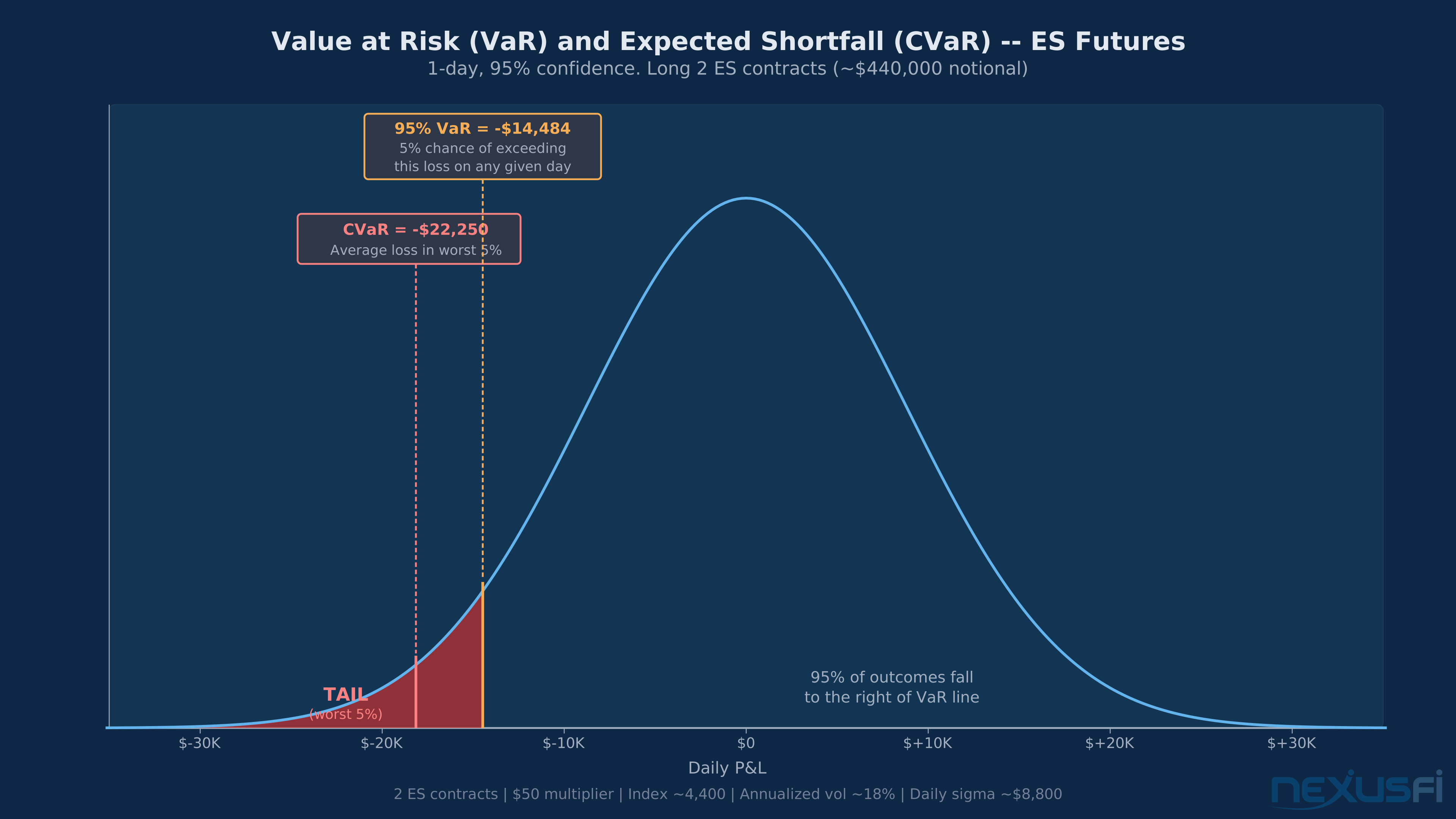
VaR answers one question: "What is the maximum loss I should expect to exceed only X% of the time, over a given time horizon?" A 1-day 99% VaR of $8,500 on your ES position means you expect to lose more than $8,500 on fewer than 1 in 100 trading days, under the model's assumptions. That last clause matters more than most traders realize.
VaR is a risk lens, not a risk guarantee. A low VaR number does not mean you are trading conservatively — it means the model hasn't predicted a tail event yet. Pair every VaR estimate with stress testing and CVaR for a complete picture.
This article covers how VaR is calculated, why futures leverage mechanics make it more complex than the textbook version, what the number gets wrong, and how to pair it with stress testing to build a framework that actually holds up when markets go sideways. The math is real, the prices are live, and the limitations are discussed honestly — because a misunderstood VaR number is more dangerous than no VaR number at all.
Key Concepts #
Before calculating anything, get these definitions locked in. They're the foundation every VaR calculation rests on.
Notional exposure — The true economic value of a futures position. Price times contract multiplier times number of contracts. For ES at 7,441.75 with a $50 multiplier, one contract controls $372,087.50. This is not margin. This is what you actually have at risk in the market.
Confidence level — The probability that your loss won't exceed VaR. 95% confidence means you expect to lose more than VaR on 5% of days — roughly 13 trading days per year. 99% confidence means you expect to exceed VaR on only 1% of days, or about 2-3 times per year. The difference isn't just statistical. It changes how conservative your risk management is and how much capital you need to buffer against tail events.
Time horizon — VaR is always horizon-specific. A 1-day VaR and a 5-day VaR on the same position are at the core different numbers. Day traders care about intraday horizons. Swing traders care about 1-5 day horizons. The square-root-of-time rule (scale daily VaR by √h for h-day VaR) works only when volatility is stable — which it rarely is in futures, especially around events.
Conditional VaR (CVaR) / Expected Shortfall — The average loss in the scenarios where you exceed VaR. If your 99% VaR is $8,500, CVaR answers: "In that worst 1% of days, how bad does it actually get?" The answer is often two to three times the VaR number. CVaR is the more honest metric for leveraged futures trading.
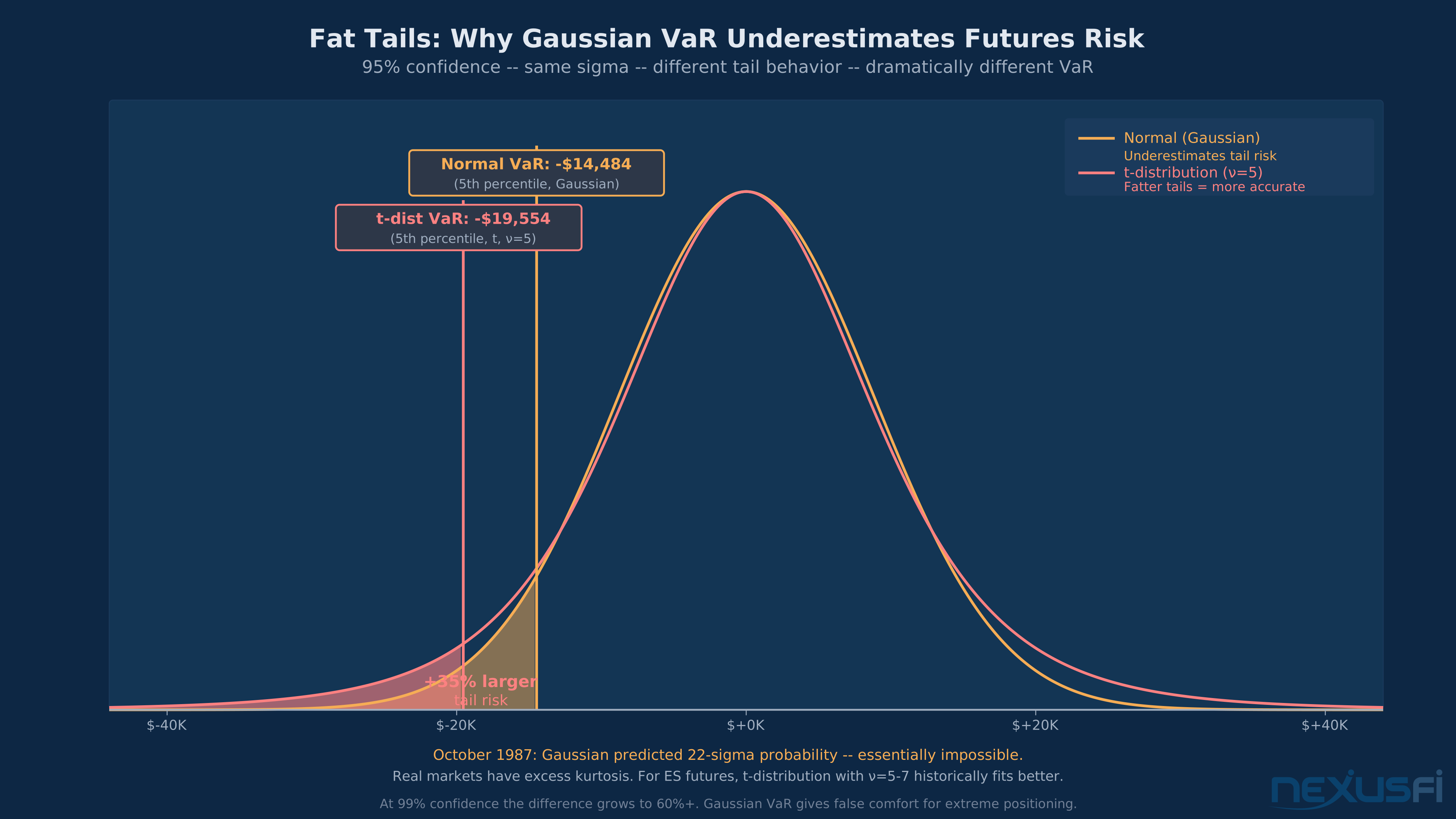
Fat tails — Real futures returns don't follow a normal bell curve. The tails are fatter — extreme moves happen more often than the normal distribution predicts. This is why parametric VaR, which assumes normality, consistently underestimates tail risk for ES, NQ, CL, and GC.
Volatility clustering — Bad days follow bad days. Volatility doesn't distribute randomly across the year. After the March 2020 crash, after the 2022 rate shock, after any major macro disruption — volatility spikes and stays elevated. A VaR model trained on a calm period will be badly wrong entering a volatile one.
The Three VaR Methods #
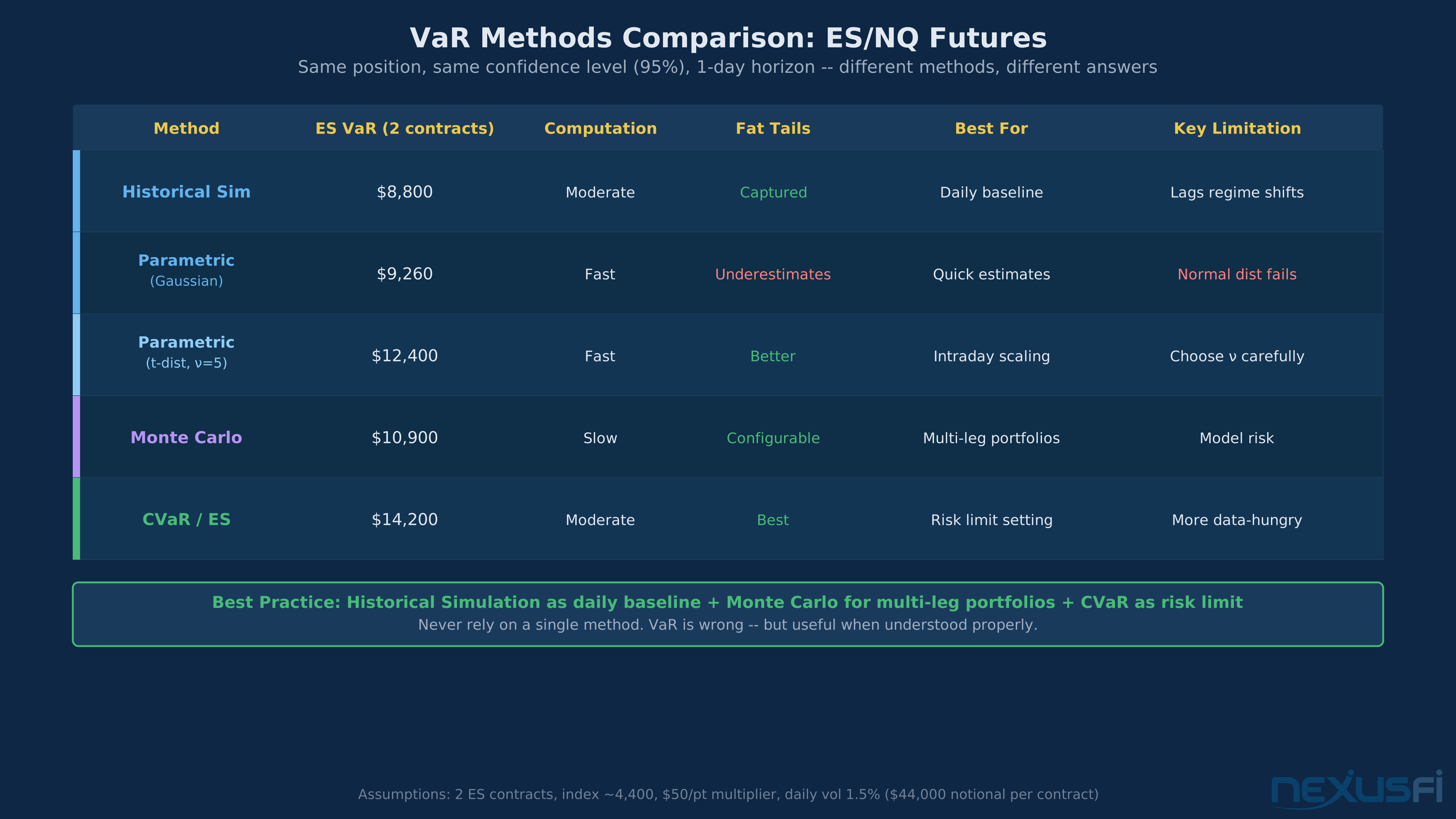
There's no single VaR. Three main methods exist, each with different assumptions, different failure modes, and different use cases for futures traders.
Parametric VaR (Variance-Covariance) #
The simplest version. Assumes returns follow a normal distribution, then uses standard deviation to estimate the loss at a given confidence level.
The formula:
VaR = z × σ × Notional
Where z is the standard normal quantile (1.65 for 95%, 2.33 for 99%), σ is the daily return volatility, and Notional is the full economic exposure.
A real calculation. ES closed at 7,441.75 on May 13. One contract: 7,441.75 × $50 = $372,087.50 notional. Assume 30-day historical daily return volatility of 0.85% (a realistic number for a moderate-volatility ES regime).
1-day 99% parametric VaR = 2.33 × 0.0085 × $372,087.50 = $7,361
So the model says: on a typical trading day, you should expect to lose no more than $7,361 with 99% confidence. That's per contract.
The problems. This calculation breaks down in three specific ways for futures:
First, normality assumption. ES returns have a kurtosis around 5-7, compared to 3 for a true normal distribution. The distribution has fatter tails, which means extreme moves happen materially more often than the model predicts. When ES moves 3% in a day — rare but not unheard of — the parametric model says it shouldn't happen. The market doesn't care.
As @grausch noted in an extended discussion on risk methodology in the thread "The Scalper's Path":
That regime-change problem is the core failure of static parametric VaR. The model's inputs are calibrated to one environment. Markets change environments.
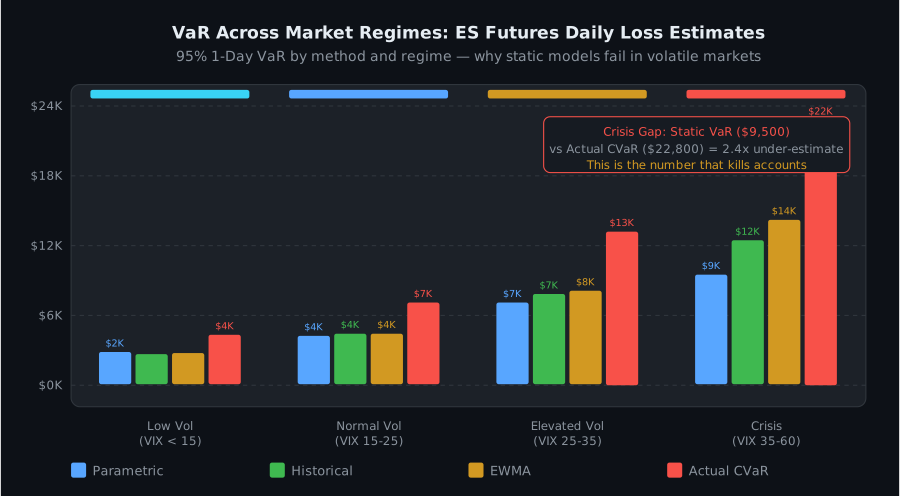
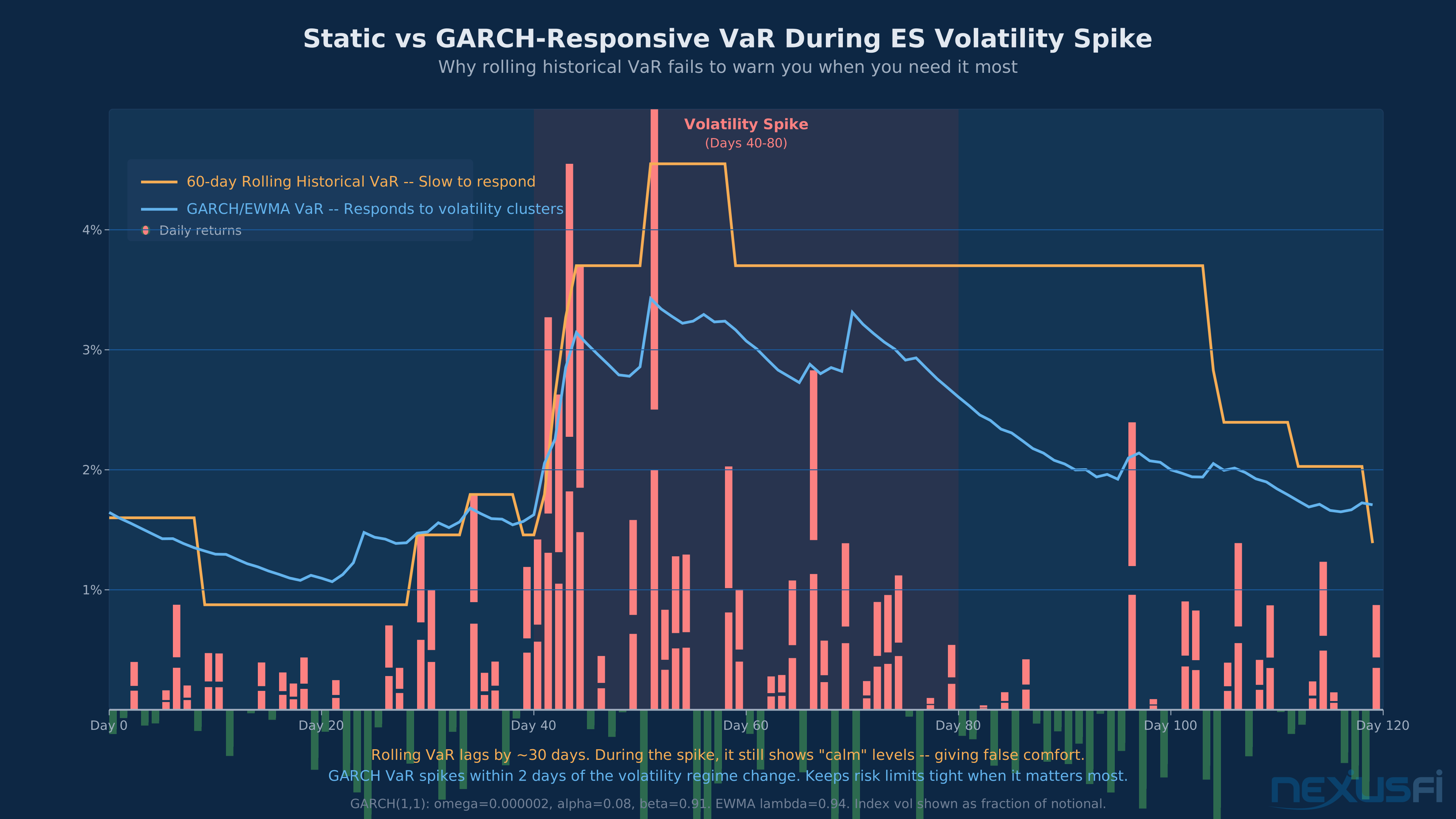
Second, static volatility. The formula uses a single σ estimate. Real volatility changes. When the VIX is at 15, ES daily moves average around 0.5-0.7%. When it hits 35, that number triples. A VaR model calibrated during a calm period will catastrophically underestimate risk entering a volatile period.
Third, it ignores the tails beyond the threshold. Parametric VaR at 99% tells you the loss level. It says nothing about how bad losses get when you exceed that level. For that, you need CVaR.
Making it better. Two upgrades much improve parametric VaR for futures. First, use EWMA (Exponentially Weighted Moving Average) volatility with λ = 0.94, which gives more weight to recent observations and lets the model respond faster to volatility regime changes. Second, substitute the Student-t distribution for the normal, using 4-6 degrees of freedom — this directly addresses the fat-tail problem by building heavier tails into the model.
Parametric VaR with EWMA and t-distribution is appropriate for quick dashboard calculations and initial position sizing. Don't rely on it alone.
Historical Simulation VaR #
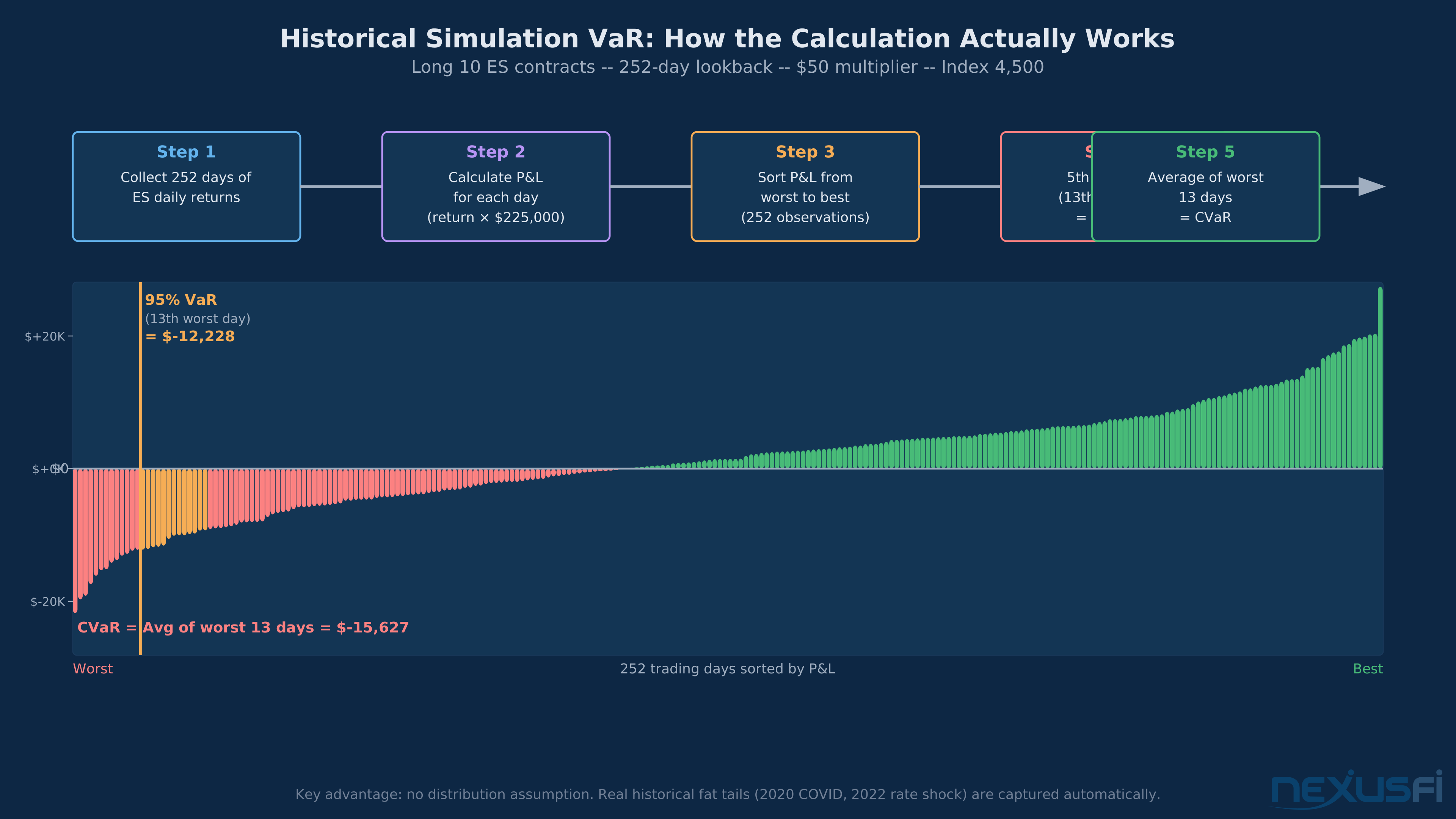
No distribution assumptions. Take the last N days of actual returns, rank them from worst to best, and read off the percentile you care about.
The process:
- Collect 252 daily close-to-close log returns for ES (one full year)
- Sort them ascending
- The 95% VaR is the loss at the 5th percentile — the worst 5% of actual historical days
- The 99% VaR is at the 1st percentile — the worst 1% of actual historical days
- Multiply by current notional exposure
The advantage. Historical simulation captures real distribution shape — the fat tails, the skewness, the clustering that actually shows up in markets. It automatically includes the October 2022 rate shock if that's in your lookback window. It doesn't assume anything about the shape of the distribution.
The problems. Two main issues. First, the lookback window problem. If your 252-day window is a calm period, your historical VaR will dramatically understate tail risk — exactly when you need accuracy most. CL is the worst offender here. A year of stable $70-80 oil tells you nothing about the risk of an OPEC cut or a geopolitical shock that moves the contract $5 in an afternoon.
Second, stale data problem. Historical simulation can't capture regime changes that haven't happened yet. If you're running a model calibrated on 2021 data heading into 2022's rate cycle, the model has no recent memory of a rate-shock regime. It will be blind to the actual risk profile.
Making it better. Use volatility-scaled historical simulation. Normalize each historical return by the volatility on that day, then rescale by current volatility. This gives you the distribution shape from history while weighting the magnitude by current conditions. Effectively: "What would historical bad days look like if today's volatility applied?" Much more responsive during volatility transitions.
For ES and NQ: use at least two lookback windows — 63 days (one quarter) and 252 days (one year) — and report both. When they diverge much, current conditions have changed and the longer-window estimate needs scrutiny.
Monte Carlo VaR #
Simulate thousands of possible price paths using a model, then read the loss distribution from the simulations.
The basic approach:
- Fit a model to recent returns (GARCH(1,1) with Student-t innovations is the standard)
- Simulate 10,000-50,000 possible price paths over the horizon
- Calculate P&L for each path: Notional × return
- Read the 1st or 5th percentile of the P&L distribution
When it's useful. Monte Carlo is best when you need to incorporate volatility clustering explicitly, when you have a portfolio of contracts with correlated risk (ES + NQ positions together), or when you're modeling options alongside futures where payoffs are nonlinear.
The problems. Model risk. The output is only as good as the model inputs. If you assume 15% annualized volatility when actual volatility is running at 25%, your Monte Carlo VaR is wrong by 67%. For CL specifically, where inventory reports and geopolitical events create price jumps that no smooth-path model captures well, Monte Carlo with a standard GBM process is arguably worse than historical simulation.
For most retail futures traders, historical simulation with EWMA volatility scaling is more reliable than Monte Carlo — it's transparent, fast, and doesn't require fitting a model that might be misspecified.
Conditional VaR: The Number VaR Won't Tell You #
VaR gives you a threshold. CVaR tells you what happens beyond it.
The formula for historical CVaR is simple: average the losses that exceed VaR. If your 99% VaR is $8,500 and 10 of your 1,000 historical simulation runs exceeded that (the worst 1%), CVaR is the average of those 10 losses.
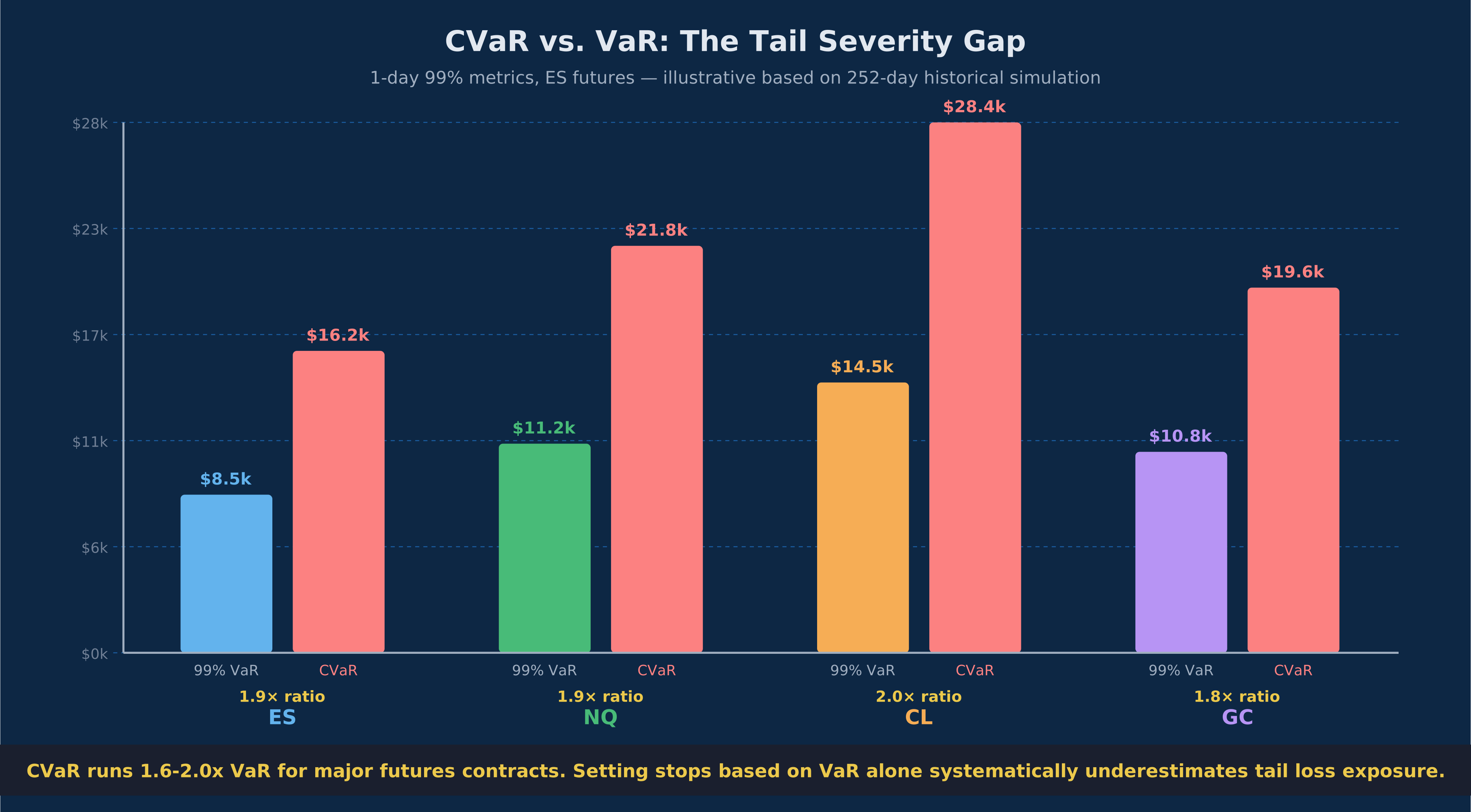
In practice, for futures with fat-tailed return distributions, CVaR typically runs 1.5-2.5× the VaR number. That ratio is the tail severity. An ES position with a 99% VaR of $7,500 might have a CVaR of $14,000-18,000. That's what your average "worst day" actually looks like.
CVaR is why Basel III moved away from VaR for regulatory capital requirements. A firm optimizing to a VaR limit can build a portfolio that looks fine until a 1-in-100 event hits — then catastrophically fails. CVaR captures the average severity of those tail events, not just the threshold.
Why CVaR matters more. Regulators figured this out. Basel III and CFTC capital frameworks for professional traders moved from VaR to Expected Shortfall (same thing as CVaR) precisely because VaR ignores what happens in the tail. For futures traders, the implication is practical: if you set your position size based on VaR alone, you may be systematically underestimating tail exposure.
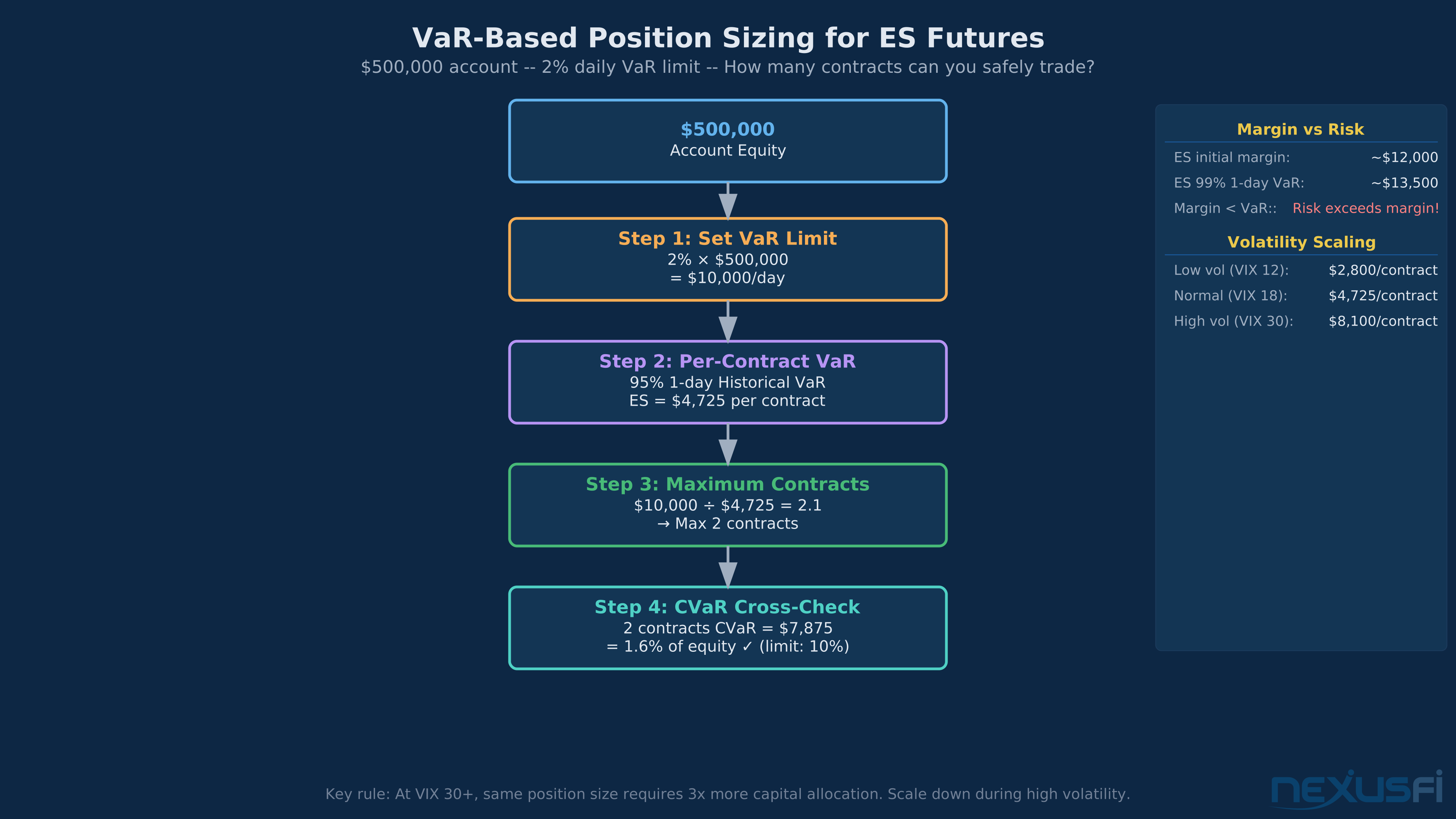
The CVaR position sizing rule. Instead of sizing positions so that VaR ≤ 2% of account, size so CVaR ≤ 3% of account. This gives you explicit tail protection rather than just a threshold metric.
Leverage and the Notional Trap #
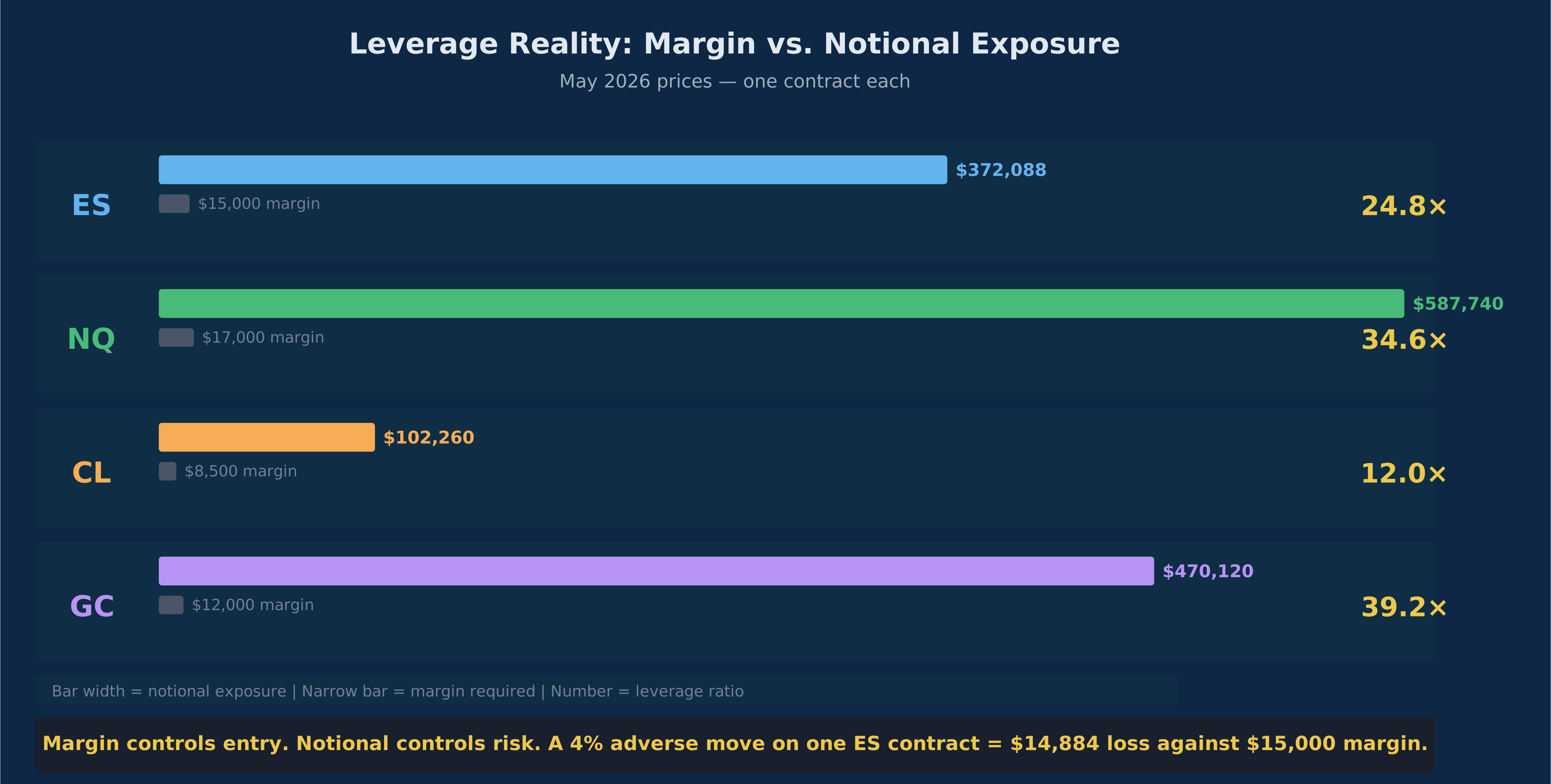
This is where futures traders get into the most trouble with risk metrics. Every risk metric for futures must be calculated on notional exposure, not margin posted.
Here's why it matters. On May 13, 2026:
- ES closed at 7,441.75 — one contract notional = $372,087.50
- Initial margin for one ES: ~$15,000 (representative)
- Leverage ratio: 24.8:1
A trader with $75,000 in their account holds 5 ES contracts. Total notional: $1,860,437.50. Total margin required: ~$75,000. They're using the full account in margin — a common setup for active day traders.
Now, the 1-day 99% parametric VaR on that $75K account position, using realistic current volatility:
5 contracts × $7,361 per contract = $36,805 VaR
That's 49% of the account. In one day. A 1-in-100 event — which happens 2-3 times per year — could wipe out half the account.
This is the notional trap. The margin requirement obscures the actual economic exposure. As @shodson explained in a thread on understanding margin and leverage:
@josh expanded on this point in a discussion about micro futures risk:
Margin-adjusted VaR (M-VaR). The most actionable risk metric for futures is VaR expressed as a fraction of total margin deposited:
M-VaR = VaR / Total Margin
For the 5-contract ES position above: $36,805 / $75,000 = 49% M-VaR
That's dangerously high. The practical limits used by risk-aware futures traders:
- Day traders: M-VaR ≤ 20% (one bad day shouldn't threaten more than 20% of your capital)
- Position traders: M-VaR ≤ 30% (slightly more tolerance for overnight risk)
At 49%, this trader needs to cut to 2-3 ES contracts or much increase their account equity.
The Kelly connection. Kelly-based position sizing feeds directly into VaR calculation. Once you have a per-contract 1-day VaR estimate, position sizing becomes:
Maximum contracts = (Account × Risk% per day) / VaR per contract
For a $75,000 account targeting maximum 0.5% daily risk at 99% confidence: $75,000 × 0.005 / $7,361 = 0.05 contracts.
That's basically no position — which reveals that 5 contracts at this volatility level is 100× the Kelly-implied maximum. Running that calculation is worth doing before adding size.
For a complete treatment of position sizing methodology, see the Position Sizing Methods for Futures Trading and The Kelly Criterion articles.
VaR in Practice: ES, NQ, CL, and GC #
Each contract has distinct risk characteristics that affect how VaR should be calibrated and interpreted.
ES (E-mini S&P 500) #
Current data (May 13, 2026): Open 7,419.25 / High 7,454.25 / Low 7,410.00 / Close 7,441.75. Daily range: 44.25 points = $2,212.50 per contract.
ES is the most liquid futures market on earth. The bid-ask spread is typically 0.25 ticks even during volatility events. This liquidity means VaR estimates are more reliable — fills happen near where the model expects.
Typical 1-day 99% VaR: $6,000-9,000 per contract in moderate volatility, rising to $15,000-20,000 during high-stress periods (2022 rate cycle saw daily ranges of 80-120 points regularly).
Key event risk windows: CPI, FOMC announcements, jobs reports, and unexpected geopolitical events. On FOMC days specifically, volatility can double or triple intraday. Historical simulation VaR trained on calm days will badly underestimate the risk profile of holding through the announcement.
VaR methodology recommendation: EWMA historical simulation with a 63-day lookback as the primary metric, supplemented by a 252-day lookback for comparison. Update daily, check at session open.
NQ (E-mini Nasdaq 100) #
Current data (May 13, 2026): Open 29,143.75 / High 29,447.00 / Low 29,055.50 / Close 29,387.00. Daily range: 391.50 points = $7,830 per contract.
NQ runs hotter than ES. Higher volatility, higher per-contract notional ($20 × 29,387 = $587,740 per contract), and more sensitivity to rate expectations and tech sector sentiment. During the 2022 rate cycle, NQ dropped over 30% — movements that no historical simulation trained on 2019-2021 data would have predicted.
Typical 1-day 99% VaR: $8,000-14,000 per contract in moderate conditions, higher in stressed environments.
Key risk pattern: NQ fat tails are asymmetric. The downside tails are fatter than the upside — negative surprises hit harder than positive ones of similar magnitude. Using a skewed Student-t distribution in parametric VaR improves accuracy.
Critical point for NQ day traders. The initial margin for NQ is in a similar ballpark to ES despite NQ's higher per-contract P&L. This means the leverage ratio for NQ positions is often higher than traders realize. Running M-VaR on NQ positions typically shows traders they're more exposed than their margin usage suggests.
@mgcharl's discussion of position sizing with the introduction of MES is relevant here:
The micro contracts let you size down to appropriate levels when VaR calculations show a full contract exceeds your risk budget.
CL (Crude Oil) #
Current data (May 13, 2026): Open 102.16 / High 102.31 / Low 100.56 / Close 102.26. Daily range: 1.75 = $1,750 per contract.
CL is the wild card. It's event-driven in a way no index future is. An OPEC production cut, a major inventory surprise from EIA, or a geopolitical escalation in a major producing region can move crude $3-5 in an afternoon. The April 2020 negative price event — CL trading at -$37/barrel on the May contract — is the extreme case, but $5-8 moves on OPEC news have happened multiple times in the past five years.
Typical 1-day 99% VaR: $12,000-18,000 per contract in normal conditions. But "normal conditions" for CL includes the above events.
@Pariah Carey's direct approach to CL risk captures the practical framing traders actually use:
A $1/barrel move in CL is $1,000 per contract. In VaR terms, that's a conservative daily loss target — actual 1-day 99% VaR for CL often runs $12,000-18,000. The gap between a trader's intended stop and actual VaR exposure is worth examining explicitly.
The historical simulation problem. CL has the most severe lookback bias problem of any major futures contract. A model trained on a 6-month quiet period before an OPEC shock will show a $5,000 VaR estimate right before a $12,000 move day.
Mandatory addition for CL: Add a 20-30% liquidity buffer to any VaR estimate. CL spreads can widen much during fast markets, and slippage on stops often runs $0.05-0.15/barrel more than the quoted price. This is real friction that VaR estimates based on mid-price returns completely ignore.
GC (Gold) #
Current data (May 12, 2026): Open 4,745.30 / High 4,783.40 / Low 4,692.40 / Close 4,701.20. Daily range: 91.00 points = $9,100 per contract.
GC is a different animal from the equity indices. It responds to real rates, USD strength, risk sentiment, and central bank activity in ways that aren't fully captured by simple return distributions. At current levels above $4,700, dollar-per-tick exposure is significant.
One contract: 4,701.20 × 100 = $470,120 notional. Margin requirement: roughly $8,000-15,000 depending on broker and account type. That's 31-59× leverage on notional exposure.
Typical 1-day 99% VaR: $8,000-14,000 per contract in moderate conditions, expanding much during macro dislocations.
VaR Limitations: What the Number Gets Wrong #
Every futures trader using VaR needs to know its failure modes. A misread VaR is worse than no VaR.
What VaR cannot tell you:
It doesn't tell you the size of losses beyond the threshold. This is the biggest gap. If 99% VaR is $8,500, VaR says nothing about whether the loss on a bad day is $8,600 or $85,000. That's why CVaR/Expected Shortfall is necessary.
It assumes you can exit at the modeled price. Real trading involves slippage, especially during fast markets. In the August 2015 flash crash, ES gapped lower at the open by over 100 points. If your VaR was calculated on a $6,000/contract basis, the gap alone wiped out 60% of your typical margin without giving you a chance to exit. VaR models based on closing prices missed all of this.
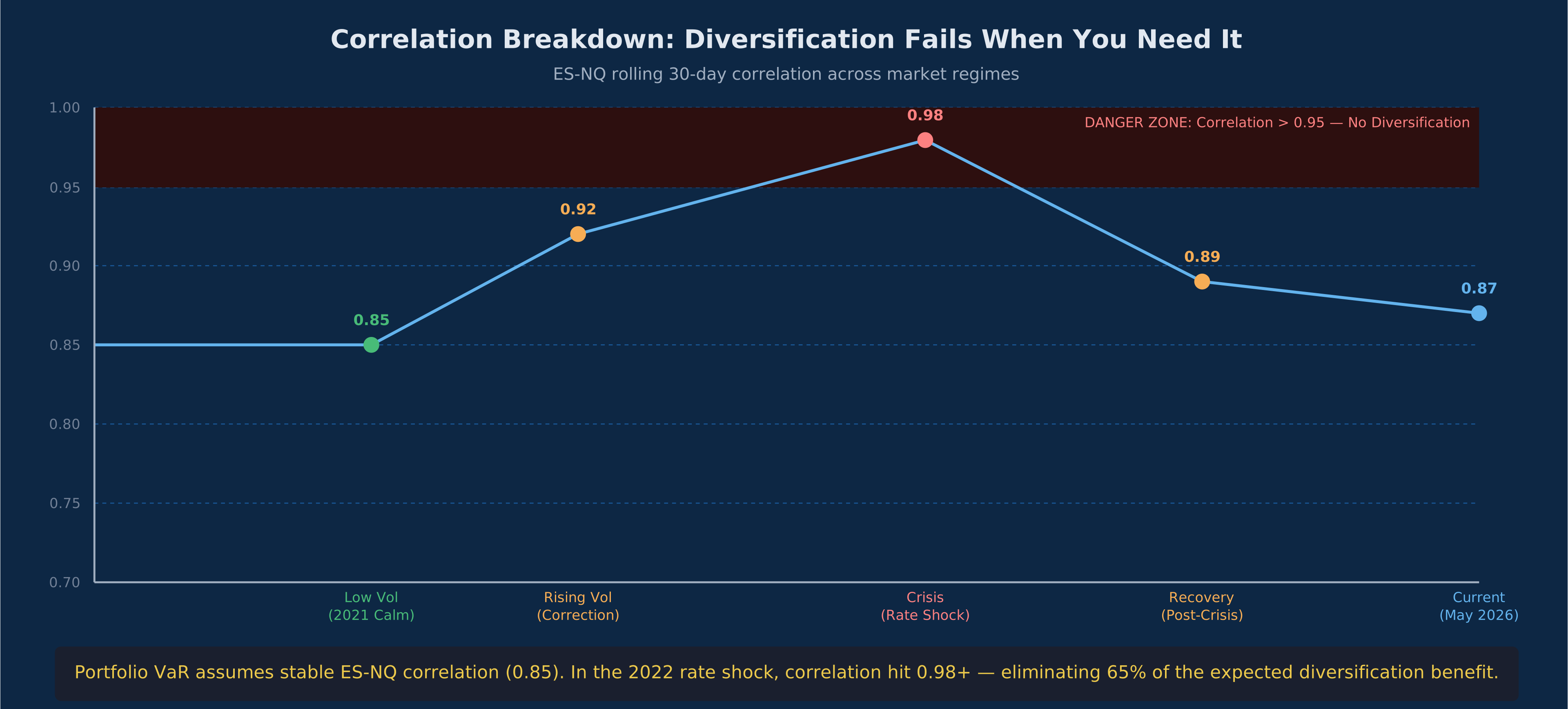
It treats correlations as stable. In a crisis, correlations between normally uncorrelated assets collapse to 1. ES and NQ, which might have a typical 0.85 correlation, run to 0.98+ during crashes. Portfolio VaR with a diversification benefit built in disappears exactly when you need it most.
It can't see regime changes coming. A model trained in a low-volatility regime doesn't know it's about to enter a high-volatility regime. The parameter estimates are backward-looking by construction.
The false confidence trap. This is the single most dangerous failure mode. A low VaR number feels like a license to add size. A trader looks at their 1-day 99% parametric VaR of $3,200 on their position and concludes they're trading conservatively. They're not — they've just built a model that underestimates tail risk.
@dsdnaples described the end state of this failure mode in a thread called "Account blown up":
Moving stops is the behavioral failure that follows the analytical failure of underestimating risk. If your VaR model told you the position was safe at that size, moving the stop felt rational. It wasn't.
A low VaR estimate combined with overleveraged positions is the most common pathway to catastrophic loss in futures. The model looks fine right up until the tail event arrives.
{{IMAGE:var-regime-comparison-9413f308.svg}}
Stress Testing: VaR's Essential Partner #
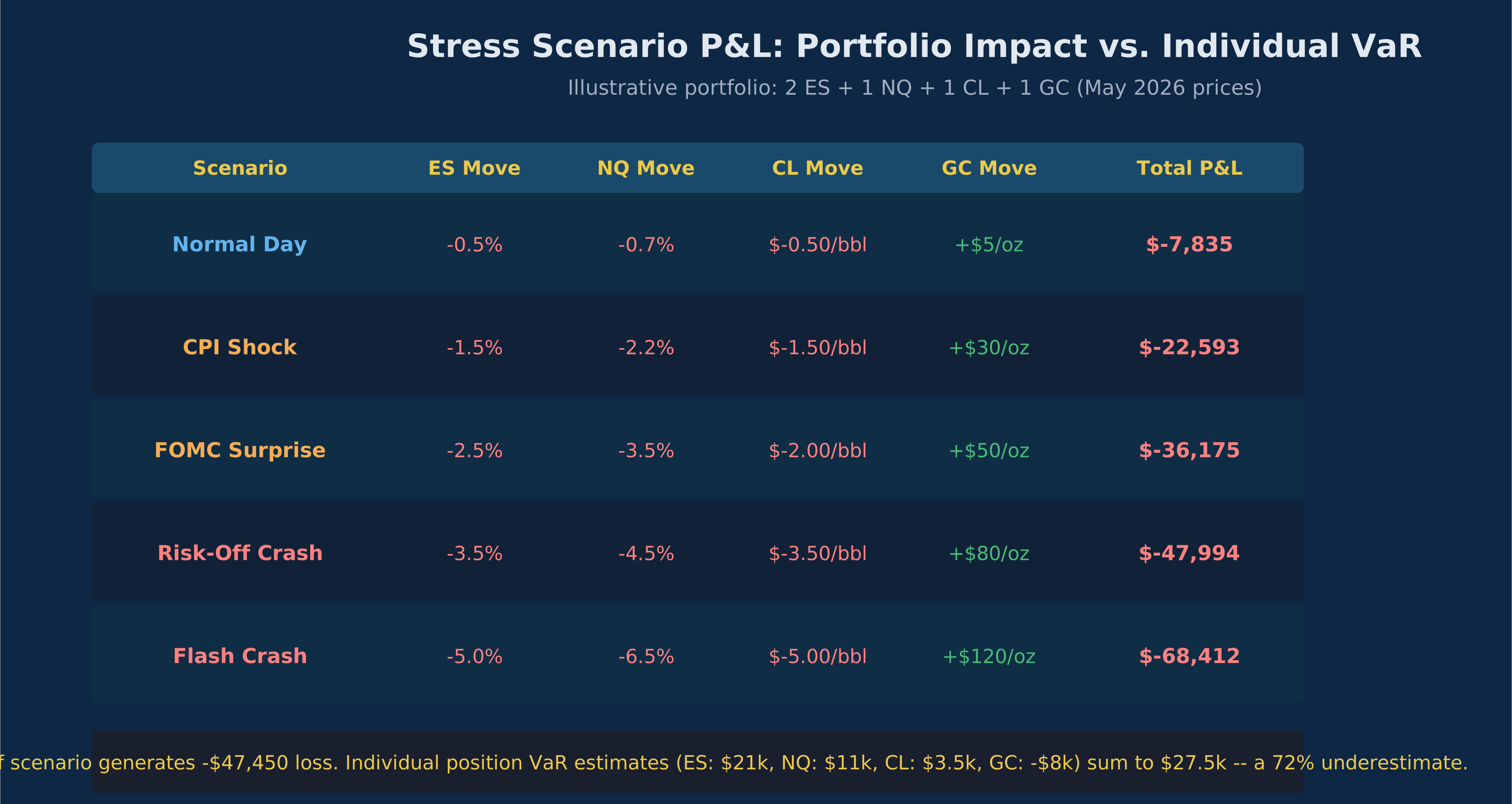
All experts agree: stress testing is more actionable and more important than VaR for practical futures risk management. The two tools are designed for different purposes.
VaR is probabilistic — it estimates what you should expect at a given frequency. Stress testing is scenario-based — it calculates what would happen under a specific adverse event.
Mandatory stress scenarios for futures traders:
Equity index scenarios:
- ES/NQ down 2% in one session (happens ~10 times/year in volatile markets)
- ES/NQ down 3% in one session (happens 3-5 times/year)
- ES down 5% in one session (rare but plausible — happened multiple times in COVID)
- Overnight gap of 1.5% lower on ES (happens with major geopolitical events, earnings)
Crude oil scenarios:
- CL moves $3/barrel on OPEC headline
- CL moves $5/barrel on major supply disruption
- CL gaps $2 lower on large inventory build (EIA)
Gold scenarios:
- GC moves $80/ounce on Fed surprise
- GC gaps $50 lower on risk-on event
- GC runs $100 higher on geopolitical shock
Cross-asset scenario:
- Everything risk-off simultaneously: ES -3%, NQ -4%, CL -$2, GC +$60 (classic flight-to-safety trade)
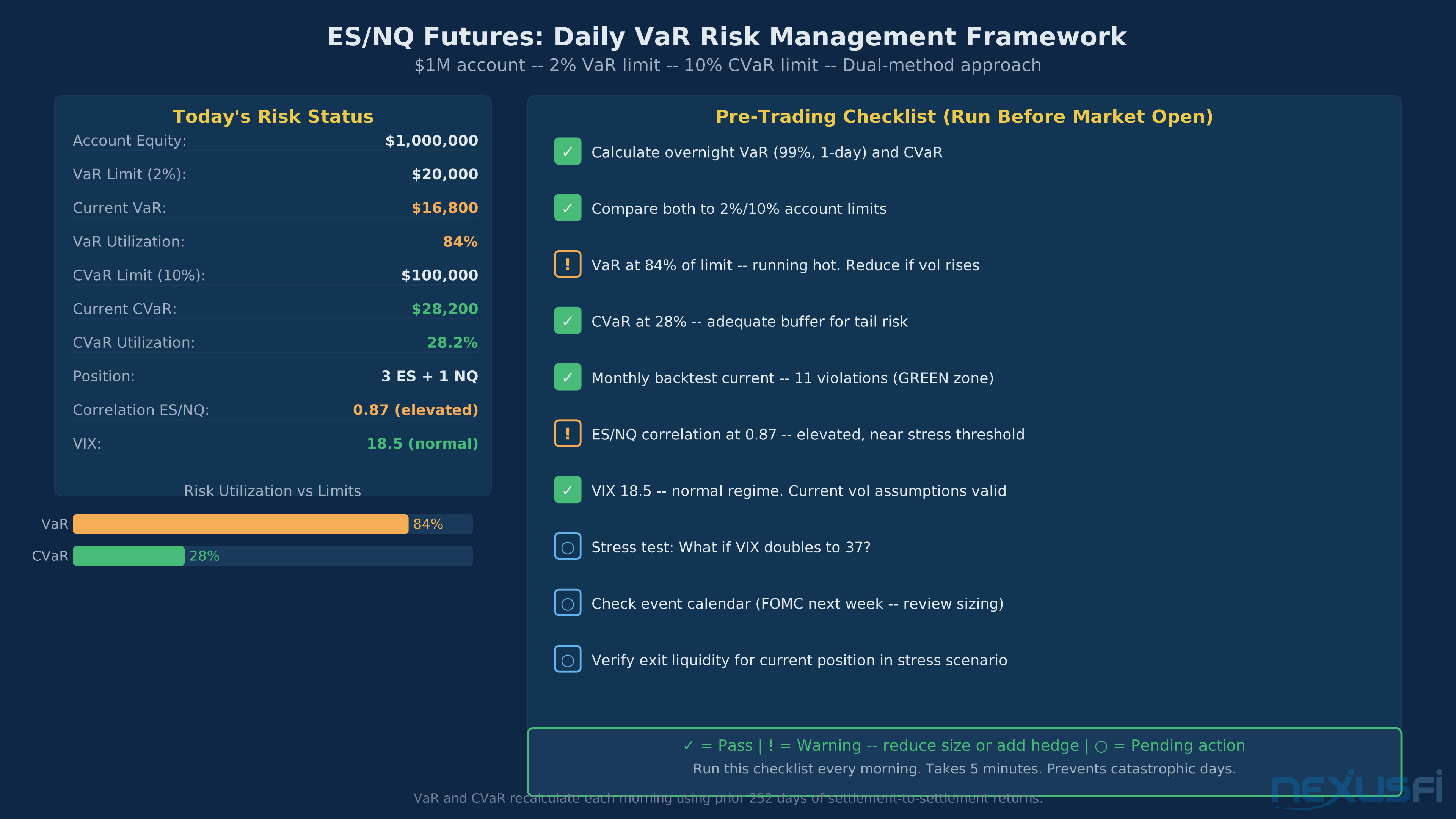
Decision rule. If your stress scenario loss exceeds 2× your VaR, you're carrying too much risk for the current environment. Reduce size or tighten stops before the scenario can materialize.
Practical implementation. Build a simple spreadsheet with your current positions and contract multipliers. Enter the scenario price changes. Read off the P&L. Do this at the start of every trading week, and always before holding through major events (FOMC, CPI, OPEC, EIA inventories).
For related coverage of drawdown dynamics, see Drawdown Management for Futures Trading and Overnight Risk and Gap Management.
Practical Implementation: Day Traders #
Day traders in ES/NQ/CL/GC need a simpler, faster version of VaR that can actually inform real-time decisions.
Intraday VaR approach:
Step 1: Calculate a per-contract 1-day VaR using EWMA historical simulation (63-day lookback, λ = 0.94). Update this number weekly.
Step 2: Translate to M-VaR. Divide by your per-contract margin requirement. Keep M-VaR ≤ 20%.
Step 3: Set a session stop at 0.5× VaR. If your 1-day 99% VaR on one ES contract is $7,000, your session hard stop is $3,500 in losses for that contract. Hit that level, you're done for the day.
Step 4: On event days (CPI, FOMC, major reports), halve your normal position size. You're operating in a different volatility regime, and your VaR estimate is calibrated for normal days.
Position sizing integration.
@jamiej83 worked through the exact decision framework in a position sizing discussion:
The VaR version of this logic: define the maximum daily dollar loss (VaR), then back-calculate the maximum tick stop distance and contract count. If a 12-tick stop on ES costs $600, and your VaR-derived daily limit is $1,500, you have 2.5 round-trips of capacity — which translates directly to contract size decisions.
@PandaWarrior's journal entry captures the real-world implementation:
That 1-2% daily risk budget maps directly to M-VaR limits. 1% of $75K = $750 daily risk budget. If per-contract VaR is $7,000, that budget supports 0.11 contracts — one micro ES, not full-size.
Practical Implementation: Position Traders #
Position traders hold overnight, which introduces gap risk that day trader VaR completely ignores.
Daily VaR approach:
Use 252-day historical simulation (full year) as baseline, supplemented by GARCH(1,1) model for volatility forecasting if you have the tooling. The GARCH model captures the fact that volatility tomorrow is partly predictable from today's volatility — which it is, with significant statistical confidence.
For a realistic 5-day VaR (weekly position trader):
5-day VaR = 1-day VaR × √5 = 1-day VaR × 2.24
This square-root scaling only works when volatility is stable. During volatility clusters, the actual 5-day VaR is often 1.5-2× the scaled estimate. Use the scaled number as a lower bound, not a target.
Overnight risk specifically:
Add a gap risk supplement to VaR. For ES, overnight gaps of 0.5-1% happen regularly around events. For CL, gaps of $0.50-1.50/barrel are common around weekend events or early morning geopolitical news. A simple approach: add 50% of a typical event-day gap to your VaR estimate when holding overnight positions.
Position sizing:
Volatility-based position sizing connects directly to VaR. Calculate the dollar volatility of the position (daily σ × Notional), then size so the weekly CVaR is below your risk budget.
@Fat Tails developed an ATR-based position sizer for NinjaTrader that implements exactly this logic:
The VaR version is the same logic with a confidence level attached. If your ATR-derived stop implies $2,500 per contract risk, and you want that to represent a 2% account risk, you need $125,000 in account equity per contract.
For portfolio management across multiple contracts, see Correlation and Portfolio Risk in Futures Trading and Volatility-Based Position Sizing.
The Full Risk Management Stack #
VaR doesn't exist in isolation. It's one layer of a risk management stack. Here's how the pieces fit together, ranked by practical importance for futures traders:
Layer 1: Stress testing. Scenario-based P&L for discrete adverse events. Updates weekly, mandatory before events. Most actionable, most immune to model error.
Layer 2: CVaR/Expected Shortfall. Tail-average metric that captures what VaR misses. Use at 97.5% or 99% confidence. Informs stop-loss buffer sizing and capital allocation.
Layer 3: VaR. Statistical measure of typical tail risk. Useful for day-to-day position sizing and M-VaR calculations. Must not be used alone.
Layer 4: Margin-adjusted VaR (M-VaR). VaR as a fraction of margin. Hard limits: 20% for day traders, 30% for position traders. The most direct leverage control metric.
Layer 5: Hard stop-loss logic. Execution-level protection. The VaR number informs where stops should be, but the stop itself is the ultimate protection.
Layer 6: Drawdown-based shutdown rules. At the account level, define maximum drawdown limits that trigger a trading halt. See Consecutive Loss Protocols and Trading Shutdown Rules for the framework.
The risk management failure mode isn't "not knowing what VaR is." It's relying on one metric without understanding what it misses. The 2008 financial crisis was partly a failure of risk managers who treated VaR as a complete risk picture rather than a single lens.
Quick Reference: VaR Checklist for Futures Traders #
Before entering a position:
- Calculate 1-day 99% VaR per contract (historical simulation, EWMA-weighted)
- Check M-VaR: is it ≤ 20% (day trader) or ≤ 30% (position trader)?
- Run the scenario stress test for this contract/direction
- Confirm session stop is set at 0.5-1× VaR
Weekly tasks:
- Recalibrate VaR estimates with fresh volatility data
- Run the full stress scenario set
- Check if parametric and historical VaR estimates are converging or diverging (divergence = regime change signal)
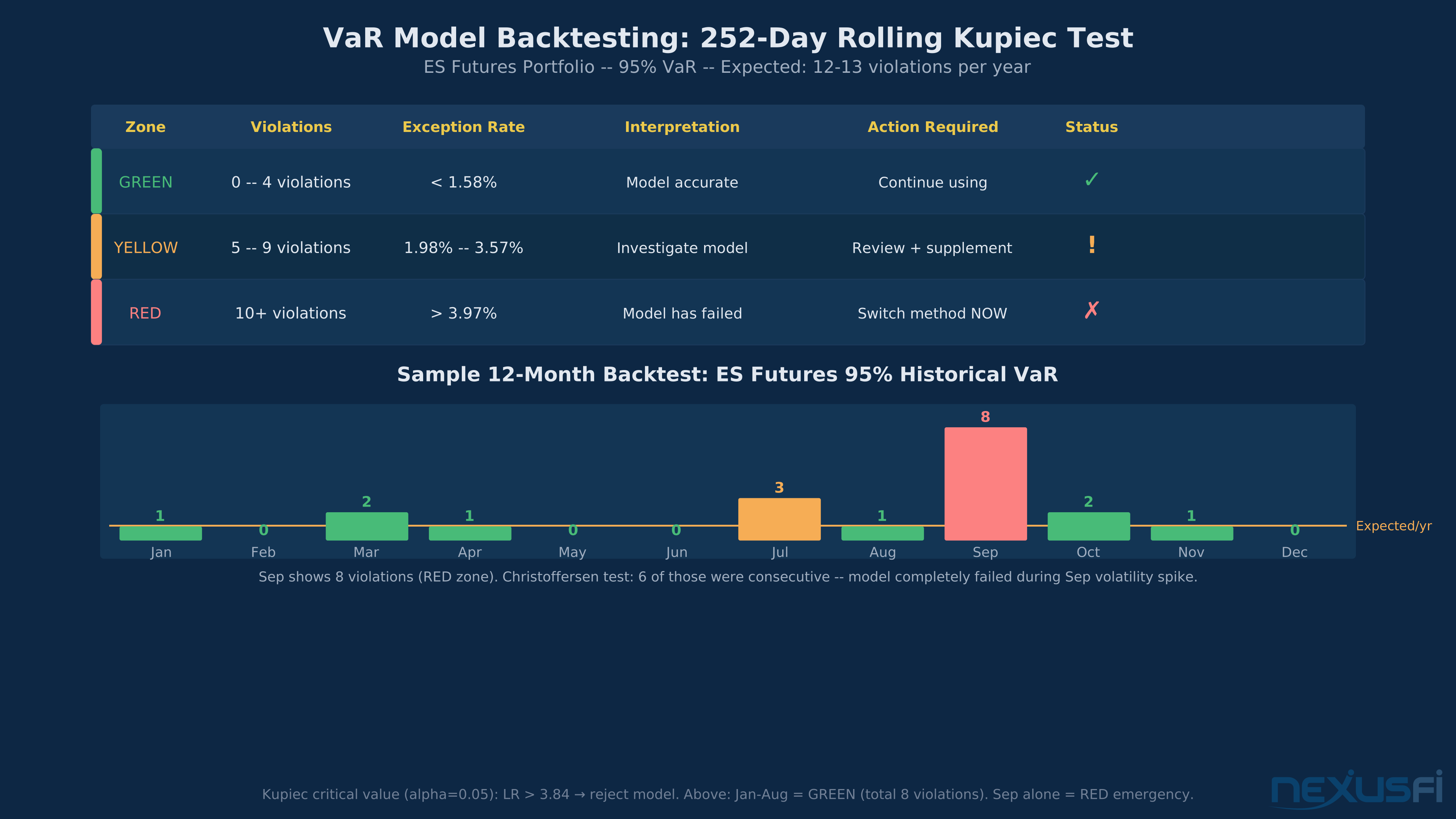
- Backtest breach rate: are your 95% VaR estimates being exceeded ~5% of days, or more often?
Event day protocol:
- Reduce position size to 50% normal before major announcements
- Widen VaR estimates manually by 1.5-2× for event windows
- Set tighter stop-loss at 0.4× normal VaR estimate
- No new positions within 30 minutes of scheduled high-impact releases
Red flags (reduce size immediately):
- M-VaR exceeds 25% for day traders
- Stress scenario loss exceeds 2× VaR
- VaR breach rate exceeds 7-8% (model is systematically wrong)
- Volatility regime shift detected (EWMA vol suddenly doubles)
The number that matters isn't the VaR alone. It's whether your position size survives the tail event that your model didn't predict.
Knowledge Map
Go Deeper
Build on this knowledgeReferences This Article
Articles that build on this topicCitations
- — The Scalper's Journey (2016) 👍 9“VaR does not really determine where stops should be - one of the negatives of the standard VaR models is that they assume that the return distribution holds through different regimes”
- — Concerning risk per trade sizing (2012) 👍 18“Position sizing has 2 key elements - 1) number of ticks risked 2) $ amount risked. 0.5% is an optimal bet size for me per trade, as if I have 2 consecutive losers I hit my daily loss limit”
- — PositionSizer for ninjatrader (2010) 👍 17“I assume that the ATR(36) of the 5 min chart is a reasonable value for my money management stop-loss. Starting from these values I calculate the stop loss in ticks and the number of contracts”
- — The Program (2020) 👍 14“I risk a dollar in crude oil, $10 in gold, 20 points in ES, and half a euro in the euro. I use a hard stop every time, no exceptions”
- — understanding margin & leverage in emini and futures (2017) 👍 3“Please do not trade with real money until you first understand the leverage ramifications of the instrument you are trading. The leverage allowed does depend on your broker”
- — Risk of trading micro futures (2020) 👍 3“A contract controls $145,000. With a $500 intraday margin, you are trading at 290:1 leverage. This is dangerous, not much different than OTC forex dealers who offer similar levels”
- — Account blown up (2015) 👍 17“I blew up my day trading futures account 3 times. The last time was in 2009 when I put on a few large ES shorts. I moved my stops. Total idiot move and I knew better. I lost $125K on a $150K account”
- — The Pandawarrior Chronicles II (2014) 👍 20“I plan on using 1% of the account or $1500 as my per day initial risk for scalping and up to 2% for swing trading. For day trading I will size based on the stop size”
- — Martin's Price Action Journal (2019) 👍 5“With the recent volatility and the introduction of the MES, it seems like a good time to discuss position sizing. Al says you should keep your risk the same on each trade”
- — Understanding Margins
- — Value at Risk (VaR) definition