



Value Area (VAH & VAL)
The price range where 70% of volume traded — defining where the market accepted value
Overview #
The Value Area is the price range containing 70% of the session's traded volume. It answers the most fundamental question in auction market theory: where did the market agree on value? Every price inside the VA saw enough two-sided participation that business got done there. Prices outside the VA were explored and rejected — either too cheap (below VAL) or too expensive (above VAH) for that session's participants.
The top edge is VAH (Value Area High). The bottom edge is VAL (Value Area Low). Between them sits the range where the bulk of the auction resolved. The POC (Point of Control) lives inside the VA as the single price with the most volume — the VA is built outward from it.
[2] That magnet effect is real. When the market drifts away from value and can't find acceptance at new prices, it gets pulled back.
The Value Area brackets where business got done. VAH and VAL are the edges of accepted value. Price outside those edges is either finding new value or getting rejected back inside.
How the Value Area Is Calculated #
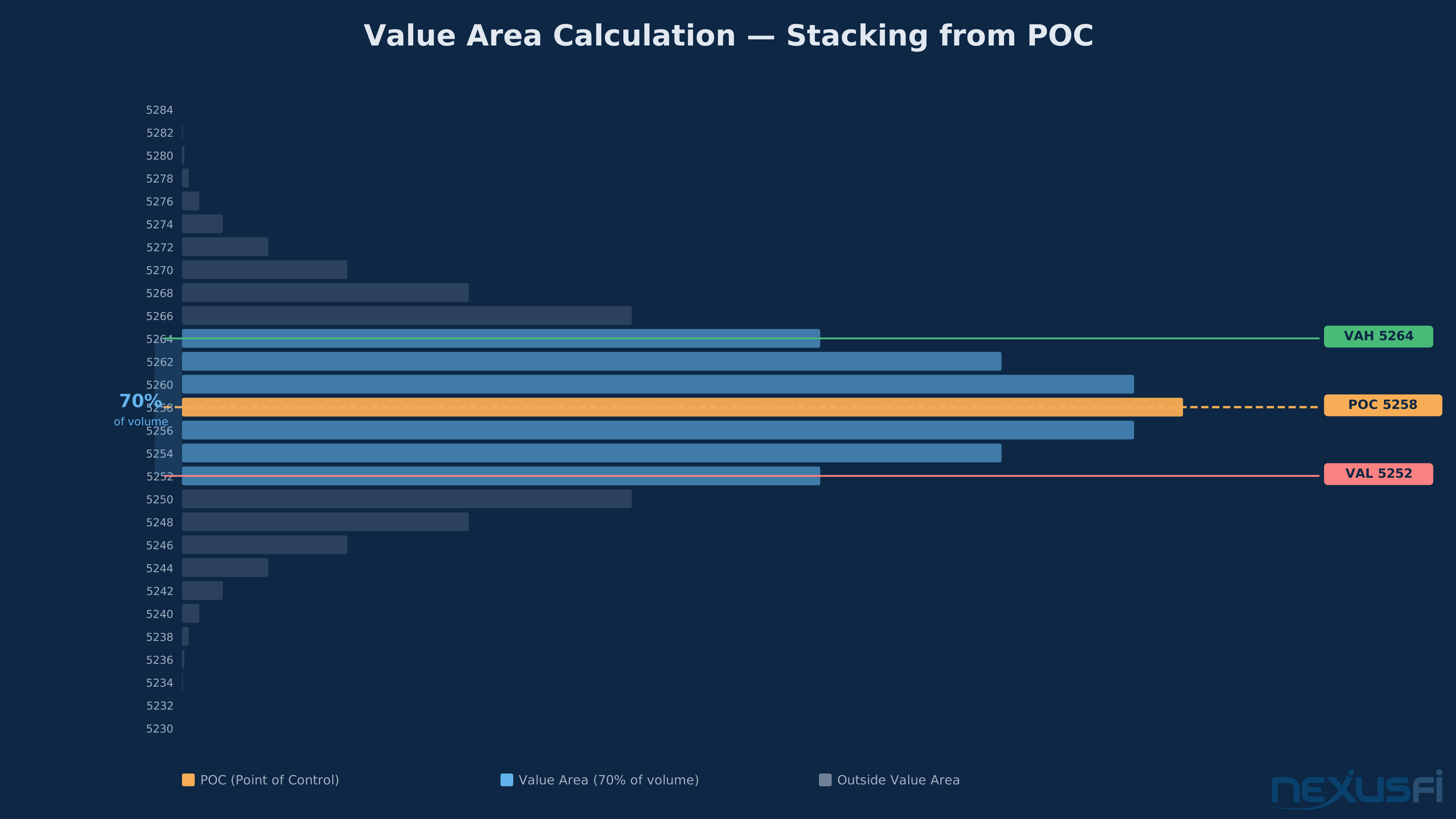
The calculation starts at the POC and works outward:
- Identify the POC — the price with the highest volume
- Look at the price level directly above the POC and directly below it
- Compare: which side has more volume?
- Add the higher-volume side to the Value Area
- Repeat, alternating based on which side has more volume at each step
- Stop when the running total reaches 70% of the session's total volume

Because the algorithm alternates based on which side has more volume, the VA is almost always asymmetric. The POC rarely sits at the midpoint. If buying was aggressive above the POC but responsive below, the VA will extend further above. This asymmetry is information — it tells you which side of the POC attracted more participation.
[1] He combines VA with the prior day's high and low to create a "fighting arena" — predefined zones where price reactions are expected.
The 70% Threshold — Where It Comes From #
— one standard deviation of a normal distribution. [3] When Peter Steidlmayer introduced Market Profile at the CBOT in 1985, PCs weren't readily available for exact calculations. He used Time Price Opportunities (TPOs) from 30-minute bars and set the threshold at 70% because it was close enough to one standard deviation and simple to compute by hand.
The 70% number is a convention, not a law. Some traders use 68.2% for a tighter zone that aligns precisely with one standard deviation. Others use 80% for a wider boundary. Most platforms default to 70%, most VP traders reference 70%, and most published analysis assumes 70% — so that's the standard for comparing notes across the community.
Don't get fixated on the exact percentage. The concept matters more than the fifth decimal place. Whether you use 68.2% or 70% or 72%, the VA defines the zone where the bulk of business got done. Consistency within your own analysis matters more than the specific threshold.
Three Methods for Calculating Value Area #
@Fat Tails identifies three distinct approaches: [3]
Steidlmayer's original method — Built around the mode (POC). This is what most platforms implement. The VA captures the highest-volume cluster around the most-traded price. Strength: identifies the volume concentration. Weakness: the POC can sit far from the session's average price, and the VA can miss important consolidation areas during multimodal sessions.
Standard deviation method — Built around the mean (VWAP). Uses one standard deviation above and below the volume-weighted average price. This is statistically cleaner and tracks closer to the session's center of gravity. Strength: stable, doesn't jump around as the session develops. Weakness: doesn't anchor to the volume peak.
Median absolute deviation method — Built around the median. Adds price levels above and below the median until 35th percentiles are reached on each side. Strength: the most stable developing reference point. Weakness: least commonly used, harder to find platform support.
Most traders use Steidlmayer's method because that's what their platform computes. The differences matter most on multimodal days — sessions with two or three distinct volume clusters. On clean D-shaped days, all three methods produce similar results.
When the Value Area Matters -- and When It Doesn't #
The VA is a powerful reference in balanced markets. It becomes unreliable in imbalanced ones. Knowing the difference is the entire game.
Balanced Markets: VA Is Your Map #
@josh nails the distinction: "When a market is in balance, the profile will often be very gaussian/normal/bell shaped. In this situation, the VAH/VAL represent a meaningful representation of one standard deviation, 'value,' at least as it pertains to the existing data set." [4]
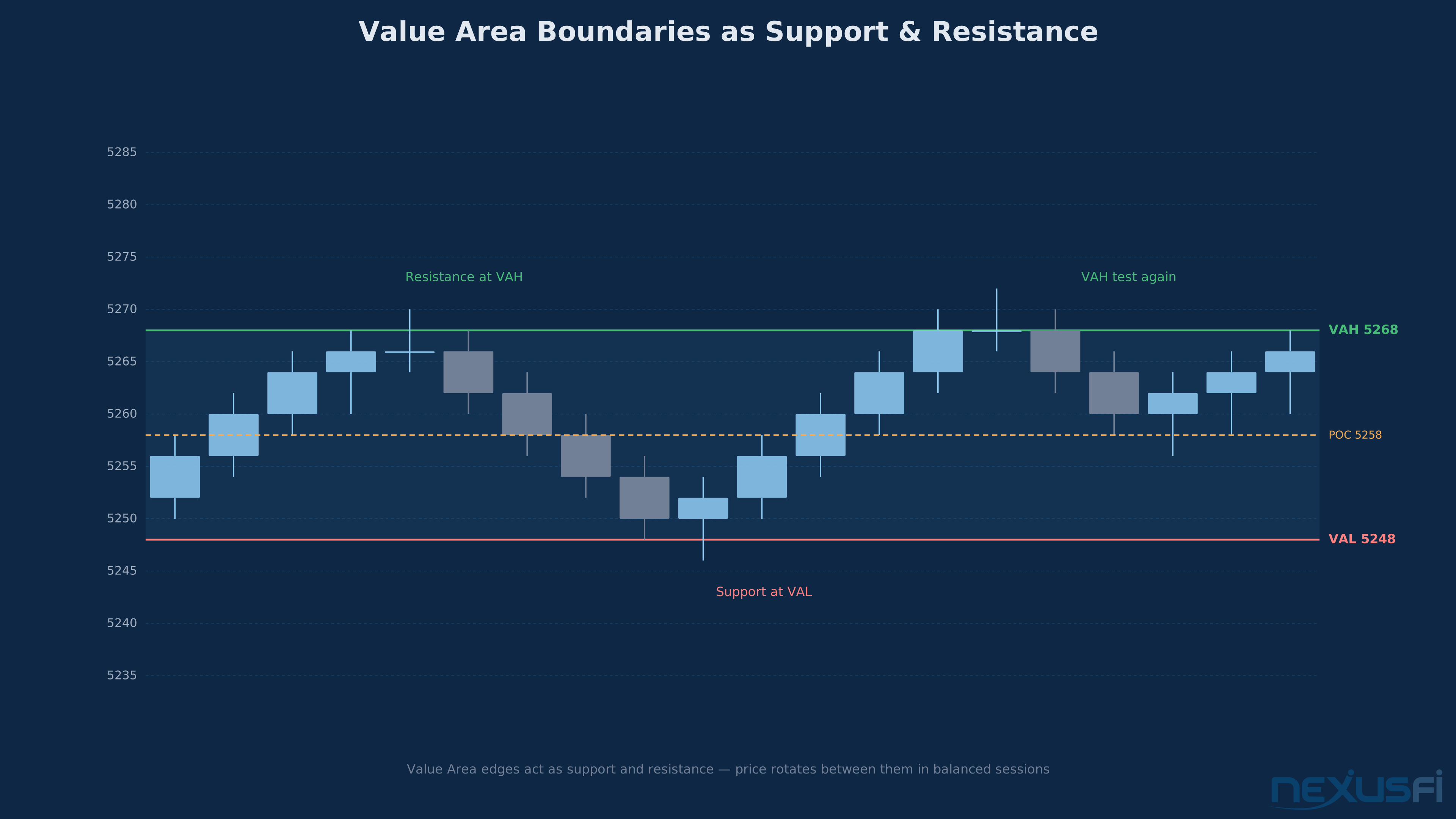
In balance, the VA tells you where to trade:
- Fade at VAH — responsive sellers step in at the top of value, targeting POC
- Fade at VAL — responsive buyers step in at the bottom of value, targeting POC
- POC as magnet — trades initiated from the edges gravitate toward the center of the distribution
- VA edges as zones — not exact prices, but zones where the probability of responsive activity increases
[5] That's the fade trade in a sentence — price leaves value, gets rejected, and rotates to the opposite edge.
Imbalanced Markets: VA Is Stale #
@josh continues: "For a distribution that is imbalanced, and shows no consensus on actual value, then the VAH/VAL is meaningless — if value itself is unclear, how can a derivation of value be determined?" [4]
On trending days, the prior session's VA is a reference for where value was, not where it is. Price leaves the old VA, builds volume at new levels, and establishes new value. Fading VAH or VAL in a trending market gets you run over.
[5] The old VA edge acts as a pullback level, not a reversal level. Price bounces off it and continues in the trend direction.
Multimodal Days: VA Can Mislead #
When the session prints two or three distinct volume clusters (a bimodal or trimodal distribution), the VA calculation forces a single range around the POC. This can capture one cluster completely while cutting through or missing others.
@Fat Tails demonstrated this problem with a developing VA indicator: on a session with three volume peaks, the Steidlmayer method included the smaller early-session clusters but only partially captured the largest afternoon cluster — the most important one — because the POC sat in the middle peak. [6]
The fix isn't to abandon VA on multimodal days. It's to use your eyes alongside the computed levels. If the profile shows two obvious clusters with thin volume between them, the VA boundaries may not capture what matters. Mark the HVN edges of each cluster separately and treat those as your real support/resistance zones.
The VA calculation is mechanical. It doesn't know whether the distribution is normal, skewed, or multimodal. You do. When the profile shape is clean and bell-curved, trust the VA edges. When it's fragmented, supplement with visual node analysis.
Trading with the Value Area #
Prior Day's VA as a Framework #
The most common VA application: mark yesterday's VAH, VAL, and POC before the RTH open. Where price opens relative to these levels sets the session's initial framework.
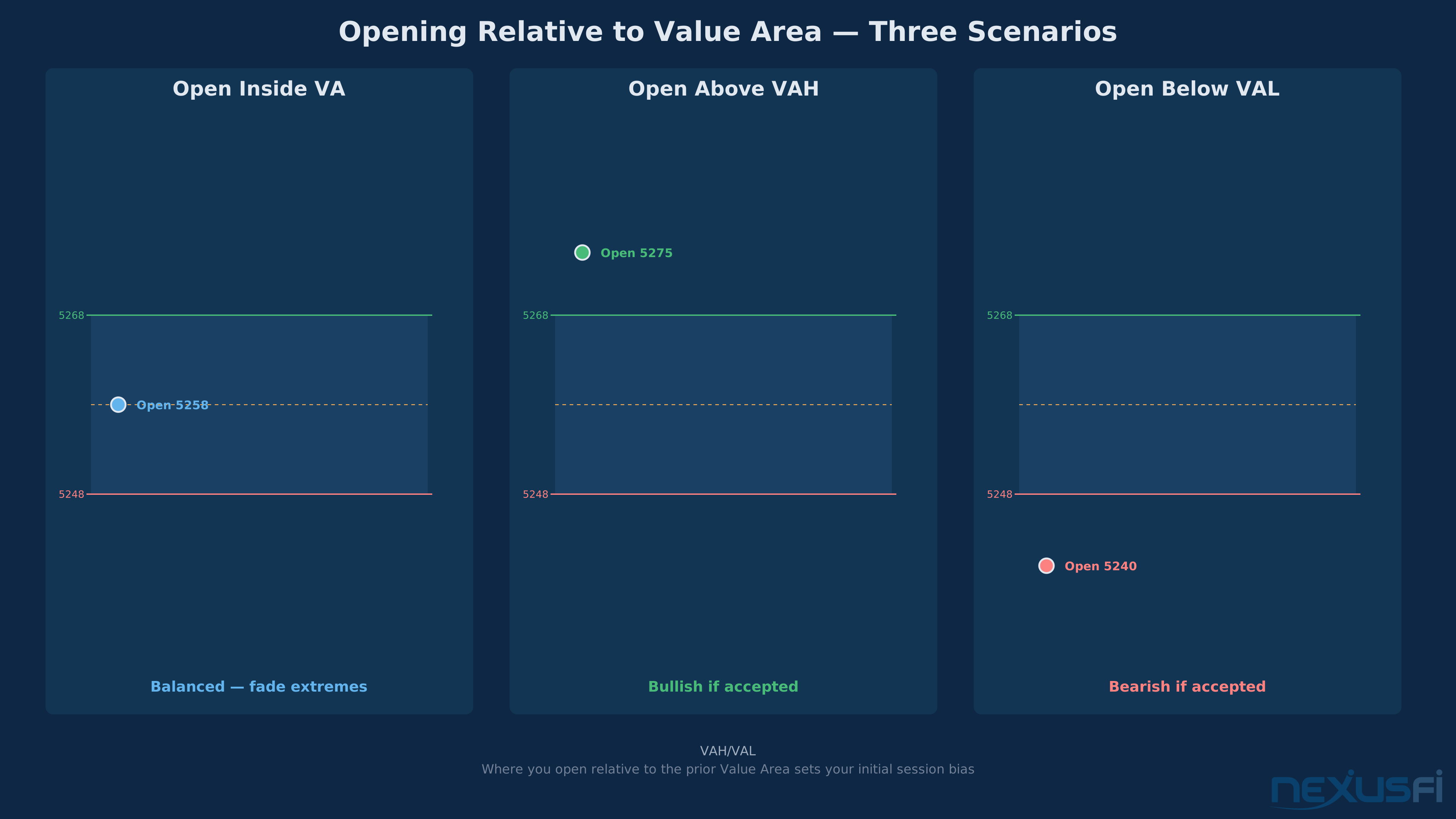
Opening inside prior VA — Default assumption is balance. The market is accepting yesterday's value as today's starting point. Lean toward rotational setups — fade the VA edges, target POC.
Opening above prior VAH — Potential imbalance higher. Buyers are willing to pay prices the prior session rejected. Watch for acceptance (volume building above VAH) or rejection (quick return below VAH). Acceptance above means the old VAH becomes support. Rejection above means it was a probe.
Opening below prior VAL — Potential imbalance lower. Same logic inverted. Watch for acceptance or rejection below the old VAL.
Value Area Migration #
When the VA shifts directionally across sessions, the market is repricing. Track it by overlaying consecutive sessions' VA ranges:
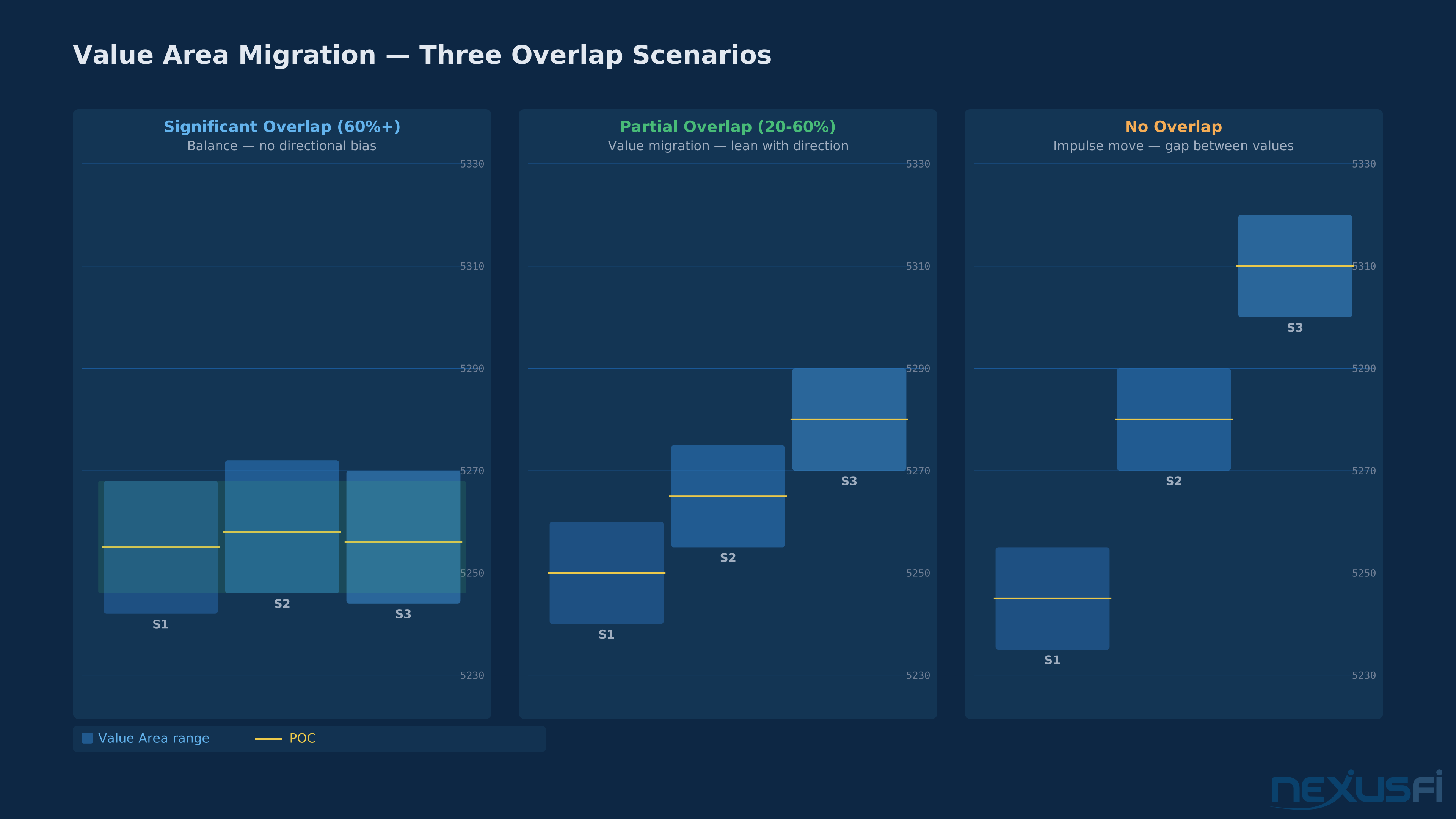
- VAs overlapping much (60%+) — Balance. The market hasn't decided to move yet. The overlapping zone is high-conviction value.
- VAs overlapping partially (20-60%) — Value migration. The market is repricing in a direction. Lean with the migration direction on pullbacks.
- VAs not overlapping — Impulse move or gap. The market jumped to a new level without building a bridge. These moves often get partially retraced as the market fills the gap between old and new value.
The 80% Rule #
The classic heuristic: if price opens outside the prior VA, re-enters, and sustains inside for two consecutive 30-minute periods, there's high probability it will rotate to the opposite VA edge. The "80%" label is Market Profile folklore — community backtests show the setup is more subtle than the textbook claims. When you define the criteria rigorously, it doesn't trigger often. But the underlying logic is sound in balanced conditions: price returned to value and couldn't push back out, so gravity pulls it through.
Don't trade it blindly. Pair it with the developing profile — if the VPOC is building inside the old VA after re-entry, the rotation thesis has structural support. If the VPOC stays anchored near the re-entry edge, the market might still push back out.
Developing VA During the Session #
The developing VA — the VA calculated from the current session's data as it prints — is your real-time compass.
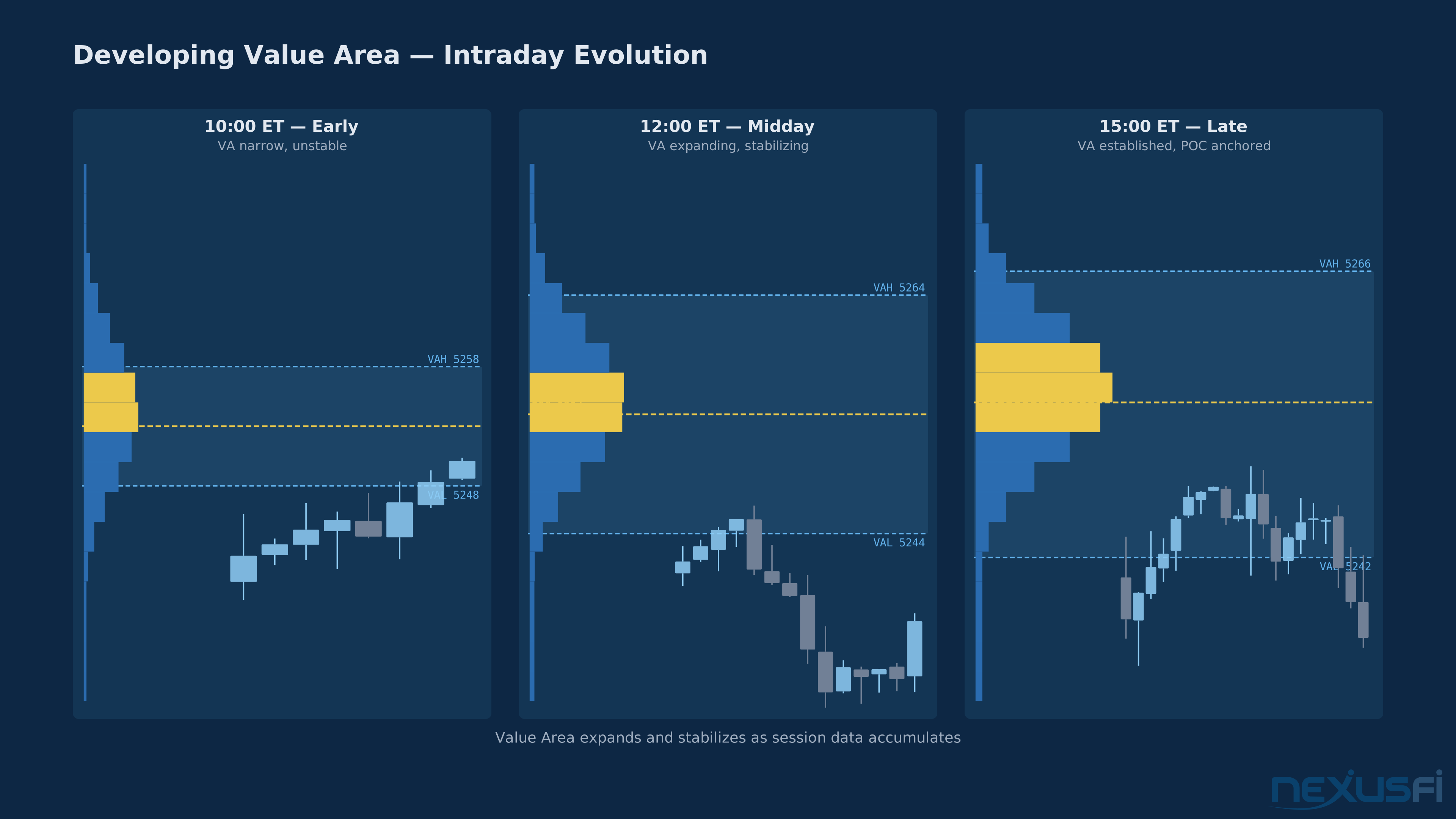
- Developing VA expanding — The market is finding new accepted value. The expansion direction tells you where business is building.
- Developing VA stable — The market has established a range and is rotating within it. Balance regime until the VA breaks.
- Developing VPOC migrating — Directional conviction. If the VPOC migrates higher and the developing VA follows, the market is repricing upward in real time.
Watch the developing VA alongside the prior session's levels. When today's developing VA overlaps yesterday's — value is stable. When today's developing VA shifts entirely above or below yesterday's — value has migrated.
VAH and VAL are your starting framework at the open. Whether price accepts or rejects these levels determines your session thesis — balance (fade) or imbalance (lean with direction). The developing VA during the session tells you if the thesis is holding.
Common Mistakes #
Treating VA edges as exact prices. VAH and VAL are zones, not lines. Price doesn't reverse at 5260.00 because your VA says 5260.00. It reverses in the general area because the volume distribution thins out there. Place orders across a zone, not at a single tick.
Using VA on the wrong timeframe. A 5-minute chart's VA from 10:00 AM has almost no statistical significance — the sample size is too small. VA becomes meaningful with enough data points. Prior day RTH VA is the standard reference. Weekly or monthly composites provide structural context.
Ignoring the session type. RTH VA, ETH VA, and 24-hour VA produce different numbers from the same data. RTH VA is the standard because that's when the majority of volume trades and the primary auction runs. The 24-hour VA overweights overnight activity and produces wider, less useful boundaries.
Fading VA edges in a trend. If the market is trending, yesterday's VA is history. The old VAH isn't "resistance" — it's a pullback level that price bounces off before continuing higher. Reading balance where imbalance exists is the fastest way to give back a week's P&L in a single session.
Knowledge Map
Go Deeper
Build on this knowledgeReferences This Article
Articles that build on this topicCitations
- — Crude Oil trading (2012) 👍 21“The VAL and VAH is the range where the 70% of the action happened in the previous day. The POC is the price at which the most TPOs occur.”
- — Making a Living with the Micros (2021) 👍 21“VALUE is the area where the buyers and sellers tend to agree on price, and is usually a big magnet. Prices can stay near the same value area for days or even weeks at a time.”
- — Volume Profile Value Area Definition? (2017) 👍 15“The 70% suggested by Steidlmayer came close to 68.3%, the value favored by the academic world. However, if you compare his method to the basic concept mean +/- 1 standard deviations, there are differences.”
- — Volume Profile and Footprint discussion (2015) 👍 14“When a market is in balance, the profile will often be very gaussian/normal/bell shaped. In this situation, the VAH/VAL represent a meaningful representation of one standard deviation.”
- — Spoo-nalysis ES e-mini futures S&P 500 (2012) 👍 14“During a rotational day, the value area should encompass a majority of the day's activity. Whenever price exits value, it finds responsive buying or selling which often takes price to the other extreme.”
- — Volume Profile and Footprint discussion (2012) 👍 25“I have tried to visualize the developing value area by coding an indicator which displays it. The rules specify that the value area be established starting with the mode and then progressing to the price levels with the highest pro-rata volume.”