



Failed Auction
**When the market reaches for a new level and gets slapped back
Overview #
A failed auction is an acceptance failure. Price extends beyond a reference level
This isn't just a wick on a candle chart. A wick tells you price touched a level. A failed auction tells you the market tried to establish value at that level and was rejected. The distinction matters because failed auctions leave structural evidence
The concept traces back to Ray Barros, who defined it as "a single print at one end of the profile occurring after the Initial Balance that is followed by a Range Extension at the opposite end." As @Mercury documented after manually backtesting over a year of Nifty Futures data, roughly 74% of failed auctions get revisited within five trading days.[1]
How Failed Auctions Form #
Failed auctions share a common DNA: the market explores a new price neighborhood, finds no interest, and retreats. The specific trigger varies.
IB Breakout Failure #
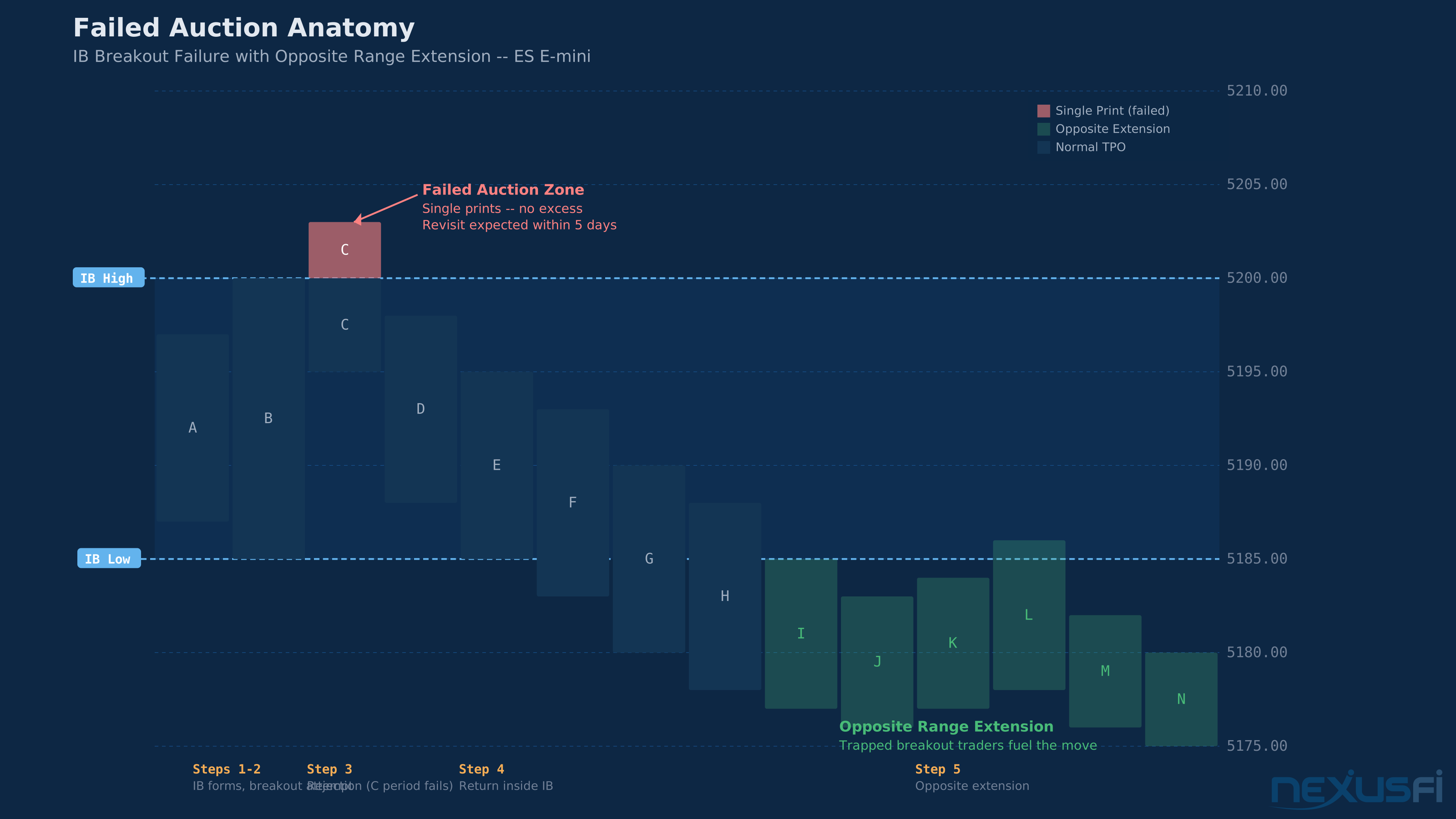
This is the bread and butter. The Initial Balance forms over the first 60 minutes of RTH. Price breaks through the IB high or low, attracting breakout traders and triggering stops. Then it stalls.
Here's the sequence:
- IB establishes
- Breakout
- Stall
- Return
- Retest failure
- Opposite extension
The failed IB breakout is so common because the IB boundary concentrates stops and breakout orders. When those get triggered but no sustained initiative follows, the market has tested the waters and found them cold.
ES example: IB high at 5200.0. Price spikes to 5203.0 around 10:15 ET. Within 25 minutes, it's back below 5200. The next attempt to trade above 5200 gets absorbed immediately. Traders who faded the failure target the IB midpoint at 5190, then the IB low at 5180.
Prior Session Extreme Test Failure #
Overnight or early-RTH, price probes the prior day's high or low
This failure hits harder when price barely exceeds the prior extreme before retreating. A 1-2 tick penetration with immediate rejection says the market tested the level, found no responsive sellers (at a low) or buyers (at a high), and moved on.
[2]
News-Driven Spike Rejection #
Common in CL and NQ. A data release
CL caution: Crude is notorious for headline-driven false failures. A stop-run spike that reverses can look exactly like a failed auction but may just be a momentary liquidity vacuum. In CL, wait for structural confirmation
Structural Signatures #
Failed auctions leave fingerprints on the chart. Three signatures to watch for.
Single Prints on TPO Charts #
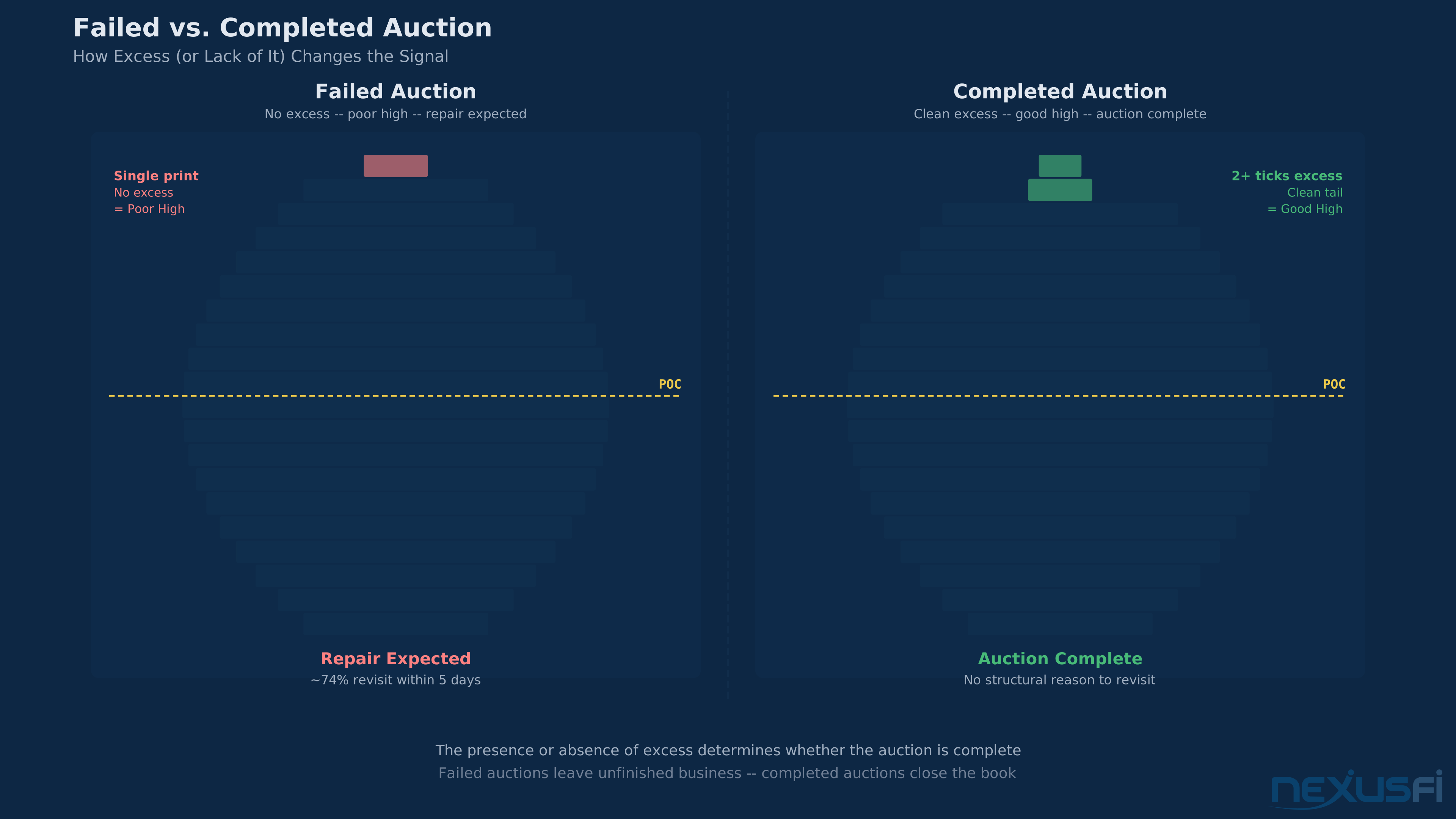
A single print is one TPO period trading at a price level
Single prints at the extreme of a failed auction are evidence of rejection, not a standalone signal. They tell you the extension was fast, thin, and unsustained. The market printed there once and never came back.
[3] The presence of single prints at a failed extreme, with no clean excess beyond the profile body, is the classic TPO signature of an incomplete auction.
Poor Highs and Poor Lows #
Poor structure is what the failed auction leaves behind. A poor high has multiple overlapping prints at the top with no decisive rejection tail
The distinction: failed auction is the process; poor structure is the result. Not every poor high comes from a classic IB breakout failure
Why this matters for trading: poor highs and lows are repair targets. The market left unfinished business at that level, and the auction process tends to come back and complete it.
[3]
Volume Profile Appearance #
On a volume profile, the failed auction zone shows:
- Thin volume at the extreme
- Sharp volume cliff
- No POC migration
If the market had truly accepted the new level, you'd see volume accumulating beyond the reference, the value area expanding, and the POC shifting. Their absence is the volume profile's way of saying "nobody wanted to trade there."
Confirming With Order Flow #
Structure tells you what happened. Order flow tells you it's happening right now.
Absorption at the Extreme #
Price reaches the breakout level but can't push through despite aggressive orders hitting. The DOM shows repeated lifting of offers (at a high) or hitting bids (at a low) with no progress. Passive liquidity absorbs the initiative. Price goes nowhere despite volume.
This is the strongest real-time confirmation. If the breakout had legs, aggressive orders would move price. When they don't, someone big is absorbing the flow.
Exhaustion of Initiative #
The breakout side runs out of steam. Each successive push produces less range extension. The initial burst that broke the IB was 4 ticks; the next attempt is 2; the next is 1. Diminishing initiative is the market telling you the breakout participants are running out of ammunition.
Delta Divergence #
Price makes a new high but cumulative delta doesn't confirm. Or delta flips rapidly from buy-dominant to sell-dominant at the extreme.
[4]
That 1.5-3x ratio is a practical threshold. Strong rejection shows aggressive participation on the reversal side. Weak rejection
Instrument-Specific Notes #
ES/NQ: Footprint and delta confirmation work well here. DOM absorption patterns are readable. NQ produces sharper traps and faster reversals than ES
CL: Highest caution. Headline-driven spikes can mimic failed auctions but are often just liquidity vacuums. As @Private Banker explains, incomplete auctions in CL occur "where we will see a high or low of a bar that exhibits volume printing on both the bid and the ask"
The 5-Day Repair Window #
Failed auctions create unfinished business. The market tends to come back and complete it.
@Mercury's manual backtest of over a year of Nifty Futures data showed approximately 74% of failed auctions were revisited within five trading days.[1] The methodology: identify single-print extensions beyond the IB followed by opposite-side range extension, then track whether price revisited the failed extreme within 5 RTH sessions. Ray Barros, who originated the concept, framed it as "Market Profile Theory suggests we ought to see a Failed Auction's price within 5 trading days."
Context matters for that 74% number. In balance-dominated regimes where markets rotate within multi-day ranges, the revisit rate is higher
This is a probabilistic tendency, not a mechanical rule. The 5-day window gives you a time horizon for expecting repair, but the actual timing depends on:
- Volatility regime
- Trend strength
- Instrument
- Higher timeframe context
What "repaired" actually means: the market trades back through the failed auction zone and spends time there. Volume accumulates. The thin, single-print area gets filled in with genuine two-sided trade. The inefficiency is neutralized
When Failed Auctions Don't Work #
Failed auctions are reliable, not infallible. Here's when the pattern breaks down.
Trend day overruns. On a strong initiative day where the prior 2-3 sessions already showed acceptance outside the prior range in the same direction, an IB breakout that "fails" and pulls back may just be a normal rotation before continuation. The market probes back inside the IB briefly, traps faders, and then rips through the IB boundary with real conviction on the second attempt. If the higher timeframe auction is clearly directional, give the trend priority over the local failed auction signal.
Liquidity vacuum spikes (especially CL). A news-driven spike that immediately reverses isn't necessarily a failed auction
Partial acceptance forming. Sometimes what looks like a failed auction early in the session becomes accepted territory later. If 15+ minutes of two-sided trade develops at the "failed" extreme, with volume accumulating and POC beginning to migrate, the auction isn't failing
Second failure within session. When the market fails at the same extreme twice in one session, the pattern destabilizes. The first failure set up shorts; the second failure set up more shorts; if the market then breaks through on a third attempt, the trapped short inventory fuels a violent continuation. Two failures at the same level within a session is a warning sign, not a stronger fade signal.
Signal Priority #
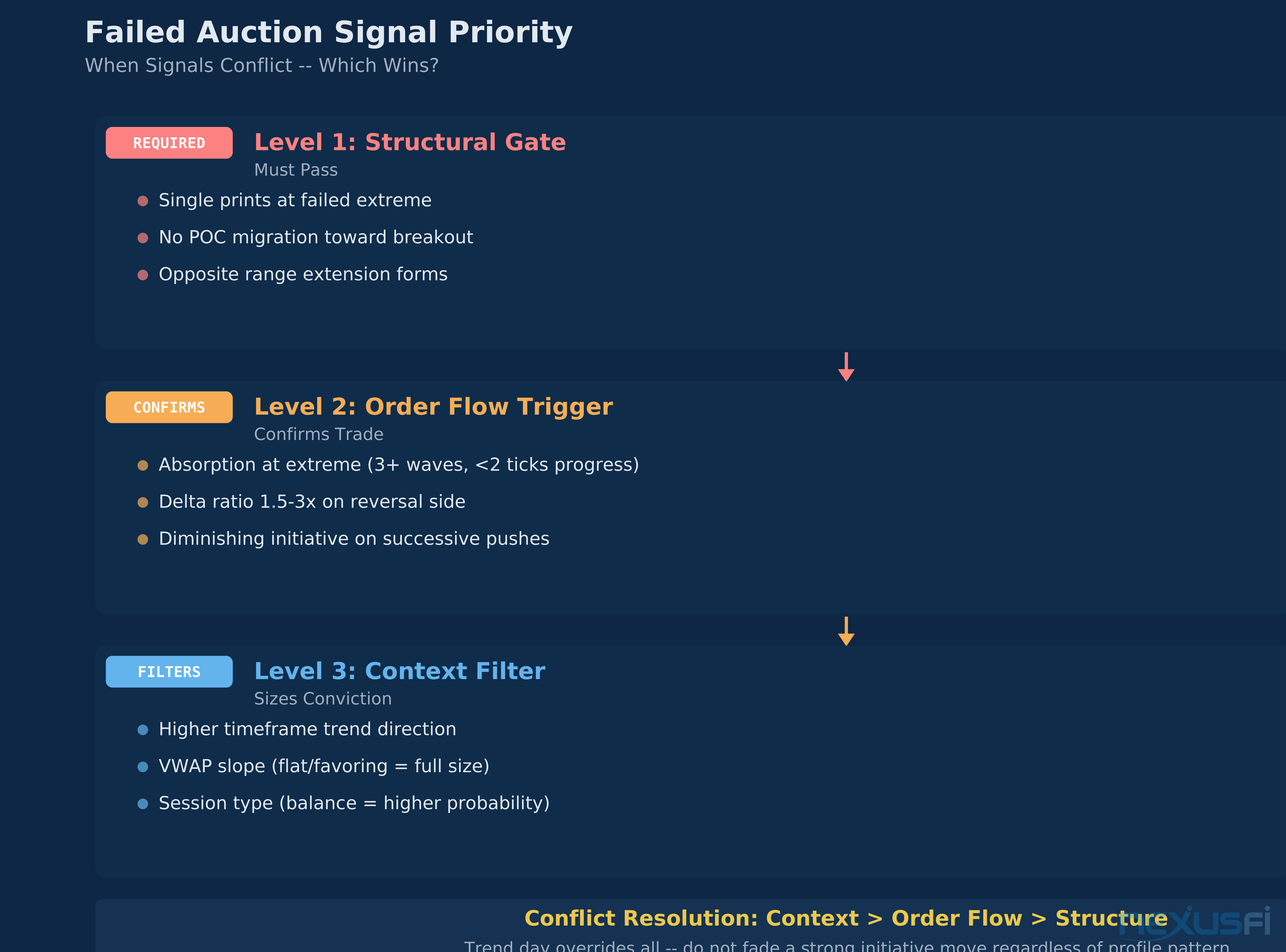
Not every signal will agree. Use this hierarchy:
**Level 1
**Level 2
**Level 3
Conflict resolution rules:
Trading the Failed Auction #
Same-Day Fade #
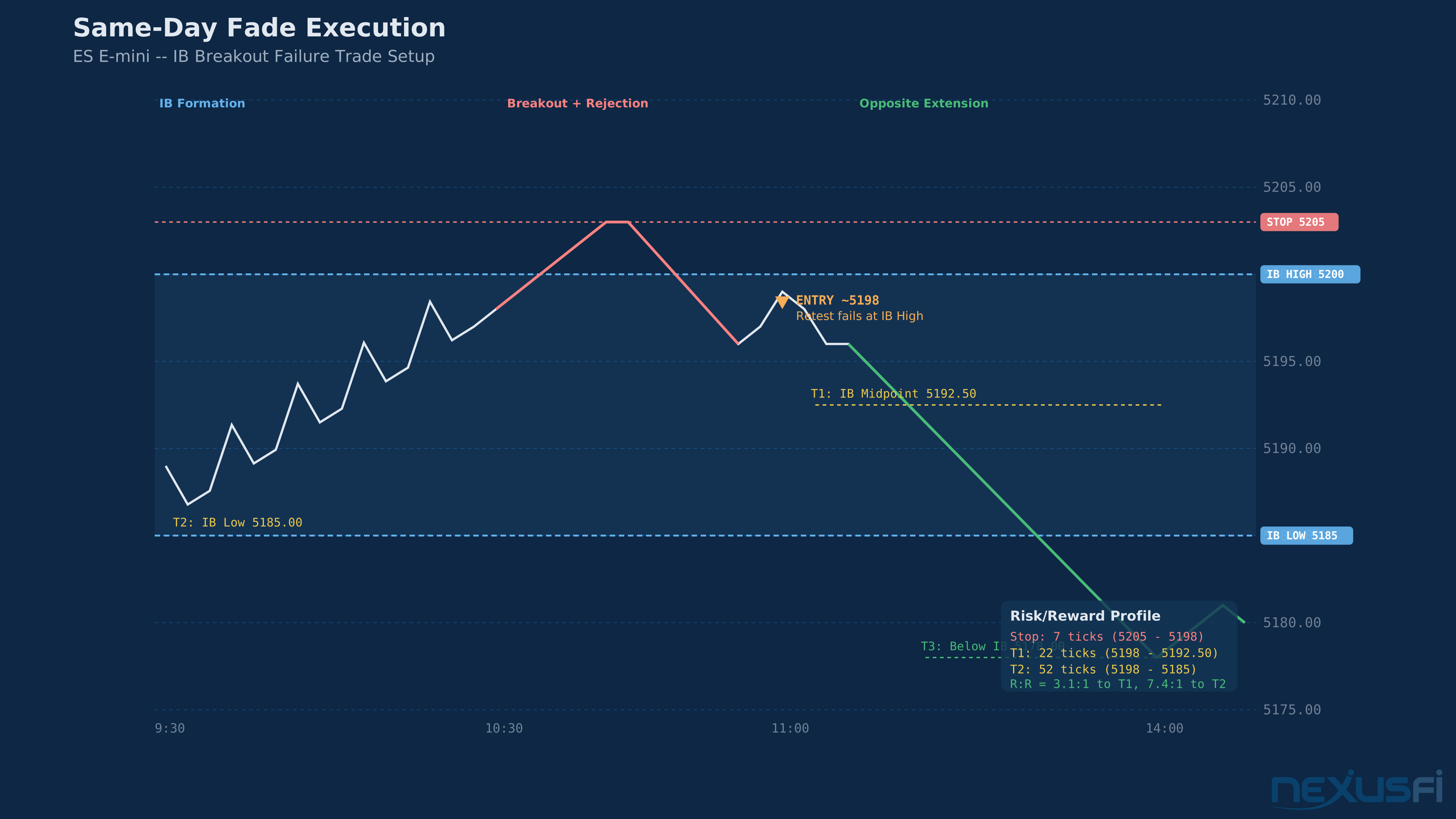
The highest-probability intraday application. Once the IB breakout fails and price returns inside the range:
- Confirm structure: Single-print extension beyond IB with no excess. Price returned inside IB within 30 minutes of breakout.
- Wait for retest: Price attempts to reclaim the IB boundary. Watch for absorption on the DOM
- Entry: Short (if failed high) or long (if failed low) as the retest stalls. In ES, this typically means entering within 2-4 ticks of the IB boundary on the second or third failed push.
- Stop: 2-3 ticks beyond the single-print extreme. In ES, if the failed auction high was 5203.0, place stop at 5205.5-5206.0. Keep stops tight
- Target sequence: IB midpoint (first partial, take 1/3 off), then VWAP (second partial), then opposite IB boundary (remainder). In the 5200 example: partials at 5190, 5185 (VWAP), runner to 5180.
- Invalidation: Price reclaims the breakout level and holds for 10+ minutes with volume building. POC begins migrating beyond the IB. Exit immediately.
Expectancy framing: With a typical ES stop of 6-8 ticks and a first target at the IB midpoint (often 10-15 ticks away), even at a conservative 60% win rate the math works: (0.60 x 12) - (0.40 x 7) = 4.4 ticks expected per trade. The 74% revisit probability from @Mercury's research[1] applies to the 5-day window, not the intraday fade
Multi-Day Repair Trade #
Map the failed auction zone
- Entry: As price approaches the failed auction zone on a subsequent session, confirmed by initiative order flow in the repair direction
- Confirmation: Prior day auction direction favoring the repair, higher timeframe balance tilting toward the failed zone
- Target: The exact price level of the failed auction extreme
- Risk: The repair may not come within the window. If 5 sessions pass without a revisit, close the trade. The remaining 26% of failed auctions that don't repair within the window often get absorbed by stronger directional trends.
When It Doesn't Work #
ES, IB failure on a trend day: IB forms 5180-5200. Price breaks above to 5203, pulls back to 5198, and you short the retest at 5200. The first 20 minutes look perfect
The lesson: trend days make failed auction faders look foolish. When the prior 2-3 sessions showed clear directional acceptance and the current session opens with initiative continuation, reduce your confidence in any IB failure signal by at least half.
Citations #
[1] @Mercury, "Market Profile- Failed Auction," The Elite Circle, 2011. https://nexusfi.com/showthread.php?t=9578&p=115634#post115634
[2] @josh, "Spoo-nalysis ES e-mini futures S&P 500," The Elite Circle, 2014. https://nexusfi.com/showthread.php?t=13452&p=412520#post412520
[3] @CenFlo, "Spoo-nalysis ES e-mini futures S&P 500," The Elite Circle, 2016. https://nexusfi.com/showthread.php?t=13452&p=572046#post572046
[4] @Jigsaw Trading, "Order flow - Thoughts on incomplete auction," The Elite Circle, 2014. https://nexusfi.com/showthread.php?t=31755&p=409966#post409966
[5] @Private Banker, "CL Light Crude Analysis TPO/MP/VWAP/VPOC," Commodities, 2013. https://nexusfi.com/showthread.php?t=24896&p=324987#post324987
[6] @Silvester17, "CL today - interpretation of tape / time and sales data," Traders Hideout, 2018. https://nexusfi.com/showthread.php?t=44015&p=671993#post671993
Version History #
| Version | Date | Changes |
|---|
| | 1.0 | 2026-03-25 | Initial draft
| 2.0 | 2026-03-25 | Added failure modes, signal priority hierarchy, execution checklist, failed example, statistical context |
|---|
Knowledge Map
Prerequisites
Understand these firstGo Deeper
Build on this knowledgeReferences This Article
Articles that build on this topicCitations
- — Market Profile- Failed Auction (2011) 👍 9“Failed Auction concept. Ray Barros definition: single print at one end after IB followed by Range Extension at opposite end. 74% revisited within 5 trading days based on manual Nifty Futures backtest.”
- — Market Profile- Failed Auction (2011) 👍 2“Characteristics of valid FA per Ray Barros: Single Prints at one side of Profile after Initial Balance, Range Extension at opposite end, close at other extreme.”
- — Spoo-nalysis ES e-mini futures S&P 500 (2016) 👍 4“From Dalton training: poor high means no excess, at least two ticks of excess above/below the main body. A good high means the auction process for that time frame is complete.”
- — Order flow - Thoughts on incomplete auction (2014) 👍 3“If sell market orders outpace market buy orders by a factor of 1.5 to 3 on the way down, strong case for downside continuation. If sellers barely outnumber buy orders, looking at a pullback.”
- — CL Light Crude Analysis TPO/MP/VWAP/VPOC (2013) 👍 11“Incomplete auctions are where we will see a high or low of a bar that exhibits volume printing on both the bid and the ask.”
- — CL today - interpretation of tape / time and sales data (2018) 👍 3“Unfinished auction pattern: market was at bid/ask, contracts traded on bid and offer, then moved up with nothing traded at the new offer. Shows incomplete auction on footprint chart.”
- — Volume Profile and Footprint discussion (2012) 👍 18“If a market breaks out of a balance area and fails and moves back within the balance area, my expectation is that the market will test the low of the balance area.”
- Ray Barros / Trading Success — Failed Auction concept originator (2011)