



Naked VPOC: How Unfilled Point of Control Levels Magnetize Price in ES, NQ, and CL
Subtitle: The unfilled balance point that draws price back like a magnet — and how to trade it in ES, NQ, and CL
Overview #
Most futures traders learn about the Point of Control as a historical curiosity — the price where a session concentrated its volume, a line you draw and then mostly forget about. That's leaving money on the table.
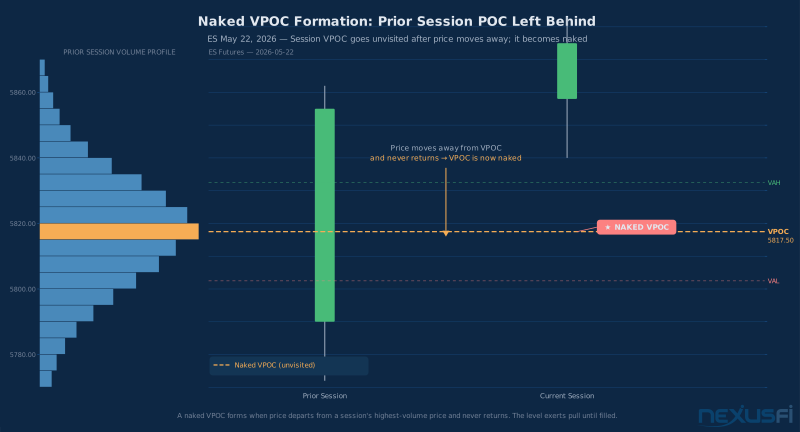
When a session's POC goes unvisited after price moves away — when the market leaves that balance point behind without ever returning to test it — you have a naked VPOC. And naked VPOCs don't just sit there as passive reference lines. They exert pull. The market has a documented tendency to return to high-volume acceptance zones, and a level that's never been retested carries the additional weight of unfinished auction business.
That last part matters — a naked VPOC from three sessions ago still exists on your chart, still represents prior fair value, still magnetizes price under the right conditions.
This article covers how naked VPOCs form, how their relevance decays over time, how to prioritize a list of them across sessions, and — most importantly — how to actually trade around them in ES, NQ, and CL.
Key Concepts #
VPOC (Volume Point of Control): The price level with the highest traded volume within a defined measurement window. Computed from volume-at-price data — how many contracts traded at each price level — and represents the market's strongest price acceptance during that period.
Naked VPOC: A prior session's VPOC that has not been "filled" — price has not returned to trade back through that level — after the session ended. Also called NVPOC or naked POC.
Fill rule: The specific condition that marks a naked VPOC as no longer naked. The most practical definition for futures trading: price must print within the VPOC bin (the price range around the peak volume level) with at least minimal acceptance — not just a single tick spike through the level that immediately reverses.
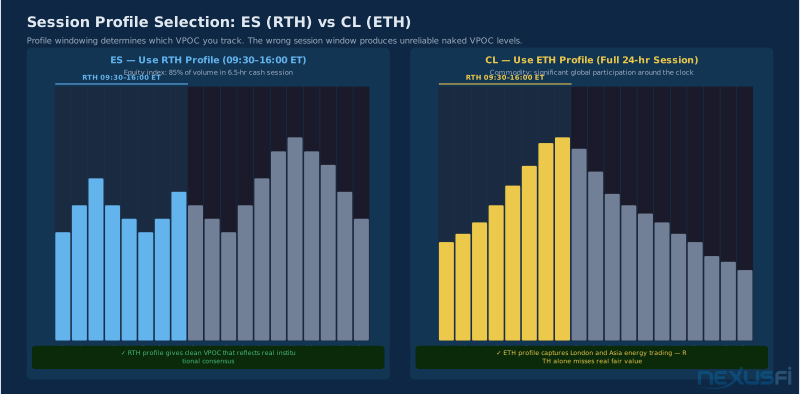
Session profile: The volume-at-price distribution computed for a specific time window. Most futures traders working with index futures (ES, NQ) use RTH profiles (09:30--16:00 ET), while commodity traders often prefer ETH profiles to capture global participation.
Developing VPOC (DVPOC): The current session's live point of control as volume builds throughout the day. This is different from a historical naked VPOC — it's a moving target that shifts as the session progresses. @Private Banker in NexusFi's Volume Profile thread described tracking the DVPOC the same way most traders approach VWAP: "The DVPOC acts similar to the VWAP in that it can act as support and resistance as well as a magnet/target for trades made from the DVAH or DVAL."
RTH vs ETH: Regular trading hours (RTH) captures the cash session — the period of highest institutional participation and price discovery for equity index futures. Extended trading hours (ETH) includes the full overnight Globex session. The profile type matters because the resulting VPOC reflects different participation pools.
Value Area: The price range containing 70% of a session's volume, bounded by the Value Area High (VAH) and Value Area Low (VAL). The VPOC typically sits within or near the value area, but not always — skewed distributions can place it at one edge.
HVN / LVN: High Volume Node and Low Volume Node. Areas where volume concentrates or thins out across a profile. Related to naked VPOCs but not the same — a naked VPOC is the single peak of prior session volume, while HVNs are broader zones of acceptance spread across a composite profile.
How It Works #
Formation: Computing the VPOC #
The VPOC emerges from volume-at-price histograms. Every traded contract at every price level gets binned into the profile, and the bin with the most accumulated volume becomes the VPOC.
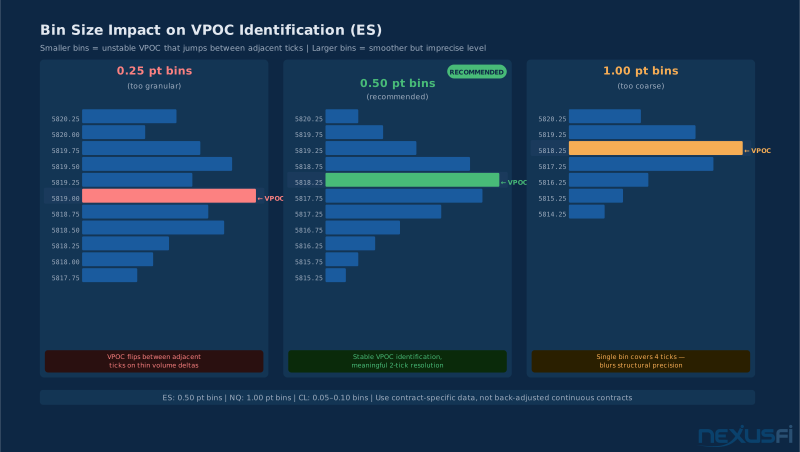
Bin size matters. ES traders typically use 0.50-point bins (2 ticks). Too small — 0.25-point bins in ES — and the VPOC dances around between adjacent price levels on thin volume differences, giving you an unstable target. Too large — 1.00 or 2.00 point bins — and you're blurring the distinction between genuinely different structural levels.
Recommended starting points:
- ES: 0.50-point bins (2 ticks)
- NQ: 1.00-point bins (4 ticks)
- CL: 0.05 to 0.10 bins
Session windowing. Most ES and NQ traders compute VPOCs from RTH sessions only. The rationale: institutional equity-correlated participation dominates from 09:30--16:00 ET, and these sessions produce the cleanest acceptance patterns. This structural reality traces directly to the framework J. Peter Steidlmayer developed at the Chicago Board of Trade in the 1980s: price advertises opportunity, time regulates it, and volume measures the success or failure of those advertised opportunities. With 80--90% of daily ES and NQ volume concentrating during RTH, the VPOCs generated from these sessions carry disproportionate structural weight — they represent where the vast majority of genuine institutional price acceptance occurred. CL traders generally prefer ETH profiles since crude trades around the clock with meaningful global participation.
For CL naked VPOC tracking, this observation has direct implications: RTH-only profiles for crude frequently produce VPOCs that fail to magnetize price because a large portion of price discovery already occurred in the London or Asia sessions.
Contract-specific data. This is non-negotiable for exact VPOC tracking. Continuous back-adjusted contracts distort volume distribution around roll dates — sometimes shifting the apparent VPOC by 1-3 ticks. For the purposes of marking naked levels and verifying fills, use the active front-month contract data. Display continuous charts for trend context, execute against contract-specific levels.
The Fill Rule: What "Naked" Actually Means #
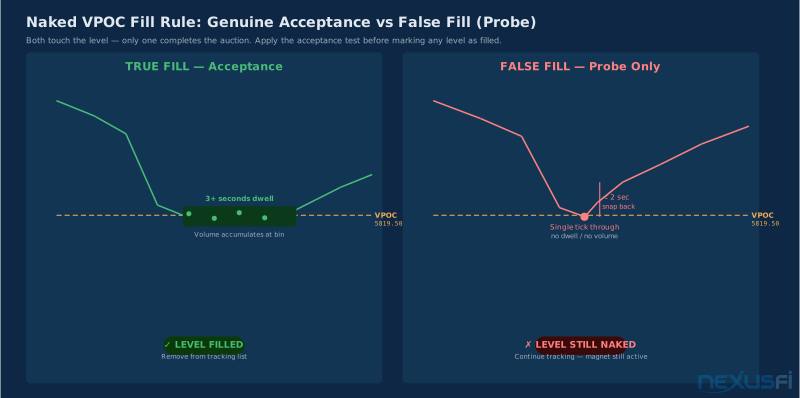
The working definition that holds up under scrutiny: a naked VPOC is filled when price trades into the VPOC bin with acceptance — not when price merely ticks through it.
A fleeting single-tick probe into the level with immediate rejection doesn't count. The market returned to the area but didn't transact meaningfully there — the auction didn't complete. A practical acceptance filter:
- Price must print within the VPOC bin
- AND the level must hold for at least 2-3 consecutive prints at/through the level, OR at least 2-3 seconds of dwell time before reversing
This distinction matters operationally. On ES, during high-volatility periods around macro data or the open, price routinely spikes a few ticks into a level and snaps back. Under a strict "any trade at the level counts as filled" rule, you'd be constantly marking levels as complete that aren't. Under the acceptance-based definition, a level stays naked until the market actually settles there.
The distinction between a tick-through and a genuine fill is where most naked VPOC traders lose their edge. A price spike that touches the bin and snaps back in under 2 seconds hasn't completed the auction — the level stays naked. Only when price dwells at the bin with actual volume accumulation does the market's unfinished business resolve. Always apply the acceptance test before marking a level as filled.
If you're using an indicator that auto-marks VPOCs as filled, check what fill logic it uses. The ALTOGomMP indicator discussed extensively in NexusFi's Elite Circle includes naked VPOC/gap tracking — the feature exists precisely because the community recognized that fill identification needed to be explicit.
Lifecycle: Four States of a Naked VPOC #
Treat naked VPOCs as stateful objects, not static lines. Each goes through four phases:
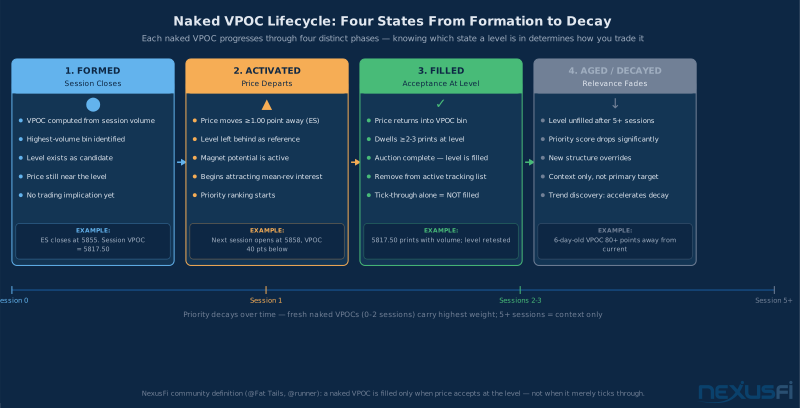
Formed: The session closes and the VPOC is computed. The level now exists as a candidate. If price is still trading near the VPOC at session close, it's formed but not yet of interest — it needs to be "left behind."
Activated: Price moves away from the VPOC level by a meaningful distance, establishing the level as an unfinished reference point. Practical activation thresholds:
- ES: price moves at least 1.00 point (4 ticks) away from the VPOC after session close
- NQ: price moves at least 2.00 points (8 ticks) away
- CL: price moves at least $0.25 away
Filled/Invalidated: The acceptance-based fill rule triggers — price returns, enters the bin, and dwells. The level is no longer naked. Mark it as filled in your tracking and remove it from active reference.
Aged/Decayed: If the level goes unfilled, its practical relevance diminishes over time and distance. A naked VPOC from 4 days ago sits lower in priority than one from yesterday. The level doesn't become irrelevant, but it competes with fresher references:
- ES/NQ: primary relevance windows at 0-2 sessions (highest), 3-5 sessions (moderate), 6+ sessions (low unless aligned with major structure)
- CL: can retain relevance longer given the slower auction character of commodity markets
The Magnet Effect #
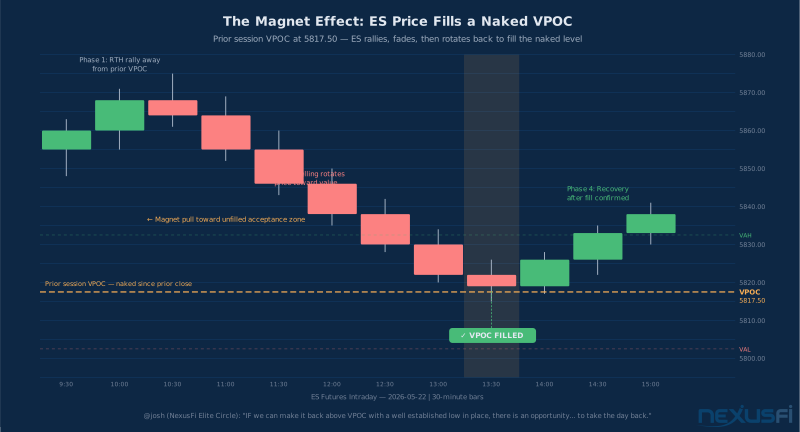
Why does price go back to naked VPOCs? The auction market framework gives a clear answer: when the market leaves a high-volume acceptance zone behind, the auction remains incomplete in a fundamental sense. The most traded price of a session represents where buyers and sellers reached their strongest consensus. When price departs and never returns, that consensus never gets challenged, retested, or updated.
James Dalton, one of Market Profile's most influential practitioners, formalized this principle in Mind Over Markets: the purpose of the auction is to travel from balance to imbalance and back to balance. A naked VPOC is the clearest expression of a balance point that the market abandoned without completing the return trip. In Dalton's framework, the POC represents where the most two-sided business occurred — the level where the market reached its strongest equilibrium. When an imbalance phase carries price away from that equilibrium without ever returning, the auction's natural tendency to complete the cycle creates persistent gravitational pull toward the abandoned level.
Runner's terminology — NVPOC for untouched naked VPOCs, McNVPOC for micro-composite naked VPOCs — reflects years of tracking these levels in CL, a market where the effect is especially visible given the auction-driven nature of energy price discovery.
The mechanism runs through several channels:
Algorithmic mean reversion: Systematic strategies that use prior session value anchors — and there are many — create buy/sell orders concentrated at prior high-volume zones. When enough participants reference the same level, the self-fulfilling element is real.
Resting limit order concentration: The highest-volume bin naturally accumulates more passive limit orders as it gets approached from either side. This creates a liquidity cluster that both slows price action and attracts further activity.
Institutional hedging: Portfolio managers and market makers frequently rebalance against prior value area benchmarks. A naked VPOC often coincides with levels where institutional interest resumes.
Auction completion logic: In balanced/rotational market regimes, price oscillates around value until it finds the next range. A naked VPOC from the prior session is the most recent definition of "where value was" — returning to it is the auction completing its natural rotation.
The concept of price being drawn toward predictable reference levels has also been studied in academic finance. Abad and Pascual (2007) examined the "magnet" or "gravitational" effect hypothesis in financial markets, studying how traders' collective positioning behavior creates self-reinforcing dynamics around anticipated price levels. While their research focused on exchange-imposed price limits, the underlying mechanism — predictable reference levels concentrating order flow and influencing price trajectories — parallels the force at work when the market approaches an unvisited balance point.
The magnet effect is strongest in rotational, balanced market conditions.
— prior acceptance points exert gravitational pull across market frameworks, not just for auction-method traders. In trending/discovery sessions, the market is actively rejecting the prior definition of fair value and establishing a new one. Naked VPOCs accumulate without being filled during strong trends — this is important to understand because it defines the primary failure mode.
Multi-Session Tracking #
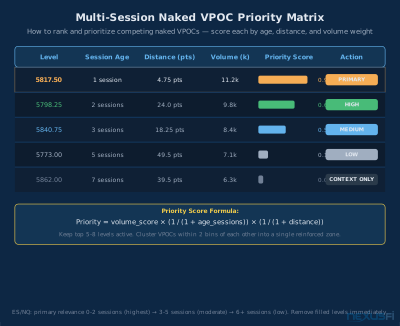
In practice, you'll have multiple naked VPOCs from different sessions, all potentially active at the same time. The question becomes which ones to pay attention to and in what order.
A working prioritization approach:
Score each naked VPOC by:
- Age (fresher = higher priority)
- Distance from current price (closer = higher priority)
- Volume at the VPOC bin (heavier = higher priority)
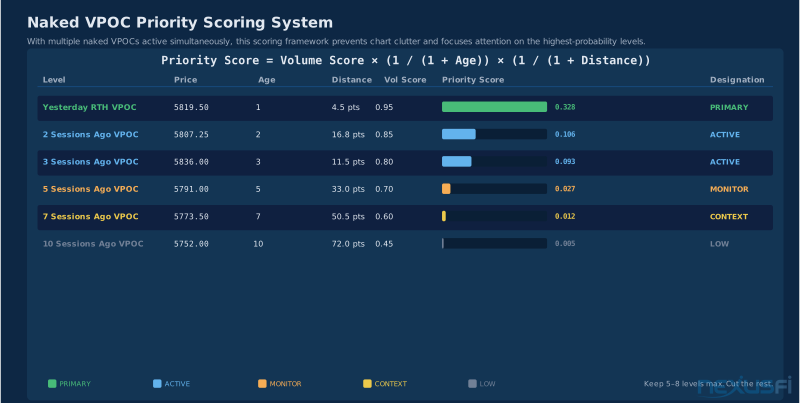
A rough scoring formula: Priority = volume_score × (1 / (1 + age_sessions)) × (1 / (1 + distance))
Where age_sessions is how many trading sessions have elapsed since formation and distance is the absolute distance in points from current price.
This produces a ranked list. Keep the top 5-8 for ES/NQ, 5-8 for CL. More than that creates chart clutter without adding edge.
Practical list structure for an ES trader:
- Prior day RTH VPOC (age = 1): highest priority if not filled overnight
- Two days prior RTH VPOC (age = 2): meaningful if within 15 points
- Three days prior RTH VPOC (age = 3): monitor, reduced weight
- Anything older: context only, not primary target
Some traders also maintain composite naked VPOCs — the peak volume level from a weekly or multi-day profile. These carry different weight than single-session VPOCs and represent broader acceptance zones.
When naked VPOCs from different sessions cluster within 1-2 bins of each other, treat them as a reinforced zone rather than separate levels. Confluence between a yesterday NVPOC and a two-days-ago NVPOC at the same price area amplifies the structural significance.
Trading Framework #
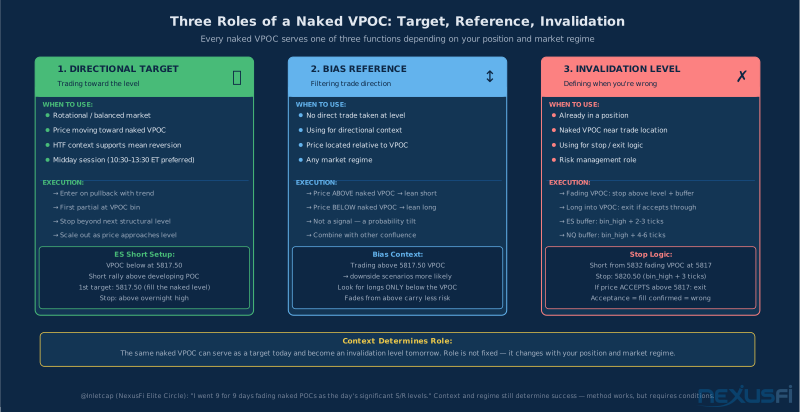
Naked VPOCs serve three distinct roles in a trading plan. Each requires a different execution posture.
Role 1: Target (Directional Play) #
You expect price to travel toward the naked VPOC and trade it as your first profit objective. This works best in rotational/balanced markets when the higher-timeframe context suggests mean reversion is occurring.
ES example (Dec 9, 2025 data):
- ES closes the RTH session at 6848.25 with session VPOC at 6857.00
- Overnight, price rallies to 6871.00 and begins to fade
- Prior session NVPOC from two days prior sits at 6839.50
- A trader shorting the overnight rally uses 6839.50 as the primary target
- Stop: above 6875.00 (above the overnight high, beyond any overnight acceptance zone)
- The trade is: sell the fade, ride it back to the unfilled balance point
NQ example:
- NQ at 25699.75, prior session naked VPOC at 25648.00 below
- In a rotational environment with HTF neutral, a trader selling rallies above the developing POC uses 25648.00 as the first target
- The level represents where NQ's heaviest RTH participation occurred during the prior session — a natural gravitational pull point
Role 2: Reference Level (Bias Filter) #
You use the nearest naked VPOC to define your directional bias without taking an explicit position.
The bias logic:
- Price trading above a nearby naked VPOC → the market needs to "come back and fill it" → tilt toward downside scenarios being more likely to target that level
- Price trading below a nearby naked VPOC → upside excursions may target the level as a mean-reversion point → tilt toward long scenarios targeting it
This doesn't mean you only trade one direction. It means the naked VPOC provides context for probability assessment. A long trade that targets a naked VPOC overhead has the structure working for it — the auction wants to fill that level.
Role 3: Invalidation Level (Risk Management) #
When you're positioned and a naked VPOC sits near your trade, it defines where the premise breaks.
If you're fading a rejection at a naked VPOC (selling after price reaches and rejects the level):
- Your stop goes above the level with a buffer for the fill rule — price that accepts above the VPOC with dwell has proven the level filled, and the short premise is wrong
- Practical placement: stop at bin_high + 2-3 ticks for ES, + 4-6 ticks for NQ
If you're long into a naked VPOC (buying expecting the VPOC to act as resistance):
- Exit plan: if price accepts through the VPOC and holds above, the level has flipped — reassess rather than holding against the fill
@josh described a masterful VPOC retest setup in ES that illustrates the target role perfectly: identifying that "IF we can make it back above VPOC with a well established low in place, there is an opportunity... to take the day back and force overnight and day timeframe sellers to cover." His entry was long below the VPOC, with the VPOC itself as the target for the first partial — using the naked level's gravitational pull as the trade's structural justification.
Confirmation Filters #
Trading naked VPOCs without additional context is how traders get chopped up at widely-watched levels. The market knows where these levels are too, which means price action around them can be erratic.
Time-of-Day Regime #
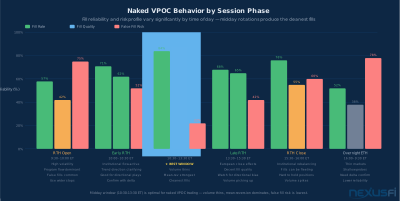
Naked VPOC behavior varies much by session phase:
RTH open (09:30--10:00 ET): Most volatile, highest probability of false fills and aggressive probes. Institutional flow and program trading create rapid sweeps. If you're fading a naked VPOC during the open, expect sharper moves and tighter acceptance windows.
RTH midday (10:30--13:30 ET): The most mean-reversion-friendly window. Volume thins, institutional participation rotates, and magnetic tendencies toward balance points are strongest. This is the ideal window for naked VPOC targets in balanced market conditions.
The midday window (10:30 — 13:30 ET) is the single best time to trade naked VPOCs as targets in ES and NQ. Institutional volume thins, mean-reversion mechanics dominate, and the order book is calm enough to confirm fill quality versus false fill. When a naked VPOC is within 10 points at 10:45 ET in a balanced market — that's your highest-probability window to see it tagged.
RTH close (15:30--16:00 ET): Hedging, portfolio rebalancing, and position squaring generate artificial-feeling moves. Naked VPOCs can get hit hard as large participants mark positions. Fills during this window can be reliable or can be fleeting — volume context matters.
Overnight ETH: Thinner market, so naked VPOCs approached overnight can see aggressive-but-shallow probes. Require stronger delta confirmation before accepting overnight fills as meaningful.
Higher-Timeframe Context #
The single most important filter. Ask: is the market trying to return to value (range/rotation environment) or discover new value (trend environment)?
In trend/discovery sessions, naked VPOCs accumulate behind price without being filled. The market is moving away from the prior fair value definition, not toward it. @tigertrader made this point directly: "trend-following approaches should be stopped during sideways markets, mean-reverting methodologies should not be used during [trend periods]." Trading naked VPOCs as targets is a mean-reversion methodology — it requires mean-reversion market conditions to work at its best.
Practical filter:
- If ES is making consecutive sessions of higher highs and higher lows with broad market breadth confirming — you're in discovery. Naked VPOCs below are targets only if and when the trend exhausts.
- If ES is oscillating within a multi-day range, naked VPOCs become reliable rotation targets.
Delta and Order Flow at the Level #
When price reaches a naked VPOC, watch what the order flow tells you:
For fades (expecting rejection at the level):
- Cumulative delta divergence: price rises to the level but buying delta slows or reverses
- Absorption: sell volume hits but price doesn't accelerate higher — someone is absorbing the buying pressure
- Delta spike into the level followed by quick reversal — aggressive buyers getting trapped
For confirming fills (expecting acceptance through the level):
- Delta confirmation in the direction of travel as price enters the bin
- Volume expansion on the approach, not the rejection
- Price accepting above/below the bin center after initial contact
In NQ especially — which moves faster and with less order book depth than ES — delta confirmation before fading a naked VPOC is essential. Blind fades at naked levels in NQ without order flow backing are high-risk.
Failure Modes #
Naked VPOCs fail in predictable ways. Understanding the failure modes is how traders avoid getting steamrolled by a tool they thought they understood.
Failure Mode 1: Trend/Discovery Sessions
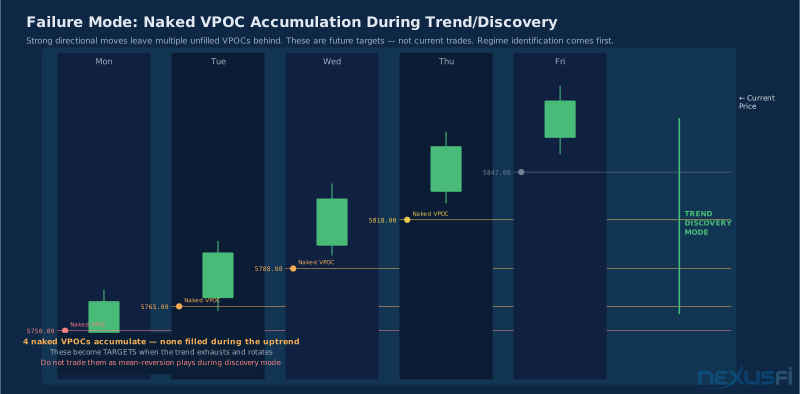
The most common failure. Price moves strongly in one direction, leaving multiple naked VPOCs behind without filling any of them. The market is actively repricing, not rotating.
Signs you're in a discovery session: expanding daily ranges, consecutive sessions where RTH action extends well beyond prior value areas, declining overlap between current session value area and prior session value area.
Response: don't fight it. When you're in a strong discovery move, accept that old naked VPOCs are temporarily irrelevant. The market will return to them — eventually — but "eventually" might be 2 weeks from now.
In strong trending markets, trading naked VPOCs as targets is a mean-reversion methodology applied in the wrong regime. Price actively reprices away from prior fair value — not toward it. Naked VPOCs accumulate behind the move without filling. The solution isn't to ignore them; it's to use them as future targets once the trend exhausts and the market rotates back to value. Regime identification comes first, always.
Failure Mode 2: News-Driven Repricing
Economic releases, Fed statements, geopolitical shocks, and earnings-driven moves can render prior auction logic meaningless within minutes. In CL, an OPEC headline can move the market $2.00 in a single bar. The naked VPOCs that existed before that print are still there, but the market's value framework has been reset.
After a major macro event, treat prior naked VPOCs as secondary context until a new session of acceptance establishes a fresh value reference. The old anchor points may remain magnetic eventually, but the near-term auction is dominated by the repricing process.
Failure Mode 3: False Fill (Tick-Through Without Acceptance)
This is the operational danger in naive naked VPOC tracking. Price spikes into the VPOC bin for 0.5 seconds with a handful of prints and then reverses hard. Under a "any trade at the level = filled" rule, you'd mark the level as complete and stop tracking it. But nothing actually happened — there was no acceptance.
Under the acceptance-based fill rule, the level stays naked. The spike was just that — a spike. The genuine magnetic effect may still be intact.
How to catch false fills: after you think a level filled, look at the print quality. Was there a concentration of volume at the VPOC bin, or did a single large market order sweep through it? Did price dwell, or did it snap back immediately? Volume-less prints at a level are probe behavior, not auction completion.
Failure Mode 4: Naked VPOC List Clutter
This isn't a market failure mode — it's a trader failure mode. When you accumulate 15-20 naked VPOCs across multiple sessions without a decay/removal rule, every price level on the chart has some historical naked VPOC nearby. The concept loses its value because everything is "a naked VPOC." Apply the prioritization model and cut the list aggressively.
Execution Realities #
Naked VPOCs are widely referenced. That creates specific execution challenges at the level.
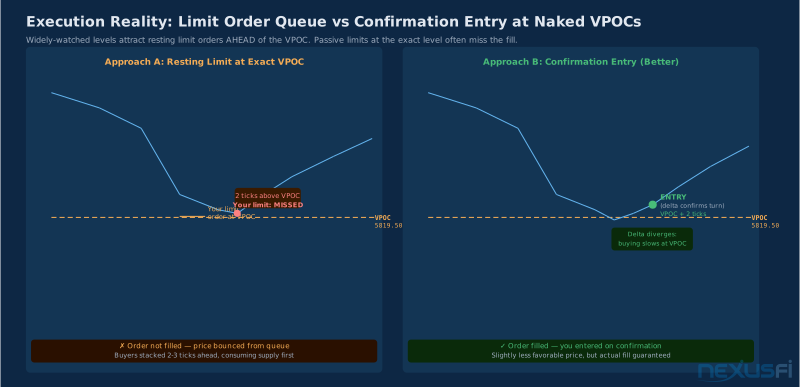
Crowding at widely-watched levels. When a naked VPOC is clearly visible to the community — especially one from the prior day that's prominently displayed in volume profile tools — you'll see limit orders stacking ahead of the level. If you're trying to get long at a downside naked VPOC, your limit order might not fill. Aggressive buyers are entering a few ticks in front of the level, pulling price to the zone but creating a queue ahead of you.
Mitigation: rather than placing a resting limit exactly at the VPOC, consider entering on the approach with confirmation — a tick or two above the level for longs when delta confirms the turn, rather than resting passively at the level itself.
Targeting vs. fading requires different position management. When you're targeting a naked VPOC (taking profit into it), scale out as price approaches rather than placing a limit at the exact level. The market may get close but not quite fill the level, then reverse — leaving you holding if you waited for the exact target. A partial at VPOC - 2 ticks and a partial at the exact level protects against this.
When you're fading a naked VPOC (betting on rejection at the level), keep stops tight and decision windows short. A trade that doesn't reject quickly at the level is more likely to accept through it — false acceptance signals that decay into consolidation are less common than clean rejections.
CL execution note: In crude, slippage risk around major volume levels is higher than in ES/NQ. The order book is thinner in CL, and during headline periods, price can gap through naked VPOCs without clean fills. Size down and use wider stops (relative to ES norms) when trading naked VPOCs in crude.
Developing POC vs. Historical Naked VPOC #
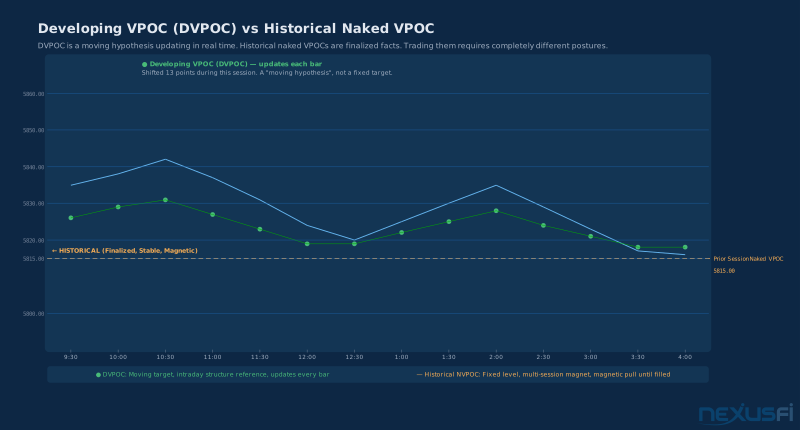
The developing VPOC (DVPOC) is what you see updating in real time during a session. As volume accumulates at different prices, the peak volume bin shifts — what starts as the morning's high-volume zone may not end up as the final session VPOC.
This distinction is critical and creates real confusion.
The DVPOC is a live hypothesis. When runner discussed "McVpoc 97.73 in the 330-minute chart" as a market direction scenario for CL, he was working with a developing composite reference — a candidate level that would matter if it finalized. His framework explicitly accounted for multiple scenarios rather than treating the developing POC as a certain target.
A historical naked VPOC is a completed fact. The session closed. Volume is locked. The highest-volume bin is determined. That level is either naked (never returned to) or filled (price came back and accepted). No ambiguity.
The practical implication:
When you're analyzing a current session, the developing VPOC tells you where the current session is building acceptance — it's an intraday structural reference, not a magnet in the historical sense.
When you're planning against prior session naked VPOCs, you're working with finalized, stable levels where the magnet logic applies — because the session is complete, the level is fixed, and the fill/no-fill state is deterministic.
Conflating the two leads to trading a moving target (DVPOC) as if it has the same weight as a finalized historical reference. The DVPOC is useful for current session structure. Historical naked VPOCs are useful for multi-session targeting and bias.
Some traders maintain both — tracking the DVPOC for real-time session structure while separately maintaining a list of prior session naked VPOCs as the multi-session reference framework. This is the correct approach.
Practical Checklist #
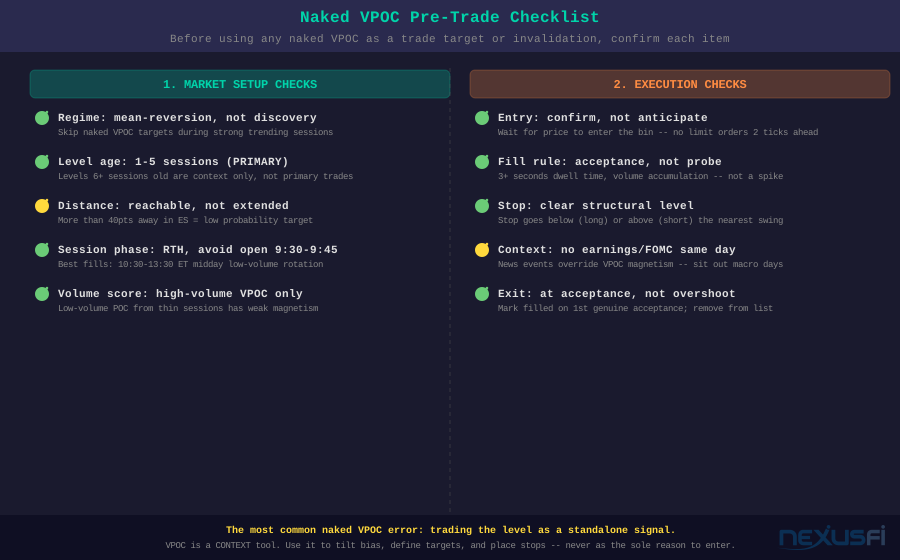
Before using a naked VPOC as a target or trade reference, run through:
✓ Is this level actually naked? Verify against your fill rule — was there acceptance at the level after it formed, or just a probe?
✓ What's the age and priority score? A 5-day-old naked VPOC 40 points away from current price ranks below a 1-day-old naked VPOC 8 points away.
✓ Is the market in a rotational or discovery regime? If it's a strong trend day, naked VPOCs are back-burner reference points, not current targets.
✓ What's the time-of-day liquidity context? Midday fills are cleaner than open-window or close-window fills.
✓ Does higher timeframe structure support the move? A naked VPOC that aligns with prior day value area or VWAP reclaim is a stronger target than one sitting in isolation.
✓ Is there order flow confirmation at contact? Delta divergence on fades, delta confirmation on fills — don't trade the naked VPOC blind.
A naked VPOC is a target, a reference, or an invalidation level — never a trade on its own. Prioritize by age (0 — 2 sessions), proximity (within 15 ES points), and market regime (rotational/balanced). When the market is in discovery mode, these levels are back-burner context. When it rotates, they become the first stops on the path back to value.
Knowledge Map
Prerequisites
Understand these firstGo Deeper
Build on this knowledgeReferences This Article
Articles that build on this topicCitations
- — Volume Profile and Footprint discussion (2012) 👍 118“A line is naked until price trades at this level again. For example, if yesterday's POC was 1300.00 then you can extend a line forward in time until price trades at 1300.00 again, whether it be today, or 3 years from now.”
- — VPOC indicator where can I find please? (2011) 👍 5“Naked point of controls: these are the point of controls of prior sessions which have not been revisited or taken out.”
- — Trading Futures with Context (2013) 👍 8“VPOC (or McVPOC) acts as a magnet, it's a balance point where CL found a balance in the past. NVPOC = Naked Volume Point Of Control (not touched yet).”
- — Spoo-nalysis ES e-mini futures S&P 500 (2020) 👍 25“IF we can make it back above VPOC with a well established low in place, there is an opportunity... to take the day back and force overnight and day timeframe sellers to cover.”
- — Spoo-nalysis ES e-mini futures S&P 500 (2016) 👍 3“A year or so ago I went something like 9 for 9 days fading 'naked' POCs as the day's significant S/R levels.”
- — Volume Profile and Footprint discussion (2012) 👍 36“The DVPOC acts similar to the VWAP in that it too can act as support and resistance as well as a magnet/target for trades made from the DVAH or DVAL.”
- — Trailer Park Capitol (2021) 👍 3“Did I look for a random day's naked VPOC as a target? When does a POC matter? When does value area matter? These are things which take experience to sort out.”
- — Volume Profile and Footprint discussion (2012) 👍 22“For me, when I see the POC shift, it is a reminder to me what side of the market I should be on. Often we will push away from the POC into the close.”
- — Spoo-nalysis ES e-mini futures S&P 500 (2021) 👍 13“Whether you follow an auction approach or not, areas of previous activity (POCs) tend to act like a magnet. If we break, 4350 is a very juicy target -- the VPOC since the 4400 breakout.”
- — Trading Futures with Context (2013) 👍 11“Up trend until 97.60 where 97.62 was Thursday NVPOC and 97.66 NTPO. I got long around 97.91 as the market opened and managed my long until 97.62-66 NVPOC-TPO. Long based on context and intraday set-up on 800 ticks and 500 vol charts.”
- — Trading Futures with Context (2014) 👍 10“On 30 min Market and Vol Profile you see how the prev day normal distribution supported the up move with 100.00 magnet and next 100.15-100.47 low volume area that usually is being covered with fast movements.”
- James F. Dalton, Eric T. Jones, Robert B. Dalton — Mind Over Markets: Power Trading with Market Generated Information (Updated Edition) (2013)
- J. Peter Steidlmayer (framework), Jim Dalton Trading — What is the Market Profile? (2024)
- David Abad, Roberto Pascual — On the Magnet Effect of Price Limits (2007)