



Breakout Trading Strategies for Futures
Overview #
A breakout isn't price crossing a line. It's the market deciding it belongs somewhere new — and staying there. That distinction is everything.
Most breakout traders lose money because they're buying a price event when they should be trading an auction shift. Price tags a prior high? Not a breakout. Price punches through, holds, builds volume above, and never looks back? That's acceptance. That's the trade.
This article covers how to identify, enter, manage, and exit breakout trades in liquid futures markets — ES, NQ, CL, and anything else with enough depth to trade properly. The methodology is microstructure-first: we care about what the auction is doing, not what a line on the chart says.
Key Concepts #
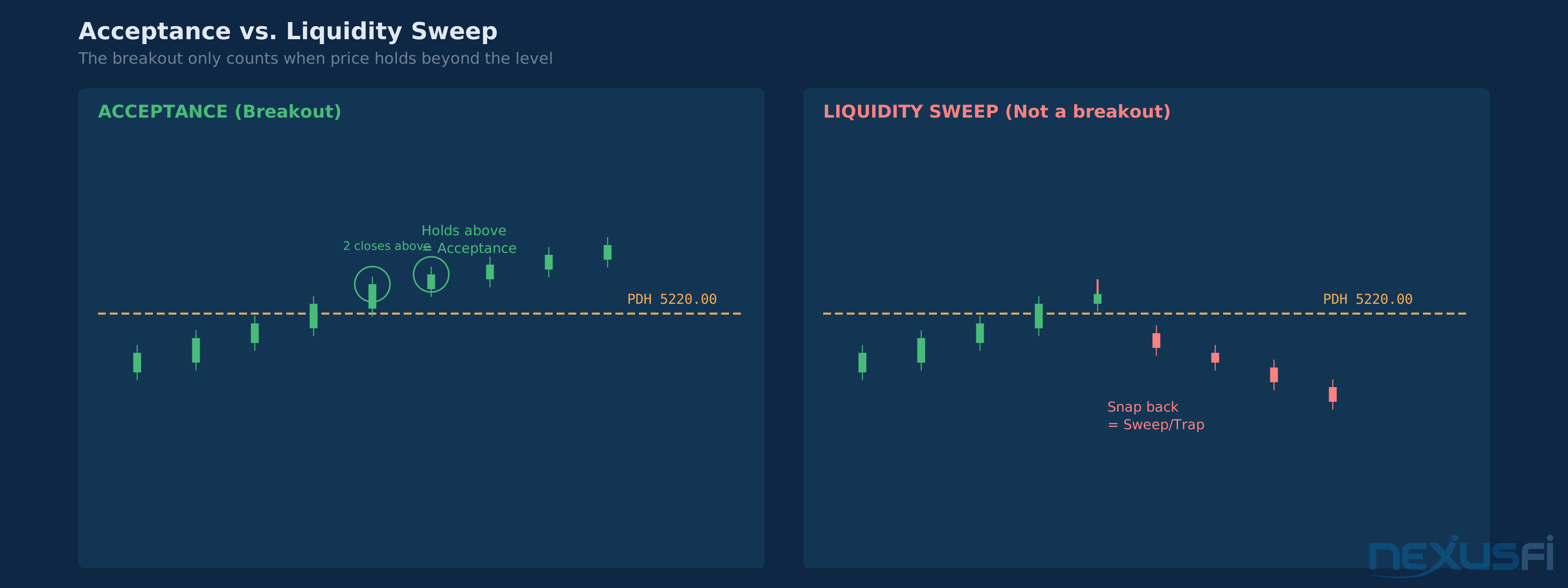
Acceptance vs. crossing. The foundation of everything here. A cross is price touching a level. Acceptance is price trading beyond the level and staying there — building time, building volume, attracting responsive participation. The threshold: two consecutive closes on the breakout side on a 1-3 minute chart, or price holding beyond the level for 5-15 minutes without reclaiming. If price pokes through and snaps back inside 1-2 bars, that's a liquidity sweep — the opposite of a breakout.
Pre-breakout context. Breakouts don't happen in a vacuum. The market's state before the move determines the move's probability:
- Balance — overlapping swings, mean-reverting around VWAP. Breakouts from balance are the highest-probability setups because compression precedes expansion.
- Trend — directional auction already running. Breakouts at new highs/lows in trend can work, but exhaustion risk is real. Prefer pullback entries over first-touch entries.
- Transition — volatility expanding, structure shifting. These are where failed breakouts breed — the market hasn't committed yet.
See Balance vs. Imbalance and Auction Market Theory for the full framework.
Reference levels. Not all levels are equal. The ones that matter are where participants have actual resting interest:
- Prior day high/low (PDH/PDL) — with a 1-2 tick buffer to avoid false precision
- Overnight high/low (ONH/ONL) — especially for ES and NQ
- Opening range high/low (ORH/ORL) — first 5, 15, or 30 minutes
- Initial balance high/low (IBH/IBL) — first 30-60 minutes
- Value area high/low (VAH/VAL) — 70% volume distribution
- VWAP and standard deviation bands
Confluence matters. A breakout through the overnight high that also happens to be yesterday's VAH carries more weight than either level alone.
Five Breakout Types #
1. Opening Range Breakout (ORB) #
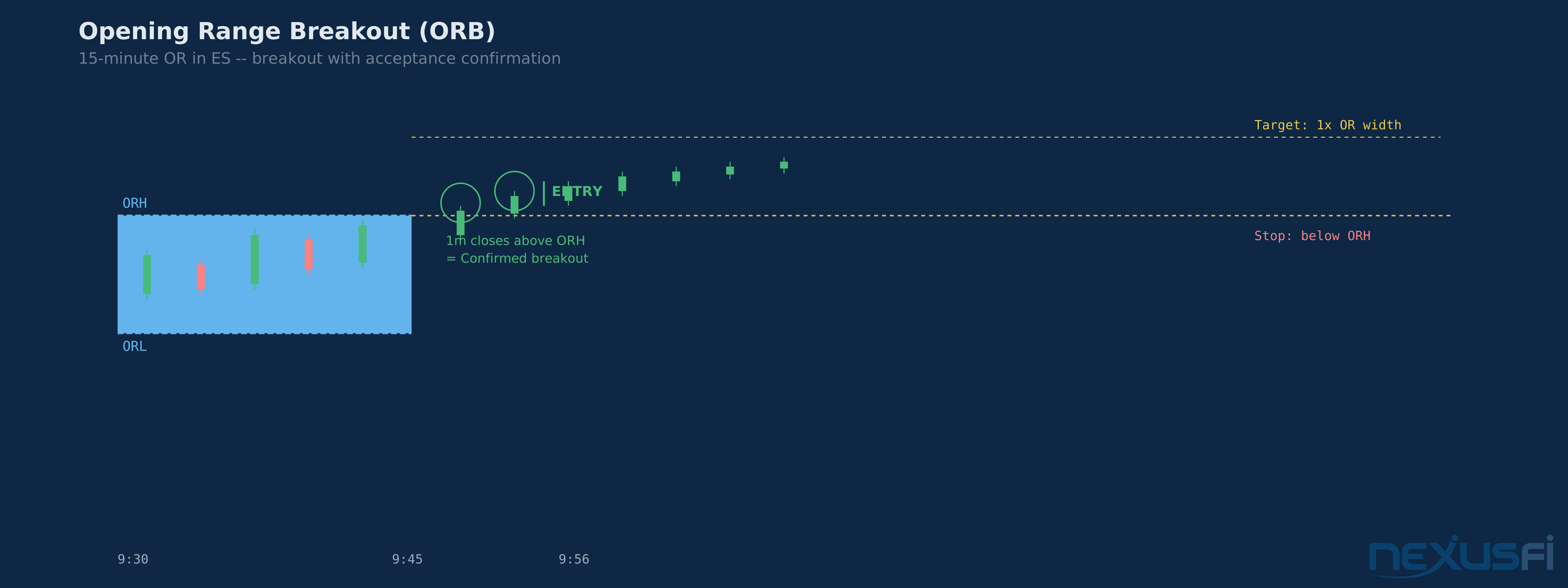
The oldest breakout strategy in futures, popularized by Toby Crabel's work in the early 1990s. Define the opening range using the first N minutes of RTH (9:30 ET for ES/NQ), then trade the break of that range.
Time windows:
- 5-minute OR: more signals, more noise, best for scalpers
- 15-minute OR: the sweet spot for ES and NQ — enough structure to filter noise, enough speed to catch the move
- 30-minute OR: best for CL (crude oil) where opening noise is wider, and for structural traders who want fewer, higher-quality signals
That context-over-range principle is the difference between profitable ORB traders and the ones getting chopped up. A narrow opening range relative to ATR means higher odds of range expansion — Crabel's core insight.
Entry trigger: Price crosses ORH/ORL and prints a 1-minute close beyond it. Stronger confirmation: a 5-minute close beyond. Don't buy the first tick through — wait for the close.
Anti-chase rule: If price extends more than half the 5-period ATR from the OR edge without retesting, the risk/reward has deteriorated. Wait for a pullback or skip.
Mark Fisher's ACD method extends the ORB concept by adding volatility offsets (A-up, A-down, C levels) to the opening range, creating a framework for determining whether the day is likely to trend or rotate. The opening range becomes a classification tool, not just an entry trigger.
See Open Type Classification for how the opening auction shapes the rest of the session.
2. Range Expansion from Compression #
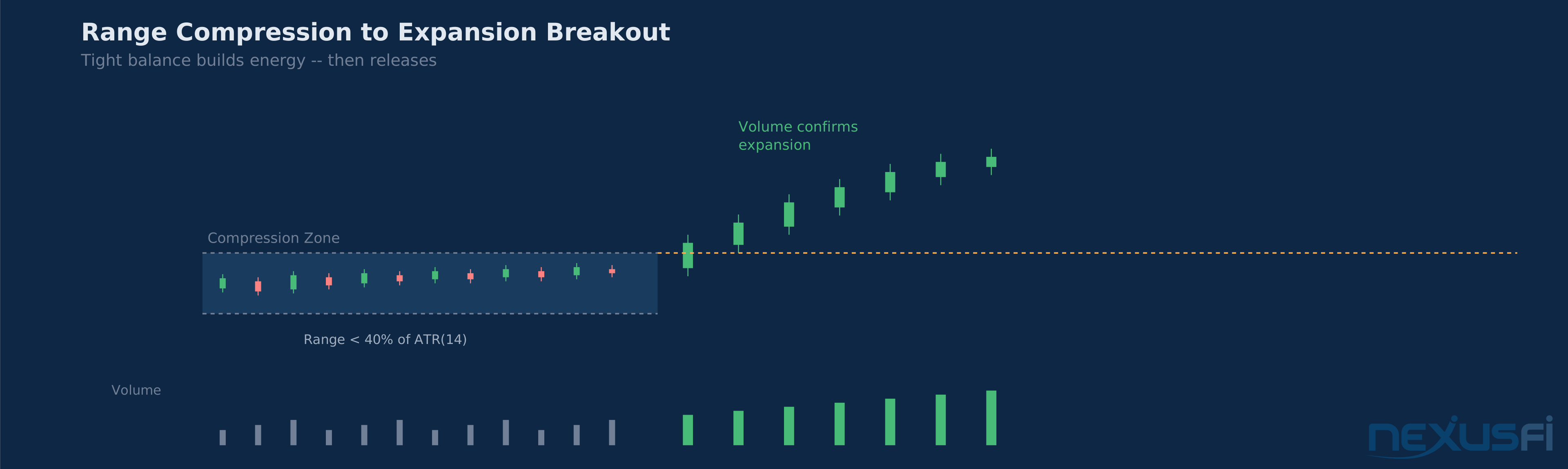
When the market compresses, energy builds. Balance areas get tighter, swings get smaller, and the ATR contracts. Then it releases — sometimes violently.
Compression detection: The last 30-60 minutes of price action produces a range that's less than 40-50% of the 14-period ATR on an intraday chart. That's a coiled market.
Breakout trigger: Price exits the compression boundary, and the subsequent 3-5 bars show expanding range. Acceptance means holding beyond the boundary for 5-15 minutes with no sustained return inside.
This maps directly to the balance-to-imbalance transition in auction theory. A market in tight balance is a market building cause for a directional move.
Noise band filter: Many NexusFi community members use noise bands — VWAP standard deviation bands or Crabel-style average noise calculations — as the compression boundary. A breakout is valid only when price exits the band and holds. If the breakout level sits inside the noise zone, skip it.
3. Volume-Confirmed Breakout #
Price alone lies. Volume tells you whether anyone's actually committed.
Participation proxy: The breakout bar's volume should be at least 1.2-1.5x the trailing 20-bar average. Not one spike and done — sustained above-average volume for 2-5 bars after the breakout separates real moves from fakes.
Advanced confirmation: Cumulative volume delta (CVD) showing directional imbalance. For a bullish breakout, aggressive buying should dominate the tape. On a footprint chart, look for stacked imbalances — three or more consecutive price levels where aggressive buying overwhelms selling.
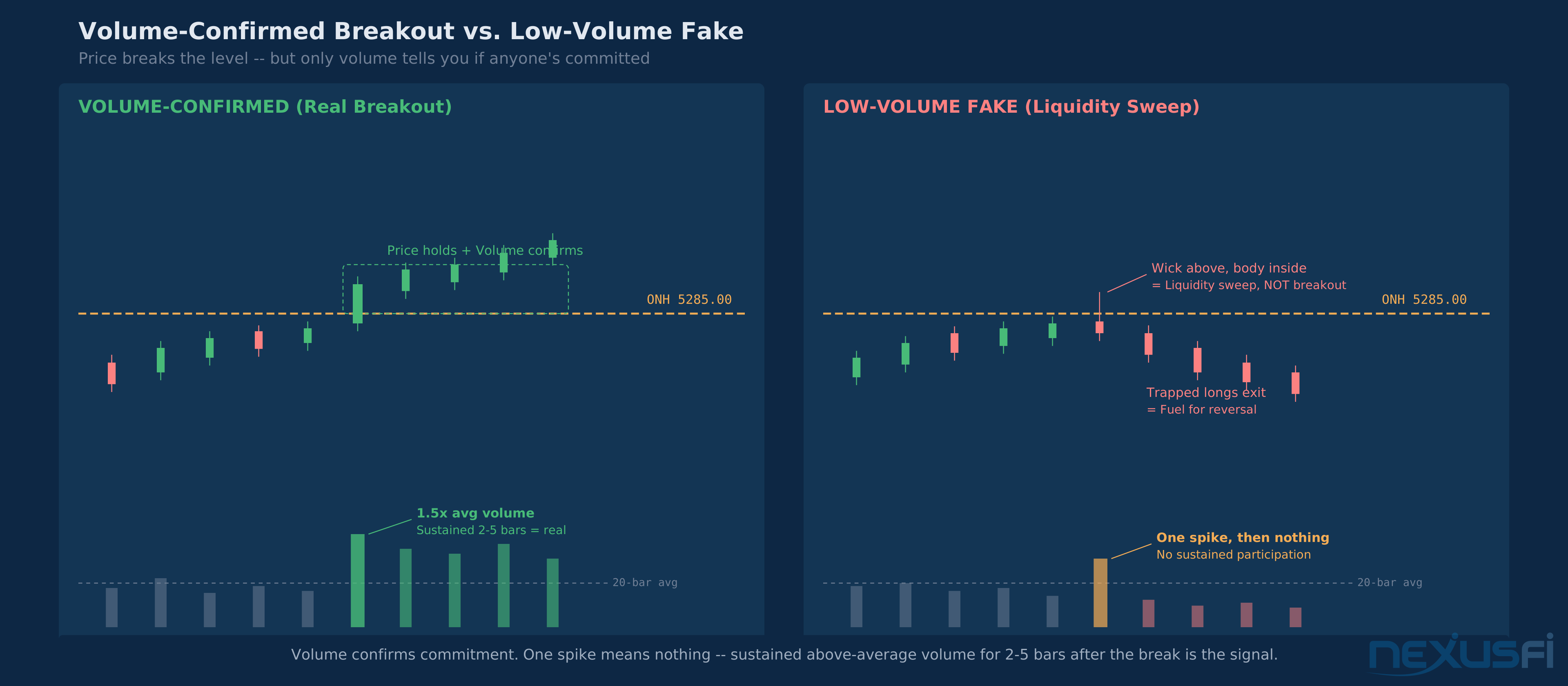
The catch: Volume spikes appear in liquidity sweeps too. That's why volume confirmation must be paired with acceptance (close-and-hold). A volume explosion that immediately reverses is absorption at the level, not a breakout.
4. Breakout Pullback / Retest Entry #
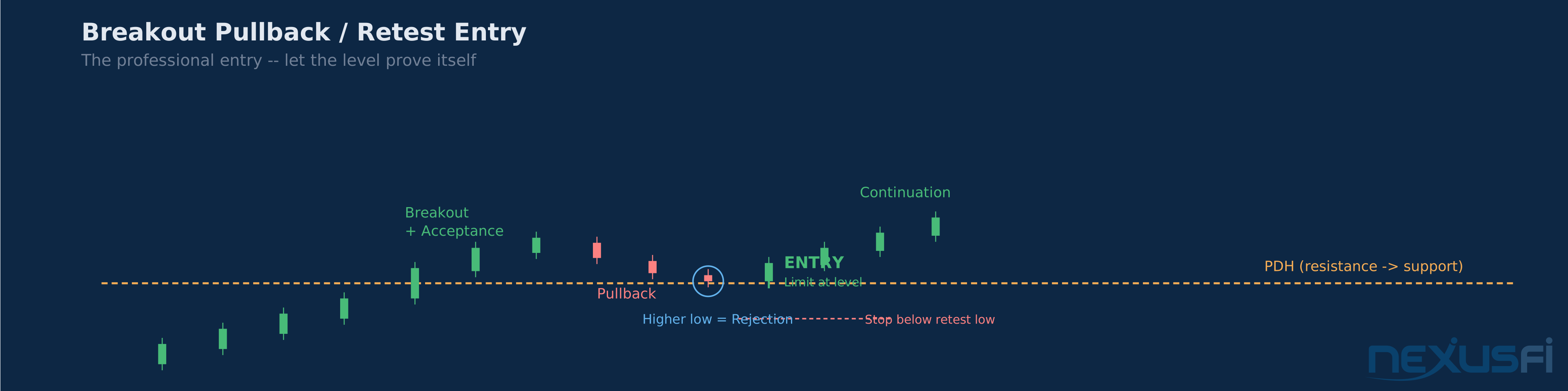
This is the professional entry. You let the market prove the breakout is real, then enter on the pullback to the broken level.
Mechanics: After breakout acceptance, price pulls back toward the level — what was resistance becomes support (or vice versa). The retest should form a rejection structure: a higher low on a 1-3 minute chart for longs, with a close back in the breakout direction.
Time window: The retest should happen within 10-30 minutes of acceptance. If the market never comes back, reduce size or wait. If it takes longer than 30 minutes, the setup has evolved into something else.
Failure threshold: If price closes back inside the original range for more than 5-10 minutes during the retest, the breakout has failed. Don't force it.
As @VinceVirgil documented in CL Trades on NexusFi — "first short was a breakout pullback" — the retest entry works across instruments. The key is patience: let the level prove itself as support/resistance before committing.
Why retest beats chase: Tighter stops (below the retest swing), better risk/reward, and confirmation that the level has flipped. The tradeoff: you miss the moves that never pull back. Acceptable cost.
5. Failed Breakout / Breakout Trap #
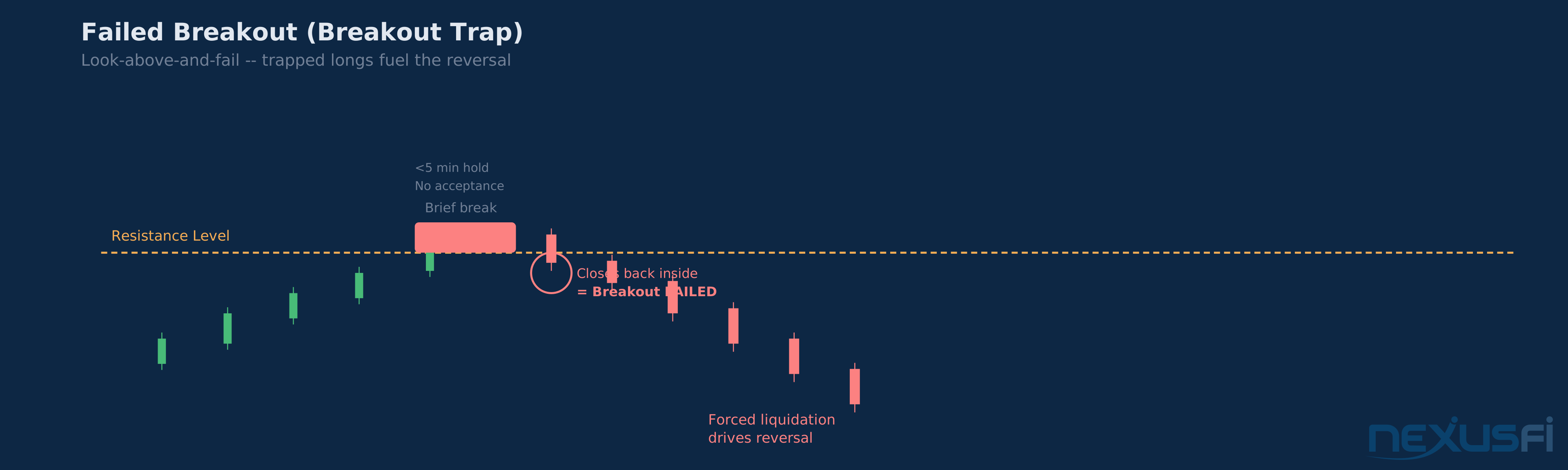
Failed breakouts are among the strongest signals in technical analysis. A trapped breakout creates a pool of underwater positions that become the fuel for the reversal.
Failure criteria:
- Immediate failure: Price returns inside the level within 2-5 bars (on a 1-3 minute chart)
- Acceptance failure: Price holds briefly (10-30 minutes) then collapses back through the level with counter-volume
- Market Profile term: "Look-above-and-fail" or "Look-below-and-fail" — see Failed Auction
What makes a breakout fail:
- No follow-through volume — the move wasn't backed by participation
- Absorption at the level — aggressive counter-orders absorbing the breakout flow
- Delta divergence — price makes a new high but CVD doesn't confirm
- Late-in-session timing — breakouts in the last hour often lack the time for acceptance
Response protocol: Don't instantly reverse. Wait for price to reclaim the level back inside the range and show acceptance on the reversal side. The target becomes the opposite extreme of the original balance. ES/NQ traps typically revert toward VWAP or the value area midpoint.
Entry Methodology #
Getting the concept right means nothing if the execution is wrong.
Limit vs. market orders:
- Retest entries: Limit orders at the level (+/- 1-2 ticks tolerance). This is precise, controlled, and the preferred method for professional execution.
- Initial breakout entries: Stop-limit orders, not raw market orders. Trigger on the break, fill on the acceptance.
- Never: Market orders into a thin book during a spike. That's how you buy the high tick.
Acceptance criteria (actionable):
- Two consecutive 1-minute closes on the breakout side (minimum)
- OR price holds beyond the level for 5+ minutes without reclaiming
- For CL, extend to 3 consecutive closes due to higher noise
Anti-chase rules:
- If price is already more than half the 5-period ATR away from the breakout level, don't enter. Wait for a pullback or pass.
- If the breakout candle's range exceeds 75% of the expected move, the risk/reward is already damaged.
- If 3-5 bars have passed with no retest, the entry window has closed. Next trade.
Risk Management #
Breakout trading in futures without proper risk management is gambling with leverage. The math is unforgiving.
Stop placement: Structure-based, not arbitrary tick counts. Your stop goes where the breakout thesis is invalidated:
- For initial breakout entries: Beyond the breakout level by a volatility buffer (1-2 ticks for ES, wider for NQ and CL)
- For retest entries: Below the retest swing low (more precise, tighter stop)
Contract-specific sizing:
| Contract | $/Point | Typical Stop Range | Character |
|---|---|---|---|
| ES | $50 | 1-2 points (4-8 ticks) | Moderate volatility, respects value levels |
| NQ | $20 | 3-6 points (12-24 ticks) | High beta — needs wider ATR-scaled stops |
| CL | $10/cent | $0.15-0.20 (15-20 ticks) | Headline-driven — ATR(14)-based stops required |
Position sizing formula: Contracts = Account Risk per Trade / (Stop Distance in Points x Dollar per Point)
Example: $500 risk, ES setup with a 1.25-point stop. $500 / (1.25 x $50) = 8 contracts max. Then adjust down for slippage and conviction.
See Position Sizing and Stop Loss Strategies for the complete frameworks.
Daily loss limits: Professional breakout traders typically cap daily losses at 2-3x their standard risk per trade. After the cap, the screens go off.
Trade Management #
This is where breakout trading is won or lost. Entry is the easy part. Management determines whether you keep the gains.
Partial exits:
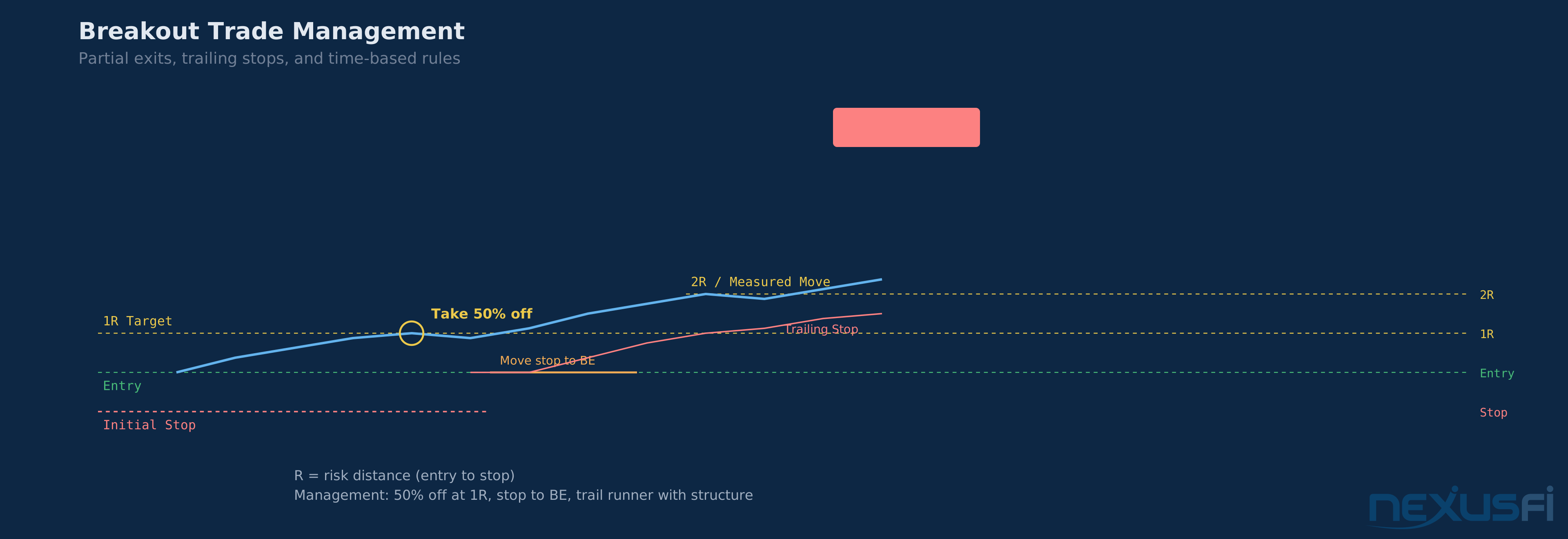
- Take 50% at 1R (one times your initial risk distance)
- Move stop to breakeven after +0.8R and a new minor swing forms
- Run the remaining position with structure-based or time-based management
Trailing methods:
- Structure trail: Under the last higher low (longs) or over the last lower high (shorts) on a 2-5 minute chart
- VWAP trail: If price is consistently above VWAP and building value higher, trail below VWAP
- ATR trail: 1x ATR(14) behind current price as a volatility-adaptive trailer
Time-based exits — the universal breakout rule: If the breakout hasn't progressed by roughly 1R within 15-30 minutes, exit. Breakouts have a shelf life. A move that stalls after the initial push is either a trap developing or a transition into rotation. Either way, your edge has evaporated.
Measured move targets: Use the width of the prior balance or compression box as a measured extension. If the box was 4 points wide in ES, the first target after breakout is 4 points beyond the boundary. For ORB, the opening range width itself becomes the measured move.
Session and Contract Behavior #
Not all breakouts are created equal. The instrument and the session change everything.
RTH vs. ETH (overnight):
- Overnight levels (ONH/ONL) are "liquidity targets" during RTH — the cash session often tests them, but acceptance is what matters
- ETH breakouts require longer confirmation windows because participation is thinner
- ORB and IB logic apply specifically to RTH (starting 9:30 ET for ES/NQ)
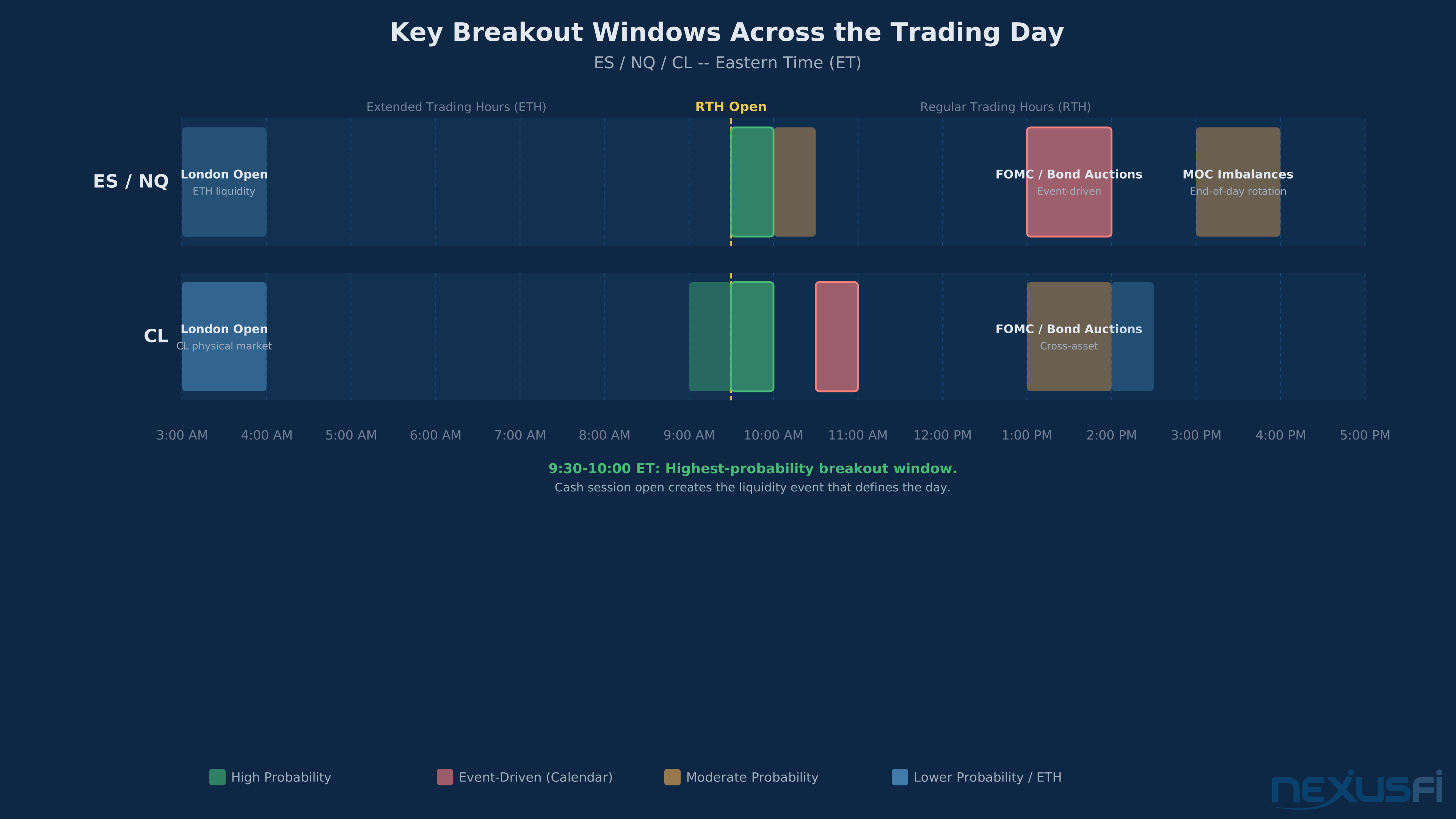
- The cash open (9:30 ET for indices) creates a liquidity event that makes the first 15-30 minutes the most productive breakout window of the day
Contract personality:
- ES: The workhorse. More orderly, respects value levels, mean-reverts within balance. ORB and IB breakouts work cleanly. Traps revert to VWAP.
- NQ: High beta. Breakouts extend further but traps are sharper. Needs wider stops and faster management. More explosive moves make partial exits critical.
- CL: Headline-driven and gap-prone. London open (3:00 AM ET) and EIA inventory reports (10:30 AM ET Wednesday) create distinct breakout windows. Use 30-minute ORs, wider acceptance thresholds, and accept that news-driven breakouts have different risk profiles.
Key session windows for breakout traders:
- 9:30-10:00 ET: Cash open — highest probability ORB window for ES/NQ
- 10:00-10:30 ET: Economic data releases (depending on calendar)
- 10:30 ET Wednesdays: EIA crude inventory (CL)
- 13:00-14:00 ET: Bond auction results, FOMC announcements
- 15:00-16:00 ET: MOC imbalances, end-of-day rotations
Practical Application #
Here's the decision workflow for a breakout trade, from identification to exit:
Step 1: Read the context. Is the market in balance, trend, or transition? Balance-to-expansion is the highest probability setup.
Step 2: Identify the level. Where is the breakout boundary? Use the reference level hierarchy. Confluence (multiple levels near the same price) strengthens the setup.
Step 3: Wait for the break and acceptance. Price crosses the level. Now wait. Two closes beyond? Holding for 5+ minutes? Volume confirming? If yes, the breakout is real.
Step 4: Enter. Retest entry is preferred — limit order at the level after acceptance. If no retest develops and you're taking the initial break, use a stop-limit with acceptance confirmation.
Step 5: Define risk. Stop goes where the thesis is wrong. Size the position so a full stop-out is within your risk parameters.
Step 6: Manage. Partials at 1R, trail with structure, time-exit if the move stalls. Don't let a winner become a round-trip.
Step 7: Recognize failure. If price reclaims the level and shows acceptance back inside, exit. Consider the trap trade in the opposite direction, but only with fresh confirmation.
Breakouts have a shelf life. If the move hasn't progressed by 1R within 15-30 minutes, the edge has evaporated. Exit and reassess — don't let a stalled breakout become a round-trip.
The entire framework rests on one principle: acceptance, not crossing. Every decision — entry, stop, target, management — flows from whether the market has genuinely accepted price beyond the reference level. Master that distinction and breakout trading transforms from a coin flip into a structured edge.
Knowledge Map
Prerequisites
Understand these firstGo Deeper
Build on this knowledgeReferences This Article
Articles that build on this topicCitations
- — Open Range Breakout (2012) 👍 11“@trendisyourfriend ans @mfbreakout have already given answer, but I will try to be more general. There are several approaches to determine the breakout levels.”
- — Backtesting the 30min Opening Range Breakout Strategy. (2013) 👍 9“The guys at MasterTheGap have studied open range breakouts significantly, but the 15min and 60min breakouts, not 30min.”
- — ACD trading By Mark Fisher (2010) 👍 7“Thanks for sharing. To stay with CL, Fisher seems to use a 45 min opening range and an A value of 8 ticks and a C value of 13 ticks. Not sure that these are the most recent values.”
- — Traps and Failures (2010) 👍 24“Traps and Failures are the strongest signal in technical analysis. So I think we need a thread on this subject. Why are traps such a strong signal? Markets are by design suffering from schizophrenia and bipolar disorder.”
- — CL Trades (2012) 👍 13“Excellent question. They are very similar trades....but the first says short, the second says long. First short was a breakout pull back that immediatley went lower. My concern on the first short was the support area of the over night of around 9150.”
- — Opening Range Breakout (EasyLanguage, automated) (2010) 👍 7“Updated version with fix mentioned in last post.”
- — opening range play (2013) 👍 9“Toby Crabel and Mark Fisher are both legendary for their trading methods based on opening range breakouts.”
- — Trading Futures with Context (2014) 👍 13“Same old story, same old song and dance”
- — The Beast Slayer (2016) 👍 5“I think what you are referring to is a deliberate institutional ploy”
- — The PandaWarrior Chronicles (2014) 👍 4“I agree with you on breakouts.”
- Toby Crabel — Day Trading with Short Term Price Patterns and Opening Range Breakout (1990)
- Mark Fisher — The Logical Trader: Applying a Method to the Madness (2002)