



Fibonacci Sequence and Golden Ratio in Trading
Overview #
Fibonacci levels are one of the most widely used tools in technical analysis — not because of any mystical relationship between mathematics and markets, but because enough traders use them that they become self-reinforcing zones of order placement, stop clustering, and liquidity concentration. When institutional algorithms and discretionary traders both target the 61.8% retracement, that level becomes real. The mechanism is coordination, not prophecy.
Overview Fibonacci levels are one of the most widely used tools in technical analysis -- not because of any mystical relationship between mathematics and markets, but because enough traders use them that they become self-reinforcing zones of order placement, stop clustering, and liquidity concentration.
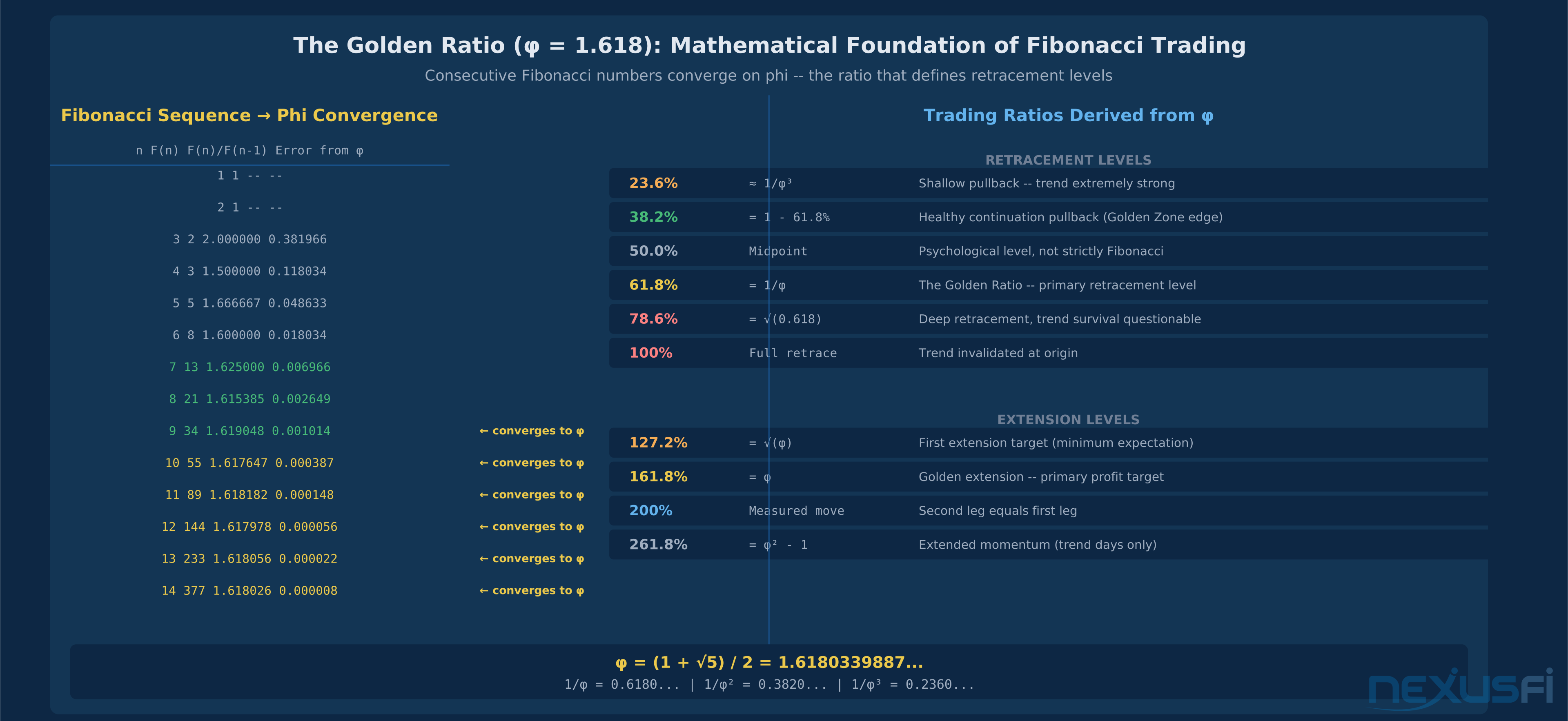
The underlying math is genuine. The Fibonacci sequence (1, 1, 2, 3, 5, 8, 13, 21, 34, 55, 89, 144...) generates the Golden Ratio phi (φ ≈ 1.618) through the convergence of consecutive term ratios. The trading ratios — 23.6%, 38.2%, 50%, 61.8%, 78.6%, 127.2%, 161.8% — are derived directly from phi and its powers. These aren't arbitrary levels. They're mathematical relationships that traders, platforms, and automated systems have standardized around for decades.
As @Fat Tails explained in a detailed analysis of Fibonacci cluster zones [1]: "I use Fibonacci tools for trading, not because I believe in black magic or the omnipresence of the golden ratio, but because they are an efficient tool to establish support and resistance." That framing captures it exactly. The tool works because it's widely used — and it's worth understanding deeply.
Key Concepts #
The Fibonacci Sequence
Start with 1, 1. Each subsequent number is the sum of the two before it: 1, 1, 2, 3, 5, 8, 13, 21, 34, 55, 89, 144, 233, 377... Divide any number by the next one in the sequence — say 89 divided by 144 — and you get 0.6180. Divide by the number two positions ahead: 89 divided by 233 = 0.3820. Three positions ahead: 89 divided by 377 = 0.2360. These are the 61.8%, 38.2%, and 23.6% Fibonacci retracement levels used every day in futures markets.
The deeper you go in the sequence, the closer the ratios converge to phi. By the time you reach the teens, the approximation is accurate to four decimal places. The formula for phi is (1 + √5) / 2 = 1.6180339887..., an irrational number that appears throughout natural geometry — plant spirals, shell proportions, crystal structures. Whether that natural occurrence carries any causal weight in financial markets is debated. What isn't debated is that these levels work as coordination points.
Key Trading Ratios and Their Derivation
Retracement levels measure how far price pulls back within an existing move:
- 23.6% -- approximately 1/φ³. Shallow pullback territory. When price only retraces 23.6%, the trend has serious momentum behind it.
- 38.2% -- equals 1 - 61.8%, or equivalently F(n)/F(n+2) as the sequence converges. The continuation sweet spot -- deep enough for a real entry, not so deep that the trend is in question.
- 50.0% -- not technically a Fibonacci ratio, but psychologically significant as the midpoint. Universally watched. Part of the Golden Zone when combined with 61.8%.
- 61.8% -- equals 1/φ, the Golden Ratio. The single most important Fibonacci level. When price holds at 61.8%, the trend structure is intact. When it breaks through cleanly, the trend is likely exhausted.
- 78.6% -- equals √(0.618). Deep retracement territory. At 78.6%, the trend is in serious trouble. The 78.6% level is often the last stand before a full reversal.
- 100% -- full retracement back to origin. Trend is invalidated if price closes below this in an uptrend.
Extension levels project where the next leg is headed after a pullback:
- 127.2% -- equals √φ. First extension target. The minimum expectation for a healthy trend continuation. If a move can't even reach 127.2%, momentum is weak.
- 161.8% -- equals φ itself. The Golden Extension. Primary profit target for most extension-based setups.
- 200% -- the measured move. The second leg equals the first leg. Overlaps with classical technical analysis.
- 261.8% -- equals φ² - 1. Extended momentum. Only realistic on strong trend days with expanding volume and range.
The Golden Zone: 50-61.8%
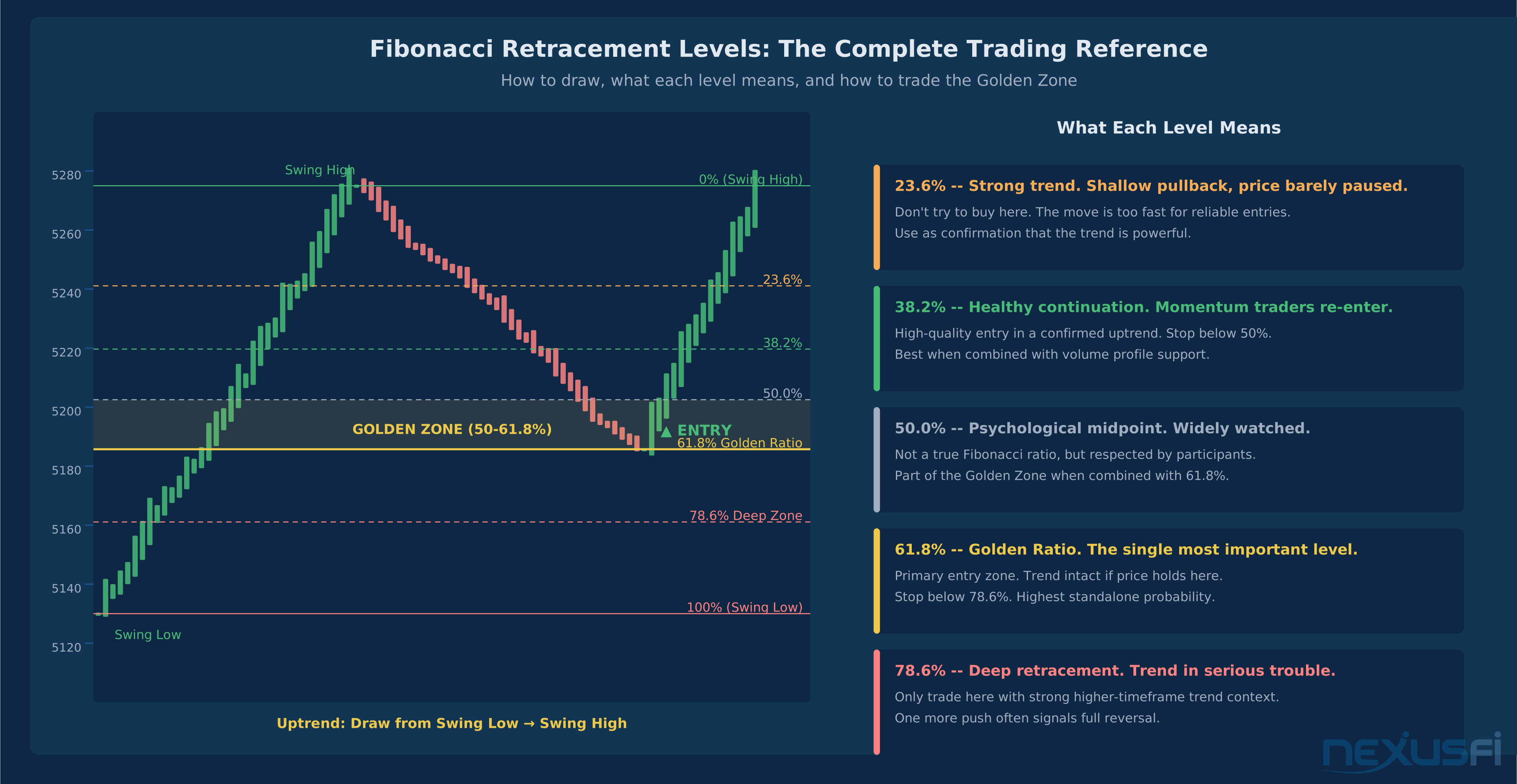
The area between 50% and 61.8% is called the Golden Zone — the highest-probability pullback entry area for trend continuation trades. When institutional money is adding to a position in an uptrend, they're typically scaling in through this zone. Multiple studies of futures market retracements confirm this range produces the highest-probability reversals when combined with volume and structure confirmation.
@sstheo observed in an ES trading journal [4]: "The 50% retracement and the 61.8% retracement are excellent at holding price much of the time. I used to think fibs were hocus-pocus, but after seeing the evidence (many times to the tick!) I am now a believer." The key phrase is "many times to the tick" — the precision of Fibonacci reactions in liquid futures markets is what converts skeptics.
Why Markets Respond to These Levels
Three mechanisms explain Fibonacci respect in markets:
Order clustering: When millions of traders and thousands of algorithms mark the same levels from the same swings, limit orders and stops cluster at those prices. The 61.8% level has real buy orders beneath it — not because phi is magic, but because traders put them there.
Structural alignment: Fibonacci ratios often coincide with prior highs, session opens, volume profile nodes, and VWAP standard deviations. The Fibonacci level "works" because it's aligned with something structural — the Fib label just helps you find it faster.
Institutional benchmarking: In equity index futures, gamma exposure from options concentrates around round numbers that often align with major Fibonacci levels. VWAP-based algorithms rebalance at predictable intervals that cross Fib zones. These are not accidents.
How to Draw Fibonacci Levels Correctly #
Swing Selection: The Foundation
The Fibonacci tool is only as good as the swing points you feed it. This is the skill that separates profitable Fibonacci traders from the ones who complain the levels don't work. Swing selection matters more than which ratios you use.
Use decisive structural swings — the kind where price reversed with conviction, volume confirmed, and you can look at the chart and say "that's the swing high" without second-guessing. Minor wicks, intraday noise, and mid-range pivots produce garbage Fibonacci levels.
@Lmess built an ES trading system around this principle [3]: "Retracement levels are used to determine entry, stop and target, while extension levels are used to determine when to draw a new fib and how to draw it." The entire system generates 1-3 trades per day — and on days where "price just extends itself without having much of a retracement, there will most likely be no trading opportunities." No clean swing, no Fibonacci, no trade. That's discipline.
Drawing for Uptrends
In an uptrend: draw from the swing low to the swing high. The retracement levels then measure how far price pulls back before the trend resumes. A 61.8% retracement of an upswing means price has pulled back 61.8% of the distance from the swing low to the swing high.
Critical rule: Use the actual price extremes including wicks, not the candle closes. In futures, the wick represents real trades at real prices. A spike to 5284 that closes at 5282 has a swing high at 5284 — that's where your Fibonacci anchor belongs.
Drawing for Downtrends
In a downtrend: draw from the swing high to the swing low. The retracement levels measure potential bounce points. The same levels apply — 38.2% and 61.8% are the primary reaction zones, now as resistance rather than support.
Timeframe Hierarchy
Higher timeframe Fibonacci levels carry more weight. Weekly chart Fibonacci levels will act as resistance or support for days. Daily chart levels govern sessions. Hourly levels are intraday references. Five-minute levels are scalp territory.
The hierarchy for ES futures day trading: Draw daily chart Fibs first to establish session context. Identify where the daily 61.8% or 38.2% lands. Then use hourly Fibs for timing. Look for intraday price entering a zone where daily and hourly Fibs converge — that's where you want to be a buyer or seller.
The Retracement Levels in Practice #
23.6% -- Strong Trend Signal
The shallowest standard Fibonacci level. When price only retraces 23.6%, the trend has serious momentum. This isn't primarily a trade entry level — the stop distance is enormous relative to reward, and the move is too fast for reliable entries. Use 23.6% as a momentum gauge: if you're watching a trend and it barely dips before continuing, that 23.6% tells you buyers or sellers are aggressive. The trend has legs. Plan entries on the next deeper pullback.
38.2% -- Continuation Confirmation
In a confirmed uptrend, the 38.2% retracement is where momentum traders add to positions. Deep enough to offer a reasonable entry price, shallow enough that the trend clearly isn't in trouble. The 38.2% entry setup: strong impulse move, clean pullback to 38.2%, volume drying up into the level, then a rejection candle to confirm. Stop below 50%. Target the prior swing high and beyond.
This level works best when the impulse that produced the retracement had strong volume and range expansion. A weak impulse that barely moves produces a weak 38.2% that'll quickly turn into a 61.8% pullback.
50.0% -- The Psychological Pivot
Not a Fibonacci ratio by strict mathematical definition, but one of the most watched levels in all of technical analysis. Retracing half of a move carries deep intuitive weight — price has given back exactly half of what it gained. This level frequently acts as a decision point, especially in index futures where price often stalls here before the next directional move.
Trade the 50% in conjunction with the 61.8% as the Golden Zone. A limit order at 61.8% with an alert at 50% lets you confirm that price is moving through the zone before committing size.
61.8% -- The Golden Ratio
The single most important Fibonacci level in futures trading. When price holds at 61.8%, the trend structure remains intact. This is the level where the maximum retracement can occur while still allowing the prior swing to be valid — theoretically, if price retraces more than 61.8% of Wave 1 in Elliott Wave terms, the wave count requires revision.
The 61.8% level produces the cleanest reactions in liquid futures markets — ES, NQ, CL, GC. Strong bounces on first touch indicate the trend has institutional support at this level. Multiple tests at 61.8% weaken it progressively, just like any support zone that gets tested repeatedly. A clean break through 61.8% with volume and momentum carries significant continuation potential.
Entry at 61.8%: Limit entry at or slightly beyond the level. Stop below 78.6%. Target: prior swing high (1:1) as minimum, 127.2% extension for the full setup. Risk-reward is typically 1.5:1 to 2:1 from the 61.8% entry to the 161.8% extension.
78.6% -- Last Chance Zone
A deep retracement that signals the trend is under stress. At 78.6%, price has given back nearly all of the prior move. Trading at this level requires strong higher-timeframe context — a powerful macro trend on the daily chart, clear structure holding above, and a specific trigger for the reversal. Without those conditions, a 78.6% retracement more often leads to a full reversal than a trend continuation.
Don't use 78.6% as a standalone entry level in day trading. Reserve it for cases where a daily trend is strongly intact and the current swing is a minor pullback within a much larger structure.
Fibonacci Extensions: Where the Next Leg Goes #
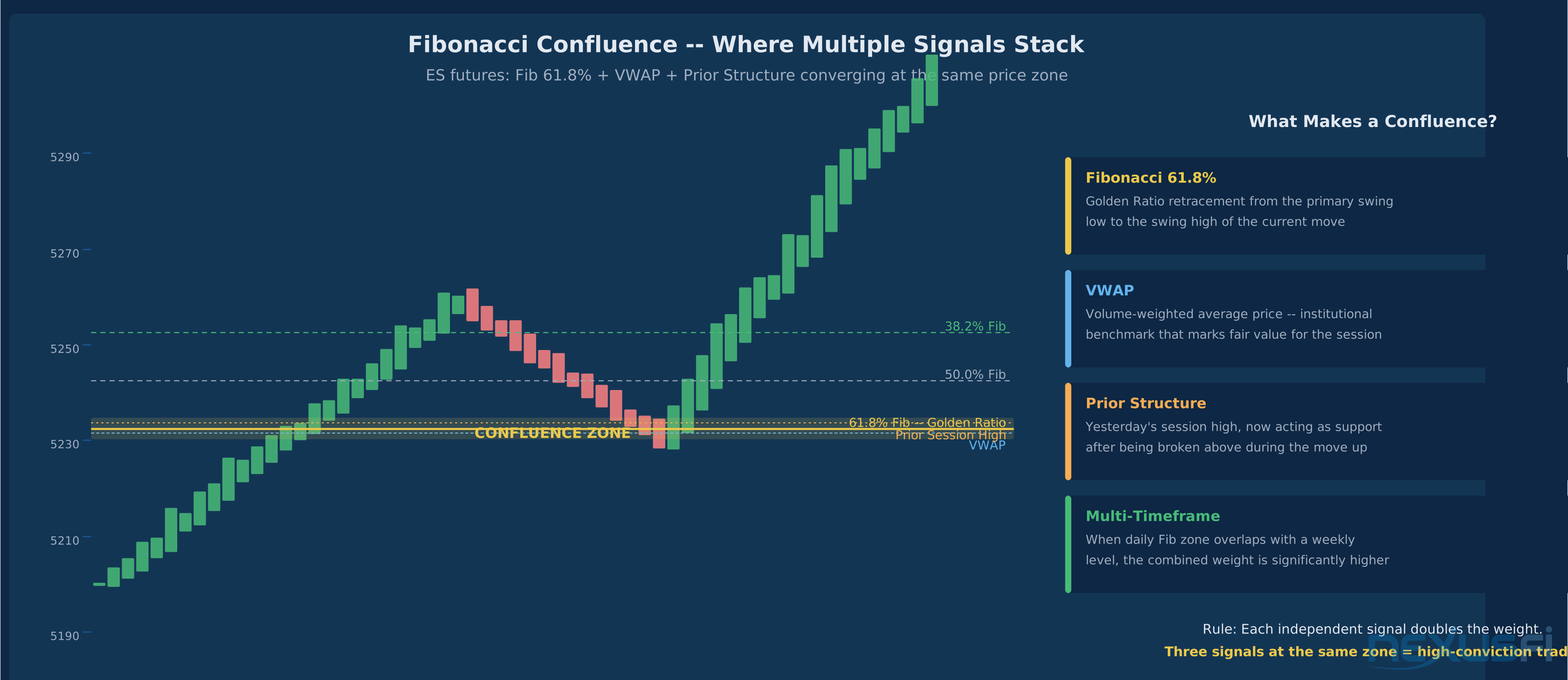
Extensions project beyond the initial swing using three reference points: the start of the impulse (A), the end of the impulse (B), and the end of the pullback (C). From C, project forward using the A-to-B distance multiplied by Fibonacci ratios.
The formula: Extension Target = C + (B - A) × Fibonacci Ratio
For an ES trade: Swing from 5100 (A) to 5200 (B), pullback to 5162 (C). 161.8% extension = 5162 + (5200 - 5100) × 1.618 = 5162 + 161.8 = 5323.8. That's your primary profit target.
@Fat Tails analyzed the statistical distribution of Fibonacci extension reactions [2] and found: "higher probability lines are expansions, followed by prior swing highs and lows and the common retracements." Extension levels, statistically, produce higher-probability reactions than retracement levels — they just occur less frequently and require more trade management to reach.
Professional Extension Management
Don't try to ride a move from entry to 261.8% in one shot. Scale out methodically:
- Take 50% off at the 127.2% extension and move stop to break-even
- Hold the remaining 50% to the 161.8% extension
- Only hold to 200% or 261.8% if the trend is showing signs of acceleration (expanding range, increasing volume, ATR expanding)
Combine extension targets with prior structural highs and lows. If the 161.8% extension lands within 2-3 points of the prior session high on ES, that's a much stronger target — two independent reasons price should react at the same level.
Fibonacci Confluence: The Professional Edge #
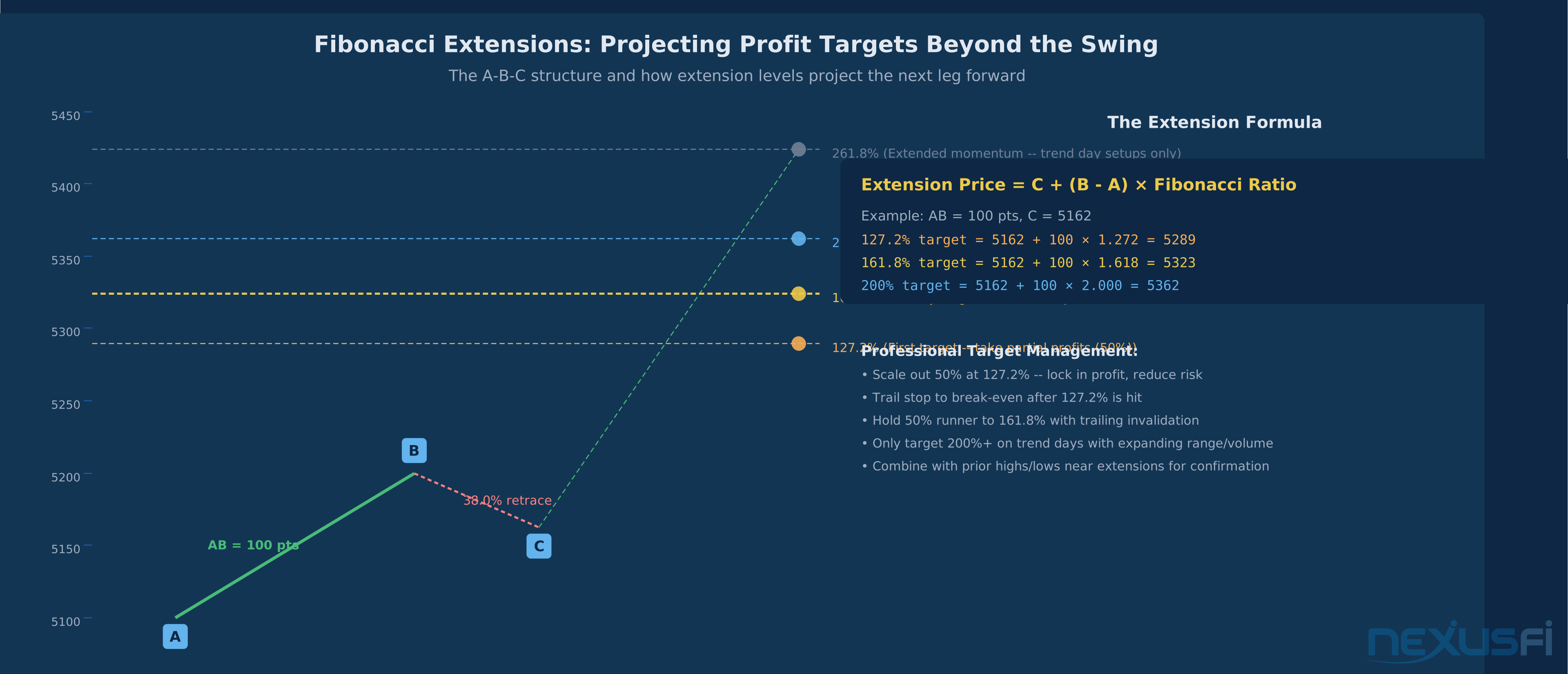
Fibonacci levels in isolation provide a framework. Fibonacci levels in confluence with other technical signals provide actual trading setups. Every additional independent signal pointing to the same price zone increases the probability of a significant reaction.
Fibonacci + Volume Profile
When a Fibonacci retracement level lands on a High Volume Node (HVN) or Point of Control from a prior session, the level carries double the weight. The Fibonacci says "this is a proportional pullback target." The HVN says "this is where the market previously accepted value and will likely do so again." Both pointing to the same price is a high-conviction zone.
Conversely, if a Fibonacci level falls in a Low Volume Node (LVN), expect price to slice through it. LVNs are rejection zones — price doesn't linger there regardless of what Fibonacci shows. When Fibonacci and volume profile conflict, volume profile usually wins.
Fibonacci + VWAP
When the session VWAP or a VWAP standard deviation band aligns with a Fibonacci retracement, the level carries institutional weight. VWAP-tracking algorithms are benchmarking against that level. Add Fibonacci confluence, and you have a zone both the technical community and institutional execution algorithms are referencing simultaneously.
Fibonacci Clusters
A Fibonacci cluster occurs when Fibonacci levels from multiple different swings converge within a tight price band. @Fat Tails built an entire indicator system around this concept [1], using "a collection of 10 zigzags in different timeframes" to identify where Fibonacci lines from different time scales stack up. The denser the cluster, the stronger the level — multiple communities and algorithms targeting the same area simultaneously creates genuine liquidity concentration.
Practical cluster approach: draw Fibs from the two or three most significant swings on your primary timeframe. Identify the price zones where levels from different swings overlap within a narrow band (1-3 points on ES, 0.15-0.30% of price). Those cluster zones are your highest-priority Fibonacci levels.
For a deep dive into cluster analysis and multi-swing Fibonacci methodology, see Fibonacci Confluence and Cluster Zones.
Fibonacci and Elliott Wave #
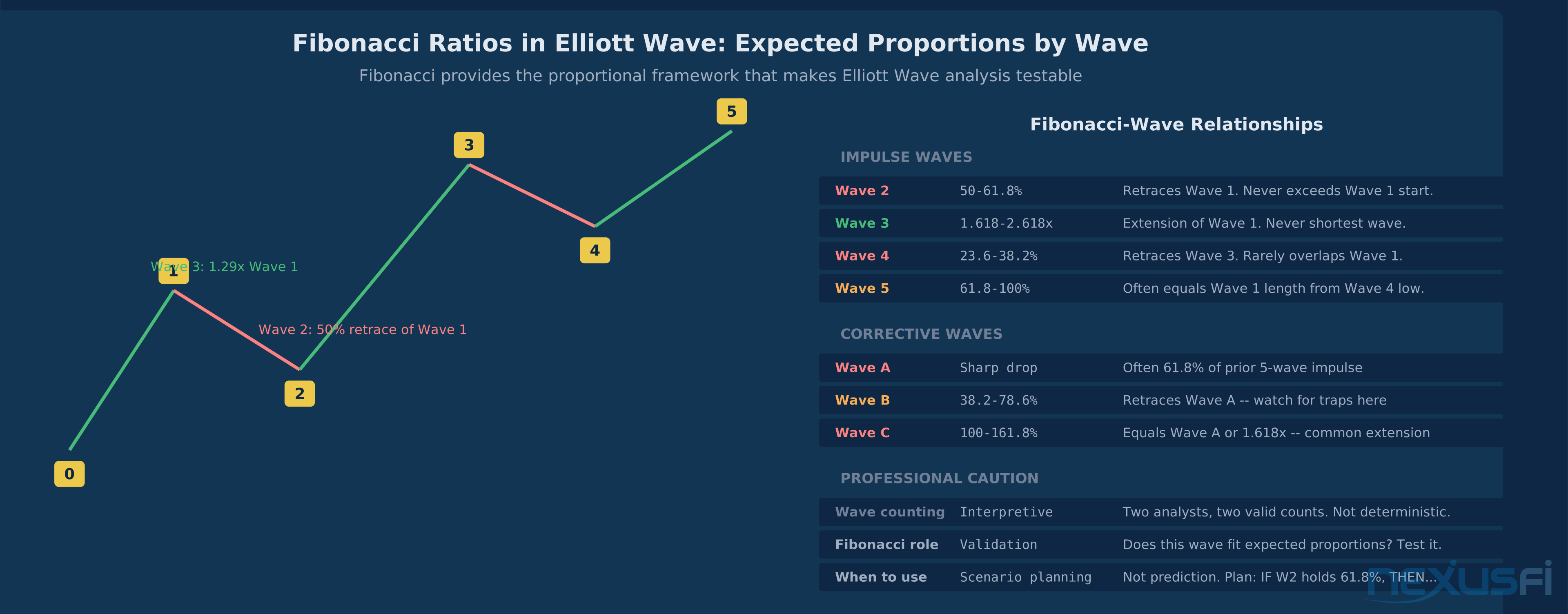
Elliott Wave theory uses Fibonacci ratios to define expected proportional relationships between waves. This isn't coincidence — the theory was developed in part around Fibonacci, and the two frameworks reinforce each other when used correctly.
Common Fibonacci-wave relationships:
- Wave 2 typically retraces 50-61.8% of Wave 1. If it retraces more than 100%, the wave count is wrong.
- Wave 3 often extends to 1.618-2.618 times the length of Wave 1. The 1.618 extension is most common.
- Wave 4 typically retraces 23.6-38.2% of Wave 3. Rarely overlaps Wave 1 territory in impulse sequences.
- Wave 5 often equals Wave 1 in length, or extends to 61.8% of Waves 1 through 3 combined.
The professional caution: Elliott Wave counting is interpretive. Two analysts looking at the same chart can have two valid wave counts. Use Fibonacci as a validation tool — "does this wave relationship fit expected Fibonacci proportions?" — rather than as a predictive framework. When the count aligns with Fibonacci proportions, confidence increases. When it doesn't, something's off in either the count or the expectation.
For the full treatment of Fibonacci in wave analysis and time-based Fibonacci applications, see Fibonacci Time Zones and Cycles.
Practical Application in Futures Markets #
ES (S&P 500 Futures)
ES is the most liquid futures market and shows excellent Fibonacci respect. The key: focus on 61.8% and 38.2% retracements from the overnight range high/low and from RTH session swings. When the daily 61.8% aligns with the prior day's value area high, that confluence catches the most significant intraday reversals.
ES entry framework: Clean impulse move (minimum 20 points RTH). Wait for pullback to enter the Golden Zone (50-61.8%). Look for a failed swing low on the 5-minute chart within the zone — a bar that makes a lower low but closes above the prior bar's low, with delta divergence on the footprint. Enter on the next bar above the failed swing high. Stop 2-3 points below 78.6%. Target: prior swing high minimum, 127.2% extension as the stretch target.
NQ (Nasdaq Futures)
NQ has higher beta than ES and shows larger Fibonacci zones due to its volatility. Retracements to 61.8% on NQ can be 60-100 points. The extension targets are proportionally larger: 127.2% and 161.8% extensions of a 200-point NQ swing produce 254 and 323-point targets respectively.
NQ responds especially well to multi-timeframe Fibonacci confluence. Align a 15-minute chart 61.8% retracement with a daily chart 38.2% retracement, and the combined level produces high-probability setups. Use wider stops on NQ compared to ES due to its higher ATR.
CL (Crude Oil Futures)
Crude oil exhibits larger intraday ranges and more abrupt reversals than equity index futures. Deeper retracements (78.6%) occur more frequently on CL than on ES, driven by the commodity's susceptibility to fundamental supply/demand shocks. Use wider decision zones: 0.30-0.50% of price rather than the 0.10-0.20% appropriate for ES.
On CL, the confirmation requirement is higher. A wick into the 61.8% that immediately reverses is common and often a trap. Wait for absorption — sustained buying or selling at the level on the footprint chart, with delta building in the direction of the expected move.
GC (Gold Futures)
Gold respects well-defined supply/demand zones and shows strong Fibonacci respect at 61.8% retracements from daily swings. The key alignment is Fibonacci with prior day highs/lows and Asian/London session range boundaries. When a 61.8% retracement coincides with the prior London session high, the combined level has multiple participant groups referencing it simultaneously.
When Fibonacci Fails #
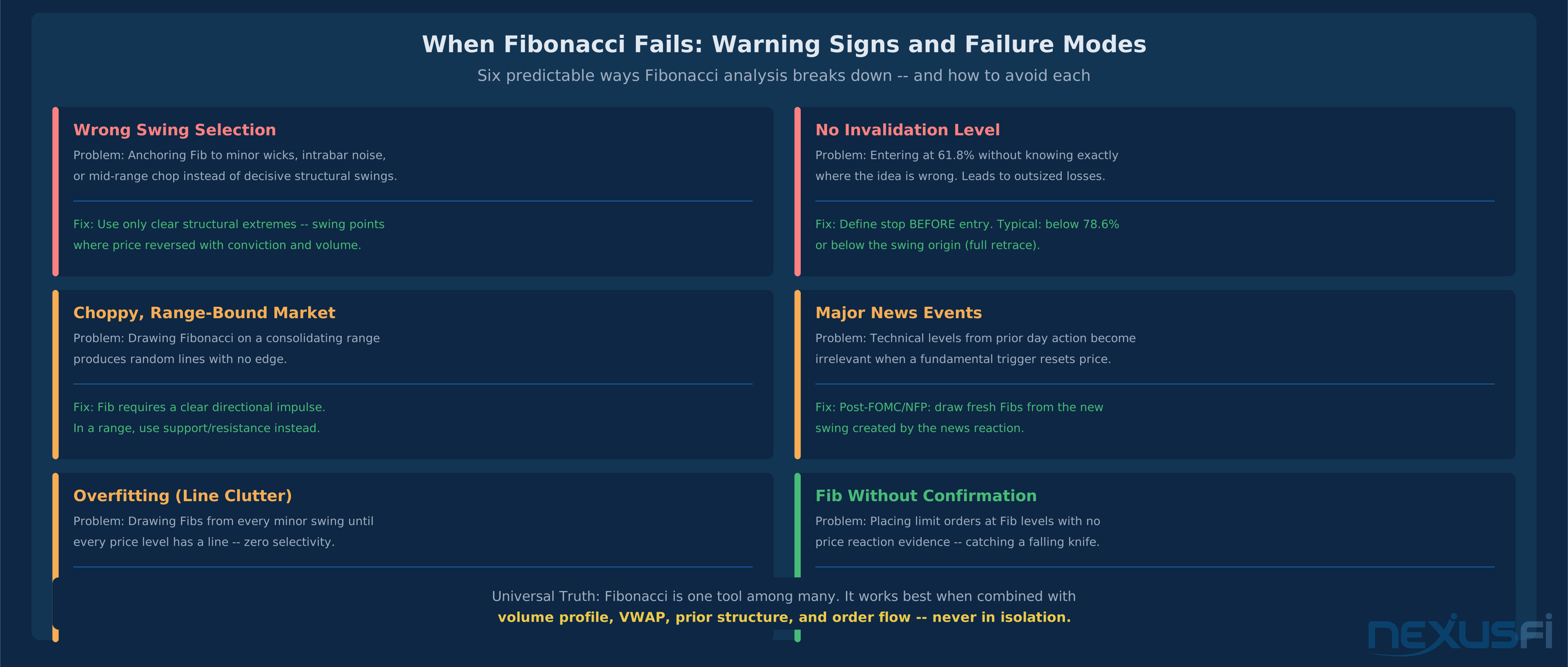
Fibonacci levels fail in predictable ways. Knowing the failure modes is as important as knowing the setups.
Choppy, range-bound markets: In a consolidating range, there's no clean directional swing to measure. Drawing Fibonacci on chop produces random horizontal lines that'll hit by chance. The fix: don't draw Fibs until you have a clear impulse. In a range, use the range's high and low boundaries as your reference levels instead.
Overfitting: If you draw Fibonacci from every minor swing, your chart becomes a wall of lines. Price will hit one by chance, and you'll confuse random price action for Fibonacci respect. @Fat Tails acknowledged this directly [1]: "Sure, if you draw enough lines on your chart, price is going to hit one of them." The discipline is specificity: two or three significant swings, no more.
News-driven markets: A major economic release (NFP, CPI, FOMC) resets the playing field. The Fibonacci levels you drew before the announcement are now measuring the old structure. After the news reaction, draw fresh levels from the new swing that the announcement created.
Stale swings: Fibonacci levels from three-week-old swings carry much less weight than those from yesterday's session. The further back the anchor points, the more likely the market has repriced around that information and moved on. Keep your Fibonacci reference fresh.
No confirmation: Placing limit orders at Fibonacci levels without waiting for a price reaction is the most common failure mode. The level might fail immediately, and you have no filter. Require a confirmation signal — a rejection candle, a structure break on the lower timeframe, or a delta divergence on the footprint — before entering at any Fibonacci level.
Risk Management with Fibonacci #
Fibonacci levels define where to look, not what to do. The edge comes from structure confirmation, order flow evidence, defined invalidation, and position sizing — not from the Fibonacci level itself.
Standard Fibonacci risk management:
- Stop placement: Below the 78.6% level when entering at 61.8%. Below the 50% level when entering at 38.2%. Always placed beyond the next Fibonacci level, not within the zone itself.
- Risk per trade: Define in points or ticks, not percentages of the Fibonacci zone. On ES, a 5-7 point stop from a 61.8% entry is typical. On NQ, 15-25 points. On CL, 0.30-0.50 points.
- Target structure: Minimum 1:1 risk-reward to prior swing high. Prefer 1.5:1 to 2:1 targeting the 127.2% or 161.8% extension. Never enter a Fibonacci trade without a defined target.
Advanced Techniques #
For traders ready to go deeper into Fibonacci methodology, the Academy covers these specialized applications:
Harmonic Patterns — Rule-based Fibonacci geometry that defines specific A-B-C-D reversal structures (Gartley, Bat, Butterfly, Crab). These use Fibonacci ratios to define precise completion zones. See Harmonic Trading Patterns.
Fibonacci Clusters — Multi-swing analysis where Fibonacci levels from different timeframes and swings overlap to create high-probability decision zones. See Fibonacci Confluence and Cluster Zones.
Fibonacci Time Zones — Applying Fibonacci ratios to time intervals between swing points to identify probabilistic reversal windows. See Fibonacci Time Zones and Cycles.
Fibonacci for Trade Management — Using Fibonacci levels for stop placement, scaling, and position management throughout a trade lifecycle. See Fibonacci for Trade Management.
Knowledge Map
Prerequisites
Understand these firstReferences This Article
Articles that build on this topicCitations
- — Applying Fibonacci Cluster and Confluence Zones“I use Fibonacci tools for trading, not because I believe in black magic or the omnipresence of the golden ratio, but because they are an efficient tool to establish support and resistance.”
- — Applying Fibonacci Cluster and Confluence Zones -- probability analysis“The 100% line has the strongest impact both in absolute and relative terms. In terms of relative probabilities, the extension levels have a higher success rate than the retracements.”
- — Spoo-nalysis ES e-mini futures S&P 500“Fibs appear to work, as a result of a human perceptual (and information processing) error.”
- — Spoo-nalysis ES -- like everything else fibs work best in confluence“Like everything else, fibs work best in confluence.”
- — Harmonic Trading“Harmonic Trading is based on patterns that are present in nature highlighted by the golden or the divine ratio.”