



Futures Pricing and the Cost of Carry: Why Every Contract Has a Fair Value
Overview #
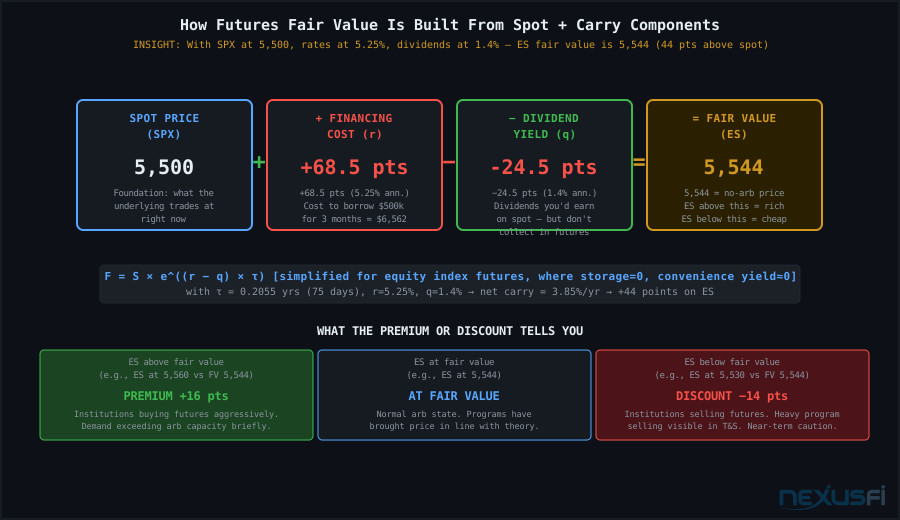
If you've ever looked at the ES futures quote and wondered why it's sitting 8 points above the S&P 500 cash index — or below it — you've run into the cost of carry. Most traders notice this discrepancy and shrug it off as noise. The ones who actually understand it trade differently.
Every futures contract has a theoretical fair value. That value is calculated from the spot price plus the cost of financing the position, minus any income the underlying asset generates while you hold it. When the market price drifts away from fair value, arbitrageurs bring it back. This happens so efficiently in liquid markets like ES that the gap between fair value and market price rarely exceeds a fraction of a point. Statistical arbitrage systems are built specifically to capture these fleeting deviations, and bitcoin basis trading applies the same cash-and-carry logic to crypto markets.
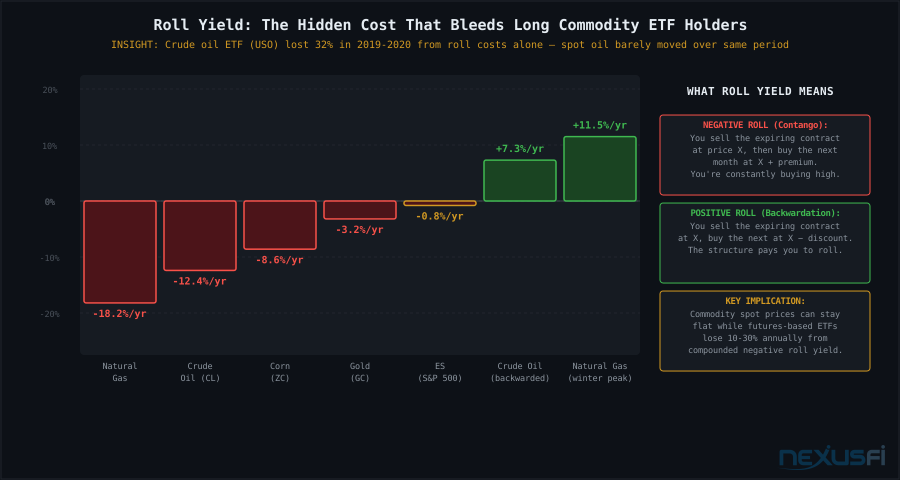
Understanding why futures prices diverge from spot prices — and what drives that divergence — is foundational knowledge for any serious futures trader. It explains why ES sometimes trades at a premium and sometimes at a discount. It explains why crude oil futures can sit 20% above spot for deferred months or 10% below it during supply crunches. It explains roll yield, the hidden cost that bleeds long commodity ETF holders year after year while the underlying spot barely moves.
This isn't academic. Fair value affects your entries when you're trading index futures around market events. It determines whether you're paying up or getting paid to roll your position forward. And for traders who work with options on futures, the cost-of-carry model is the foundation of every pricing model they'll use.
The Cost of Carry Formula #
The formal relationship is built on a no-arbitrage argument. The price of a futures contract must equal the cost of buying the underlying today, financing it to delivery, storing it if needed, and accounting for any income it generates along the way.
The continuous-time formula (the foundational cost-of-carry model as treated in John C. Hull, Options Futures and Other Derivatives, 11th ed., Chapter 5):
F = S × e(r + c − q − y) × τ
Where:
- F = futures price
- S = spot price of the underlying
- r = risk-free financing rate (what it costs to borrow money to buy the spot)
- c = storage costs (warehousing, insurance, handling -- zero for financial assets)
- q = dividend or cash-flow yield paid to the spot holder
- y = convenience yield (the benefit of having the physical asset in hand)
- τ = time to expiration in years
The exponent (r + c − q − y) is the net carry cost. If it's positive, the futures price exceeds spot (contango). If it's negative, futures trade below spot (backwardation).
For most traders working with a discrete time approximation, this simplifies to:
F ≈ S × (1 + (r − q) × τ)
The discrete formula is standard in practitioner literature. Investopedia frames it as: “Fair value is the theoretical assumption of where a futures contract should be priced given such things as the current index level, index dividends, days to expiration and interest rates.” This same relationship underpins the fair value numbers broadcast on financial media each morning before the open.
For equity index futures, storage costs and convenience yield are both effectively zero, leaving only the rate-minus-dividend spread.
Here is what that formula means in practice. Here is how to apply it with real numbers.
What "Net Carry" Actually Means
Here is what that looks like in practice: think of it this way: if you could buy the underlying asset today and hold it until the futures delivery date, what would it cost you net of any income?
For ES futures with rates at 5% and the index yielding 1.5% in dividends:
- You finance the position at 5%
- You collect 1.5% in dividends
- Net carry = 3.5% per year
Over 3 months (τ = 0.25), the futures should trade at approximately 0.875% above spot. With the S&P 500 at 5,500, that puts ES fair value around 5,548. If ES is trading at 5,540, it's cheap relative to fair value. If it's at 5,560, it's rich.
"Fair value is a function of 2 factors: interest rates and dividends. In the index arb world, traders want to know how futures are trading relative to their fair value."
Cash-and-Carry Arbitrage: The Engine That Enforces Fair Value #
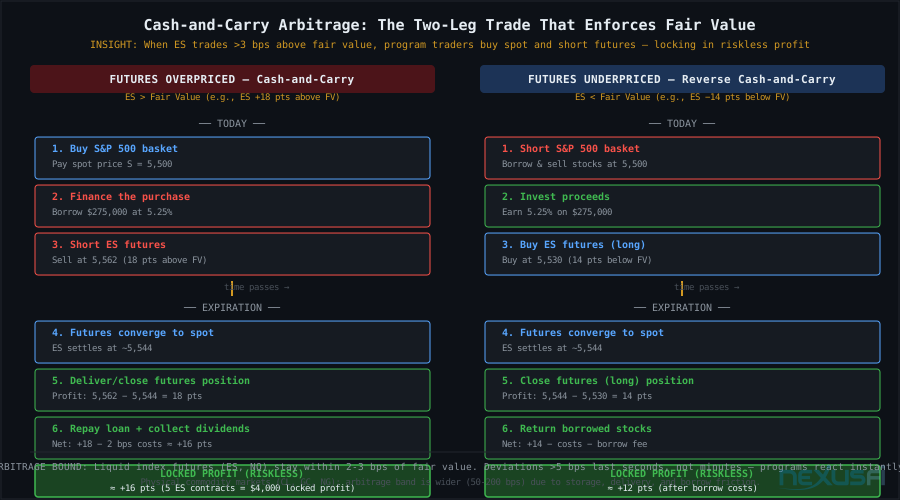
Fair value isn't just a number on a screen — it's maintained by professional arbitrageurs who exploit any deviation from it. Understanding the mechanics helps you understand why the gap almost never gets large in liquid markets.
When Futures Are Overpriced (Cash-and-Carry)
If ES futures are trading much above fair value, here's what happens:
- Buy the S&P 500 basket of stocks at spot
- Finance the purchase (borrow money at rate r)
- Short the overpriced ES futures
- At expiration, the futures converge to spot; deliver (or close) to collect the spread
- Repay the loan plus interest, net the dividends received
The profit equals the amount futures were above fair value, minus transaction costs.
When Futures Are Underpriced (Reverse Cash-and-Carry)
If ES futures are trading much below fair value:
- Short the S&P 500 basket (sell borrowed stocks)
- Invest the proceeds at the risk-free rate
- Go long the underpriced ES futures
- At expiration, close both positions
The profit equals the amount futures were below fair value, minus execution costs.
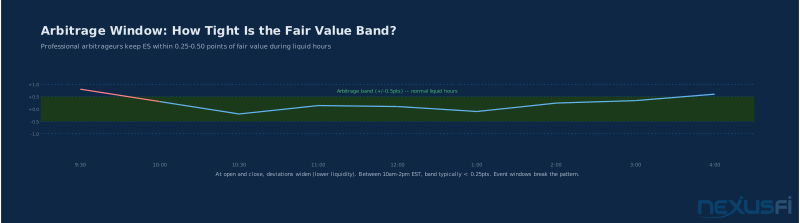
In practice, this arbitrage requires access to institutional clearing, securities lending, and low-cost execution. The minimum profitable spread for liquid equity index futures is roughly 2-3 basis points. Any gap beyond that gets arbitraged away within seconds by program traders.
@Fat Tails described the arbitrage mechanism clearly in a NexusFi discussion:
"If somebody heavily sold ES and it is below its fair value, the arbitrageurs will buy ES and sell the stocks. If somebody heavily bought ES and it is above its fair value, the arbitrageurs will sell ES and buy the stocks."
This is why, in normal market conditions, ES tracks the S&P 500 index with notable precision. The arbitrageurs aren't doing it out of civic duty — they're taking the free money the market is offering whenever pricing deviates from fair value.
Why Arbitrage Doesn't Always Fully Close the Gap
In theory, cash-and-carry arbitrage is riskless. In practice, several frictions limit how tight the band can get:
Transaction costs — commissions, bid-ask spreads, market impact on executing both legs. Borrow costs — for the reverse carry, finding and borrowing shares costs money. Storage frictions — for physical commodities, warehousing limitations constrain the trade. Capital constraints — institutional arbitrageurs face position limits and capital charges. Execution risk — the two legs of the trade can't be executed at exactly the same time.
For physical commodity markets like crude oil or agricultural futures, these frictions are much larger. A mispricing of 1-2% can persist for extended periods without being arbitraged away because of the complexity and cost of the physical delivery leg.
The practical impact is visible in two key metrics — the fair value band width and how the basis gap between futures and fair value evolves through the trading day.
How to Calculate Fair Value for ES and NQ #
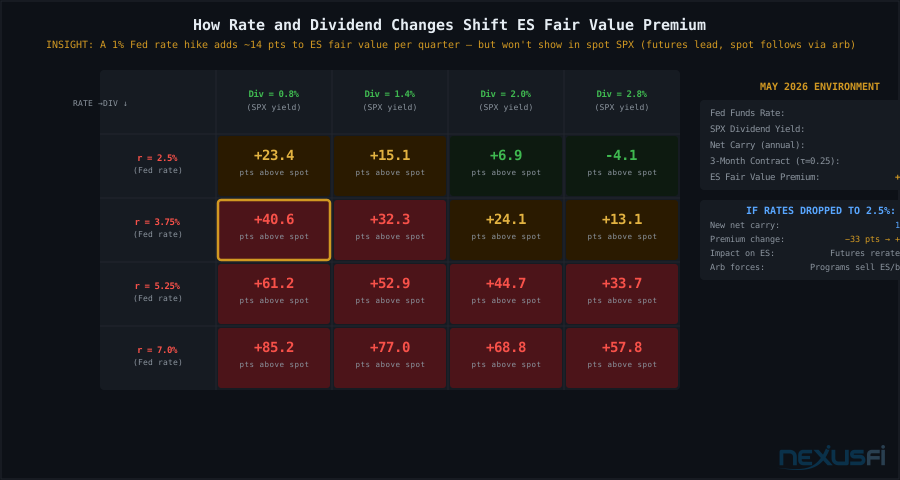
Let's put numbers to the theory. Here's how to estimate fair value for ES at any given moment.
Inputs you need:
- Current S&P 500 index level (SPX)
- Days to futures expiration
- 3-month risk-free rate (typically the 3-month T-bill rate or SOFR)
- Expected dividend yield (annualized)
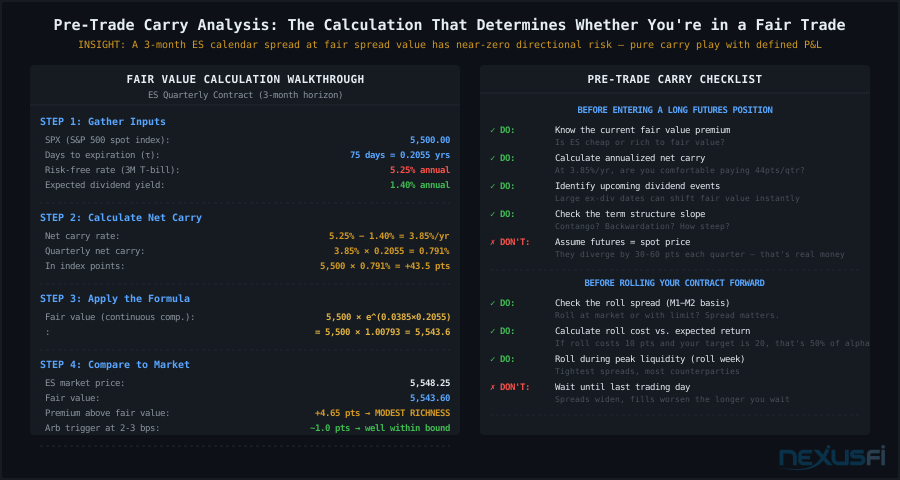
Example calculation:
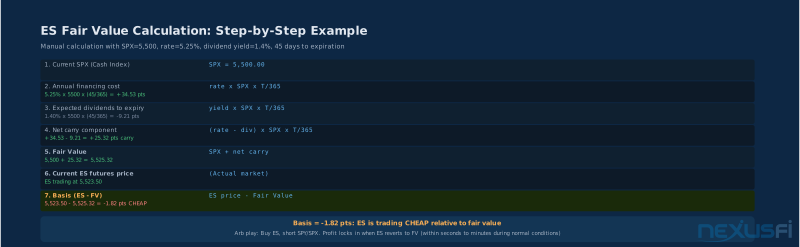
- SPX = 5,500
- Days to expiration = 75 (quarterly contract, mid-cycle)
- τ = 75/365 = 0.2055 years
- r = 5.25% (annual, risk-free rate)
- q = 1.4% (annual dividend yield)
- Net carry rate = 5.25% − 1.4% = 3.85%
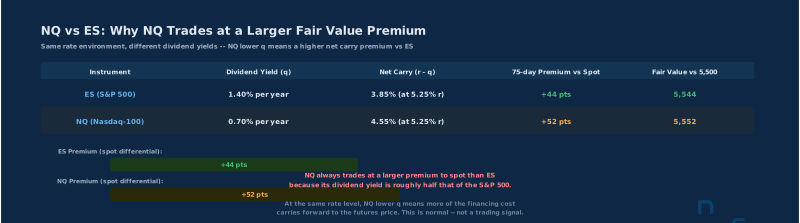
Fair value = 5,500 × (1 + 0.0385 × 0.2055) = 5,500 × 1.00792 = 5,543.6
If ES is trading at 5,546, it's about 2.4 points rich to fair value — within normal arbitrage bounds. If it's at 5,535, it's 8.6 points cheap — unusual and worth noting.
The ES Premium/Discount: Traders shorthand the fair value calculation as the "ES premium." When ES trades above fair value, the premium is positive. When below, it's negative. A consistently negative premium going into a significant market decline is a warning sign — institutions are selling futures rather than spot stocks, which can indicate more distributional selling to come.
The E-mini Nasdaq-100 (NQ) futures contract uses the same math, just with different inputs:
- The Nasdaq-100 yields roughly 0.6-0.8% (much lower dividend yield than S&P 500)
- Higher yield on NQ = higher fair value premium versus ES in the same rate environment
- This is why NQ almost always trades at a larger premium to its spot index than ES
@Fat Tails detailed the formula used to calculate fair value for index futures:
"Fair value = spot index price × (1 + (interest rate − projected dividend rate) × days until expiry / 360). The interest rate is the money market yield prior to expiry of the futures contract."
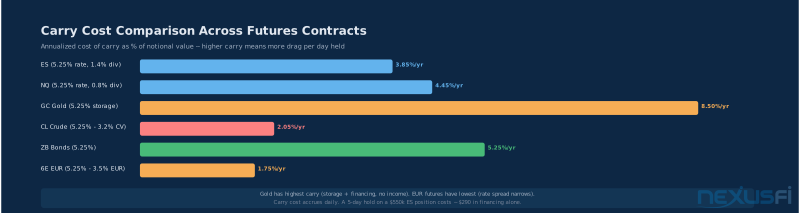
The Four Carry Components by Asset Class #
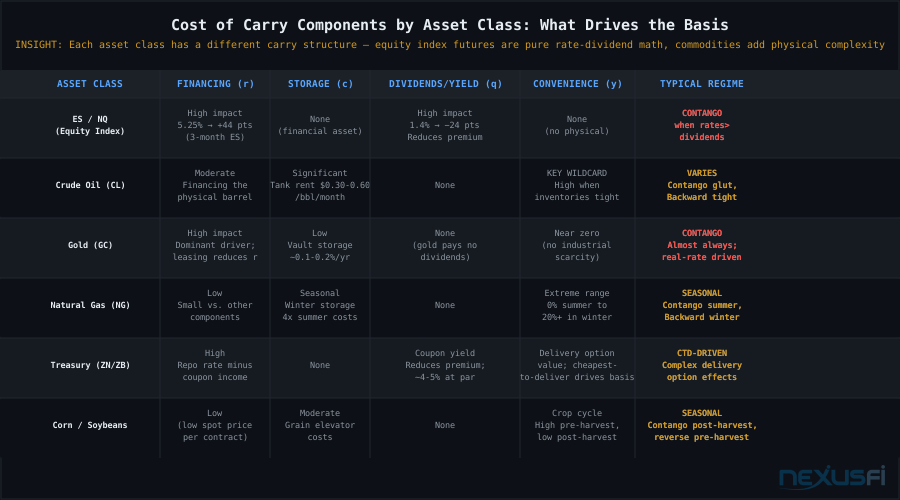
The cost-of-carry framework looks different depending on what you're trading. Here's how each component plays out across major futures markets.
Equity Index Futures (ES, NQ, YM, RTY)
The E-mini S&P 500 (ES) futures contract is the most liquid equity index futures contract in the world. Financing rate (r): The dominant driver. Futures trade at a premium to spot when rates exceed dividend yields. Dividend yield (q): Reduces the premium. When the index pays more in dividends than it costs to finance the position, futures trade at a discount to spot. Storage costs (c): Zero — no warehousing needed for an index. Convenience yield (y): Effectively zero for financial assets.
Key insight: In a high-rate environment (rates > dividends), equity index futures trade at a premium to spot. In a low-rate or high-dividend environment (dividends > rates), they can trade at a discount (backwardation). ES experienced this during the post-2008 period when dividend yields briefly exceeded rock-bottom interest rates.
@Fat Tails documented exactly this dynamic:
"If interest rates are lower than expected dividends, the ES futures would trade at a discount to the S&P 500 index. The backwardation can be observed for the whole year.
Crude Oil Futures (CL)
Crude oil (CL) futures move differently than equity index futures. Financing rate (r): Adds to futures price — costs money to finance the crude oil purchase. Storage costs (c): Significant — renting tank space for millions of barrels adds up. Convenience yield (y): The wildcard. When inventories are tight and refiners need crude now, the convenience of having physical oil in hand is worth a lot. This is what drives backwardation.
When oil inventories are high and storage is available, CL futures sit in contango — deferred months cost more than nearby months. When inventories tighten and refiners scramble for supply, the convenience yield spikes and the curve inverts into backwardation.
Research from the Bank of Canada frames the convenience yield as “the interest rate, denominated in barrels of oil, for borrowing a single barrel of oil” — and demonstrates it has predictive power over future crude oil inventories, production, and prices. When the curve signals increasing convenience yield ahead of EIA inventory reports, traders who understand the carry model are positioned for the move.
Gold Futures (GC)
Financing rate (r): Dominant driver — you're basically borrowing money to buy gold. Storage costs (c): Modest — vault storage is expensive but gold's high value-to-weight ratio keeps costs proportionally small. Lease rate: Gold has a unique financing mechanism where central banks lend gold for a "lease rate" that effectively reduces the cost of carry for arbitrageurs. Gold almost always sits in contango because gold has no dividends, no convenience yield for holding the physical, and the lease rate is typically well below risk-free rates.
Agricultural Futures (Corn, Soybeans, Wheat)
These markets have pronounced seasonal carry patterns driven by crop cycles. Post-harvest, with ample supply, storage costs dominate and deep contango is typical. Pre-harvest, potential supply uncertainty can push convenience yield higher and curves toward backwardation.
As @josh noted in a discussion of back-adjusted futures data on NexusFi:
"The price of a futures contract depends not only on the underlying, but a number of other factors. For equity index futures like ES, that would include interest rates, dividend of the underlying stocks, and days to expiration. For crude oil and other commodity contracts, storage costs and the convenience yield also play a role."
Contango vs Backwardation: Reading the Term Structure #
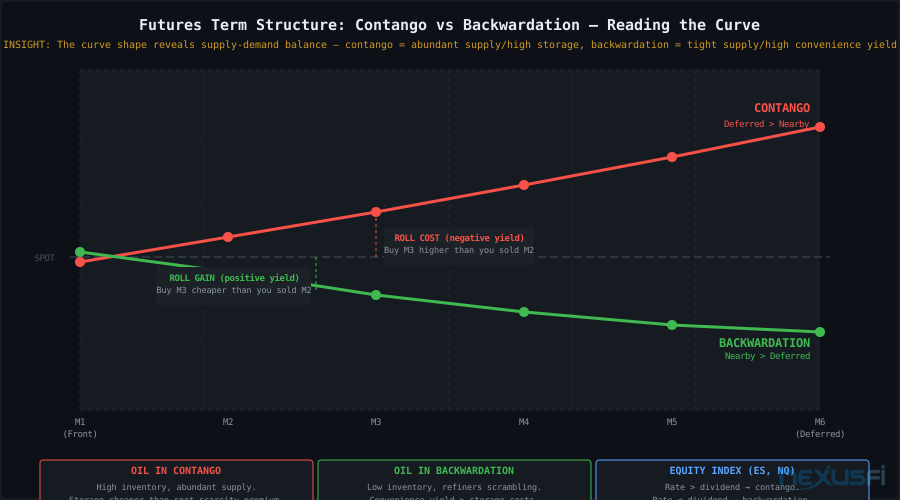
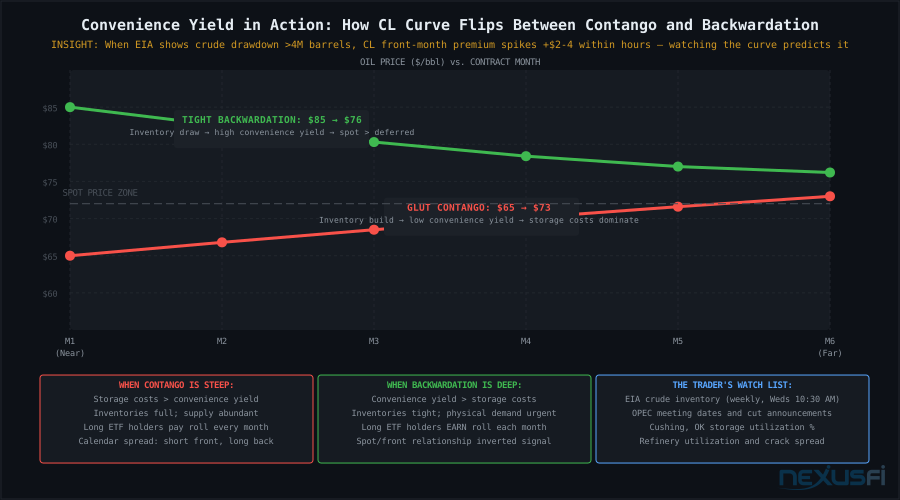
The shape of the futures curve — contango and backwardation — tells you where the market sees carry heading. Learning to read it is like gaining a second pair of eyes on supply-demand dynamics.
Contango is the normal state for most markets most of the time. Deferred futures cost more than nearby futures. This makes mathematical sense: if you're going to hold the underlying for 12 months instead of 3, your financing costs are higher. Storage costs accumulate. You pay for time.
Backwardation means nearby futures cost more than deferred ones — the same term structure logic that drives the Treasury yield curve, applied across every futures market. This is usually a signal of immediate supply tightness. The market is saying: having this thing now is worth a premium over having it in 6 months. Backwardation occurs when the convenience yield spikes above the sum of financing and storage costs.
For traders, these structures matter in several ways:
Rolling costs: If you hold a long futures position through an expiration, you have to sell the expiring contract and buy the next one out. In a contango market, the next contract is more expensive — you're buying high and selling low on every roll. This is the negative roll yield that destroys long-term returns for commodity ETF holders. In backwardation, the structure works in your favor — you roll from the expensive nearby contract into the cheaper deferred contract.
Regime information: A sudden shift from contango to backwardation in crude oil often precedes significant price moves. It means physical buyers are scrambling for supply. Traders who watch the curve rather than just the front-month price have an informational advantage.
Calendar spread trades: When the contango is steeper than storage costs justify, there's a relative-value trade: short the overpriced deferred contract, long the nearby. When backwardation is shallower than convenience yield suggests, the reverse.
As @tigertrader outlined in his definitive analysis of futures term structure:
"One of the most overlooked and misunderstood aspects of trading futures is the shape of the futures curve. Contango is when the deferred futures price is above the expected spot price — because of convergence, the implication is the futures prices will fall over time to meet spot. Backwardation is when futures prices are below the expected spot price and the implication is that price will rise."
This thread continues with extensive ES term structure discussion, noting that the shape of the futures curve provides critical information about carry regimes.
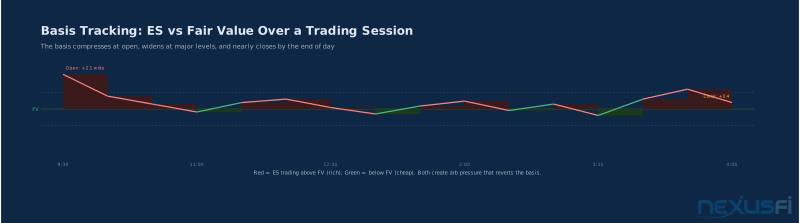
Practical Applications for Day Traders #
Check the ES/SPX premium before the US open. When ES trades 10+ points above fair value, early selling programs typically activate. Context, not direction.
Even if you never intend to trade calendar spreads or basis, understanding fair value improves your intraday decision-making.
Using fair value as a reference at the open: The gap between fair value and where ES futures are trading tells you whether the pre-market is bidding up the market above what rates and dividends justify, or whether it's selling it below. A 10-point premium above fair value at 9:25 AM suggests institutional buyers are in the market — a meaningful tell about opening direction.
Identifying program trading triggers: Major program trading firms have their own calculated fair value. When ES deviates from fair value by enough to exceed their transaction costs, buy or sell programs trigger automatically. You'll often see ES "snap back" to fair value quickly after a large tick imbalance — that's the programs at work.
Understanding why ES and SPX don't always move together tick-for-tick: Index arbitrage creates tight coupling, but there are moments — especially around major economic releases — when futures lead and arb programs take a few seconds to catch up. These brief disconnections can create execution advantages if you're trading the right side.
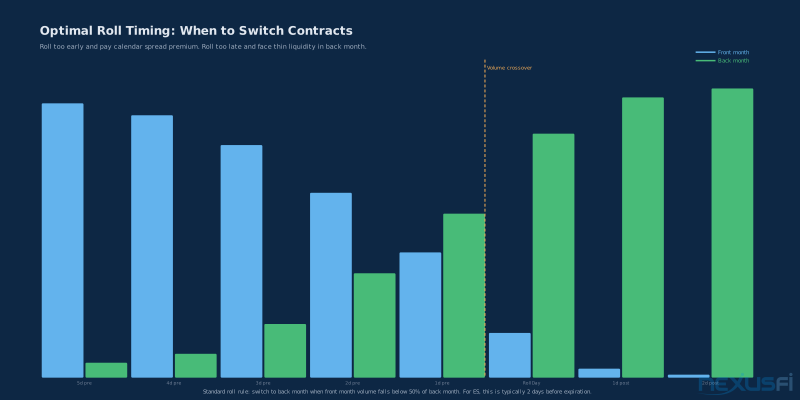
Roll timing: If you're holding a long ES position through a quarterly expiration and you want to continue, pay attention to when the roll is cheapest. Roll volume concentrates in the week before expiration, and the roll spread narrows as both parties to the roll look for counterparties. Rolling earlier, during roll week rather than on the last trading day, typically captures better fill quality.
For more on how dividend changes drive backwardation and fair value shifts, see the Contango vs Backwardation section, where @tigertrader discusses the term structure dynamics in depth.
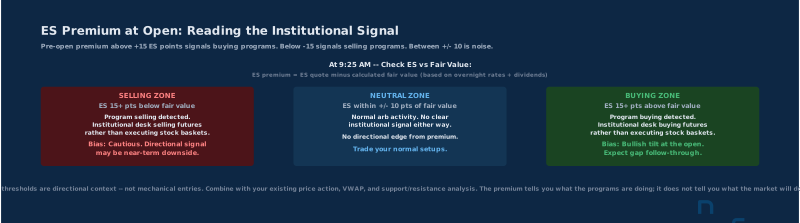
Common Misconceptions #
"A futures contract trading above spot means the market expects prices to rise." Not necessarily. Contango is usually just the cost of financing. ES trading above SPX by 12 points with rates at 5% and dividends at 1.5% doesn't imply the market expects the S&P 500 to rise — it's what the fair value formula requires. The market's expectation of price direction is captured in the movement of spot prices, not in the futures basis.
"When futures go to a discount to spot, it's bearish." Sometimes, but context matters. If ES is at a discount because dividend yields have risen above interest rates, that's just math — not a bearish signal. If ES drops to a discount during a fast selloff because institutional sellers are hitting futures rather than executing stock baskets, that can be a short-term directional signal. The distinction matters.
"Rolling futures forward doesn't affect my returns." Rolling costs something in contango markets and earns something in backwardated markets. For long-term holders, this compounds much. Systematic strategies that assume zero roll cost are systematically underestimating their actual trading costs.
"Commodity futures prices are forecasts of future spot prices." The forward price reflects cost-of-carry assumptions, not price forecasts. A crude oil futures contract for December delivery at $85 when spot is at $80 doesn't mean the market thinks oil will be at $85 in December. It means the cost of storing and financing a barrel of oil from now until December is approximately $5. Convenience yield and storage cost — not price forecasts — explain most of the deferred premium for storable commodities. Understanding futures settlement mechanics clarifies why the price converges to spot at expiration.
Monitoring Fair Value in Your Daily Trading #
You don't need to calculate fair value from scratch every morning. Several data sources publish it in real time.
On most trading platforms, you can display the fair value number alongside the live futures quote. The display shows "premium" (futures above fair value), "discount" (futures below fair value), and the fair value level itself. Bloomberg and Reuters terminals publish institutional fair value calculations with higher precision and faster updates.
For ES specifically: The commonly quoted ES fair value is published by Bloomberg and several data services before the market opens. It's derived from the S&P 500 closing price, the next futures expiration date, the overnight repo rate, and expected dividends. Major financial TV networks broadcast this number each morning.
For commodities: Calculating fair value requires knowing current storage costs, which vary by location and contract grade. This is why commodity traders typically work backward from the observed futures curve — they infer the implied convenience yield from market prices rather than calculating a theoretical fair value and comparing it to the market.
What to watch day-to-day:
- ES/NQ premium or discount to fair value (available on most futures platforms)
- Changes in the dividend yield estimate (especially around earnings season)
- Fed policy changes that shift the financing rate component
- Quarterly expiration dates and roll timing
- For commodity traders: inventory reports that can shift convenience yield dramatically
Knowledge Map
Go Deeper
Build on this knowledgeReferences This Article
Articles that build on this topicCitations
- — Spoo-nalysis ES e-mini futures S&P 500 (2014) 👍 12“Fair value is a function of 2 factors; interest rates and dividends. In the index arb world traders want to know how futures are trading relative to their fair value.”
- — Spoo-nalysis ES e-mini futures S&P 500 (2014) 👍 21“Futures term structure is one of the most overlooked and misunderstood aspects of trading futures -- the shape of the futures curve matters enormously for positioning.”
- — S&P500 index and S&P500 index futures correlation (2010) 👍 9“The cash price is the futures price, discounted at the risk-free rate. In a positive interest rate environment, where interest rates are higher than expected dividends, the S&P 500 futures would trade at a premium to the cash index.”
- — How do the prices of derivatives relate to prices of their underlyings? (2011) 👍 3“If somebody heavily sold ES and it is below its fair value, the arbitrageurs will buy ES and sell the stocks. If somebody heavily bought ES and it is above its fair value, the arbitrageurs will sell ES and buy the stocks.”
- — ES Backwardation (2014) 👍 3“Fair-value basis has turned negative. Cash is more valuable than futures because you can earn income from the dividends of the underlying stocks, but you don't have any opportunity cost to futures -- no dividends received.”
- — Futures Contract Specifications - How long is the life of a contract? (2010) 👍 3“If interest rates are lower than expected dividends, the ES futures would trade at a discount to the S&P 500 index. The backwardation can be observed for the whole year.”
- — Why Back Adjustments on Prior Contracts? (2021) 👍 6“The price of a futures contract depends not only on the underlying, but a number of other factors. For equity index futures like ES, that would include interest rates, dividend of the underlying stocks, and days to expiration. For crude oil and other commodity contracts, storage costs and the convenience yield also play a role.”
- — Relationship between CAC40 index and CAC40 September futures index. (2012) 👍 3“Fair value = spot index price * (1 + (interest rate - projected dividend rate) * days until expiry / 360). The interest rate is the money market yield prior to expiry of the futures contract.”
- — How to Determine Fair Value in Futures Trading (2025)
- CME Group — E-mini S&P 500 Futures Contract Specs (2026)
- William Diamond and Peter Van Tassel — Risk-Free Rates and Convenience Yields Around the World (2022)
- Sung Je Byun — Speculation in Commodity Futures Markets, Inventories and the Price of Crude Oil (2016)