



Five Fundamental Truths of Trading: Mark Douglas's Framework for Accepting Market Uncertainty
Overview #
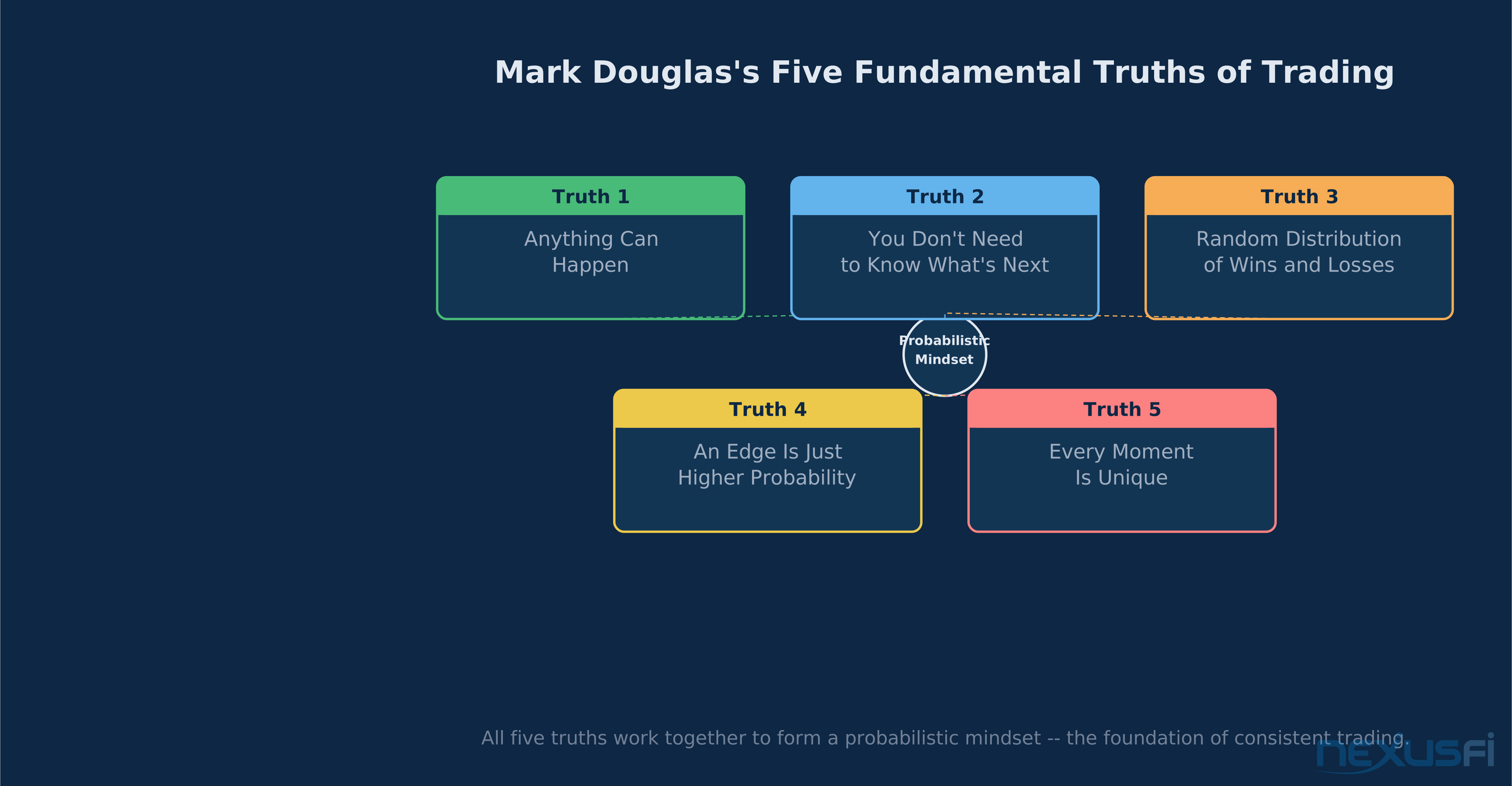
Mark Douglas spent decades studying why intelligent, disciplined people consistently lose money trading. His conclusion wasn't about strategy, risk management, or market knowledge. It was about belief. In Trading in the Zone, Douglas identified five fundamental truths that form the psychological foundation of every consistently profitable trader. These aren't motivational platitudes. They're operating principles that, when genuinely internalized, eliminate the mental friction that causes traders to override their own edge.
That sounds simple. It is simple. But the distance between knowing these truths intellectually and operating from them emotionally is where most trading careers go to die. Douglas addressed this gap extensively — a topic explored in depth in our article on Risk Acceptance as a Mental Framework.
Douglas's framework isn't about learning something new. It's about unlearning assumptions your brain makes about markets — assumptions that feel like reality but actively sabotage execution. The five truths work together as what Douglas called the "probabilistic mindset." Remove any single truth and the structure collapses.
This article breaks down each truth with futures trading examples, explains why your brain resists them, and provides exercises for moving from intellectual understanding to operational belief. If you've ever moved a stop, skipped a setup after a loss, or sized up to "make back" what the market took — at least one truth isn't integrated.
Truth 1: Anything Can Happen #
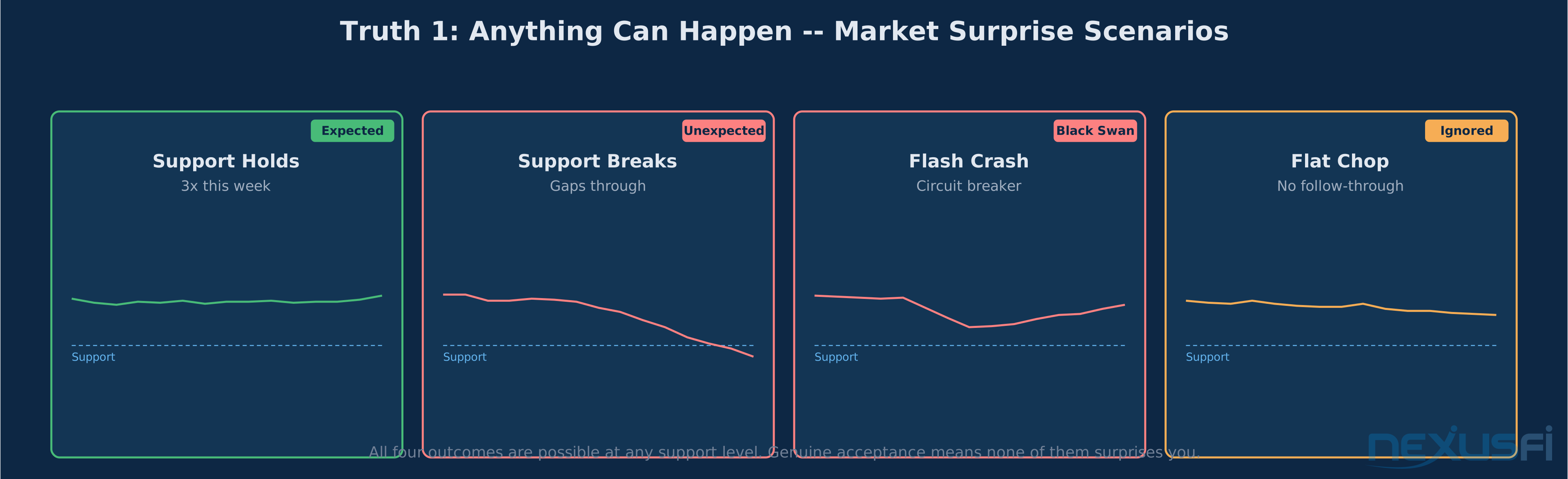
This is the truth most traders think they accept but actually don't. "Anything can happen" doesn't mean "bad things might happen." It means the market can do literally anything in the next second, minute, or session — regardless of what your charts show, what the economic data says, or what happened the last 47 times this exact setup appeared.
Think about ES approaching a level you've identified as support. It held three times this week. Volume profile shows a massive HVN. The overnight low sits two ticks below. Every signal says this level holds. You go long with your stop 4 ticks below — and the market rips straight through like the level doesn't exist.
Were you surprised? If yes, you haven't accepted Truth 1. Because "anything can happen" includes "support gets obliterated on the exact day you decide to trust it."
As @perryg advises: "If you had not read 'Trading in the Zone' by Mark Douglas, I highly recommend. Print out the following and look at it every day." Daily repetition matters more than most traders realize.
Why Your Brain Resists This Truth
Your brain is a pattern-recognition machine that evolved to predict threats. When you identify a "support level," your brain treats it as a fact — a floor that prices can't penetrate. Your ancestors who predicted where the lion would be tomorrow survived. The ones who said "anything can happen" were too paralyzed to act.
Markets aren't lions. Markets are millions of independent decision-makers whose collective behavior is unpredictable at the individual-trade level. Your pattern recognition creates an illusion of predictability that feels like knowledge but functions as a blindfold. Building awareness of these mental shortcuts is central to understanding cognitive biases in trading.
Futures Trading Example
Consider ES ahead of a jobs report. Every major level — POC, VWAP, weekly VPOC — clusters within 6 points. Traders who've internalized Truth 1 go in with defined risk. Those who haven't try to predict the direction based on "whisper numbers" — and get obliterated when the actual number surprises everyone.
CL drives the point harder. Crude can gap $3 overnight on a geopolitical event no chart predicted. A trader who accepts "anything can happen" never holds crude overnight without a risk plan. One who only thinks they accept it holds the position, hoping technicals protect them from a drone strike on a Saudi refinery.
Exercises for Internalization
Exercise 1: The Pre-Trade Confession. Before every trade, say out loud: "This trade might lose. The market might do the exact opposite of what I expect. I accept that." The discomfort reveals how far you are from genuine acceptance.
Exercise 2: The Black Swan Journal. Each week, write down three market events that fell outside your mental model entirely. Over time, this builds visceral awareness that your model is always incomplete.
Exercise 3: The Opposite-Day Simulation. For each setup, vividly imagine the exact opposite outcome before entering. Long setup? Walk through the reversal scenario. This rewires your brain to hold both outcomes simultaneously.
Truth 2: You Don't Need to Know What Happens Next to Make Money #
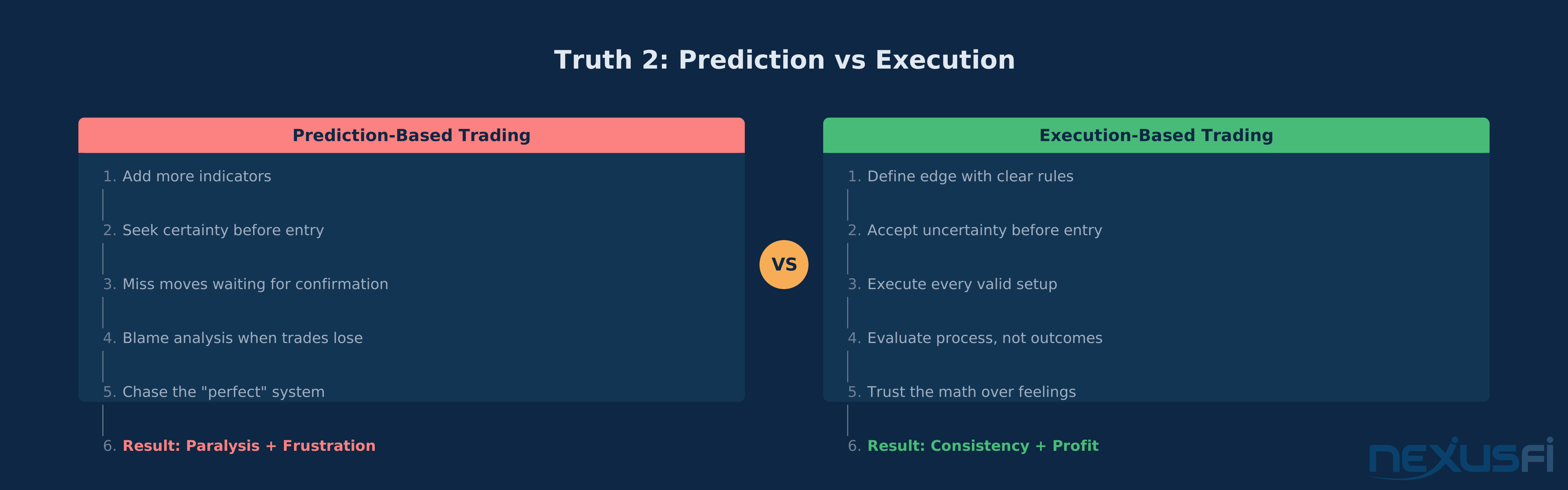
This truth attacks the deepest assumption most traders carry: that profitable trading requires accurate prediction. It doesn't. Profitable trading requires executing a positive-expectancy system consistently — a completely different activity than forecasting.
Think about a casino. The house doesn't know whether the next spin lands on red or black. It doesn't care. It has an edge built into the game (the green zero), and that edge plays out over thousands of spins. No individual spin matters. The casino doesn't agonize over the last spin or predict the next one. It just keeps the wheel turning.
That's the whole system in one paragraph. The analysis paralysis that destroys so many traders stems directly from violating this truth — believing that more knowledge will produce more certainty.
Why This Truth Is Hard to Accept
Because our entire education system trains us to equate knowledge with performance. Better grades come from knowing more. Better diagnoses come from knowing more. So traders instinctively believe that better trading comes from knowing more — more indicators, more analysis, more data, more conviction about what happens next.
The result is an ever-expanding quest for certainty. You add the RSI. Then the MACD. Then the volume profile. Then the delta footprint. Each tool feels like it brings you closer to "knowing." But it moves you further from execution, because now you need four tools to agree before pulling the trigger — and they almost never do.
Futures Trading Example
A breakout trader on NQ doesn't need to know whether the next breakout will work. They need to know their system has a 42% win rate with a 2.5:1 reward-to-risk ratio. The math: (0.42 x 2.5) - (0.58 x 1.0) = +0.47R per trade. They make money even though most trades lose.
The problem comes when a trader hits three consecutive losers (~19.5% probability at a 42% win rate) and concludes "the system is broken." They haven't accepted Truth 2. They still believe profitable trading should feel like knowing what comes next.
ES scalpers encounter the same trap. A mean-reversion scalper fading the prior day's VAH at a 65% win rate should expect 10-12 three-trade losing streaks per year. Those streaks don't mean the edge is gone. They mean probability is doing what probability does.
Exercises for Internalization
Exercise 1: The "I Don't Know" Drill. For one full week, before every trade write "I do not know if this trade will win or lose." After the trade, write "The outcome tells me nothing about the next trade." Engage with the words — don't just copy them mechanically.
Exercise 2: Remove the Score. Trade for one week with P&L hidden. Score yourself only on execution: did you take every valid setup? Honor every stop? Follow position sizing rules? This separates process from outcome.
Exercise 3: The Coin Flip Edge. Flip a coin 100 times. Heads = +$2, tails = -$1. Track the equity curve. The path is jagged and unpredictable, but the end result trends positive. This creates a felt experience of how positive expectancy works without prediction.
Truth 3: There Is a Random Distribution Between Wins and Losses #
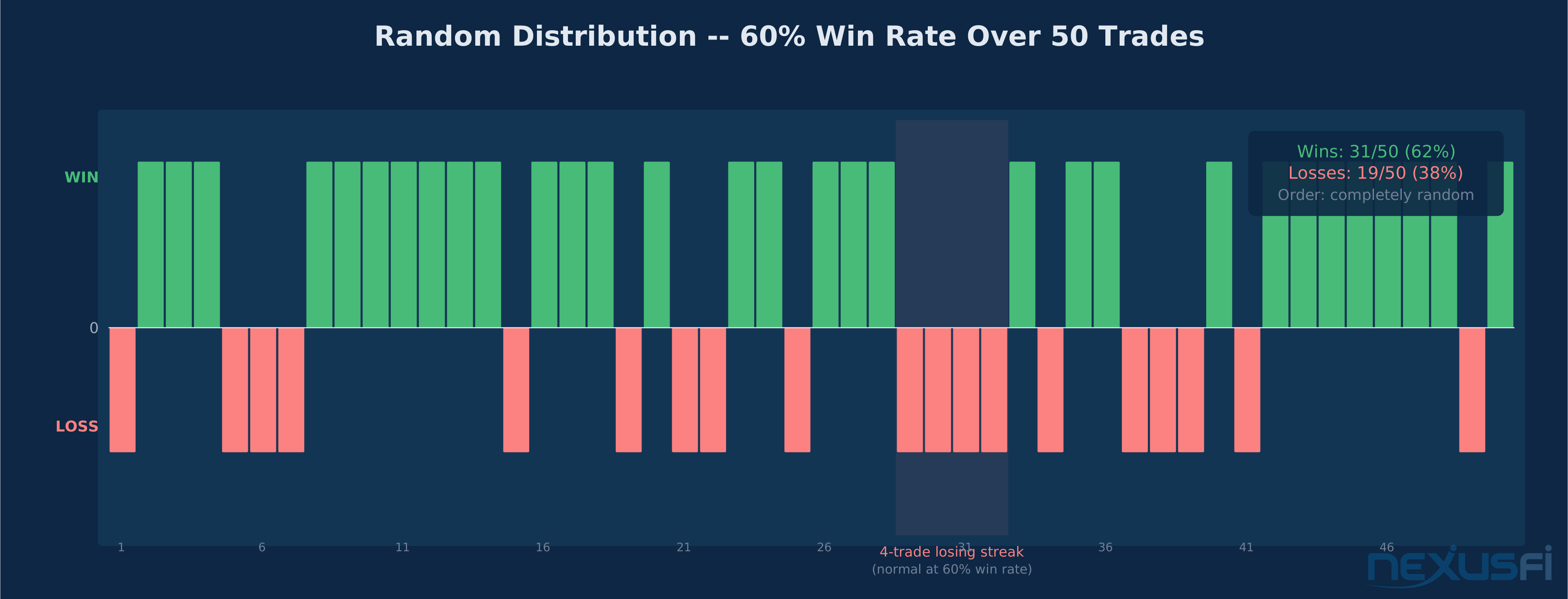
This is the most mathematical of the five truths. For any given set of variables that define an edge — your entry rules, your exit rules, your position sizing — the sequence of wins and losses is random. You might win five in a row or lose seven in a row. The distribution is unpredictable even when the overall ratio (say, 60% wins over 500 trades) is stable.
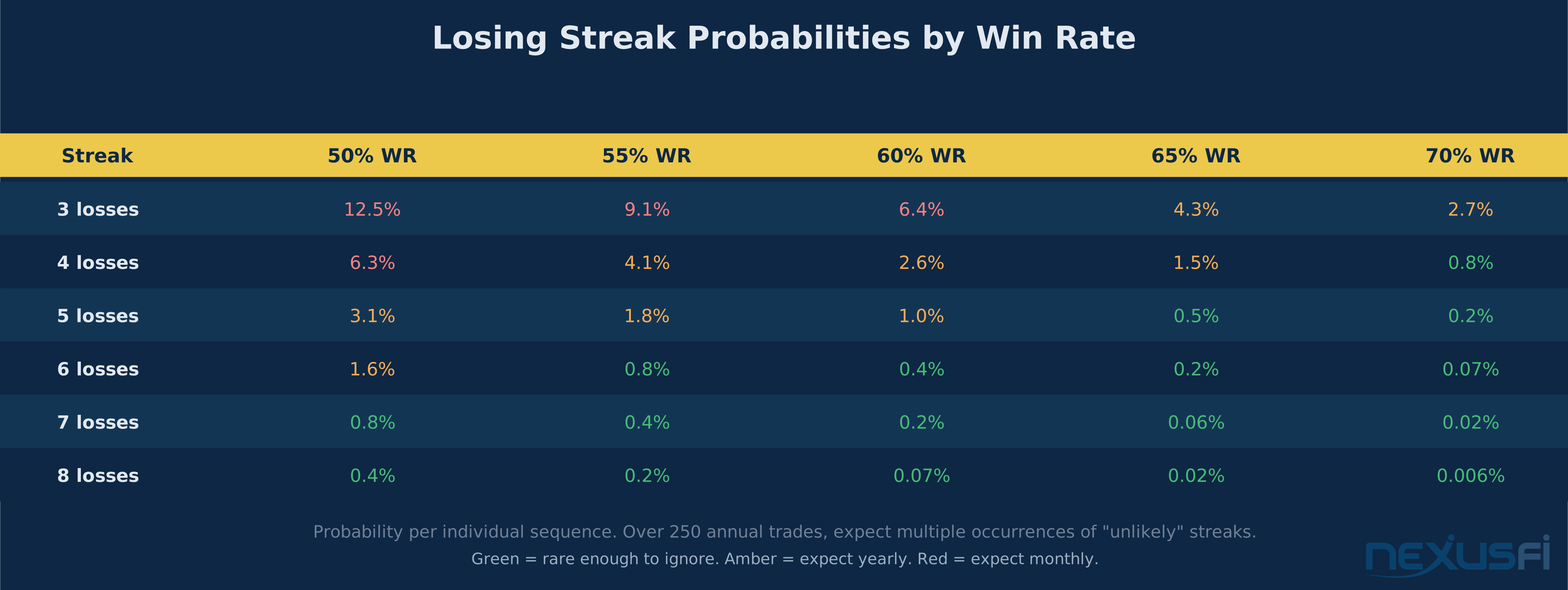
If your system wins 60% of the time, you can calculate the probability of any losing streak. A 3-trade losing streak: ~6.4% per sequence. A 5-trade losing streak: ~1%. Over thousands of trades, these aren't rare. A 60%-win-rate trader taking one trade per day should expect about 3.5 five-trade losing streaks per year. That's not a broken system. That's math.
The Coin Has No Memory
After losing three trades in a row, your brain screams that the next trade "has to" win. It doesn't. The market doesn't know you've lost three in a row. Each trade is independent. The probability of winning your next trade is still 60%. The streak only increases your emotional distress.
The flip side is equally dangerous. After winning five in a row, your brain tells you you're "in the zone." The probability hasn't changed. But the emotional high leads traders to increase position size at precisely the moment when reversion is most likely.
The key phrase is "for any given set of variables" — the randomness exists even when your system is working perfectly.
Futures Trading Example
Consider a trader fading ES moves to the VAH with a target at the POC. Backtested win rate: 62%. In January they go 14 for 20 (70%). In February, 9 for 22 (41%). Rules didn't change. The random distribution clustered differently.
The trader who has internalized Truth 3 evaluates over quarters, not weeks. They don't panic in February or get cocky in January. They keep executing.
The trader who hasn't internalized Truth 3 either abandons the system ("it stopped working") or starts modifying it ("I need a filter for this condition"). Both responses are emotional reactions to normal variance, and both make performance worse.
The Math That Matters
For a 60% win rate system, here are the probabilities of losing streaks within a 250-trade sample (roughly one year of daily trading):
- 3-trade losing streak: ~99.9% chance you'll see at least one. Expect roughly 16 per year.
- 4-trade losing streak: ~93% chance. Expect roughly 6 per year.
- 5-trade losing streak: ~68% chance. Expect roughly 2-3 per year.
- 6-trade losing streak: ~38% chance. Roughly once every 2-3 years.
- 7-trade losing streak: ~18% chance. Possible in any given year.
These numbers aren't scary. They're liberating. When you know that a 5-trade losing streak is expected twice a year, you stop treating it as a crisis and start treating it as Tuesday.
Exercises for Internalization
Exercise 1: The Streak Tracker. Build a spreadsheet tracking your current streak (winning or losing), longest streak of each type, and total streak count. Review monthly. It's harder to panic about a losing streak when you can see you've survived six of them this year.
Exercise 2: The Monte Carlo Simulation. Use a free online Monte Carlo simulator. Input your win rate and R:R ratio. Run 10,000 simulations. Some show devastating drawdowns, others smooth equity curves. All use the same edge. Print the range and tape it to your monitor.
Exercise 3: Pre-Program Your Response. Write down in advance what you'll do at 3 consecutive losses (review execution, keep trading if clean), 5 losses (reduce size 50% for 5 trades), and 7 losses (24 hours off, review 20 trades for system drift). Pre-programming removes emotional decision-making from the streak.
Truth 4: An Edge Is Nothing More Than a Higher Probability of One Thing Happening Over Another #
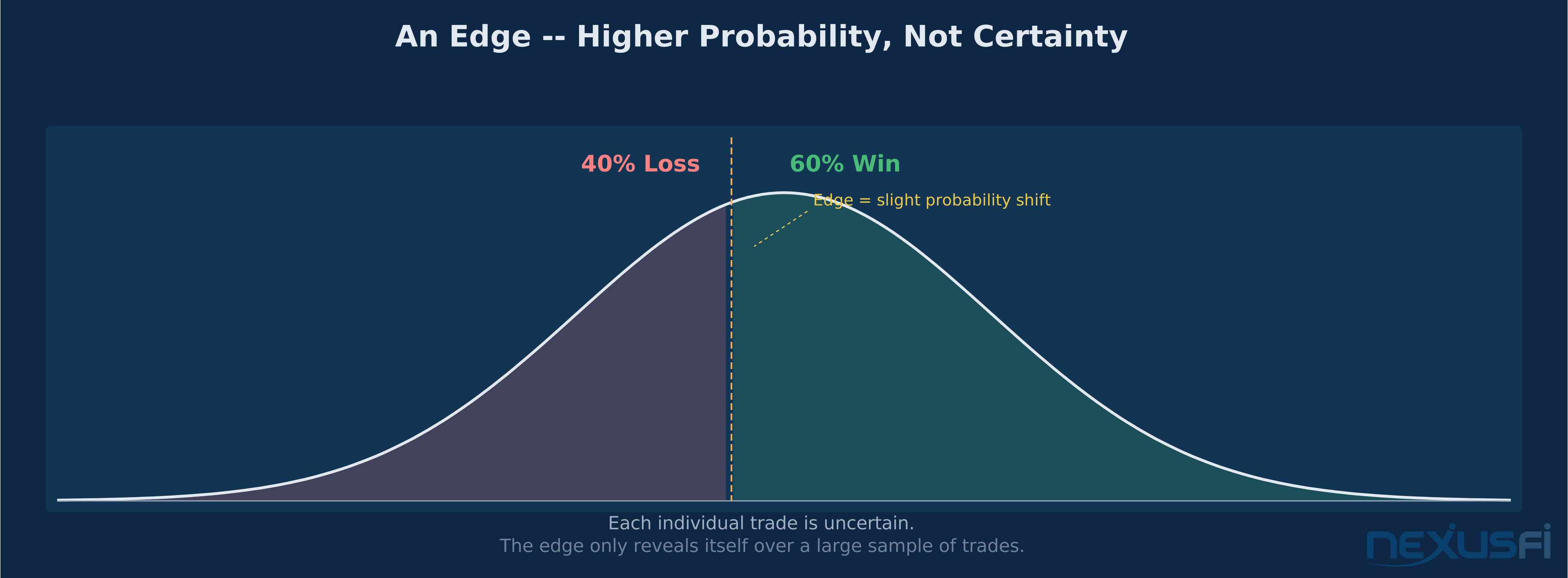
An edge doesn't mean you "know" what the market will do. It means that over a sufficient sample size, your approach produces a slight tilt in your favor. Like a casino's green zero — not a guarantee on any individual spin, just a mathematical advantage that compounds over repetitions.
The word "indication" in Douglas's formulation is deliberate. An edge indicates. It suggests. It tilts. It does not dictate or promise. A 60% win rate means that in 40% of cases, the edge fails. That's not a bug — it's part of the edge's definition.
What an Edge Actually Looks Like
In practical futures trading, edges are small. A breakout trader: 38-45% win rate, 2.0-3.0:1 R:R (+0.16R to +0.35R per trade). A mean reversion trader: 55-68% win rate, 0.8-1.5:1 R:R (+0.10R to +0.22R). A scalper: 60-75% win rate, 0.5-1.0:1 R:R (+0.05R to +0.15R). Not 5R per trade. A slight statistical tilt that compounds over hundreds of repetitions.
Why Traders Destroy Their Edge
Because it doesn't feel like an edge in real-time. A +0.20R expected value means many trades feel like random noise. Your brain interprets this as "something is wrong" and you start adjusting: moving stops, taking early profits, skipping setups. Each adjustment degrades the edge.
Futures Trading Example
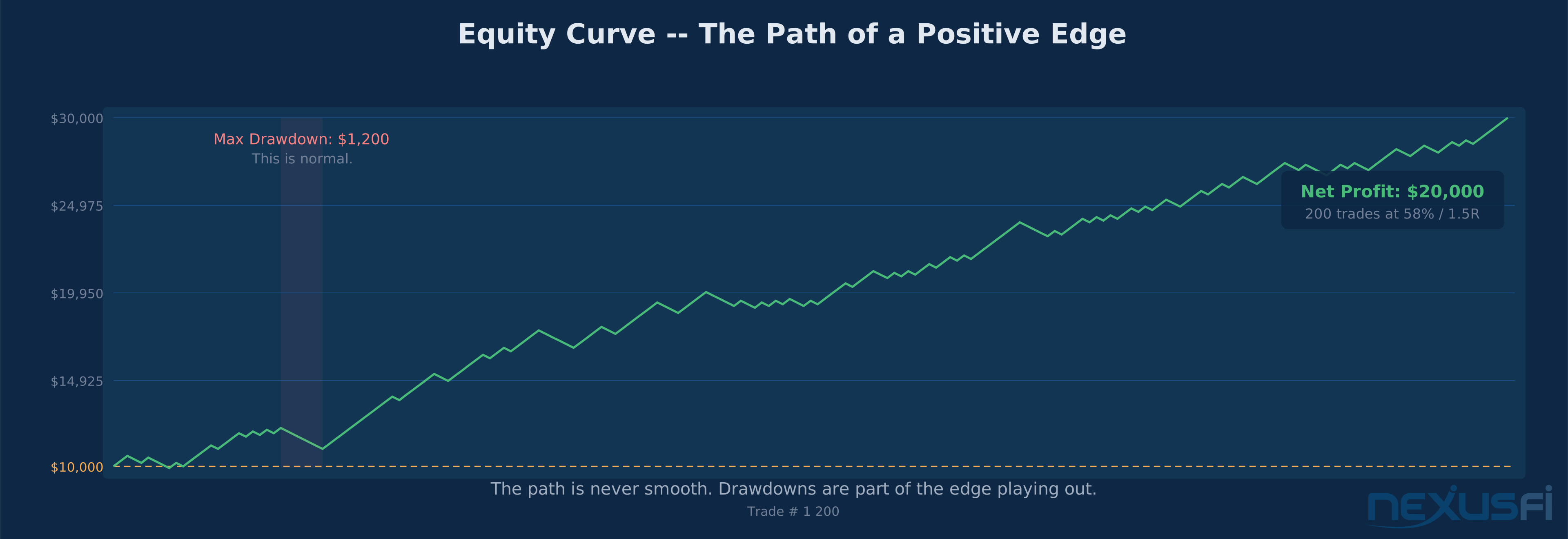
A CL futures trader uses a breakout strategy on the first 30-minute range. Enter long when CL breaks the high with confirmation volume. Stop at the low. Target at 2x the range. Win rate: roughly 40%. Expected value: (0.40 x 2.0) - (0.60 x 1.0) = +0.20R per trade.
This trader might go three days without a winner. It doesn't "feel" like an edge. But over 200 trades per year, +0.20R per trade = +40R. At $500 risk per trade, that's $20,000 — from a system that loses more often than it wins.
The trader who accepts Truth 4 executes all 200 trades. The one who doesn't starts skipping after losing streaks, reducing the sample to 120 — and the edge has less room to express itself.
Exercises for Internalization
Exercise 1: Calculate Your Edge. Compute your expected value: (Win Rate x Average Win) - (Loss Rate x Average Loss). Multiply by annual trade count. Tape both numbers to your monitor — the per-trade edge (tiny) and the annual result (meaningful).
Exercise 2: The Casino Owner Mindset. Before each session, spend 60 seconds thinking like a casino owner. The owner doesn't worry about individual bets, doesn't panic when a player wins big, doesn't change rules after a bad night. Your job is identical: keep the games running.
Exercise 3: Edge Decay Tracking. Log every system deviation — moved stops, skipped trades, gut-feeling size changes. Monthly, calculate what P&L would have been without deviations. The gap shows the cost of not trusting your edge.
Truth 5: Every Moment in the Market Is Unique #
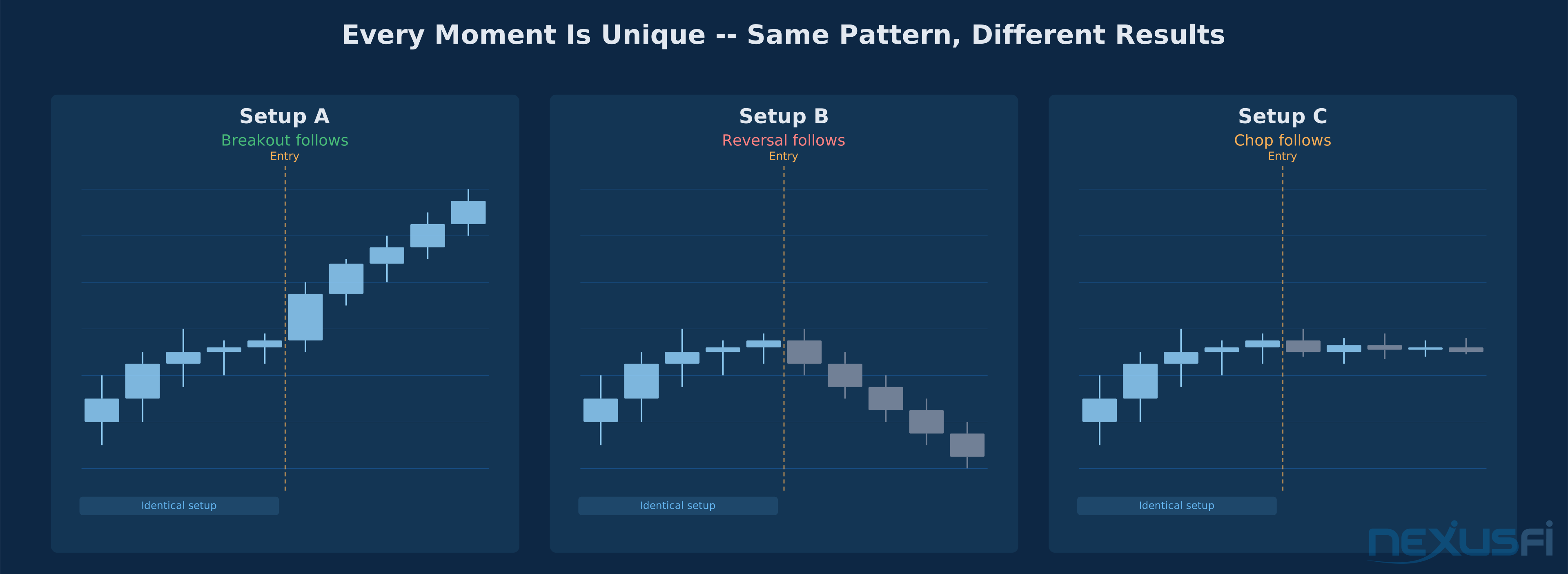
Every moment in the market is unique because the specific combination of participants, positions, beliefs, financial conditions, and available information has never existed before and will never exist again.
When you see a chart pattern that "looks like" something you've seen before, you're recognizing surface similarity. The price bars form the same shape. But underneath, the market is different — different participants, motivations, macro backdrop, gamma exposure, algorithmic positions.
The Pattern Recognition Trap
Your brain's pattern recognition takes a surface similarity (this looks like last Tuesday's setup) and extrapolates a conclusion (the outcome will be the same). This feels like analysis. It's confabulation — your brain constructing a narrative from incomplete data. The ES double-bottom at 5080 today involves different participants, order flow, and information than last month's. The pattern is similar. The underlying reality is not.
Why This Truth Eliminates Both Fear and Recklessness
Accepting that every moment is unique does two things simultaneously:
It eliminates fear. Your last three losing trades have no bearing on this trade. The market isn't "out to get you." Each trade is a fresh instance of your edge. There's nothing to fear because there's no pattern of failure — just independent events.
It eliminates recklessness. Your last five winning trades don't predict the next outcome either. You're not "hot." Each trade is independent. So you don't increase size or relax risk management just because you're on a run.
Futures Trading Example
An NQ trader notices that the last four tests of the overnight high broke through and ran 30 points. On the fifth test, they double their position because "it always breaks." NQ reverses for a 50-point selloff. The double-sized position turns a normal loss into an account-threatening drawdown.
The mistake wasn't the trade. It was using past instances to assign certainty to the current one. The first four breaks don't make the fifth more likely — they only make the trader more confident.
The same error works in reverse. A ZB futures trader who hesitates because "the last three bond trades all lost" is treating unique moments as connected sequences. When this escalates into chasing losses or forcing trades to "get even," it becomes the destructive spiral covered in Managing Tilt and Revenge Trading.
Exercises for Internalization
Exercise 1: The Clean Slate. Before each trade, mentally "delete" your previous results. Visualize wiping a chalkboard. Take three breaths. Deliberately sever the emotional connection between past trades and the current decision.
Exercise 2: The Autopsy Prohibition. For one month, don't review your last trade's outcome before entering the next trade. No P&L checks between setups. Reviews happen at end of day only. This prevents "last trade bias" from contaminating your execution.
Exercise 3: Rewrite the Narrative. After each trade, write one sentence without reference to prior trades. Not "I lost again" (implies a pattern). Instead: "Trade #47 hit my stop at [price]. Setup valid. Execution clean. Next." This rewrites your internal narrative from "streaks and patterns" to "independent events."
Integrating All Five Truths #
The five truths aren't independent principles. They form a single integrated framework — Douglas's "probabilistic mindset." Remove one and the others weaken:
- Without Truth 1 (anything can happen), you'll treat your analysis as certainty and be shocked by losses.
- Without Truth 2 (you don't need to know), you'll keep adding indicators until you're paralyzed.
- Without Truth 3 (random distribution), you'll panic during normal losing streaks and abandon working systems.
- Without Truth 4 (edge is just probability), you'll expect every trade to win and lose faith when it doesn't.
- Without Truth 5 (every moment is unique), you'll project past results onto present situations and trade emotionally.
Together, they produce a specific mental state: the ability to execute your edge without emotional interference. No hesitation on entries. No premature exits. No moved stops. No revenge trades. No position-sizing based on recent results.
The five truths aren't about becoming emotionless. They're about channeling emotion through a framework that converts fear and greed into disciplined execution. You still feel the uncertainty — you just stop letting it override your system.
The Belief-Behavior Gap
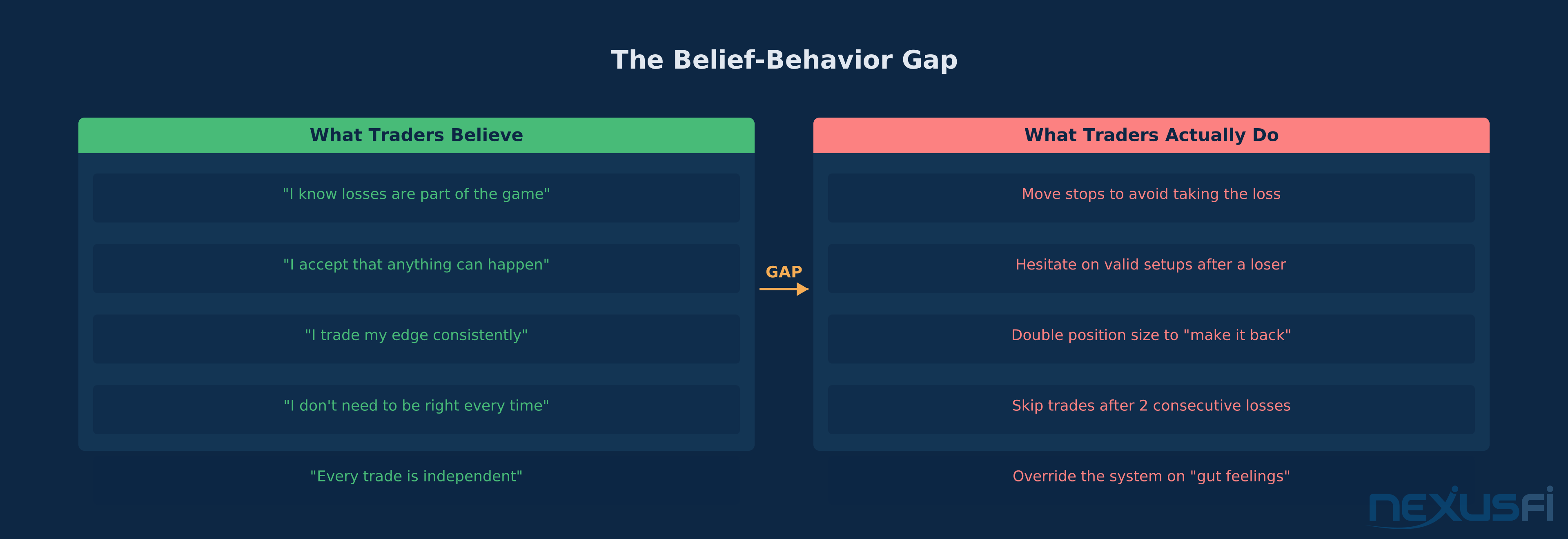
Most traders reading this already "know" these truths. They've read Trading in the Zone. They can recite them from memory. And they still move stops, skip trades, and size up after winners.
Intellectual understanding is not operational belief. You can know losses are part of the game and still feel devastated when one hits. The truths have to move from your prefrontal cortex to your amygdala before they change behavior. Our article on Loss Aversion explores the neuroscience behind this gap.
That transition happens through repetition and direct experience, not reading. Every time you take a loss cleanly and watch the edge play out over 20 trades, the truths sink deeper. Every time you execute through a losing streak and watch the equity curve recover, the truths become more real.
The Daily Practice Protocol
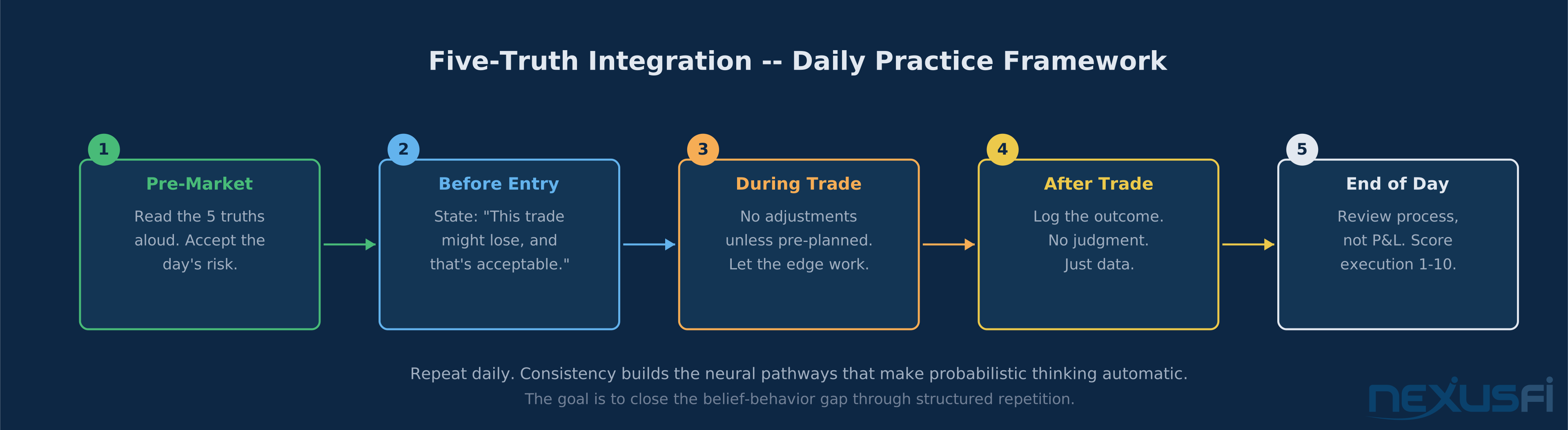
Douglas believed internalizing the five truths requires structured daily practice. Here's a framework adapted from his approach for futures traders:
Pre-Market (5 minutes): Read the five truths aloud. Deliberately. Pause after each one. "Anything can happen today. I don't need to know what will happen. Wins and losses come randomly. My edge is just a probability tilt. Every setup today is unique."
Pre-Trade (30 seconds): State your risk out loud: "I am risking $[X]. I accept this loss before the trade is placed. If my stop is hit, I take the loss and move on." This is Douglas's concept of "pre-accepting the risk."
During the Trade (continuous): Monitor yourself for truth violations. Anxiety = Truth 1 slipping. Adding indicators mid-trade = Truth 2 slipping. "I need this one to win" = Truth 3 slipping. Feeling certain = Truth 5 slipping. Name the violation, don't act on it.
Post-Trade (1 minute): Write one sentence: "I executed my plan." If not, name the violation precisely. "I moved my stop because I feared another loss" = Truth 1 + Truth 3 violation.
End of Day (5 minutes): Score execution on a 1-10 scale. Not P&L — execution. A losing day with perfect execution scores higher than a winning day with rule violations. This rewires your reward system toward trading discipline. For a deeper framework on building this habit, see Process-Focused Trading.
Recognizing Truth Violations in Real Time #
Each truth has characteristic violations — behavioral fingerprints that reveal the truth hasn't been genuinely internalized:
- Truth 1 -- "I can't believe that happened": Surprise at losses, blaming the Fed or "stop hunters," post-hoc rationalization ("I should have seen that coming"). All reveal an assumption that the market should respect your position.
- Truth 2 -- "I need more information": Analysis paralysis (waiting for one more confirmation), infinite study (another book, another course), prediction addiction (weekend forecasting sessions that don't change execution).
- Truth 3 -- "Something is wrong with my system": Abandoning strategies after 3 losses (the system needed 200 trades, you gave it 47), evaluating performance daily instead of per-50-trade blocks, tweaking parameters after every losing streak.
- Truth 4 -- "This trade is a sure thing": Oversizing on "high conviction" setups, skipping risk management on "obvious" trades, feeling frustrated when a "perfect" setup loses.
- Truth 5 -- "I've seen this before": Trading based on what happened last time at this level, revenge trading ("it has to work this time"), increasing size during a hot streak.
The pattern across all five violations is the same: treating probabilistic events as deterministic ones. Every violation stems from the belief that you can — or should — eliminate uncertainty from trading. You can't. The truths exist to help you stop trying. Understanding what drives these violations at a deeper level connects to the belief systems that shape every decision a trader makes.
Douglas in Context: The Legacy #
Mark Douglas published The Disciplined Trader in 1990 and Trading in the Zone in 2000. He passed away in 2015. His work predates algorithmic dominance and social media trading culture. Yet the five truths remain as relevant as ever — modern markets amplify every psychological weakness he identified.
Social media makes losing streaks feel like personal failure. Zero-commission platforms encourage overtrading. Douglas's five truths cut through all of it. They address the only thing that determines whether a trader with a valid edge actually captures it: the mental framework.
Practical Takeaways #
Start with one truth. Don't try to internalize all five simultaneously. Pick the truth you violate most frequently (your trading journal will tell you which one) and focus exclusively on it for 30 days. Build the exercises around that single truth. Once it starts to feel natural, add the next one.
Track violations, not convictions. Telling yourself "I believe anything can happen" is useless. Instead, track every time you behave as if it's not true. The violations are the data. The beliefs are just stories you tell yourself.
Use position sizing as a truth test. If you can't trade your normal size without emotional interference, you haven't accepted the risk. Drop to micros (MES, MNQ) until the truths are internalized at that size, then gradually scale up.
Evaluate quarterly, not daily. Evaluating your system daily is like judging a diet by weighing yourself every hour. Set a minimum of 50 trades or one calendar quarter before drawing conclusions.
Accept that internalization is non-linear. You'll think you've accepted Truth 3 — then a 7-trade losing streak will expose that you haven't. That's calibration, not failure. Each stress test either reveals a gap or deepens the truth.
The five truths are Douglas's enduring contribution to trading psychology. They don't make trading easy. They make trading possible — by removing the mental conflicts that prevent disciplined people from executing strategies they've already proven work. For the companion framework — Douglas's seven principles for achieving consistency — see Seven Principles of Trading Consistency.
Knowledge Map
Prerequisites
Understand these firstCitations
- — Concerning risk per trade sizing (2012) 👍 43“I accept the 5 fundamental trading truths. I just WAIT until my edge appears and trade without hesitation, have a defined risk on every trade, and understand that anything can happen.”
- — Dear Ruby (2013) 👍 14“Mark Douglas captures the essence of profitable trading with what I like to call The 5 & 7: The 5 Fundamental Truths of Trading.”
- — Trading in the Zone - Mark Douglas (2012) 👍 15“A probabilistic mind-set pertaining to trading consists of five fundamental truths.”
- — Perry's Trading Method - Elite Members (2012) 👍 20“If you had not read the book Trading in the Zone by Mark Douglas, I highly recommend. Print out the following and look at it every day.”
- — Notes from Trading in the Zone (2016) 👍 16“We can perceive with the greatest degree of clarity and objectivity what the market is communicating from its perspective.”
- — Trading in the Zone (2000)
- — Breakout Journal - a journey to full time trading (2013) 👍 4“Anything can happen. Really embrace that, because it is true. A trade may be perfectly set up in every way, but we do not know the actions that big players are about to take.”
- — Some highly recommended books (2021) 👍 2“The core of this belief of anything can happen in the market is to get the trader to start thinking in probabilities, and it is not to suggest that likelihoods do not exist.”
- — Dear Ruby (2013) 👍 13“Trading a technical methodology or a technical pattern does not have anything to do with being right or wrong. It is just an odds game.”
- — Spoo-nalysis ES e-mini futures S&P 500 (2014) 👍 23“Uncertainty is a fundamental truth in trading. The best we can hope to achieve is an incomplete, but probabilistic knowledge of that environment.”
- — Why most traders fail, in 1 minute of an interview (2019) 👍 9“Trade from a series of trades perspective, rather than caring anything at all about what happens on the next trade.”