



Iron Condors on Futures Options: The Defined-Risk Premium Selling Strategy
Overview #
The iron condor is where many futures options traders arrive after their first serious loss on a naked strangle. It has the same core thesis — sell premium, collect theta, profit from time decay — but the structure includes bought wings that cap your maximum loss. You give up some premium to buy that protection. What you get in return is a position that can survive black swans, clear margin requirements, and let you sleep.
Understanding iron condors means understanding exactly what you're buying and what you're selling, where the edge comes from, and what conditions make them work versus when they destroy accounts. The structure is deceptively simple. The execution and management are not.
Key Concepts #
Iron condor: A four-leg options position consisting of a short strangle (short OTM call + short OTM put) combined with long wings farther out. Creates a defined-risk, defined-reward premium collection trade.
Short strangle (inner legs): The core of the trade. Sells an OTM call and an OTM put at the same expiration. Generates premium. Unlimited risk without wings.
Long wings (outer legs): Bought options farther OTM than the short strikes. Cap maximum loss. Turn unlimited-risk strangle into defined-risk condor.
Call spread: The upper half of the iron condor — short call + long call further OTM. Also called a bear call spread or short call vertical.
Put spread: The lower half — short put + long put further OTM. Also called a bull put spread or short put vertical.
Net credit: The premium collected for selling the short strikes minus the premium paid for the long wings. Your maximum profit if futures stays between the inner strikes at expiration.
Max loss: Width of the wider spread minus net credit received. Occurs if futures closes beyond the long wing at expiration.
Breakeven: Short strike ± net credit received. The price zone where profit transitions to loss.
Width: The distance between a short strike and its corresponding long wing, measured in points. Wider spreads = higher credit, higher max loss, same max profit zone.
Probability of profit (PoP): Estimated likelihood the trade expires within the profit zone. Higher with wider wing distance from ATM. ATM options have ~50% delta; selling 30-delta options gives roughly 70% PoP.
Expected value (EV): Net credit × PoP minus max loss × (1 - PoP). Positive EV requires edge from IV premium over realized vol.
The Four-Leg Structure #
The iron condor is two vertical credit spreads combined. Understanding each half independently makes the full structure clear.
Upper Half: The Bear Call Spread #
You sell an OTM call (the short call) and buy a further OTM call (the long call) at the same expiration. The short call generates premium. The long call caps your loss if ES rallies above both strikes.
Example on ES with 30 DTE:
- Sell ES 5800 call at 12.00 ($600 per contract)
- Buy ES 5850 call at 6.00 ($300 per contract)
- Net credit: 6.00 points ($300)
- Max loss: 50 - 6 = 44 points ($2,200) if ES closes above 5850
Lower Half: The Bull Put Spread #
You sell an OTM put and buy a further OTM put. Same logic, opposite direction.
- Sell ES 5400 put at 10.00 ($500)
- Buy ES 5350 put at 5.00 ($250)
- Net credit: 5.00 points ($250)
- Max loss: 50 - 5 = 45 points ($2,250) if ES closes below 5350
Combined Iron Condor #
Total credit: 11 points ($550) per ES contract Max profit: 11 points ($550) — ES closes between 5400 and 5800 at expiration Upper breakeven: 5800 + 11 = 5811 Lower breakeven: 5400 - 11 = 5389 Max loss: ~44-45 points ($2,200-2,250) if market moves beyond either long wing

The profit zone — the space between the short strikes — is 400 ES points wide in this example. ES would need to move roughly 8% in 30 days to breach a short strike. That rarely happens. When it does, having defined wings is the difference between a 44-point loss and an open-ended disaster.
Where the Edge Comes From #
Iron condors don't work in efficient markets with no information edge. They work because implied volatility consistently overestimates realized volatility — the market prices options too richly on average.
The academic literature documents this extensively — Jackwerth and Rubinstein's analysis of option-implied probability distributions (Journal of Finance, 1996) and Coval and Shumway's study of expected option returns (Journal of Finance, 2001) both confirm the persistent mispricing. Practitioners on NexusFi have observed it in real trading since the early 2000s. As @HowardCohodas documented in the Trading Index Options OTM Vertical Credit Spreads thread: the core thesis is that index options consistently trade at an implied volatility premium over what actually occurs.
This is the volatility risk premium (VRP). The market pays extra for downside protection. Option sellers collect that extra. Iron condors capture the VRP systematically while capping tail risk with the long wings.
The edge is structural, not predictive. You don't need to know where the market goes. You need the market to not go too far in either direction. On average, implied volatility overstates realized vol by 2-5 percentage points in equity index futures. That margin is your statistical edge across many trades.

What Destroys the Edge #
- Entering when IV is low: If implied vol is already at historical lows, the VRP may be absent or inverted. You collect minimal premium and face normal realized vol risk. IV rank below 20 signals caution.
- Overleveraging: Taking max-loss scenarios on too many contracts turns a statistical edge into a ruin scenario. The math only works if you survive the losing trades.
- Not adjusting: Allowing breached strikes to turn into max-loss situations destroys EV. Management is mandatory.
- Wrong expirations: Very short DTE (under 14) has explosive gamma risk that overwhelms theta income. Very long DTE (over 60) ties up capital for months with slow theta.
Strike Selection and Width #
Strike selection is the most consequential decision in constructing an iron condor. It determines your probability of profit, credit collected, and how much room you have before management is required.
Delta-Based Strike Selection #
Most practitioners select short strikes by delta rather than a fixed point distance from current price. Common approaches:
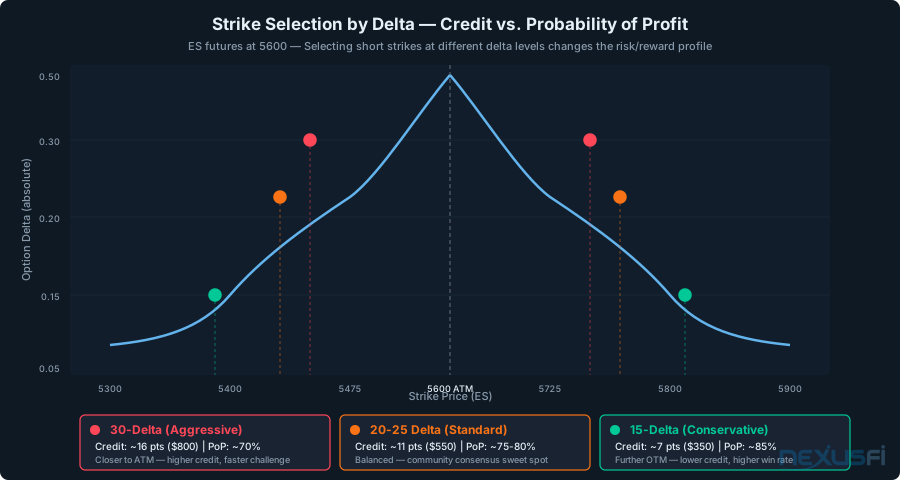
Conservative (15-delta shorts): Lower credit, higher probability of profit (~85%). Wings further from current price. Better for volatile regimes or uncertain conditions.
Standard (20-25 delta shorts): Balanced credit and probability. Roughly 75-80% probability of profit. Most common in NexusFi community discussions.
Aggressive (30-delta shorts): Higher credit, ~70% probability of profit. Strikes closer to ATM. Requires faster management when challenged.
The delta of the short strike approximates the probability the market finishes beyond that strike — a 20-delta put has roughly 20% probability of being ITM at expiration. Selling a 20-delta put means you profit about 80% of the time on that leg alone.
Wing Width #
The width between short and long strikes affects both credit and max loss:
Narrow wings (25-50 points on ES): Lower max loss, lower credit per spread. Requires capital efficiency — good when margin is tight.
Wider wings (75-100 points on ES): Higher credit collected, higher absolute max loss. Better when IV is elevated and you want to capture more premium.
Asymmetric wings: Not required but common. Many traders use wider put spreads (expecting more left-tail risk) and narrower call spreads. This is a legitimate expression of view without changing the core structure.
Expiration Selection #
The 21-45 DTE range is the sweet spot discussed throughout the NexusFi options community:
- 45 DTE entry: Theta:Gamma ratio is favorable. Enough time for the position to work. Standard entry per the community consensus.
- 21 DTE close: At 21 DTE, gamma accelerates rapidly for ATM options. Closing eliminates gamma risk while most theta has already been captured.

Margin Requirements: Futures vs. Equity Options #
Futures iron condors have a meaningful structural advantage over SPX or equity index options: margin is based on the wider spread, not both spreads combined.
For equity options (SPX, RUT), brokers typically margin the larger of the two spreads assuming worst-case loss on that side. For futures (ES, NQ, CL), exchange margin rules typically charge for the wider leg, not both. This means the same premium collection requires much less capital in ES than SPX.
For a practical comparison:
- 10-point ES iron condor (5-point wide spreads both sides): ~$400-600 margin per lot
- Equivalent SPX iron condor: margin would reflect the full 5-point put spread width (~$500 per lot)
Both have similar structures, but ES margin is calculated under SPAN margining which accounts for correlation and diversification. This makes ES condors capital-efficient for smaller accounts.
Margin changes with market conditions. SPAN recalculates continuously. Know your platform's margin methodology before sizing.
P&L Profile at Expiration #
The iron condor P&L creates a characteristic plateau-and-cliff profile:
At expiration, position P&L is:
- If futures is between the short strikes: full credit collected (max profit)
- If futures is between a short strike and its long wing: partial profit, transitioning to partial loss
- If futures breaches a long wing: max loss reached
This profile differs at the core from being long or short futures. The iron condor doesn't care about direction — only magnitude. A 100-point ES rally and a 100-point ES decline are equally problematic if they breach the short strikes.
The shape of this P&L is why iron condors are described as short volatility trades. You profit from the market staying still (or moving slowly). You lose when the market moves more than expected.

Position Management: When and How to Adjust #
This is where most iron condor tutorials stop short. The structure is simple; the management is complex. Here is what the NexusFi community has developed over thousands of collective trade-years.
Profit-Taking: The 50% Rule #
Close the position when you've captured 50% of the maximum credit. If you collected 11 points, close at 5.5 points (buy back the condor for 5.5). This is the most consistently cited management rule in the Selling Options on Futures thread — capture half the available profit, eliminate the risk of the remaining half going wrong.
The math is compelling: a trade that closes at 50% profit takes the same win probability but eliminates the scenario where a late-term gamma event wipes the position.
Time-Based Exit: The 21 DTE Rule #
Close at 21 DTE regardless of profit level. At 21 DTE, gamma for ATM options has accelerated to the point where a 2-day adverse move can damage the position more than the remaining theta benefit. The risk/reward of holding through the final 21 days is negative for most traders.
Combining rules: close at 50% profit OR 21 DTE, whichever comes first.
When a Leg Is Challenged #
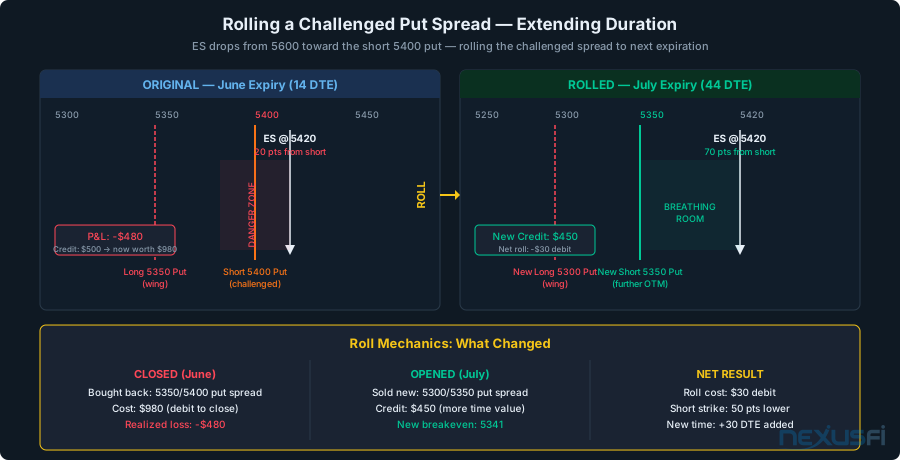
A short strike is "challenged" when the futures price approaches within 1-2 strikes. At this point you have four options:
1. Close the losing side (or the whole condor) The cleanest choice. Take the loss on the challenged spread, keep the untouched side's profit if applicable. This is the defensive default.
2. Roll the short strike further OTM Buy back the challenged spread and sell a new spread with the short strike further from current price. This extends the position duration and requires adding time — typically rolling to the next monthly expiration. The roll may be a debit (worse market) or credit (favorable volatility). For detailed mechanics, see the guide on rolling options positions on futures.
3. Add deltas via futures Some traders buy (for challenged put side) or short (for challenged call side) futures contracts to delta-neutralize the position temporarily. This doesn't eliminate the problem — it buys time and reduces immediate loss rate while the position is rebalanced.
4. Convert to a broken-wing condor Move only the losing wing, not the full spread. Creates an asymmetric position that has positive EV on the recovering side. Complex; generally only for experienced traders.
As @MDRider noted in the Selling Options on Futures thread, adding wings to a strangle — converting it to a condor — "will control the risk" while still allowing time decay to work.

Greeks Profile: What You Own and What You Owe #
Understanding the iron condor through its Greeks clarifies why management rules exist.

Delta: Near zero at entry (balanced call and put sides). Grows as futures drifts toward a short strike. Management is triggered when delta exceeds a threshold (commonly ±0.25 of the maximum).
Gamma: Negative. You're short convexity. Position loses money at an accelerating rate when breached. Gamma grows dangerously near expiration — the primary reason for the 21 DTE close rule.
Theta: Positive. Daily income that funds the trade. The bought wings decay slower than the short strikes, creating net positive theta. About 80% of theta is collected in the final third of the trade's life.
Vega: Negative. IV expansion hurts the position. If you enter when IV is elevated and IV subsequently declines, you benefit from both theta and vega. If IV expands after entry, you lose on both dimensions simultaneously — the worst scenario.
The iron condor is short gamma, short vega, long theta. Understanding this Greek profile explains when not to trade them (low IV, high gamma risk) and when they shine (elevated IV, stable markets).
Selecting Markets: ES vs. Other Futures #
Iron condors work across futures markets, but not all markets are equal. Key considerations:
ES (E-mini S&P 500): Most liquid options market in futures. Tight bid/ask spreads, continuous electronic trading, deep order books at every strike. The default market for iron condors on NexusFi.
NQ (E-mini Nasdaq): Higher beta, wider swings. Higher IV on average. Better premium for the same delta, but faster challenging. Requires wider wingspan or more active management.
CL (Crude Oil): Inventory-driven volatility spikes on Wednesdays. Option IV is high, premium rich, but the market can move 3-5% on a single inventory print. Wing protection is not optional in CL.
GC (Gold): Driven by dollar moves, Fed policy, geopolitical events. Lower liquidity in options vs. equity index futures. Decent for condors but watch bid/ask spreads.
Grain markets (ZC, ZS, ZW): Seasonal and crop-report-driven vol events. High premium during growing season. Requires calendar awareness.
As @Tiberius noted in the Options education thread, executing an iron condor about 6 weeks from expiration (45 DTE) provides a good balance of time for the trade to work while maintaining manageable gamma.
The Volatility Regime Filter #
Iron condors are regime-dependent. Knowing when not to trade them is as important as knowing the structure.
High IV (IVR > 60): Favorable. Premium is rich relative to history. VRP is elevated. Wider credit available for the same delta. Optimal entry conditions.
Medium IV (IVR 30-60): Acceptable. Selective entry, stronger bias required, tighter management.
Low IV (IVR < 20): Unfavorable. Premium is thin. You're selling cheap insurance. The VRP may be absent or inverted. Wait.
IV spike in progress: Never enter during an ongoing spike. IV skew distorts pricing, bid/ask spreads widen dramatically, and the market is in motion. Wait for IV to settle.
This regime filter means iron condors aren't a 365-day-a-year strategy. They're a cyclical strategy — most productive after volatility events when IV is elevated but stability is returning.

Practical Position Sizing #
Position sizing is the most under-discussed element of iron condor trading. The math of defined-risk positions makes it tempting to oversize.
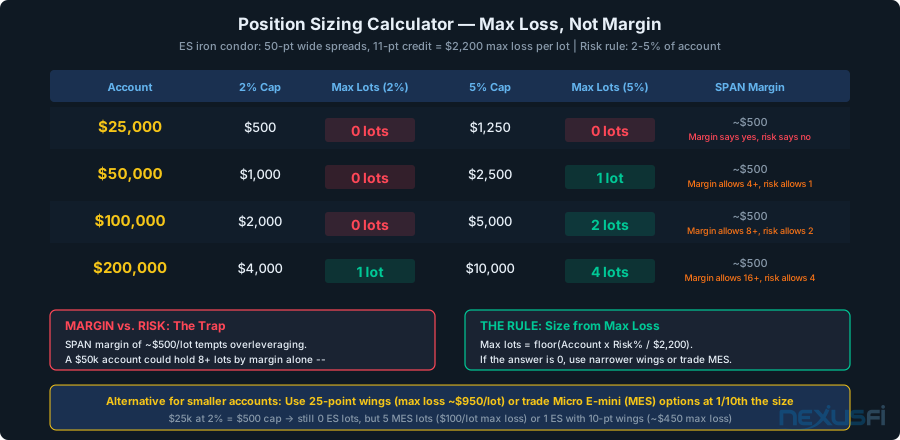
Never risk more than 2-5% of account on a single iron condor. The max-loss scenario is real — markets move beyond wings several times per year in equity index futures. Account survival requires that no single event creates catastrophic drawdown.
Calculate position size from max loss, not premium. If your max loss per lot is $2,200 and your account is $50,000, a 2% risk rule limits you to 0.45 lots — basically 1 lot maximum, with clear stop planning if challenged.
Margin is not position size. The SPAN margin requirement is less than the true economic risk. Size from max loss, not margin requirement.
Portfolio Greek limits: Professional options desks limit delta, gamma, and vega at the portfolio level. For retail traders, a practical approximation: keep portfolio vega below 1% of account per 1-point IV change.
As @wldman detailed in the Tao te Trade journal, the disciplined approach to condors tracks multiple probability metrics simultaneously — Probability of Profit, Probability of Max Profit, and Alpha (anticipated return on risk across hundreds of iterations). His benchmark of beating the two-year Treasury yield as a minimum performance hurdle keeps condor traders honest about whether the statistical edge is actually present in current conditions.
Common Mistakes #
1. Waiting to close losers — The most expensive mistake in options selling. When a short strike is breached, the position is already a partial loser. Holding hoping for a reversal typically converts partial losses into full max losses. The community consensus in the NexusFi options threads is consistent: losing trades get cut; winning trades get held to profit targets.
2. Ignoring the upcoming trigger calendar — FOMC announcements, jobs reports, and major earnings events can move equity index futures 2-4% overnight. Holding short strangles or condors through these events when IV is already suppressed is poor risk management.
3. Low IV entry — Chasing premium when IV is low means collecting 40-50% of what the position could generate in a better regime. Wait for elevated IV to enter.
4. Not understanding fill quality — Iron condors are four-leg orders. Getting filled at the mid on all four legs simultaneously requires patient order management. Legging in separately can improve fills but creates temporary directional exposure.
5. Treating the sold strangle as separate from the wings — The wings aren't just insurance — they change the position's margin, its behavioral profile as it approaches expiration, and the mechanics of rolling. Understand the whole structure.
Why Defined-Risk Matters for Futures #
Futures options have one characteristic that makes defined-risk structures more important than in equity options: the margin call.
In equity options, your brokerage can hold a naked short option position indefinitely as long as the mark-to-market loss doesn't exceed your collateral. In futures, margin is recalculated intraday and positions can be force-liquidated at unfavorable prices if a margin call is not met.
An iron condor eliminates the margin call risk. With defined wings, your maximum possible loss is known. Your broker cannot force-liquidate you beyond that amount. You can hold through adverse moves — within your risk tolerance — without the liquidation risk that naked futures options traders face.
This structural advantage is why @Fat Tails' analysis in the Am I overlooking the risk thread identified the iron condor as a meaningful improvement over uncovered strangles: "An alternative to an uncovered strangle would be selling two vertical spreads... This limits your risk, as you buy protection against black swan events."
Comparing to Naked Strangles #
The iron condor is not universally superior to the naked strangle. The comparison matters:
| Iron Condor | Naked Strangle | |
|---|---|---|
| Max loss | Defined (spread width - credit) | Unlimited |
| Credit | Lower (cost of wings) | Higher |
| Margin | Based on wider spread | Typically 5-20x higher |
| Margin calls | Impossible (max loss capped) | Possible |
| Management flexibility | Slightly more constrained | More rolling options |
| Survivability | Higher for same account size | Lower |
For smaller accounts, iron condors are typically the only viable option due to margin constraints. For larger accounts with strict risk controls, experienced traders sometimes prefer naked strangles for the additional premium and flexibility. The NexusFi community generally recommends iron condors for traders with less than two years of options experience.
Summary #
The iron condor captures the volatility risk premium — the persistent tendency of implied volatility to exceed realized volatility in index futures — while eliminating the tail risk that destroys naked strangle traders.
The structure works when:
- IV rank is elevated (IVR > 30, ideally > 60)
- Entry is at 30-45 DTE
- Strike selection uses 15-25 delta short options
- Management rules are followed (50% profit target, 21 DTE close)
- Position size is based on max loss, not margin
The structure fails when:
- IV is low at entry (collecting cheap premium)
- Positions are held through trigger events without adjustment
- Losses are allowed to run hoping for reversals
- Position sizing is based on margin rather than max loss
Iron condors are not passive income. They require a regime filter, systematic management, and honest accounting of when the edge is or isn't present. The NexusFi options community has documented both the edge and its limits in thousands of posts. The profitable practitioners treat them as a rule-based system, not a fire-and-forget trade.
Knowledge Map
References This Article
Articles that build on this topicCitations
- Trading Index Options OTM Vertical Credit Spreads (2011)
- Selling Options on Futures? (2023)
- Options education (2011)
- Am I overlooking the risk? (2012)
- Tao te Trade: way of the WLD (2024)
- — Recovering Probability Distributions from Option Prices (1996)
- — Expected Option Returns (2001)