



Scalping Strategies for Futures
Overview #
Scalping is the art of extracting small, consistent profits from micro-movements in price — getting in, getting paid, getting out. In ES that means 2-6 ticks. In NQ, 4-12. In CL, 5-15. The holding time ranges from seconds to a few minutes. The edge comes from reading order flow faster and more accurately than the person on the other side of your trade.
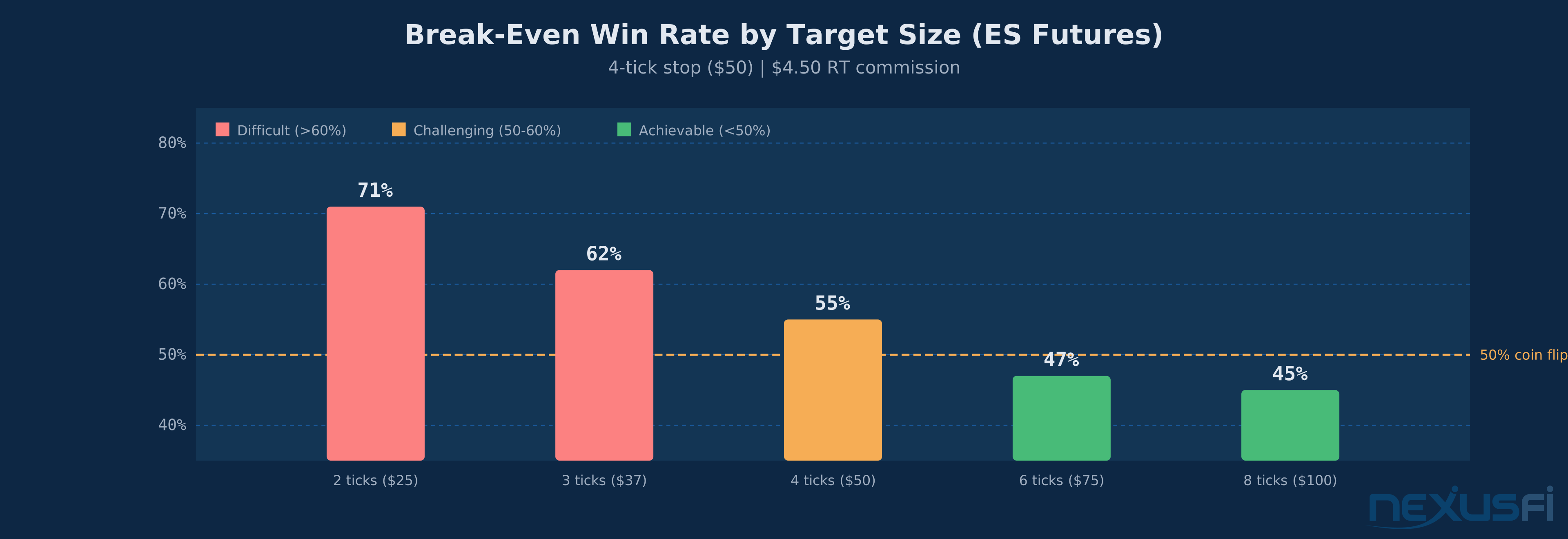
Scalping gets a bad reputation because most people do it wrong. They treat it as "trading fast" when it's actually "trading precisely with tight risk." Speed without precision is just gambling with commission drag. The math is punishing: at 2-tick targets on ES with $4.50 round-turn commissions, you need a win rate above 60% just to break even. At 4-tick targets with the same commissions, that threshold drops to 55%. Every tick matters.
This article covers the mechanics, setups, risk management, and psychological demands of scalping liquid futures — and when you should use a different approach entirely.
Key Concepts #
Scalping defined. A trading approach targeting small price movements (typically 1-8 points in ES, NQ, CL) with holding periods from seconds to several minutes. The edge comes from high-frequency decision-making and precise execution, not directional forecasting.
The commission equation. Commissions are the scalper's enemy. On ES at $4.50 round-turn, a 2-tick ($25) scalp costs you 18% in commissions. A 4-tick ($50) scalp costs 9%. A 6-tick ($75) scalp costs 6%. This is why most professional scalpers aim for 4+ ticks minimum on ES — anything less and the math turns against you fast. As @loantelligence noted on NexusFi, "at 2 to 3 ticks on the ES — $25-37.50/contract and the commission on the round turn being 4.50/contract — sure, do that 10-20 times a day" but the margin for error is razor thin.
Scalping vs. day trading. Day traders hold for minutes to hours and target larger moves (5-20+ points). Scalpers operate in a compressed timeframe where the primary tools are order flow, tape reading, and level-by-level price action. Both can be profitable — the question is which matches your decision-making speed and personality.
Instruments for scalping. Liquid futures with tight spreads:
- ES: 0.25 tick size, consistently 1-tick spread, deep book. The default scalping instrument.
- NQ: 0.25 tick size, wider effective spread during volatile periods, higher beta produces larger tick moves.
- CL: 0.01 tick size, can widen much around reports. Headline-driven, requires faster reflexes.
- MES/MNQ: Micro contracts for developing scalping skills without the capital requirement.
Scalping Setups #
1. Order Flow Scalp #
The purest scalping approach. You're reading the tape — watching market orders hit the bid and offer, tracking cumulative delta, and identifying when aggressive buyers or sellers are in control.
Setup: Using a footprint chart or DOM (depth of market), identify an imbalance where aggressive orders overwhelm the passive side. Stacked buy imbalances across 3+ price levels signal aggressive demand.
Entry: Market order or aggressive limit order on the bid side (for longs) when you see delta confirmation. The entry must be decisive — hesitation in scalping means missing the move.
Target: 2-4 ticks on ES, 4-8 on NQ. The move should happen within 30-60 seconds of entry. If it doesn't, the order flow thesis is failing.
Stop: 3-4 ticks on ES, tight but not so tight that normal noise stops you out.
See Delta Analysis & CVD and Order Flow Analysis for the complete framework.
2. Level Bounce Scalp #
Key levels attract price and produce predictable bounces — the scalper's bread and butter.
Levels that work for scalping:
- VWAP — price reverts to VWAP in balance conditions
- Value Area high/low (VAH/VAL) — 70% distribution boundaries
- Prior day high/low, overnight high/low
- Moving average dynamic S/R (20 EMA on 5-min)
- Round numbers (4000, 4050, etc. on ES)
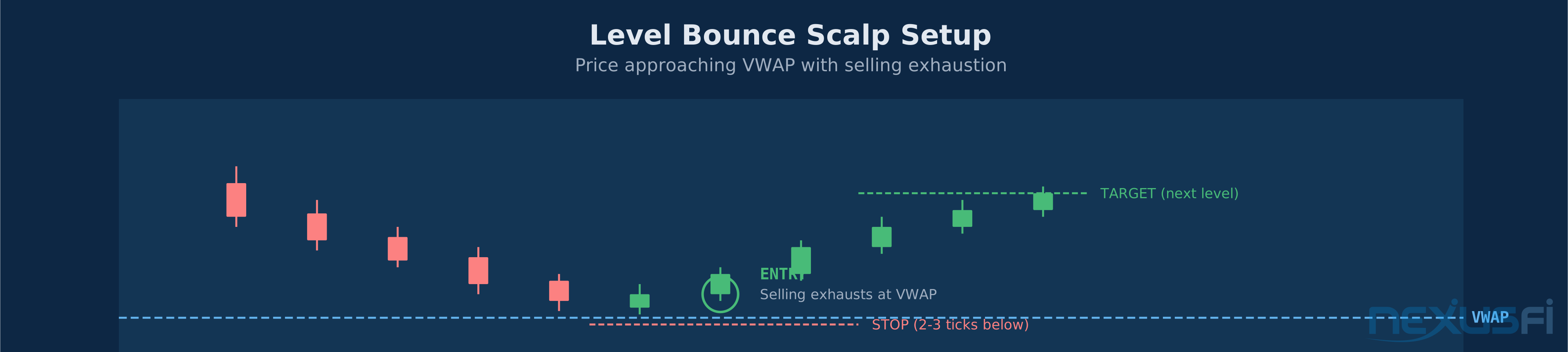
Setup: Price approaches a level from above (for support bounce). The tape shows selling drying up — delta turns less negative, the bid holds, aggressive selling exhausts.
Entry: As the bounce initiates, enter with a tight stop below the level (2-3 ticks below for ES).
Target: The scalp target is the distance to the nearest opposing level or VWAP. Don't hold for the full swing — take what the level gives you.
3. Failed Breakout Scalp #
When a breakout fails, trapped traders create a pool of motivated exit orders. Scalping the reversal captures that energy.
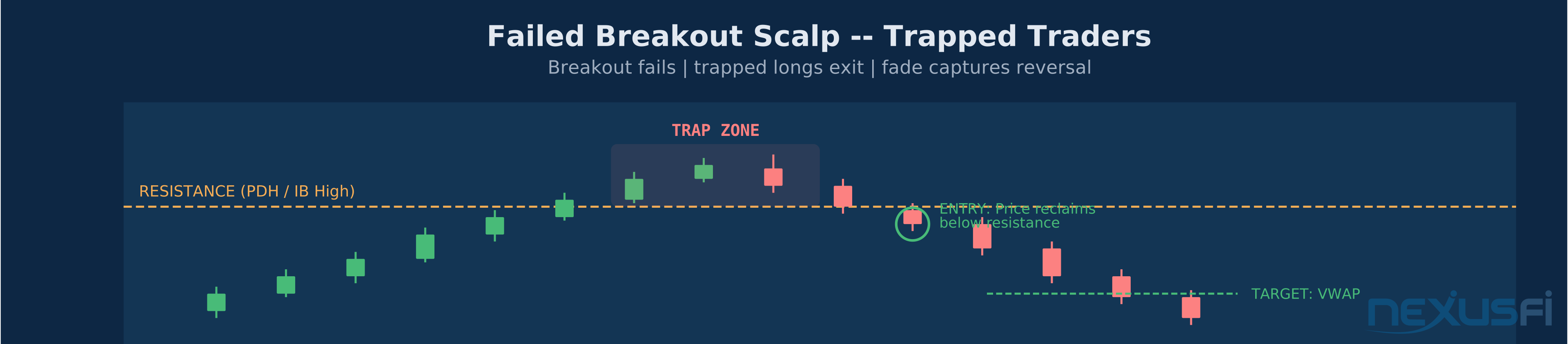
Setup: Price breaks a key level (IB high, PDH, ONH) but fails to hold — no acceptance, no follow-through volume. The failed auction develops.
Entry: When price reclaims the level back inside the prior range, enter in the reversal direction.
Target: VWAP or the midpoint of the balance. Failed breakout scalps often produce larger moves (4-8 ticks on ES) because the trapped traders need to exit.
Stop: Above the failed breakout high (for short entries). This is typically 3-5 ticks.
See Breakout Trading Strategies for the complete breakout and failed breakout framework.
4. Pullback Scalp in Trend #
During one-timeframe directional moves, pullbacks to support levels create high-probability entries for scalpers aligned with the trend.
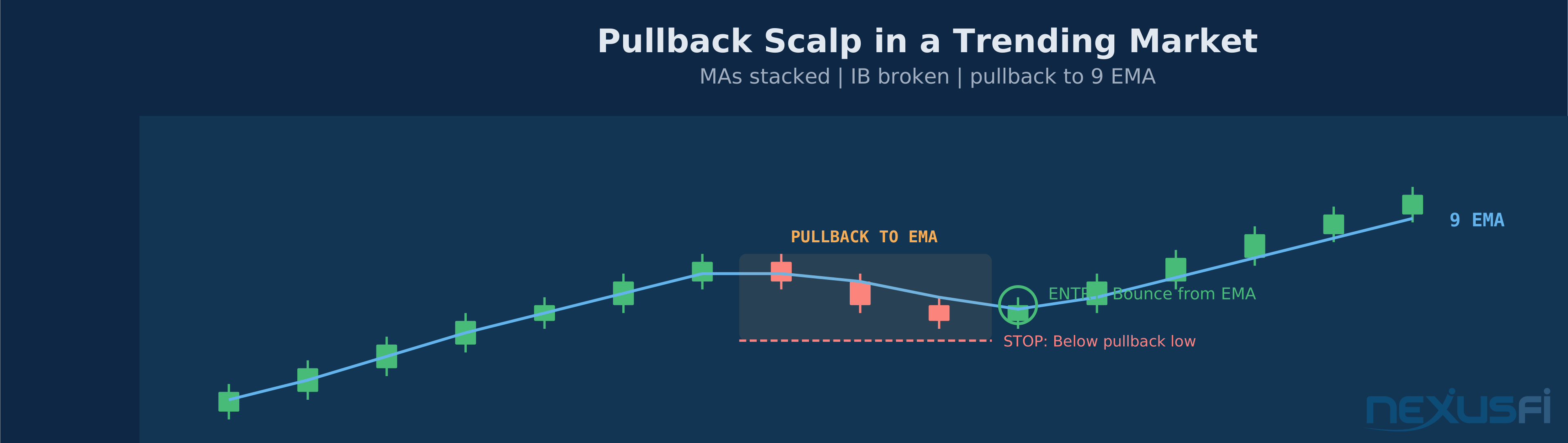
Setup: Price is trending (MAs stacked, initial balance broken in one direction). A pullback develops to the 9 EMA or the first standard deviation of VWAP.
Entry: On the bounce from the MA or VWAP band. Enter with the trend.
Target: The prior swing high (longs) or a measured 4-6 tick target.
Stop: Below the pullback low by 2-3 ticks. In trend, pullbacks that fail usually fail decisively — a tight stop is appropriate.
Risk Management for Scalping #
Scalping without strict risk management is a fast path to ruin. The high frequency of trades means losses compound quickly.
Position sizing. Never risk more than 1% of account per scalp. For a $25K account with a 4-tick stop on ES ($50/contract), that means max 5 contracts per trade. Most developing scalpers should trade 1-2 contracts until consistency is proven.
Win rate requirements. The math is unforgiving:
| Target (ES ticks) | Stop (ES ticks) | Commission cost | Break-even win rate |
|---|---|---|---|
| 2 ($25) | 4 ($50) | $4.50 RT | 71% |
| 4 ($50) | 4 ($50) | $4.50 RT | 55% |
| 6 ($75) | 4 ($50) | $4.50 RT | 47% |
| 8 ($100) | 6 ($75) | $4.50 RT | 45% |
Wider targets dramatically improve the math.
Daily loss limits. Professional scalpers cap daily losses at 2-3x their average winning day. After hitting the cap, stop trading. No exceptions. The temptation to revenge-trade after losses is highest for scalpers because the next setup is always "right there."
Trade count limits. Diminishing returns set in after 10-15 trades per session for most scalpers. Decision fatigue degrades execution quality. Some NexusFi traders report peak performance in 5-8 high-quality setups rather than 20+ mediocre ones.
See Risk Management for Futures Trading and Position Sizing for the complete frameworks.
Execution and Technology #
Scalping demands tools that don't slow you down.
Chart types for scalping:
- Tick charts (1000-2000 tick on ES): Show price movement based on transactions, not time. Compress slow periods and expand active ones.
- Range charts (2-4 range on ES): Each bar covers exactly N ticks of price movement. Eliminates noise during consolidation.
- Time-based (1-3 min): The standard, but creates bars of wildly different information content during fast vs. slow periods.
DOM (Depth of Market). The primary scalping tool. Shows resting orders at each price level, allowing you to see where liquidity sits before committing. Warning: DOM orders can be pulled (spoofing), so watch the actual trades (Time & Sales) more than the resting book.
Hotkeys. One-click entries and exits are not optional for scalping. If you're using a mouse to work through menus, you're too slow. Configure: Buy market, Sell market, Flatten position, Move stop to breakeven. Practice until these are muscle memory.
Latency. For tick-level scalping, execution speed matters. Colocation isn't necessary for retail scalpers targeting 4+ ticks, but a stable low-latency connection (sub-50ms to exchange) removes one variable.
The Scalper's Psychology #
Scalping is the most psychologically demanding style of trading. Every weakness in your mental game gets amplified by the speed and frequency.
Required traits:
- Comfort with rapid decision-making
- Ability to take losses without hesitation (you will have many)
- No attachment to individual trades (the edge is statistical)
- Focus endurance for 2-4 hour sessions
- Discipline to stop when the session degrades
What kills scalpers:
- Holding losers hoping for a reversal (the #1 account killer)
- Moving stops to avoid small losses (transforms a 4-tick loss into a 20-tick loss)
- Overtrading after losses (revenge trading)
- Trading through low-volatility chop where no setups exist
- FOMO entries without proper setup confirmation
See Trading Psychology and Trading Discipline for the complete mental frameworks.
When Not to Scalp #
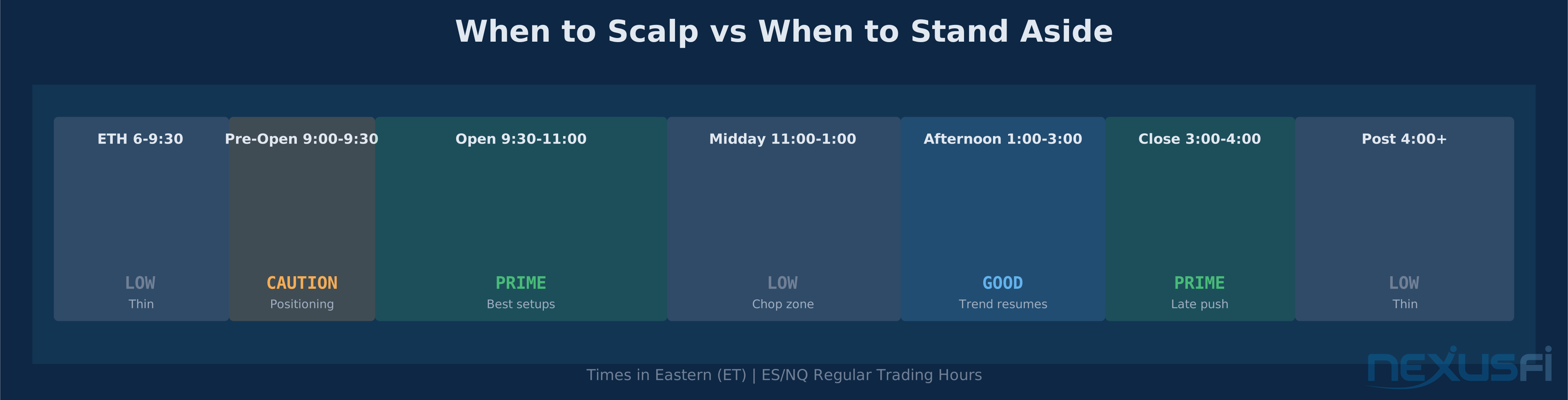
Low-volatility balance days. When the initial balance width is tiny and VWAP is flat, there's nothing to scalp. The moves are too small to overcome commissions. Stand aside or switch to longer timeframes.
Pre-announcement periods. The 30 minutes before FOMC, CPI, or NFP produce erratic price action as traders position. Scalping during this window is gambling on the announcement, not reading order flow.
Thin markets. Early ETH (overnight), lunch hour doldrums (12:00-1:00 PM ET), holiday sessions. The spread widens, fills deteriorate, and normal patterns break down.
When you're not at 100%. Tired, distracted, stressed, or on tilt. Scalping requires peak cognitive performance. A 5% degradation in execution quality at high frequency compounds into meaningful P&L damage.
Knowledge Map
Prerequisites
Understand these firstReferences This Article
Articles that build on this topicCitations
- — Commissions for e-minis are eating my profits (2022) 👍 4“Then it sounds like you are scalping 1 ES tick ?? Most scalpers go for 4-5 ticks When scalping 4-5 ticks your profit $50 / $62.5 for a winner. So if you pay $4 in fees then still have $46 / $58.5 profit left But yeah.”
- — Is scalping Emini a sustainable trading strategy? (2021) 👍 16“I think scalping is sustainable. It all depends on the expectancy of your system and self-control. I only trade the NQ and scalping is what I do from 9:30-10AM, sometimes 10:30AM max if there is a lot of volatility and the market is trending strongly...”
- — VWAP for stock index futures trading? (2019) 👍 29“I don't drop into the forum as much as I did in the old days of The Scalper's Journey, but I appreciate the nod from bobwest and find my thoughts about the VWAPs inline with him and JonnyBoy.”
- — Scalping the Bund with orderflow (DOM reading) (2014) 👍 10“Hello everyone, Here will be the place for my orderflow reading trades. First things first, I’m French, not English fluent, so there WILL be language mistakes, mix of words and so on.”
- — The Beast Slayer, Lance's NQ Trading Journal (2021) 👍 17“Hi John. In regards to your question about the goal for ticks in a week, I really haven't calculated it. I have a basic idea of the amount of profitability..on average..but that can vary too. For example, today I did 25 tick scalps for the most part.”
- — Trading Futures with Context (2014) 👍 13“Same old story, same old song and dance Overnight price had bottomed out during asian session and systematically moved higher throughout the euro session. Price move up until it stalled at y'day high, a key decision level for bulls and bears.”
- — Order Flow Scalping on the DOM Video Trades (2015) 👍 7“Hi guys I've been posting a few videos on Youtube recently of my trades in the Stoxx. I thought it would be worth posting them on here too for anyone in particular who is interested in scalping off the DOM.”
- — SoftSoap's NQ Journey - from SoftSoap to SoftGold (2016) 👍 2“I use the DOM as my primary tool for viewing markets. I love it. You can see the interactions between buyers and sellers. Consider that in a price chart you only see that the NQ went up 6 ticks, in the DOM you saw why and how.”
- — Tape is my shape (tape reading, time and sales) (2011) 👍 12“i dont know who of them institutional and retail. I can only gess through size of the orders. Many retail traders have 3000 contracts to buy or sell? Dont think so "3000 x 1 lot buy orders streaming through on the tape" Okay.”
- — For DOM based traders. (ES/NQ) (2025) 👍 6“Your curiosity about DOM (Depth of Market) trading and reading market rhythm is spot on--it's a totally different language compared to chart-based analysis, and traders who specialize in DOM often operate more like short-term price psychologists tha...”