



Corn Futures (ZC): The Complete Trading Guide
Subtitle: How to trade CBOT corn futures
Overview #
One USDA report in July can double corn's daily range in sixty seconds. That is the market you are trading when you pull up ZC.
The CBOT Corn contract (ZC) prices physical delivery of 5,000 bushels of U.S. No. 2 yellow corn. It's the benchmark for global corn pricing and sits at the intersection of agriculture, energy, and livestock economics
For futures traders, ZC offers something the equity index contracts don't: a market driven by a biological clock. Corn follows a rigid planting-to-harvest cycle that creates predictable volatility windows, and USDA reports can produce limit moves that no amount of technical analysis will anticipate.
([source] [1]).
This guide covers everything you need to trade corn futures: contract specifications, what actually drives prices, the seasonal patterns that create repeatable opportunities, spread strategies the professionals use, and the risk management discipline this market demands.
Key Specifications #
Contract Family #
| Contract | Symbol | Size | Tick Size | Tick Value | Exchange |
|---|
|
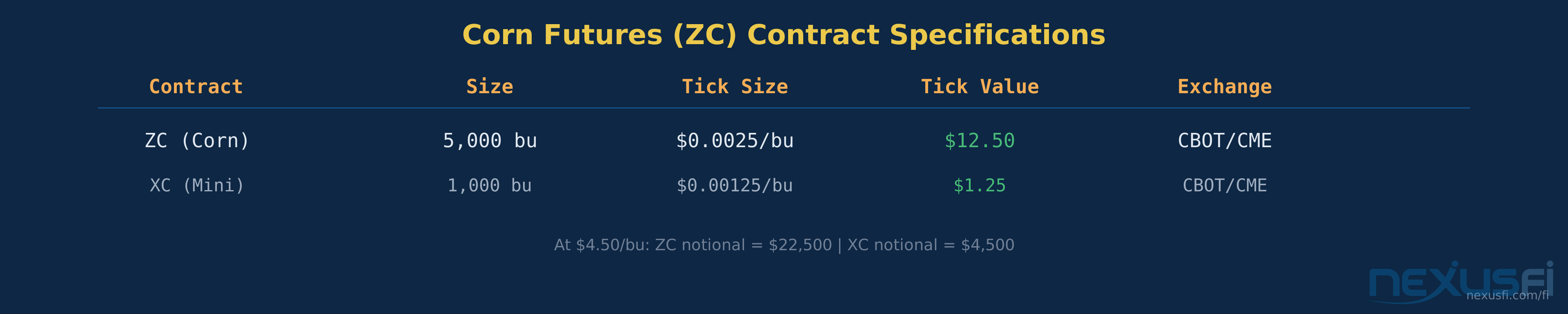
| Corn Futures | ZC | 5,000 bushels | $0.0025/bu (1/4 cent) | $12.50 | CBOT/CME |
|---|
The full-size ZC contract at $4.50/bushel has a notional value of $22,500 ([CME Group] [13]). With typical initial margin around $1,500-$2,500 (varies by volatility regime), you're looking at roughly 9-15:1 leverage. That leverage cuts both ways
Mini Corn (XC) at 1,000 bushels lets you trade the same market with $1.25 per tick instead of $12.50. If you're learning corn or sizing into seasonal patterns, XC is the right starting point
Trading Hours #
ZC futures trade on CME Globex nearly 22 hours per day, Sunday through Friday:
- Globex: 7:00 PM - 7:45 AM CT and 8:30 AM - 1:20 PM CT
- Peak liquidity: 8:30 AM - 1:20 PM CT (U.S. cash market session)
- USDA report spikes: Typically 12:00 PM ET (noon) for WASDE and crop production reports
Contract Months and Delivery #
Corn lists contracts for March (H), May (K), July (N), September (U), and December (Z)
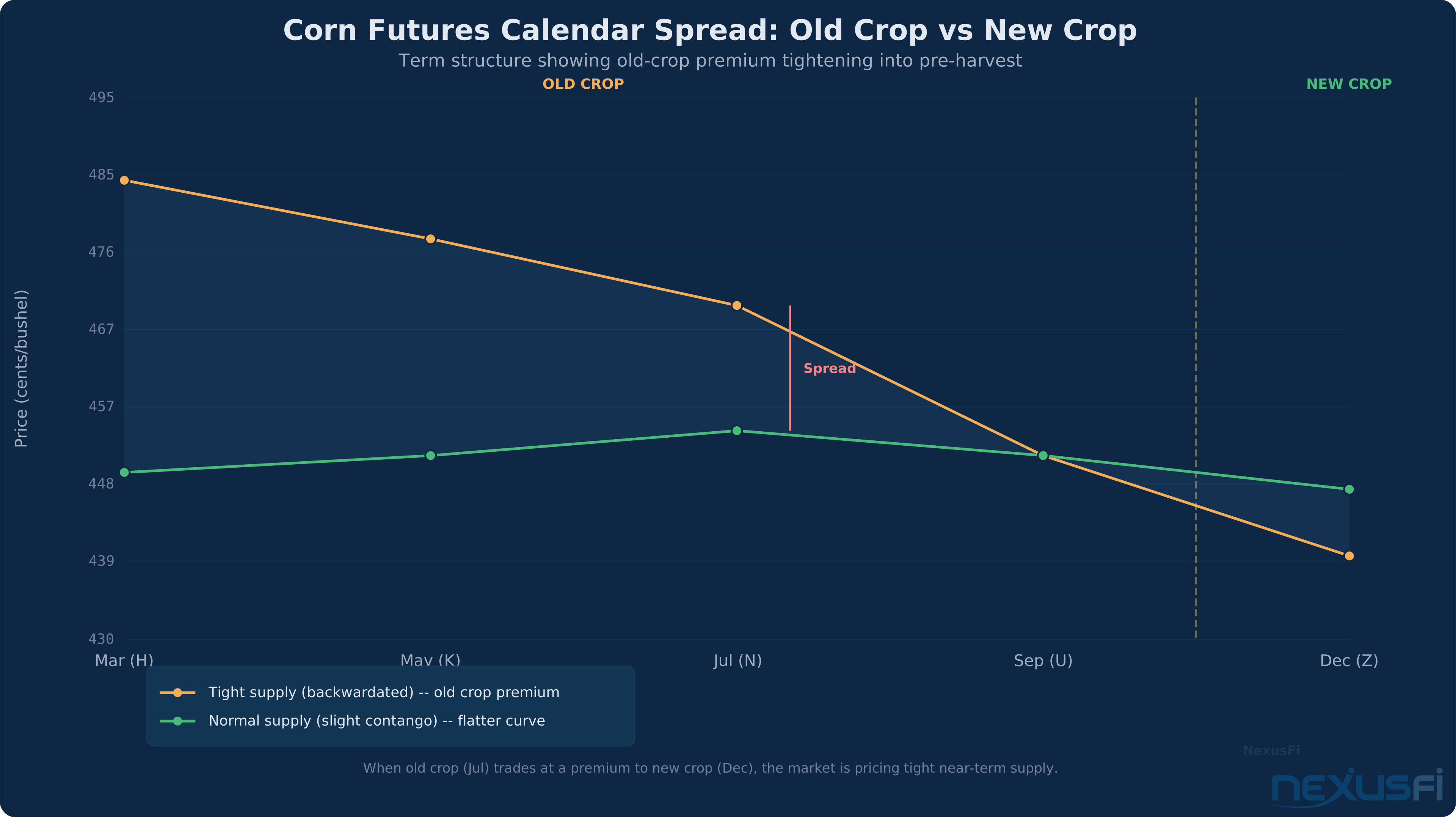
Each contract month carries different risk profiles. July contracts absorb weather premium during the critical pollination window. December contracts price the harvest outcome. The spread between old crop (July) and new crop (December) is one of the most watched relationships in agricultural futures.
Delivery occurs through approved warehouses in the Illinois River and Chicago corridors. Most traders close positions before first notice day, but understanding the delivery mechanism matters because it anchors basis behavior and influences spread dynamics as expiration approaches.
What Moves Corn Prices #
The Balance Sheet #
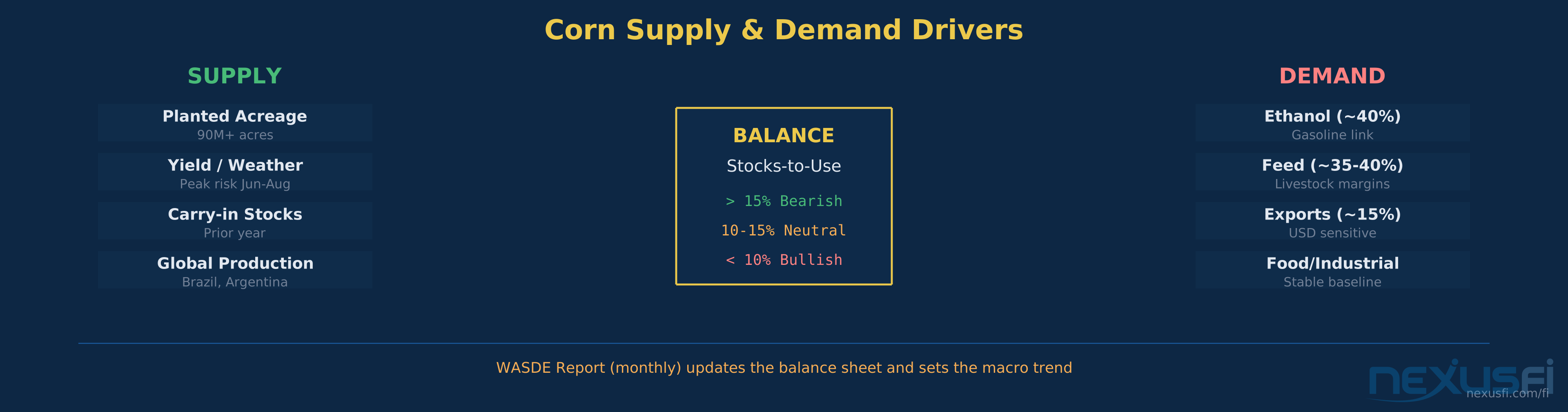
The most important number in corn is ending stocks
The USDA publishes updated balance sheet projections monthly through the WASDE report ([USDA] [14]).
([source] [2]).
When stocks-to-use falls below 10%, the market gets nervous. Below 7%, you're in rationing territory where small supply disruptions can produce outsized price moves. Above 15%, the market gets comfortable and prices tend to grind lower.
Stocks-to-use is the single number that tells you whether corn will rally or chop. Below 10% the market gets nervous and rallies stick. Below 7% you're in rationing territory
Weather #
Corn yields are determined in a roughly 6-week window from late June through early August. Pollination requires adequate moisture and moderate temperatures
This creates the "weather market" that grain traders live for.
([source] [3]).
A drought scare during pollination can send corn limit-up in a single session.
changed the calculus entirely ([source] [4]).
Key USDA Reports #
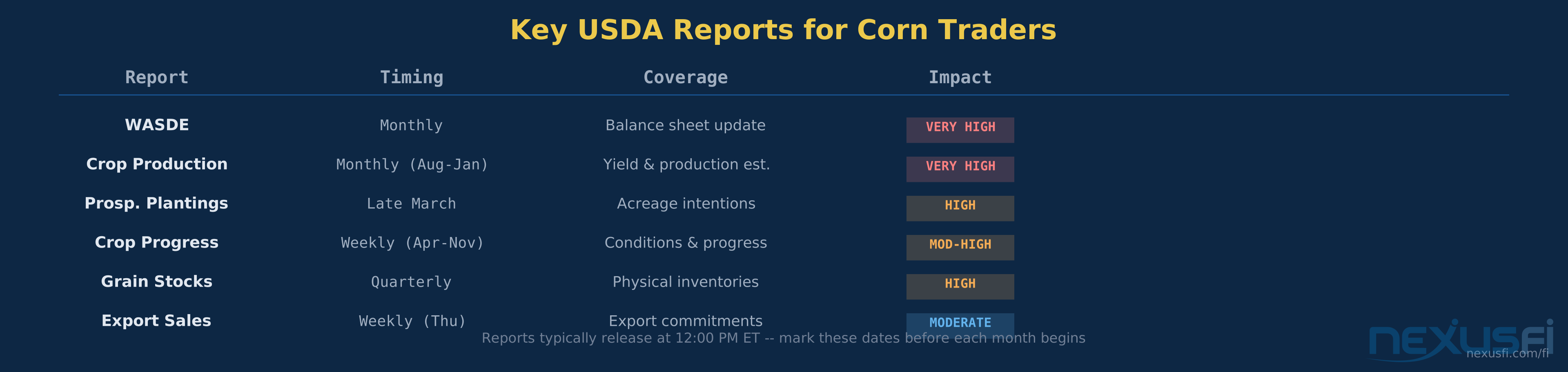
| Report | Timing | What It Covers | Market Impact |
|---|
| | WASDE | Monthly (usually 9th-12th) | Global supply/demand balance sheets | Very High | Prospective Plantings | Late March | Farmer acreage intentions | High
| Crop Progress | Weekly (Mon, Apr-Nov) | Planting pace, crop conditions, harvest progress | Moderate-High during weather markets |
|---|
| Crop Production | Monthly (Aug-Jan) | Yield and production estimates | Very High | Quarterly Grain Stocks | Late Sep/Dec/Mar/Jun | Physical inventories | High | Export Sales | Weekly (Thursday) | Weekly export commitments | Moderate
The August WASDE/Crop Production report deserves special attention.
([source] [5]). It's also worth monitoring the timing around reports
Never build a directional position without knowing the next USDA report date. WASDE and Crop Production reports can produce limit moves that gap right through your stop. If you can't answer "what report comes out this week?" then you shouldn't have a position on.
The Ethanol Connection #
Roughly 40% of the U.S. corn crop goes into ethanol production ([EIA] [16]), making crude oil prices, energy policy, and gasoline economics direct demand drivers. When ethanol margins are strong (gasoline prices high relative to corn), processing plants run at capacity and corn demand tightens. When margins collapse, plants reduce throughput and corn loses a major demand leg.
The Renewable Fuel Standard (RFS) mandates minimum blending levels, putting a floor under ethanol demand. But margins fluctuate with gasoline crack spreads, and any policy changes around biofuel mandates can move corn prices materially.
The Livestock Link #
Another 35-40% of corn demand comes from animal feed
The corn-soybean meal ratio is a key metric. Livestock producers improve feed rations based on relative prices, and a sharp move in this ratio signals substitution effects that shift demand between grains.
Exports and the Dollar #
U.S. corn competes globally with Brazil, Argentina, and Ukraine. A strong U.S. dollar makes American corn less competitive in export markets, dampening demand. Weekly export sales reports track the pace against USDA projections
Corn prices are driven by three forces: the USDA balance sheet (stocks-to-use), the weather during the 6-week pollination window, and the ethanol/feed demand complex. The balance sheet sets the macro trend, weather creates the volatility spikes, and demand determines the floor.
Seasonal Trading Patterns #
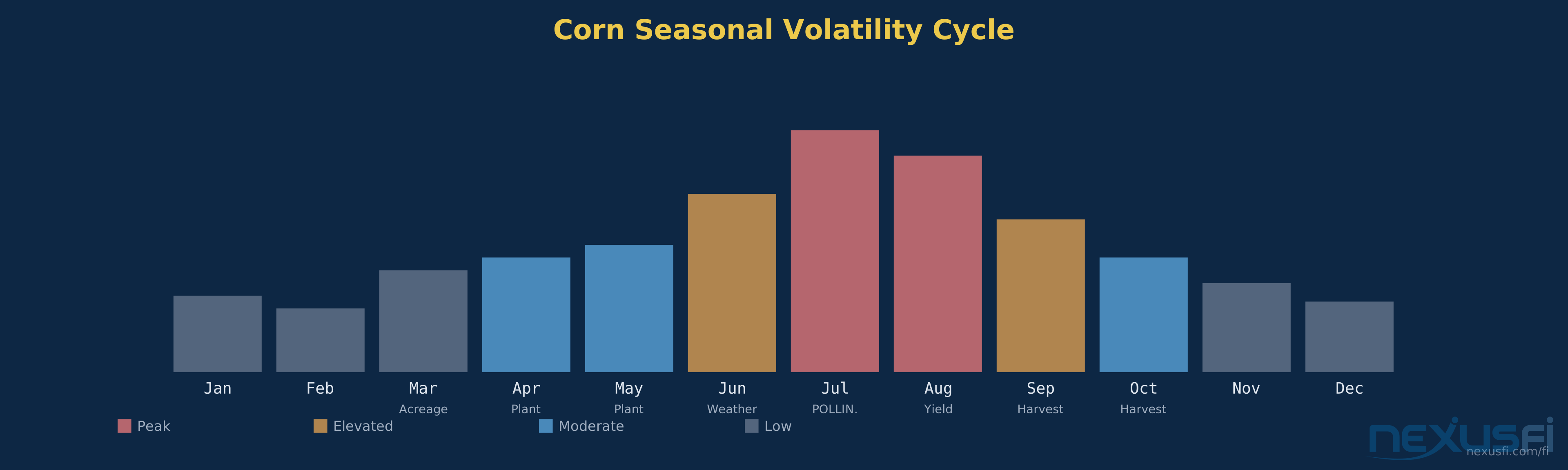
Corn's seasonality is driven by the agricultural calendar and creates distinct volatility regimes throughout the year.
Spring #
The market focuses on acreage intentions (Prospective Plantings report in late March) and planting progress. Wet springs that delay planting can push corn higher as traders price in reduced acreage or yield risk. The market wants to see 80%+ of the crop planted by mid-May.
Summer #
This is when corn earns its reputation for volatility. Pollination (typically mid-July) is the make-or-break window. The weekly Crop Progress report becomes essential reading
([source] [7]).
Seasonal Trade Example: The Summer Weather Premium #
The weather market follows a calendar you can plan around. Here is the framework professional grain traders use:
Entry window: Early June (first two weeks), before pollination premium builds into July contracts. U.S. corn typically reaches 50% pollination around July 15-19, and the market starts pricing weather risk 4-6 weeks before that critical window.
Trigger conditions for going long:
- Weekly Crop Progress report shows good/excellent ratings declining (a 3+ point weekly drop is significant)
- 14-day weather forecasts shift toward above-normal temperatures and below-normal precipitation across the western Corn Belt (Iowa, Nebraska, western Illinois)
- December corn futures have not yet rallied more than 5% off their spring lows (the premium is not priced in yet)
Target: July corn contract or December corn futures (December gives you more time but less direct weather sensitivity)
Exit triggers (take profits or cut losses):
- Crop Progress good/excellent ratings stabilize above 65% for two consecutive weeks (weather threat dissipating)
- Widespread rainfall covers the major growing areas during the pollination window
- A 15-20 cent rally from entry (partial profit-taking at minimum)
- USDA August Crop Production report confirms yields above trend (supply threat resolved)
Stop discipline: 10-15 cents below entry using ATR-based placement. During weather markets, a 10-cent daily range is normal — do not let noise shake you out before the thesis plays out.
Historical context: Since 2000, December corn futures have traded lower from June 1 to June 30 in 15 of 22 years — the Corn Belt usually delivers a good crop. But in the years it does not (2012 drought, 2019 flooding), the upside moves are 30-60+ cents. You are playing for the tail event, sized appropriately.
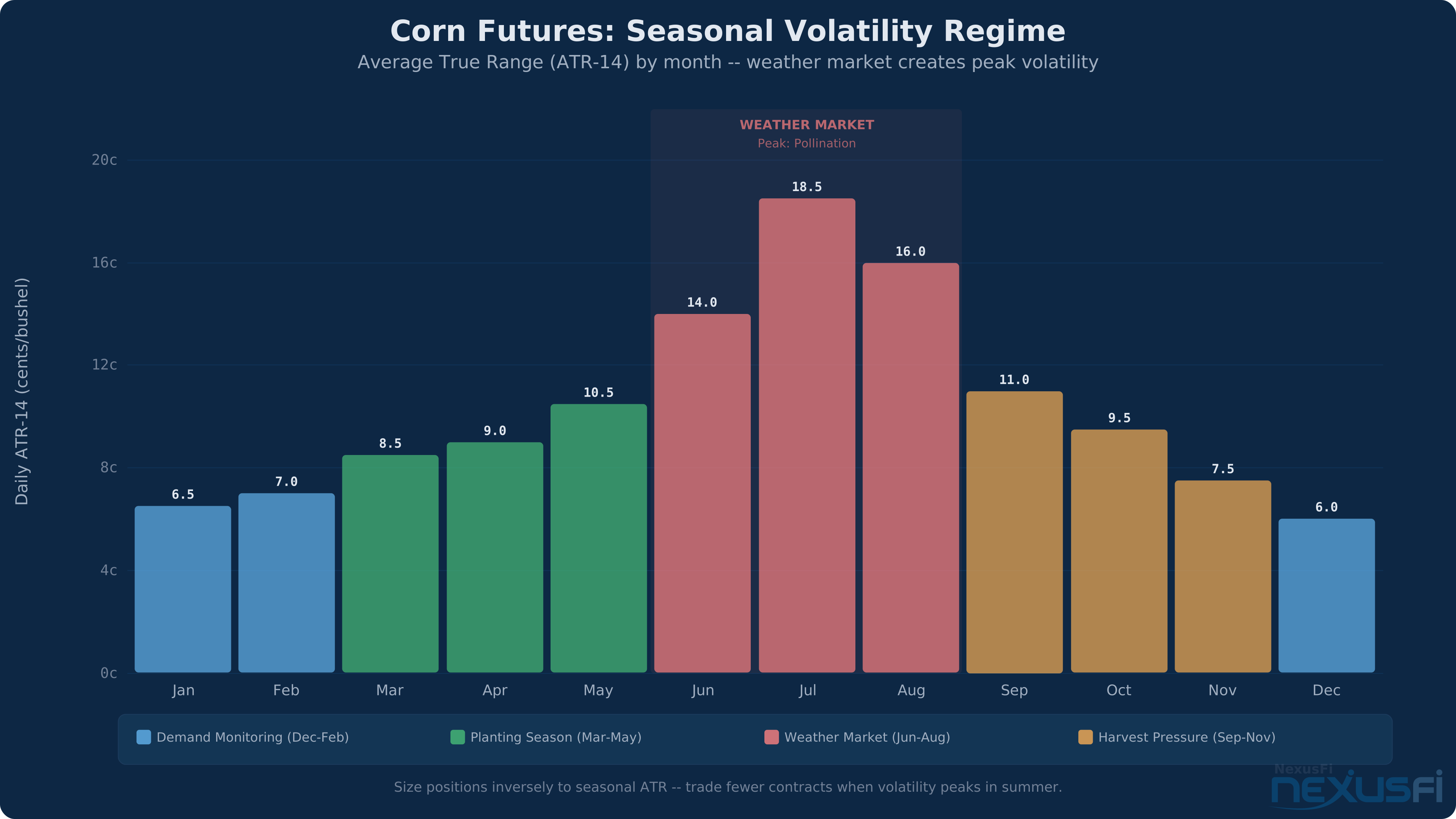
Corn volatility nearly triples during the June-August weather market compared to the winter dormancy period. This isn't just an observation
Harvest #
As harvest progresses, supply uncertainty resolves. Prices often decline as the physical crop hits the market (harvest pressure). December contract pricing converges with cash values. Basis narrows at delivery locations.
Winter #
Post-harvest, the market shifts to demand monitoring: ethanol production rates, export shipment pace, and feed usage estimates. Volatility typically compresses unless a major WASDE revision changes the balance sheet outlook.
How to Trade Corn Futures #
Technical Analysis in Corn #
Technical tools work in corn, but with an important caveat: USDA reports can invalidate any chart pattern in seconds. Use technicals for execution timing, not thesis generation.
As @Fi notes about transitioning from index to commodity futures: "If you have experience with volume profile and VWAP on the index side, the translation to commodities is pretty natural
What works well in corn:
- Moving averages (20/50/100-day) for trend identification
- ATR-based stops
- Support/resistance at round numbers and prior USDA-report reaction levels
- Volume profile at weekly/monthly timeframes to identify value areas and excess
What doesn't work well:
- Tight intraday scalping during low-volume overnight sessions
- Momentum oscillators as standalone signals (RSI divergences get destroyed by report days)
- Any setup that ignores the fundamental calendar
Use ATR-based stops instead of fixed-point stops in corn. A 10-cent stop that works in January is suicide in July when daily ranges double. Recalculate your stop width every month using 14-day ATR
Spread Trading #
Spread trading is the bread and butter of grain market professionals. It isolates specific fundamental views while reducing outright directional risk and margin requirements.
@Wartrace asks a common question about grain spread education: "I read Commodity Spread Trading - Take Advantage of the Seasonality. Joe Ross has a good book on spreads" ([source] [9]). The resources are out there, and spreads are worth learning.
Calendar Spreads (Intra-commodity): The most common corn spread is old crop vs. new crop
([source] [10]).
July/December Spread — When to Buy (Long July, Short December):
The July/December corn spread (ZCN-ZCZ) is negative in contango — December normally trades above July because it includes storage costs. You buy this spread when you expect old-crop tightness to narrow or eliminate that discount.
Entry criteria:
- Spread settles above both its 14-day and 21-day moving averages (momentum confirmation)
- Managed money is net short corn futures (COT report) — their short-covering provides a bid that supports the nearby month disproportionately
- USDA ending stocks are projected below 1.5 billion bushels (tight supply favors old crop appreciation)
- Entry window: Late February through early June (before weather premium gets fully embedded)
Stop: Place below the 52-week low of the spread. This typically represents 3-5 cents of risk ($150-$250 per spread).
Target: Move toward zero or positive (backwardation). In tight-supply years, July can trade at a premium to December. In years where stocks-to-use falls below 8%, this spread has rallied 15-25 cents from February lows to July highs.
Risk/reward framework: Risk 3-5 cents (stop below 52-week low) to make 8-15 cents. That is roughly 2:1 to 4:1 reward-to-risk, with reduced margin requirements compared to an outright position (spread margins are typically 25-40% of outright margins).
When NOT to buy: If USDA projects ending stocks above 2.0 billion bushels (comfortable supply), if the spread is already near zero or positive (premium already priced in), or if you are within 30 days of July contract expiration (liquidity dries up and delivery mechanics dominate).
Inter-commodity Spreads:
- Corn vs. Soybeans: The corn-soybean ratio (typically 2.0-2.5:1 in bushels) reflects relative planting economics. When soybeans get expensive relative to corn, farmers plant more soybeans next season
- Corn vs. Wheat: Feed substitution trade. When wheat gets cheap relative to corn, livestock feeders substitute wheat into rations, boosting wheat demand and dampening corn demand.
Options on Corn: @ron99's massive thread on selling options on futures demonstrates that agricultural options attract significant premium due to weather uncertainty. Corn options see elevated implied volatility from May through August, creating opportunities for premium sellers who manage report risk carefully ([source] [11]).
Who Trades Corn and Why #
Commercial hedgers dominate volume: grain elevators and merchandisers managing inventory risk, farmers locking in harvest prices, ethanol producers hedging feedstock costs, and livestock operations managing feed expenses. Their positioning shows up in the weekly Commitment of Traders (COT) report ([CFTC] [15]).
Managed money (CTAs and hedge funds) trades corn on technical trend signals, weather views, and relative value positions. Their net positioning in the COT report is one of the best sentiment indicators
Retail traders including swing traders like @WoodyFox, who describes running a corn swing strategy: "I believe slippage should be slightly better with the regular Corn Future, but I will be increasing contracts. This is a swing strategy and holds on average 3 days" ([source] [12]).
Risk Management #
Position Sizing Around Reports #
The single biggest risk management mistake in corn is being overleveraged into a USDA report. These reports can produce limit moves
During these events, your stop order is worthless because the market opens beyond it. Size positions assuming your worst-case exit is a full limit move.
The Position Sizing Formula for Report Days:
Max Contracts = (Account Size x Risk %) / (Limit Move in Cents x $50)Each cent of corn price movement = $50 per contract (5,000 bushels x $0.01). A full daily limit move of $0.30/bushel = 30 cents = $1,500 per contract.
Worked examples:
| Account Size | Risk % | Max Loss | Limit Move (30c) | Max Contracts |
|---|---|---|---|---|
| $25,000 | 2% | $500 | $1,500 | 0 (use Mini XC instead) |
| $50,000 | 2% | $1,000 | $1,500 | 0-1 (borderline) |
| $100,000 | 2% | $2,000 | $1,500 | 1 |
| $100,000 | 3% | $3,000 | $1,500 | 2 |
| $250,000 | 2% | $5,000 | $1,500 | 3 |
Expanded limit scenario (triggered after initial limit move): The next day's limit expands to approximately $0.45/bushel = $2,250 per contract. If you are still in after the first limit day, your exposure on day two is 50% larger. Size for expanded limits, not just initial limits, because back-to-back limit days happen.
The uncomfortable truth: At a $50,000 account risking 2%, the math says you can hold exactly zero full-size ZC contracts through a major USDA report with proper risk management. That is not a reason to ignore the math — it is a reason to use Mini Corn (XC at $1.25/tick) or options instead. The alternative is holding 2-3 contracts and hoping the report goes your way, which is gambling, not risk management.
Practical guideline: CME recalculates corn price limits twice per year (May and November) using 7% of the 45-day average settlement price. Check the current limit at CME Group's price limits page before any report week.
Never hold through a USDA report overleveraged. Your stop is meaningless when corn gaps limit-up or limit-down at the open. Size every position so that a full limit move ($1,250-$2,000 per contract) won't damage your account beyond your risk tolerance. If that math doesn't work, you're too big.
Seasonal Volatility Adjustment #
ATR (Average True Range) in corn can double between the quiet December-February period and the volatile June-August weather market. Adjust position size inversely with volatility
Margin Expansion Risk #
CME raises margin right when you can least afford it
Delivery Awareness #
If you hold a long position past first notice day, you may receive delivery notice. Know the delivery timeline for your contract month and roll or close positions well in advance unless you intentionally want to take delivery.
Corn risk management comes down to three rules: size for limit moves not average moves, adjust position size with seasonal volatility, and keep 1.5-2x margin buffer at all times. Break any one of these and the market will teach you the lesson the expensive way.
Getting Started #
Don't just paper-trade corn for a few weeks and think you've got it. The first USDA report you hold through will teach you more about position sizing than anything else
Get the calendar tattooed on your brain. Print the USDA report schedule and pin it next to your screen. Every single date. WASDE, Crop Production, Prospective Plantings, Quarterly Stocks
Follow the balance sheet before anything else. Stocks-to-use is your north star. Below 10%? The market's nervous and rallies can be explosive. Above 15%? You're fighting gravity on the long side. This one number tells you more about the next 3-month direction than any chart pattern.
Start with calendar spreads, not outrights. Old crop vs. new crop teaches you how the term structure works, gives you a fundamental thesis to trade, and won't blow your account on one bad weather forecast. Most professional grain traders started here
Size for the worst-case, not the expected case. Your stop doesn't matter on report day. The market gaps through it. Size every corn position assuming you might eat a full limit move. If that would ruin your week, you're too big.
June through August, check the weather before you check the charts. During pollination, a 14-day forecast shift from hot-and-dry to rain can wipe out a week of gains in an hour. The data points that matter aren't on your trading platform
Corn rewards patience, discipline, and homework. The traders who survive this market are the ones who respect the calendar, size for the unexpected, and know that every year the crop goes in the ground, grows, and gets harvested
Knowledge Map
Prerequisites
Understand these firstGo Deeper
Build on this knowledgeReferences This Article
Articles that build on this topicCitations
- — Diversified Option Selling Portfolio (2016) 👍 5“USDA January report limit moves”
- — Requesting help (Order Flow traders) (2026) 👍 1“WASDE report importance”
- — Grains Trading (2010) 👍 9“Weather and seasonality in commodities”
- — Grains & Beans (2020) 👍 1“USDA record corn crop forecast”
- — Grains & Beans (2017) 👍 2“August USDA report significance”
- — Seasonal Trades (2018) 👍 3“Seasonal trade timing around USDA”
- — Elite Commodities Analysis (2016) 👍 12“Crop conditions value analysis”
- — Requesting help (Order Flow traders) (2026) 👍 1“Volume profile in commodities”
- — Futures spread trading grains education sources? (2024) 👍 2“Spread trading education resources”
- — Grains & Beans (2018) 👍 2“Active corn spread management”
- — Selling Options on Futures? (2013) 👍 3“Options on corn futures”
- — Grains & Beans (2020) 👍 5“Corn swing trading strategy”