



ICT / Smart Money Concepts: The Liquidity Framework for ES and NQ Futures
Overview #
Selling options on futures has 4.4 million views. The debate about whether ICT works has generated its own thread. That gap between the popularity of ICT/Smart Money Concepts and the quality of discussion about it is the problem this article fixes.
ICT stands for Inner Circle Trader — the brand created by Michael J. Huddleston. What he built is a discretionary trading framework that attempts to explain market movement through the lens of liquidity: where it clusters, how it gets targeted, and what happens after it's swept. In the ES and NQ futures markets, where millions of contracts trade daily across interconnected participants, his concepts have found genuine traction.
This article covers the complete ICT framework: what each concept means, how to apply it to ES/NQ futures, what the evidence actually says, and where the framework breaks down. There's no cheerleading here — just the mechanics and the honest assessment.
What ICT Is Actually Trying to Model #
Before unpacking the individual concepts, it helps to understand what the framework is modeling at the system level. ICT is not a set of indicators. It's a narrative lens for reading market structure based on one central claim: price movement is driven by the pursuit of liquidity.
Liquidity, in this context, means resting orders — specifically stop-loss orders placed by traders who entered at obvious technical levels. When you buy a breakout above a prior high, you place your stop below that high. You just created sellside liquidity. When enough traders do the same thing, that cluster of stops below the level becomes a target.
The framework's claim is that larger participants — who need size to move in and out of positions — use these liquidity clusters to fill their orders. They drive price into a cluster of stops, trigger those stops (which generates the order flow they need), and then move in the opposite direction. Whether or not you accept the "smart money" narrative, the observable phenomenon — price sweeping obvious levels before reversing — is real and documented in market microstructure research.
The practical insight is this: instead of entering at the obvious levels where everyone else is trapped, you wait for the sweep and enter after the reversal. The setup isn't predicting the sweep. It's recognizing the sweep after it happens and positioning for the displacement that follows.

Liquidity Pools: Where the Fuel Is Stored #
Liquidity pools are the foundation of the entire framework. Everything else in ICT is about understanding what happens when price reaches a pool, and how to trade that moment.
Buyside Liquidity (BSL) sits above price. It's the stop-loss orders of short sellers (placed above swing highs), and the buy-stop orders of breakout traders waiting for confirmation above resistance. Common buyside liquidity locations:
- Prior day high (PDH)
- Overnight session high (Asian session or Globex high)
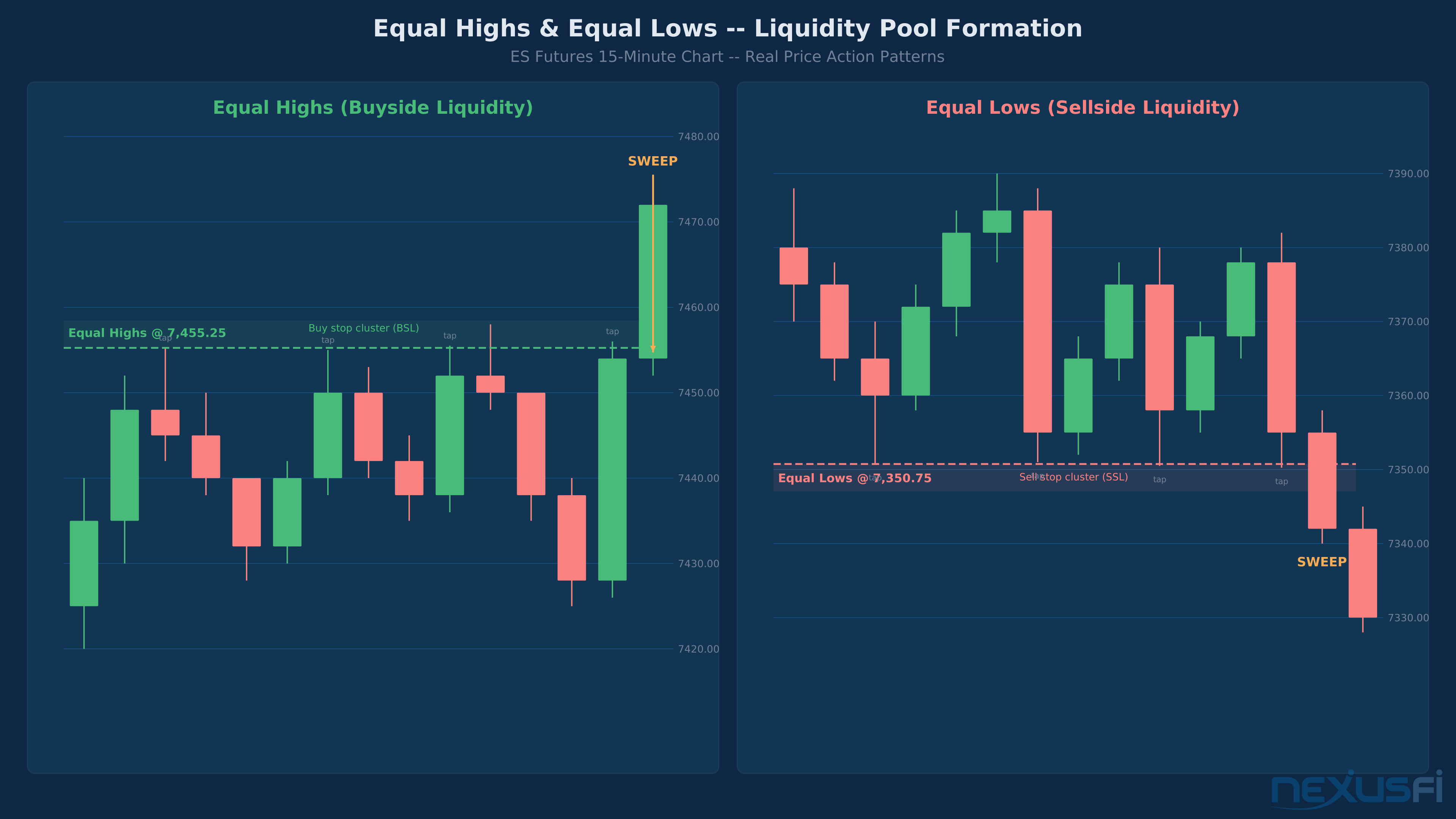
- Equal highs -- three or more touches at the same level
- Prior swing highs visible on the 15m or 1H chart
- Round numbers and obvious breakout points above consolidation
Sellside Liquidity (SSL) sits below price. It's the stop-loss orders of long traders, and sell-stop orders of breakout short sellers. Common sellside liquidity locations:
- Prior day low (PDL)
- Overnight session low
- Equal lows -- multiple tests without a break
- Prior swing lows on the 15m or 1H chart
- Round numbers below consolidation
The practical task is simple: before each session, mark the obvious BSL and SSL levels. These become your roadmap. You're not trying to predict which one gets targeted — you're waiting to see which one price moves toward, and how it behaves when it gets there.
For ES/NQ specifically, the most reliable daily liquidity reference levels are the overnight high/low (set during Asian session and Globex trading), the prior day high/low, and equal highs or lows formed during the prior session. The NQ sweeps are typically more aggressive — expect 30-50 point wicks through equal highs in a volatile session. ES tends to sweep with more precision and smaller overshoot.
Fair Value Gaps: The Imbalance Zones #
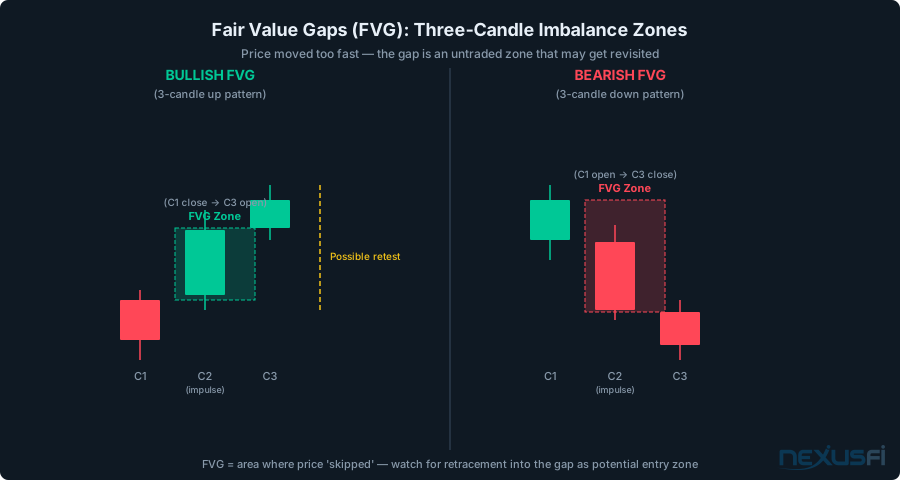
A Fair Value Gap (FVG) is a three-candle pattern that marks a zone where price moved so quickly that the market didn't trade efficiently. The gap between the first candle's range and the third candle's range represents an "untraded" area — price skipped over it during the impulse.
Bullish FVG: The low of Candle 3 is higher than the high of Candle 1. The gap between Candle 1's high and Candle 3's low is the FVG zone. Price moved up through this area in one aggressive candle (Candle 2) without equilibrium.
Bearish FVG: The high of Candle 3 is lower than the low of Candle 1. The gap between Candle 1's low and Candle 3's high is the FVG zone.
The NexusFi forum has an active thread on ICT FVG Strategy where trader jcg3003 describes using 1-minute FVGs that form during specific time windows on ES and NQ, entering on retracements into the gap. That specificity — session-timing the FVG, not just drawing every FVG on every chart — is what separates useful application from noise.
How FVGs work in practice:
- FVGs form during displacement moves -- the strong candle after a liquidity sweep
- Price may retrace into the FVG before continuing in the original direction
- The 50% level of the FVG is the typical entry zone
- FVGs below current price (from upward displacement) become potential support on pullbacks
- FVGs above current price (from downward displacement) become potential resistance on rallies
A key practical point: not every FVG is worth trading. There's a NinjaTrader indicator thread where SpeculatorSeth shares an FVG indicator and notes it stopped performing after spring 2022 — a reminder that mechanical application of the concept doesn't necessarily work. The FVG needs context: it should align with the higher-timeframe bias, form during a killzone, and ideally occur near a swept liquidity level. Without that context, you're just drawing rectangles.
A 2023 NexusFi thread on Inner Circle Trading makes an interesting observation: ICT FVGs are basically the same as Market Profile's single prints — areas where price traded but without two-sided trade facilitation. The concept isn't new; the terminology is.
Order Blocks: The Initiation Zones #
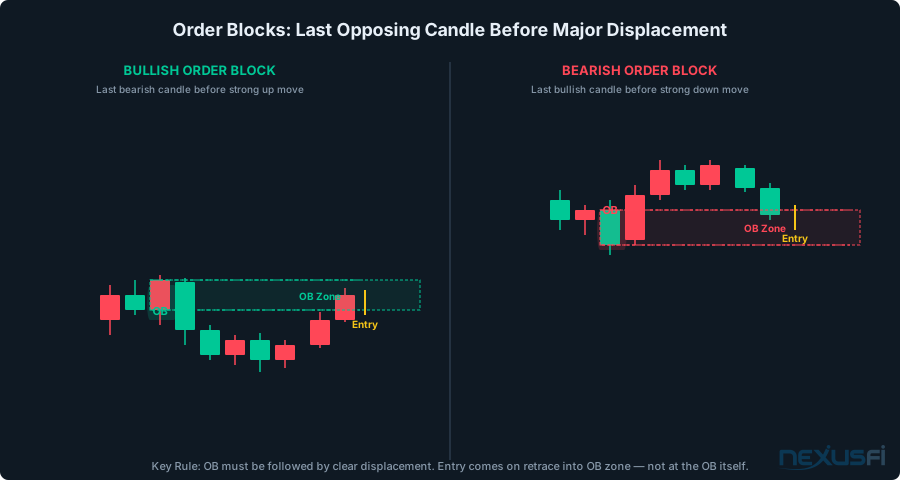
An order block (OB) is the last opposing candle before a strong displacement move. The theory is that institutional traders placed their orders in that candle, and when price returns to that zone, resting orders remain to be filled.
Bullish order block: The last bearish (down) candle before a strong upward move. Mark the open-to-close range of that candle as the OB zone.
Bearish order block: The last bullish (up) candle before a strong downward move.
When price displaces away from a liquidity pool and leaves an FVG, that FVG often contains or overlaps with an order block. The strongest entries combine both: price retraces into a zone where an FVG and OB overlap, within the correct premium/discount context.
The critical caveat that every practitioner emphasizes: order blocks are the most subjective concept in the framework. Ask ten traders to identify the order block on the same chart and you'll get different answers. Different definitions, different timeframes, different "rules" for what qualifies as displacement — all produce different OB locations. This subjectivity is why order blocks are the weakest link in the ICT empirical chain.
The practical rule: treat OBs as confluence, not signal. An OB that sits at a swept liquidity level, within a premium/discount context, during a killzone, with an FVG nearby — that's worth attention. An OB in isolation is not.
Premium and Discount Zones: Trading from Value #
The premium/discount concept is one of the most practically useful parts of the framework — and one of the least controversial, because it's basically just buying low and selling high within a defined range.
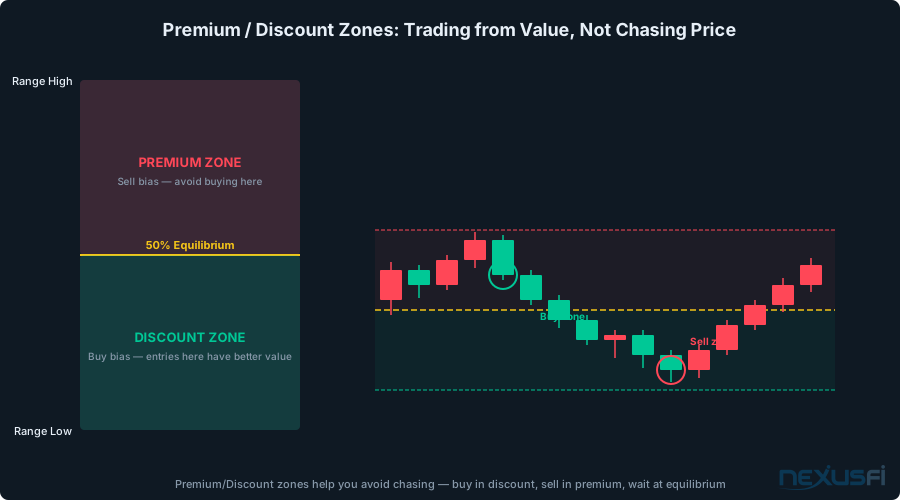
The framework divides any price range (between a relevant swing high and swing low) into three zones:
- Discount (below 50%): Favorable for longs. Price is below the midpoint of the range -- below "fair value"
- Equilibrium (around 50%): Neutral. No edge for either direction from location alone
- Premium (above 50%): Favorable for shorts. Price is above the midpoint of the range
Applied to ES/NQ trading: identify your relevant range (could be the prior day's range, the prior week's range, or the current impulse leg), find the 50% midpoint, and only take long setups when price is in the discount half, only take short setups when price is in the premium half.
This filtering alone eliminates a huge category of low-probability trades: buying breakouts in premium, or shorting breakdowns in discount. Both are chasing moves that have already extended.
The key is defining which range is relevant. For intraday ES/NQ trading, the most useful ranges are usually the prior day's range, the Globex/overnight range, and the current session's developing range. For swing setups, use the prior week's range. The specific range matters less than applying it consistently.
Killzones: When Institutional Activity Peaks #
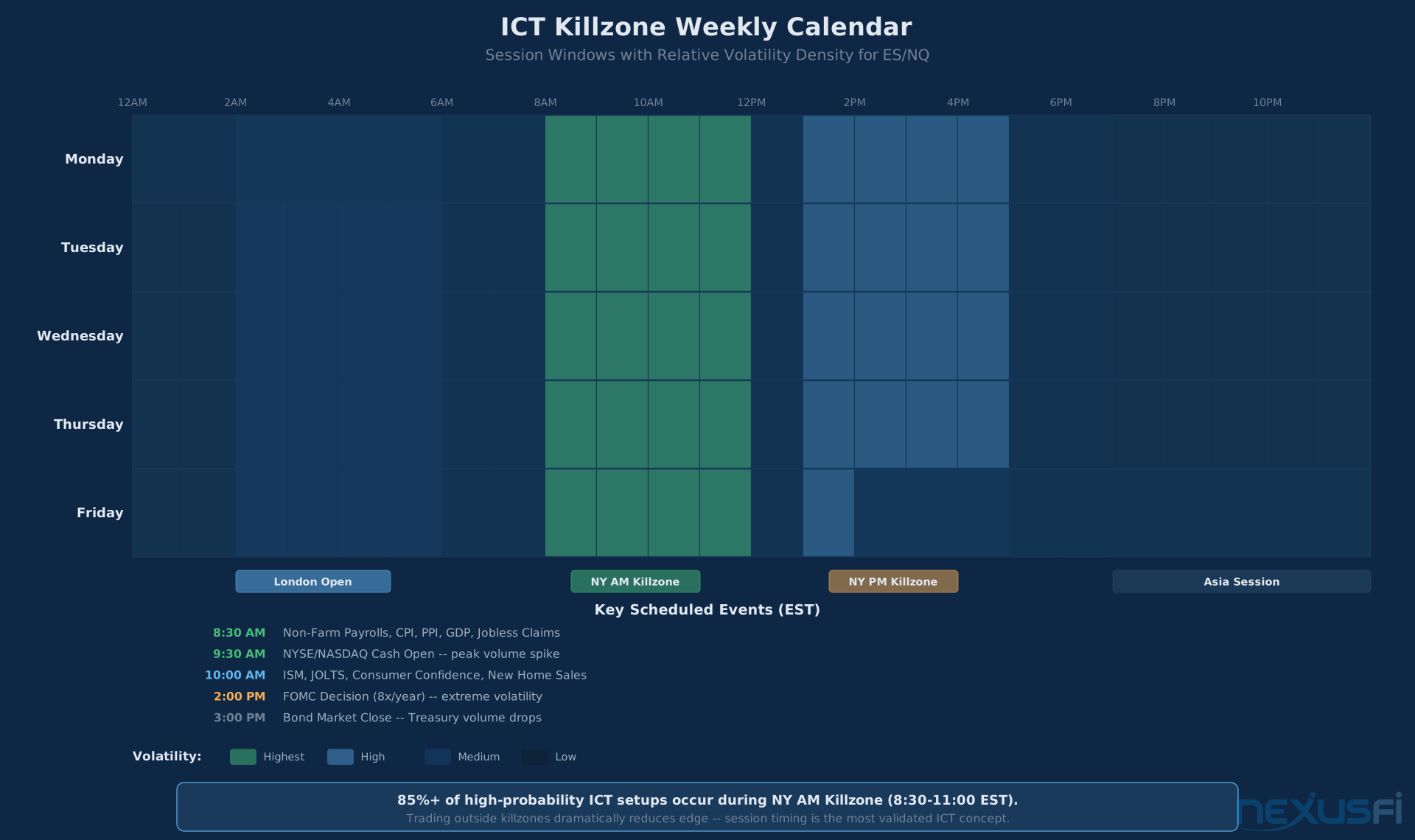
Session timing is one of the most empirically well-supported aspects of the ICT framework. Volatility and volume cluster around session opens for documented, mechanical reasons: institutional participation, scheduled economic releases, overlapping time zones, and options market activity. Trading during these windows doesn't give you any mystical edge — it just puts you in the market when the most participants are active and setups are most likely to follow through.
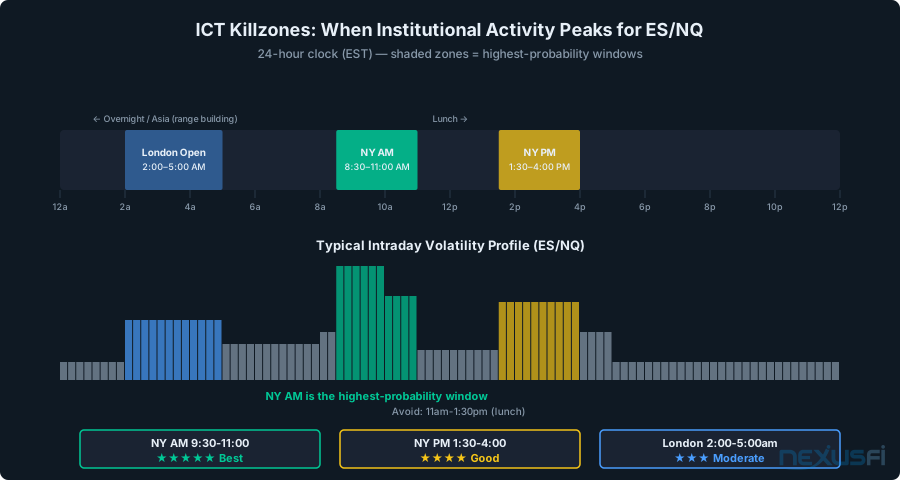
The three primary killzones for ES/NQ:
New York AM (8:30--11:00 AM EST) — Highest priority. This is when the highest probability setups occur. Economic data releases at 8:30 (jobs reports, CPI, etc.) create immediate volatility. The 9:30 cash open brings massive volume from equity market participants. The ES and NQ are driven primarily by US equity market dynamics — NY AM is when those dynamics are most active.
New York PM (1:30--4:00 PM EST) — Secondary priority. The afternoon session produces its own setups as position adjustments occur heading into the close. Lower volume than the morning but consistent enough for experienced traders.
London Open (2:00--5:00 AM EST) — Moderate priority for US traders. London overlaps with both Asian session close and US futures early trading. The overnight sessions often set up the NY AM session — identifying the Globex high/low during London hours is valuable context for the morning setup, even if you're not actively trading during London itself.
Avoid: 11:00 AM--1:30 PM EST. The lunch session typically sees dramatically lower volume, erratic price action, and false setups. Many experienced ES/NQ traders simply stop trading at 11:00 AM and resume at 1:30 PM. The setup density and follow-through during this window is substantially lower.
The practical protocol: before each session, note whether you're in a killzone. If a setup appears outside a killzone, require extra confirmation. If a setup appears during lunch, the default position should be to skip it entirely unless it's solid.
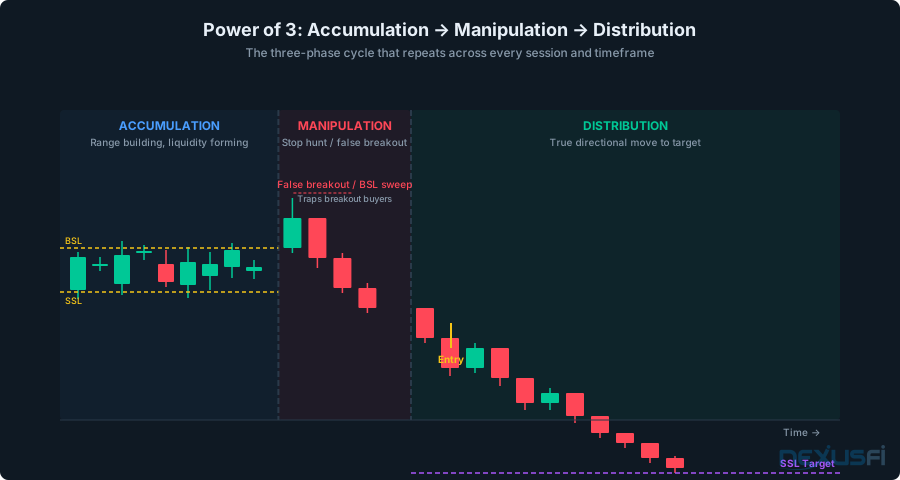
Power of Three: The Three-Phase Session Cycle #
The Power of Three (PO3) is a narrative model for how price sessions tend to unfold. It describes three sequential phases that repeat across multiple timeframes and session types.
Accumulation: Price consolidates in a range. Liquidity builds on both sides as traders establish positions. The range creates obvious BSL above and SSL below. This phase can last hours (daily timeframe) or minutes (intraday).
Manipulation: Price sweeps one side of the range — appearing to break out in one direction. This triggers the stops and breakout orders of trapped participants. The sweep looks convincing enough to attract momentum traders, then fails. This is the "false breakout" or "liquidity grab."
Distribution: Price reverses from the swept direction and moves strongly toward the opposite liquidity pool. This is the real move. Traders who recognized the manipulation phase and waited are now positioning in the correct direction.
The daily version: Asian session often provides the accumulation range. London and NY open create the manipulation (the Judas Swing — a false move in one direction). NY session delivers the distribution toward the day's actual target.
This model is useful as a scenario planning tool, not a prediction. Not every day follows this script. Some days have directional conviction from the open with no manipulation phase. Some days range all session. But having the model in mind helps you avoid entering during what might be a manipulation phase, and positions you to enter confidently once distribution begins.
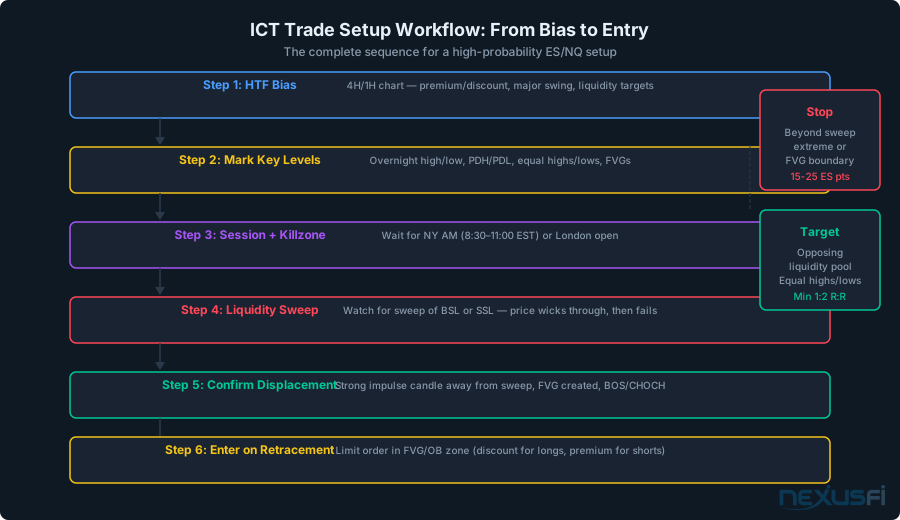
Complete ICT Trade Setup: From Bias to Entry #
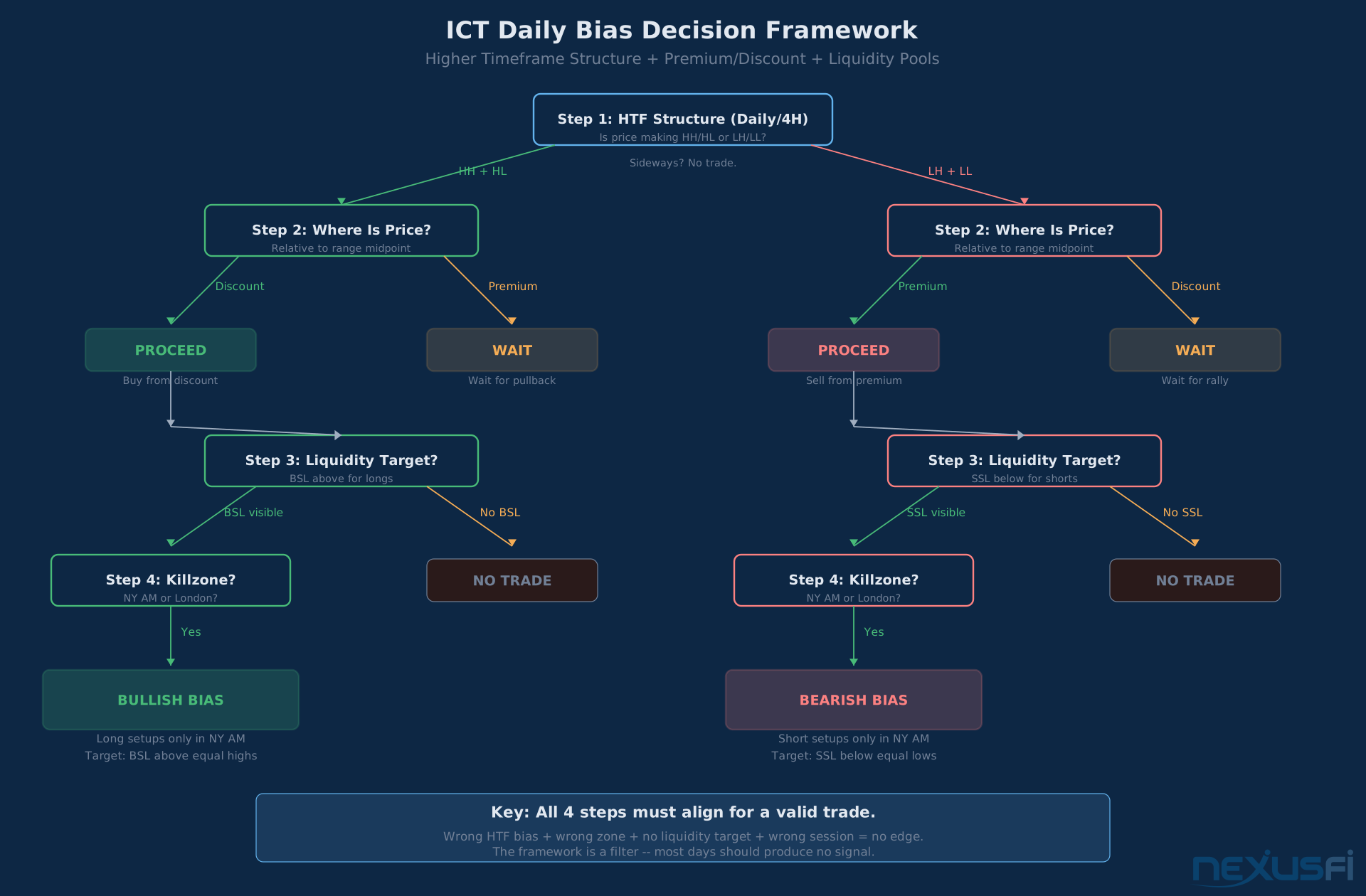
The individual concepts become tradeable when combined into a coherent workflow. Here is the complete sequence for a high-probability ICT setup in ES or NQ:
Step 1 — Build the Higher-Timeframe Bias. Use the 4H and 1H charts to answer: Is price in premium or discount of the most relevant range? Where are the major liquidity pools? Which direction has the clearest path to a target? Don't trade without a directional opinion grounded in at least the prior day's structure.
Step 2 — Mark Key Levels. Note the overnight high/low, prior day high/low, any equal highs or equal lows from the prior session, and significant FVGs from the 15m or 1H charts. These are your setup reference points.
Step 3 — Wait for Session Timing. Hold off until the NY AM killzone (8:30--11:00 AM EST). If you're watching the London open, note whether it's establishing a Globex high or low that might get swept during NY AM. Doing this waiting is harder than it sounds — the urge to trade before the killzone is real. Discipline here is the difference between consistent performance and random results.
Step 4 — Identify the Liquidity Sweep. Watch for price to move into a BSL or SSL level identified in Step 2, wick through it, and then fail to continue in that direction. The sweep doesn't need to be obvious in real-time — it often only becomes clear two or three candles after the fact. That's fine. You don't need to pick the exact high or low; you need to recognize that the sweep occurred.
Step 5 — Confirm Displacement. After the sweep, you want to see a strong, impulsive move in the opposite direction. This impulse should:
- Create a Fair Value Gap
- Break a recent swing high or low on the execution timeframe (1m-5m)
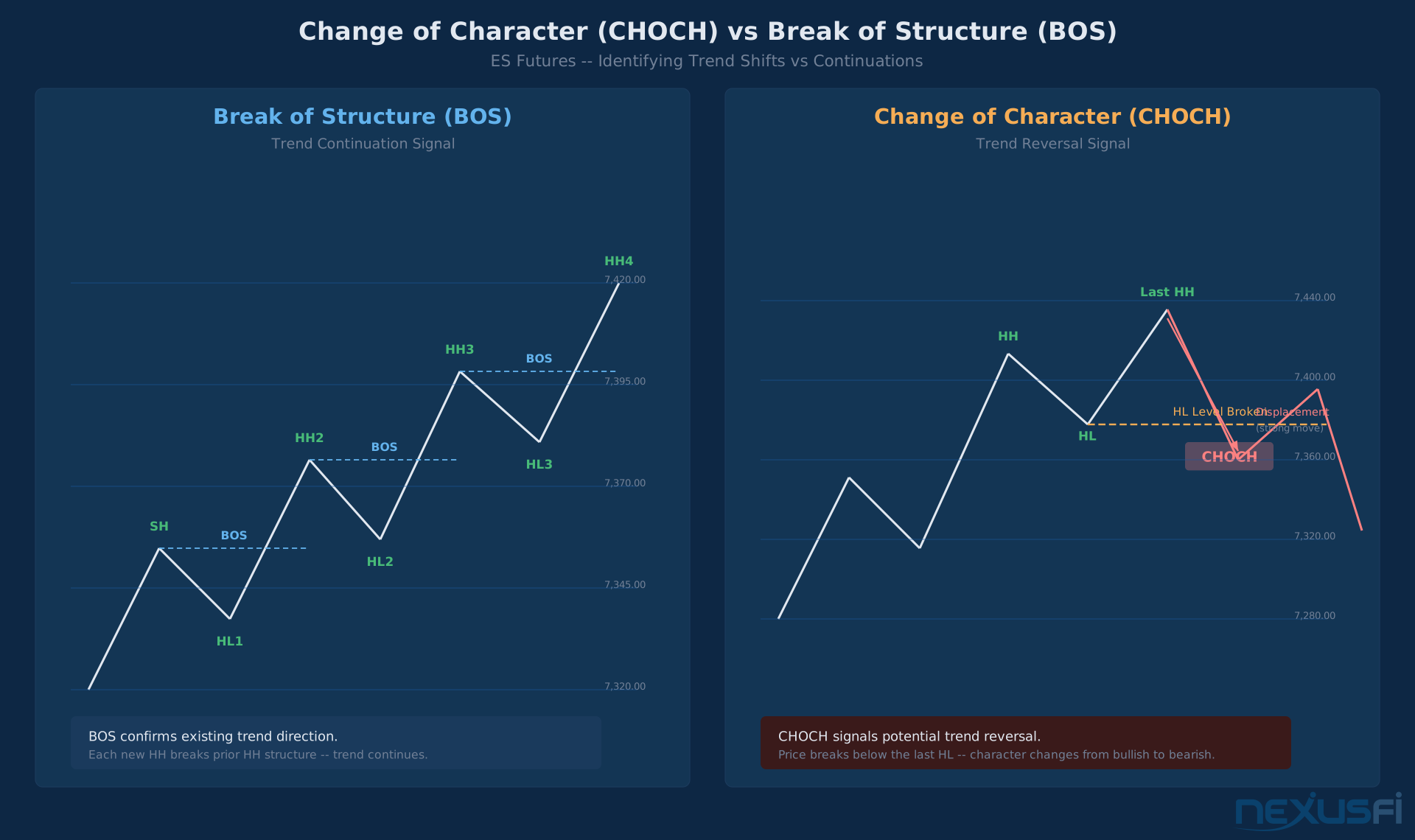
- Represent a Change of Character (CHOCH) -- first significant structure break after a period of movement in one direction
The displacement is your confirmation that the sweep was real, not that price is about to continue in the sweep direction.
Step 6 — Enter on Retracement. Set a limit order in the FVG created during displacement, ideally in the correct premium/discount context. For a long setup (SSL swept, price displacing upward), enter in discount — the lower half of the displacement leg. For a short setup (BSL swept, price displacing downward), enter in premium.
Stop placement: Beyond the extreme of the sweep — outside the swept level entirely. For ES, typical stops are 15-25 points. For NQ, 30-50 points. If the stop needs to be larger than this to clear the sweep extreme, the setup geometry isn't favorable.
Target: The opposing liquidity pool identified in Step 2. If you're long after a SSL sweep, target the BSL above. Minimum 1:2 risk-to-reward; target 1:3 when structure permits.
Worked Example — Sellside Raid to Long Setup (ES):
The prior day low sits at 5,680.00. Overnight trading creates equal lows at 5,678.00 on the 15m chart. During NY AM, ES trades down through 5,678.00, printing 5,674.75 at 9:42 AM. Then a strong 10-point up candle prints, closing at 5,684.50 — creating a bullish FVG from 5,678.25 to 5,680.50.
ES retraces to 5,679.25 (inside the FVG, in the discount half of the morning's developing range). You enter long at 5,679.25 with a stop at 5,673.75 (below the sweep low) — 5.5 points of risk. Target: the prior session's BSL at 5,698.00 — 18.75 points away. That's roughly a 1:3.4 risk-to-reward.
This is the archetype of the ICT setup. Not every day produces one this clean, but this structure repeats often enough in ES/NQ to build a systematic approach around.
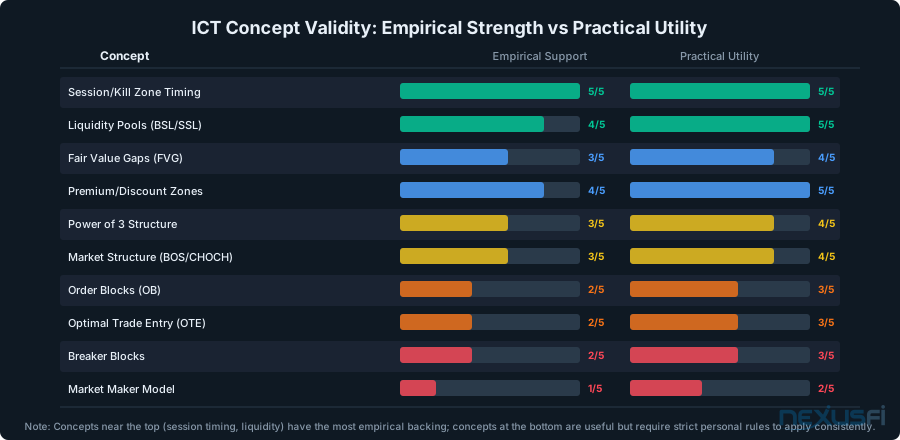
Theory vs. Evidence: The Honest Assessment #
What the evidence supports:
Liquidity provision patterns around key levels are documented in academic microstructure research (Madhavan, 2000). Intraday volatility clustering around session opens is well-established (Andersen & Bollerslev, 1997). Information asymmetry between institutional and retail participants is real and studied (Kaniel et al., 2012). Stop-hunting behavior around obvious levels is observable and consistent with how market makers and liquidity providers manage inventory.
These are the foundations that give the ICT framework its empirical legs.
What remains speculative:
The specific claim that identifiable "institutional footprints" can be reliably read via ICT annotations — order blocks in particular — lacks formal validation. The framework's most popular format online is the highlight reel: screenshots of perfect setups after the fact. This is confirmation bias at scale. The less-discussed question is: what's the base rate? How often does a "valid" order block actually hold? Different traders applying ICT rules to the same chart will draw different OBs, get different results, and draw different conclusions. NexusFi member @Analytic took a data-driven approach to this question — computing trading performance metrics and running Monte Carlo simulations on ICT's own broker statements from a two-month trading period, finding that the unaudited results lacked the statistical rigor to draw conclusions about the method's long-term edge.
The "market maker model" — the framing that a central entity engineers price movement to trap retail traders — is also oversimplified. ES and NQ are regulated CME futures with thousands of participants including commercial hedgers, pension funds, quantitative firms, and retail traders. No single entity engineers price. What looks like "engineering" is the aggregate result of liquidity dynamics that ICT's narrative happens to describe in a colorful way.
What this means for your trading:
Use ICT as a framework for what to look for, not as a mechanical system. The concepts that work best — liquidity identification, session timing, displacement confirmation — are the ones with the strongest real-world foundations. The concepts that require the most discretion — order blocks, breaker blocks — are the ones to use with the strictest personal rules and the most rigorous self-testing.
Many ICT concepts are market profile and auction market theory concepts with new names. That's not a disqualification -- it's actually evidence that the underlying ideas are sound. The language is different, but the core observation (markets seek liquidity, imbalances get rebalanced, time-of-day matters) is shared across multiple established frameworks.
NexusFi member, Inner Circle Trading thread
NexusFi Elite member @Private Banker demonstrated this convergence in practice in the Volume Profile and Footprint discussion thread — showing how order flow absorption at key levels (visible on footprint charts) is the same mechanic ICT describes as institutional activity at order blocks. The difference is language, not substance: Volume Profile identifies high-volume nodes and single prints; ICT calls them order blocks and fair value gaps. Both frameworks agree that price gravitates toward unfinished auction areas and that large participants use key levels to fill size.
Common Pitfalls in ICT Application #
Traders who struggle with ICT often make a predictable set of errors:
Treating every candle as an order block. An order block is meaningful in the context of a liquidity sweep and displacement. Without that context, it's just a candle. Draw OBs only when the structure around them qualifies.
Entering before the sweep is confirmed. Anticipating the sweep means buying into the area that might be manipulated downward, or shorting the area that might be pumped. Wait for the sweep, then wait for displacement, then enter the retracement. That patience is the edge.
Trading outside killzones. ICT setups occur most reliably during sessions when participants are active. Setting up a clean ICT pattern during the lunch session or overnight range is usually a false signal with poor follow-through.
Ignoring higher-timeframe context. A bullish FVG in a bearish market structure is fighting the tape. Every setup needs a directional opinion from the 4H/1H before dropping to the execution timeframe.
Expecting every FVG or OB to hold. These are areas of interest, not guaranteed supports or resistances. Price will violate them regularly. Position sizing and stop discipline exist specifically because even the best setups fail.
Overcomplicating the chart. Some traders mark every FVG, every OB, every equal high and equal low across multiple timeframes simultaneously. The chart becomes illegible. Identify the two or three most significant levels for the session and focus on those.
Applying ICT to ES Versus NQ: Key Differences #
ES (S&P 500 E-mini) and NQ (Nasdaq-100 E-mini) are both highly liquid CME futures that respond to ICT concepts, but with meaningful differences in behavior.
NQ tends toward more aggressive sweeps. The Nasdaq is a more volatile contract — equal highs and lows in NQ often get swept with 30-50 point wicks, compared to 8-15 points in ES. This means stop placement beyond sweep extremes needs to be wider in NQ to avoid getting stopped on noise.
ES has cleaner structure at lower timeframes. The S&P's diversification (500 stocks) produces smoother intraday behavior with more reliable FVG fills. NQ can overshoot and undershoot dramatically due to the tech-heavy concentration.
NQ moves faster after displacement. When NQ displaces from a swept level, the impulse candles are larger and faster. Limit orders in FVGs may fill at unexpected prices during fast moves. Use limit orders with some buffer, not tight slippage assumptions.
Correlation during high-impact events. During major economic releases (Fed decisions, CPI, NFP), ES and NQ move in lockstep. Don't size both simultaneously — you're taking correlated risk. Trade one or the other, not both, during high-impact sessions.
Risk Management for ICT Trading #
No methodology survives without risk management. These are the non-negotiable parameters for applying ICT to ES/NQ:
Position sizing: Never risk more than 1-2% of account per trade. With 20-25 point ES stops typical for ICT setups, a 1% risk on a $50,000 account allows approximately 4 contracts (each ES tick is $12.50, each point is $50, so a 20-point stop = $1,000 per contract).
Confluence requirement: Require at least three confirming factors before entering: liquidity sweep + FVG/OB + session timing + HTF alignment. Setups missing multiple factors have lower probability and should be passed.
Daily loss limit: Set a maximum daily loss (commonly 2-3% of account) and stop trading when hit. The discipline to stop after losses prevents the cascade where one bad day becomes a disaster. For more on surviving and recovering from losses, see our guide to drawdown management.
Session commitment: Pick one killzone and trade it consistently. Traders who trade London, then NY AM, then NY PM, then re-enter the next day's Globex are compounding fatigue with compounding risk. Focus produces better results than breadth.
What ICT Gets Right -- and What It Doesn't #
The framework's lasting contribution is providing retail traders with a structured vocabulary for reading market structure. Before ICT popularized "BSL/SSL" and "FVG," most retail traders approached markets with a vague sense of support and resistance. ICT gave them specific language: equal highs are a defined liquidity pool, not just "overhead resistance." The FVG is a specific three-candle pattern, not just "a gap." That precision — however imperfect — produces more systematic thinking about entries.
What ICT doesn't do well is falsifiability. The most important question — "what's your edge when applied consistently?" — rarely gets answered rigorously in ICT circles. The community tendency is toward qualitative storytelling about why a setup should work, not statistical analysis of whether it does. Serious practitioners use ICT as a starting framework and layer their own systematic testing on top. They track which setups, at which sessions, with which confluence factors, produce positive expectancy. That data replaces belief with evidence.
The ultimate verdict, consistent across every practitioner who treats this seriously: ICT concepts that align with real market dynamics (liquidity, sessions, imbalance) are genuinely useful. ICT concepts that depend heavily on narrative and discretion (order blocks, market maker models) require strict personal rules and rigorous self-testing before you can know if they're working for you specifically.
Getting Started: A Practical First Week #
If you're new to ICT concepts and want to build a foundation without getting lost in the complexity, start here:
Day 1-2: Master one concept only — liquidity pools. Before each session, identify and mark: overnight high/low, prior day high/low, and any obvious equal highs or equal lows. Don't trade. Just watch how price interacts with those levels. Observe which ones get swept and which ones hold.
Day 3-4: Add session timing. Trade only between 9:30 AM and 11:00 AM EST. Note whether setups that appear outside this window behave differently from those inside it.
Day 5: Add the FVG concept. After a liquidity sweep followed by displacement, identify the FVG created during the impulse move. Watch whether price returns to it.
Week 2: Combine all three — liquidity pool identification, session timing, and FVG as potential entry zone — into a simple entry rule. Keep records. Track every setup you see (even ones you don't take) and its outcome. This data is more valuable than any additional concept you could add to the framework.
Add complexity only after the foundation produces consistent observations. Most traders who struggle with ICT struggle because they added too much too fast. The framework rewards patience and systematic study.
For deeper study, the NexusFi community has an active ICT FVG Strategy thread and the original Inner Circle Trading discussion thread — both worth reading for practitioner perspectives on what works and what doesn't in live market conditions.