



Trade Management for Futures: Scaling, Trailing, and Managing Live Positions from Entry to Exit
Overview #
Overview #
You found your setup. You placed the order. You're filled. Now what?
Trade management is the entire decision chain between entry and final exit
This isn't about finding the perfect trailing stop algorithm or memorizing a scaling ladder. Trade management is a live decision framework that answers one question at every moment: given what I know right now, should I hold, add, reduce, or exit? The answer depends on your initial risk parameters, what the market is doing relative to your thesis, and
For a complete foundation in risk principles, see Risk Management for Futures Trading. This article builds on those principles and puts them to work inside a live position.
What Trade Management Actually Is #
Trade management starts the moment you have risk on. Not when you're analyzing charts, not when you're planning entries
Here's the mental model: strategy answers "why did I enter?" Trade management answers "what do I do now that I'm in?" These are at the core different skills. A trader can have a mediocre entry method but excellent management and still be profitable. The reverse almost never works.
The job of trade management breaks into four responsibilities:
1. Capital protection. Your stop loss is the maximum you're willing to lose on this trade. Everything else
2. Profit capture. Markets don't move in straight lines. The question isn't whether to take profits
3. Risk reduction. As a trade moves in your favor, you have the opportunity to reduce or eliminate risk
4. Conviction expression. When conditions confirm your thesis beyond the initial signal, you may add to the position. This is where outsized returns come from
Initial Conditions: Setting Up the Trade #
Before you can manage a trade, you need three numbers defined before entry: stop distance, target framework, and position size. These aren't trade management decisions
Stop placement should be based on market structure, not arbitrary tick counts. For ES, that might mean placing your stop below the low of the pullback that triggered your entry, or beyond a key volume profile level. For CL, where 10 ticks of noise is normal, a structure-based stop might be 15-20 ticks. The stop tells you your maximum risk per contract
Target framework doesn't require a fixed price target. You might use a fixed R-multiple (2R, 3R), a structural level (next HVN, VPOC, swing high), or a trailing approach with no hard target. What matters is that you know your exit logic before entry. "I'll figure it out when I'm in the money" isn't a plan
Position size determines everything downstream. You can't scale out of a 1-lot. You can't add to a position that already uses your maximum contract count. If you want flexibility in trade management
Scaling Out: Locking In Gains Without Killing the Trade #
Scaling out
As
[1] The key insight: scaling out at the first target and moving your stop to breakeven on the remainder can dramatically improve expectancy
FT71 puts it plainly: "I prefer all-in/scale-out for most of my trades. I know myself and will do what it takes to gain full perspective on the trade by reducing risk whenever possible." [2]
A Practical Scaling Framework
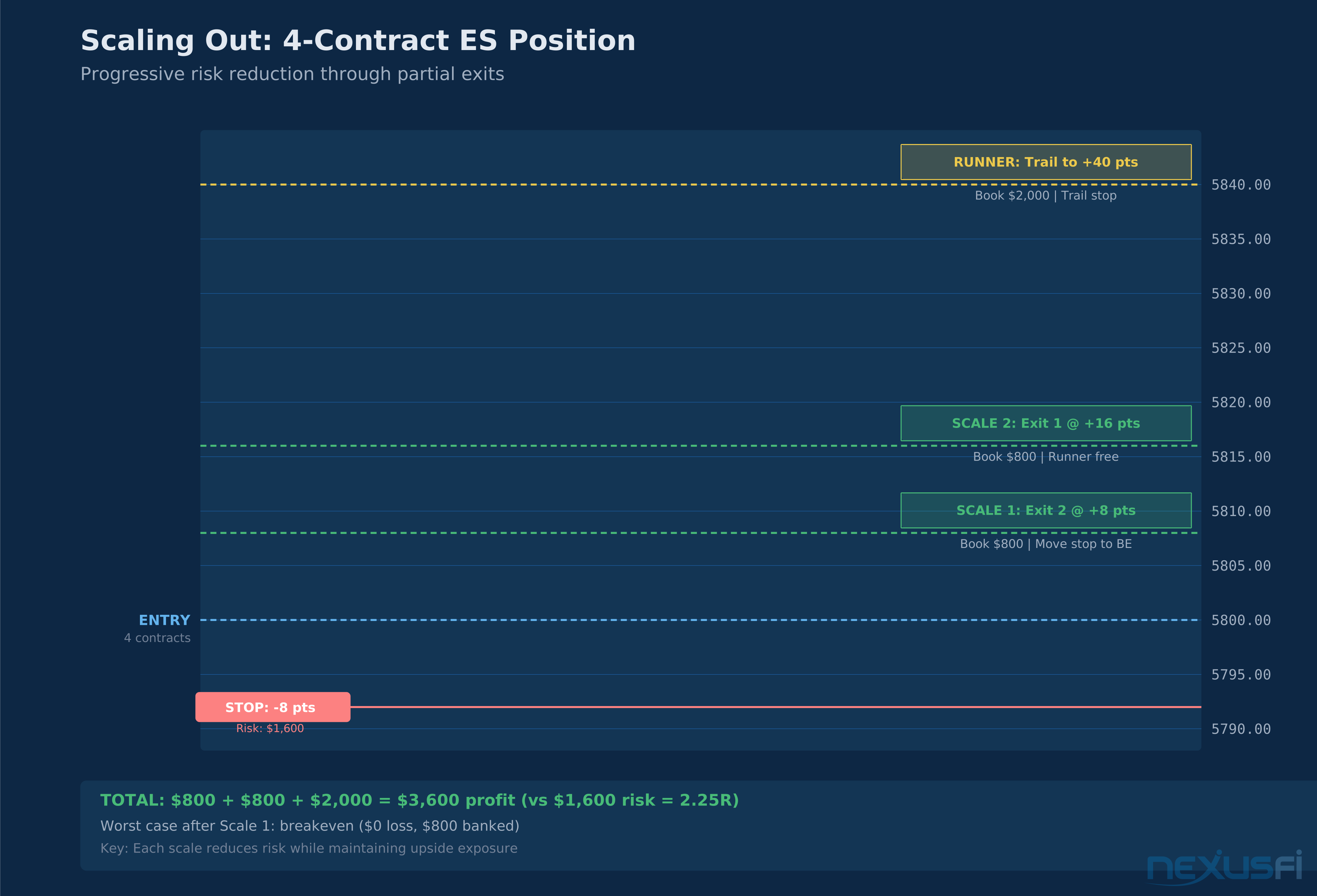
For a 4-contract ES position with an 8-point stop (32 points total risk):
Scale 1 (50% at 1R): Take 2 contracts off at +8 points. This books $800 and recovers half your risk. Move your stop on the remaining 2 contracts to breakeven or breakeven+1.
Scale 2 (25% at 2R): Take 1 contract off at +16 points. This books another $800. You've now collected $1,600 in closed profit with 1 contract still running, and your stop is at worst breakeven. The trade literally can't lose money.
Runner (25% trailing): Let the final contract ride with a trailing stop. This is where the outsized wins come from
As @RM99 demonstrates through detailed analysis, "By trading 2 contracts instead of 1, you MAY actually reduce the netprofit/contract by scaling out. However, the reduction in drawdown, many times, can easily overcome the reduced netprofit/contract by the benefits of compounding." [3] The real value of scaling isn't per-trade optimization
When Scaling Out Hurts
Scaling out is wrong in exactly one scenario: strong trend days where you know the direction with high conviction and should be adding, not reducing. If ES opens with a gap-and-go and internals are screaming trend, taking 50% off at +8 points is giving away the best trading day of the month. The problem is that you rarely know it's a trend day until you're already in it. This is where regime awareness (covered below) becomes critical.
Stop Management: The Centerpiece of Trade Management #
Your stop loss is the single most important order in your trade. Get it right and bad entries survive. Get it wrong and good entries die. There are three stop management techniques every futures trader needs to understand
Trailing Stops
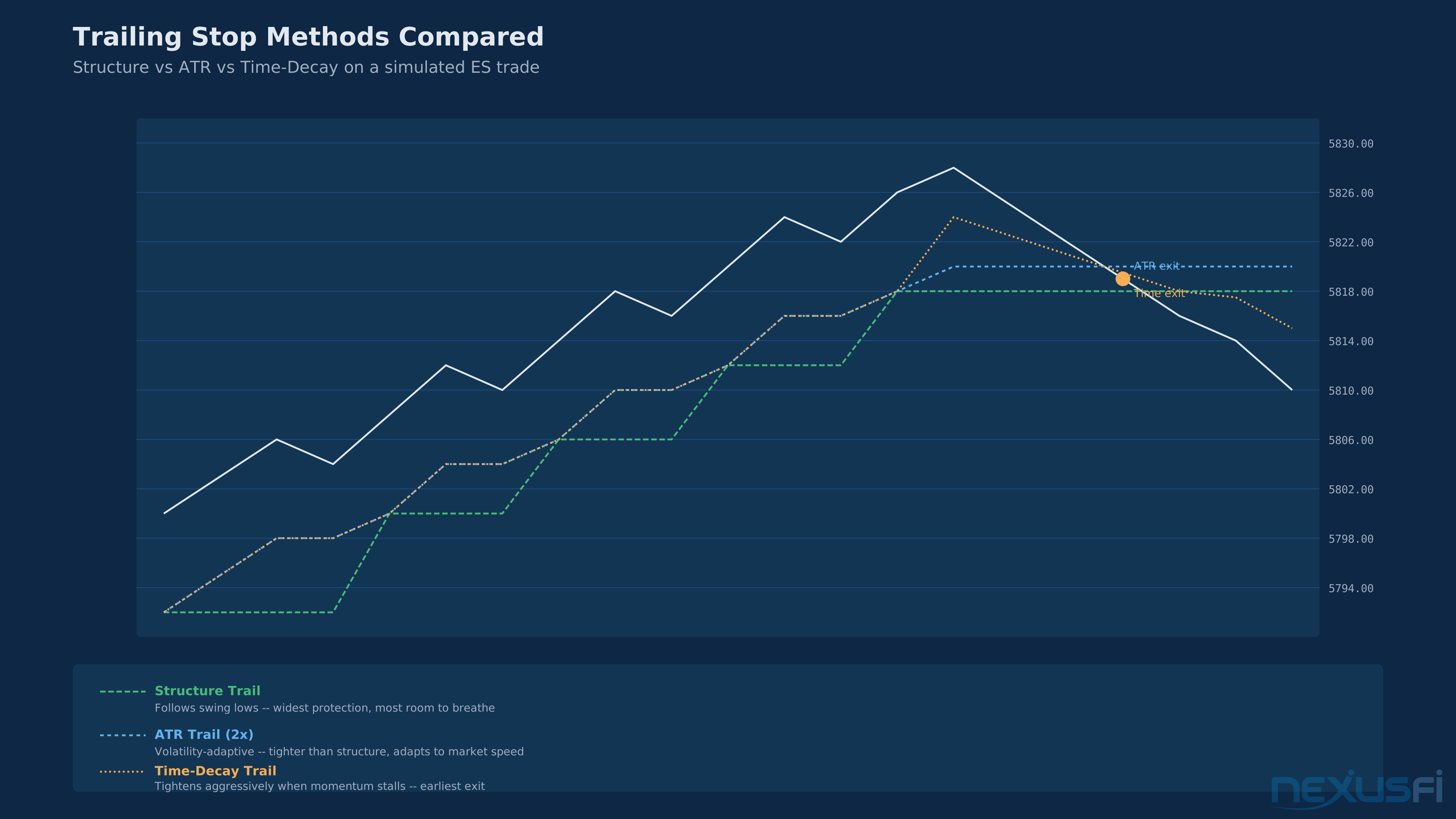
A trailing stop moves in your favor as price advances, but never moves backward. The question is what to trail against.
Structure-based trailing: Move your stop to below the most recent swing low (longs) or above the most recent swing high (shorts). This respects market structure
Volatility-based trailing (ATR): Trail your stop at a fixed multiple of the Average True Range below the highest price reached. A 2x ATR trail on a 5-minute ES chart with a 3-point ATR keeps your stop 6 points below the high water mark. This adapts automatically to volatility
Time-decay trailing: If a trade reaches a profit threshold but then stalls
One important caution from the NexusFi community: "A mechanical limit order target fill will provide much better results than a trailing stop" in many cases, especially for mean-reversion and range-bound setups. [5] Don't default to trailing stops for every trade type
Moving to Breakeven
Moving your stop to your entry price after the trade moves in your favor is the most psychologically satisfying
As
@DarkPoolTrading goes further: "Moving a stop to breakeven just because you're up X ticks makes no sense because the market neither knows nor cares where you entered." He found through months of forward testing that "a price action stop produced almost 10 times the profit compared to a breakeven stop" on the same trades with the same targets. [7]
So when does breakeven actually make sense?
After a partial exit. If you've already scaled out at +8 points on 2 of 4 contracts, moving your stop to breakeven on the remainder isn't arbitrary
When structure confirms. If you enter long at 5800 and price rallies to 5812, then pulls back and puts in a higher low at 5802
When your time window closes. If you took a trade expecting resolution within 30 minutes and 25 minutes have passed with the trade up 4 points but going nowhere, moving to breakeven before your time exit triggers is reasonable risk management.
Stop Tightening vs. Stop Widening
Most traders only tighten stops. But there are situations where widening your stop is the correct management decision
Adding to Winners: Where the Big Money Lives #
Adding to winning positions
@tigertrader, a former CME floor trader with decades of experience, describes the transformation: "I was a very risk-averse mechanical scalper on the floor for 25 years, cranking out a relatively low 6-figure income every year. I used to be proud of the fact that I rarely had a losing day. It wasn't until I changed my risk reward parameters and began to press and add to my winners. What happened was the frequency of my winners went down, but the size of my winners grew by a lot, and so did my year ends." [8]
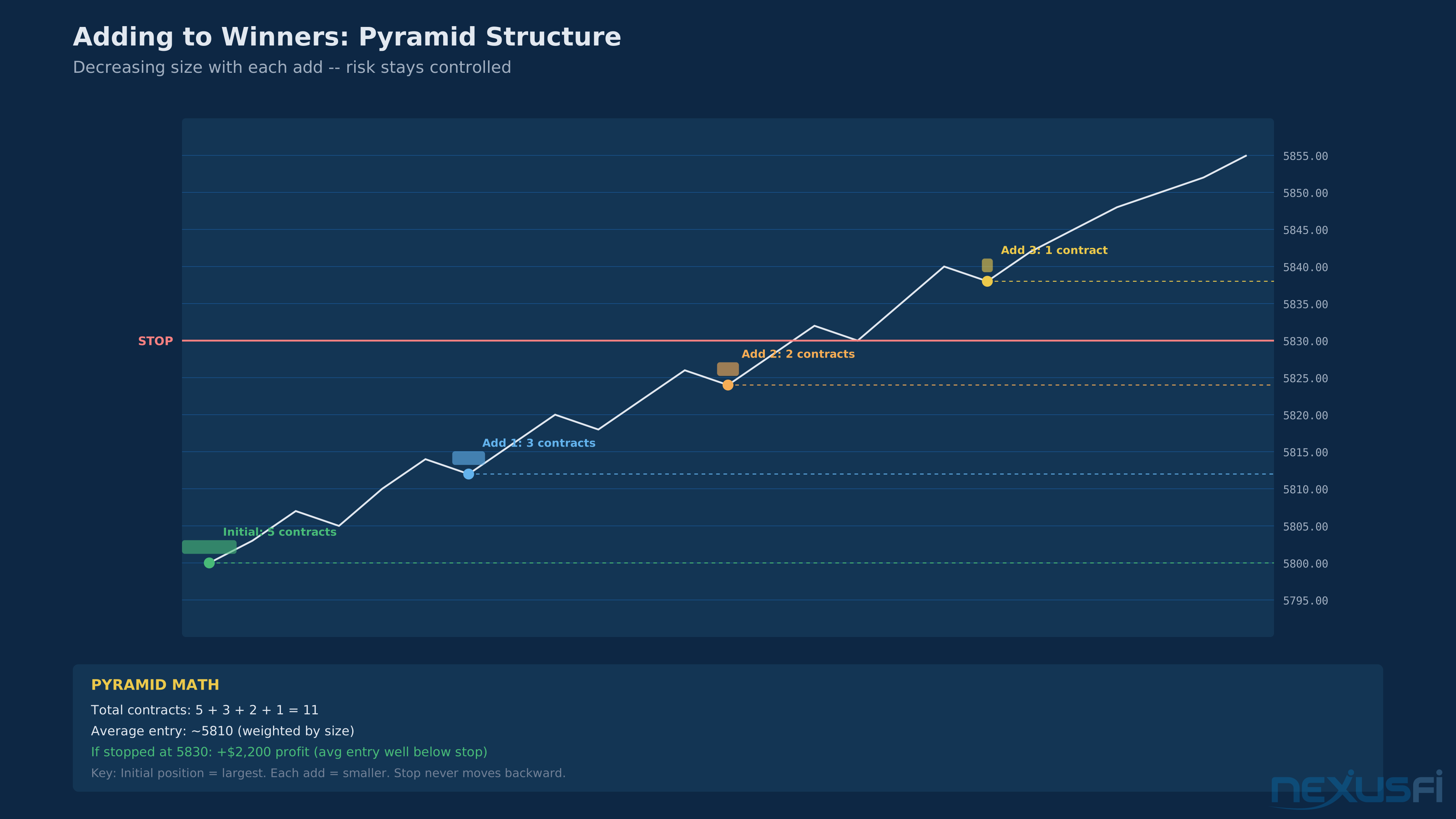
He demonstrates the power of this approach with a live ES trade: starting with 5 contracts at 3751, adding 3 on the initial rally at 3771, 2 more on a pullback at 3769-3771, and continuing to add
The philosophy behind it: "You want to have on as little as possible, and exit the trade as soon as possible, once the market provides you with the feedback that you are wrong. And conversely, you want to stay in the market as long as the feedback you are receiving proves you correct, and you want to have on as much size as possible." [10]
Rules for Adding
1. Only add at levels where you'd initiate a new trade if flat. Don't add just because you're winning. Add because the market is giving you a new entry signal at a higher (or lower) level that confirms your thesis. If you wouldn't take the trade from scratch at this level, don't add to an existing position.
2. Decrease size with each add. Your initial position should be your largest. Each subsequent add should be smaller: 5-3-2-1 is a classic pyramid structure. This keeps your average entry price close to your initial entry and prevents a late add from destroying the whole position if it reverses.
3. Never let an add increase your maximum dollar risk. Before adding, recalculate: if stopped out on the entire position (including the new contracts), would the loss exceed your maximum per-trade risk? If yes, don't add
4. Only add on trend days. Pyramiding in a range-bound session is a recipe for disaster. You'll build a large position right before a mean-reversion move wipes it out. The skill is recognizing trend conditions early enough to add, which brings us to regime awareness.
When Adding Goes Wrong
The most common failure: adding to a position that's winning but about to reverse. You entered at the right time, the trade moved in your favor, you added, added again
Time-Based Exits: When the Clock Is Your Stop #
Price-based exits get all the attention, but time-based exits are equally important in futures
Hard Time Stops
Set a maximum holding period for each trade type. For an ES scalp, that might be 15-20 minutes. For an ES day trade, it might be "close by 3:45 PM ET" to avoid the MOC volatility. For CL, closing before the 2:30 PM ET settlement avoids the settlement auction noise.
The logic: if a trade hasn't worked within its expected timeframe, your edge has likely decayed. A momentum scalp that's flat after 20 minutes isn't waiting for confirmation
Progress-Based Time Stops
More sophisticated than a hard clock: exit if the trade hasn't made progress relative to what you'd expect. If you enter an ES breakout trade and after 10 bars the trade has moved only 2 points when breakouts of this type typically move 6-8 points in the first 10 bars, the setup has failed even though your hard stop hasn't been hit. Exit at market and save yourself the full stop loss.
Session Transition Exits
Futures trade nearly 24 hours, but liquidity and volatility aren't uniform. The RTH-to-ETH transition (4:00 PM ET for ES/NQ) often sees a significant drop in volume. If you're holding a day trade position into the close, you need a clear plan: are you closing at 3:55 PM, holding into Globex, or using a wider stop for the overnight session? Each choice has implications. Overnight gaps in ES average 5-10 points and can exceed 30+ points around major events. For most day traders, the answer is simple: close before the session transition unless your thesis specifically requires overnight exposure.
Regime-Aware Management: The Same Plan Doesn't Work Every Day #
Here's where most trade management frameworks fail: they treat every market day the same. But the ES that grinds in a 10-point range on a summer Monday behaves nothing like the ES that trends 60 points on an FOMC day. Your management must adapt.
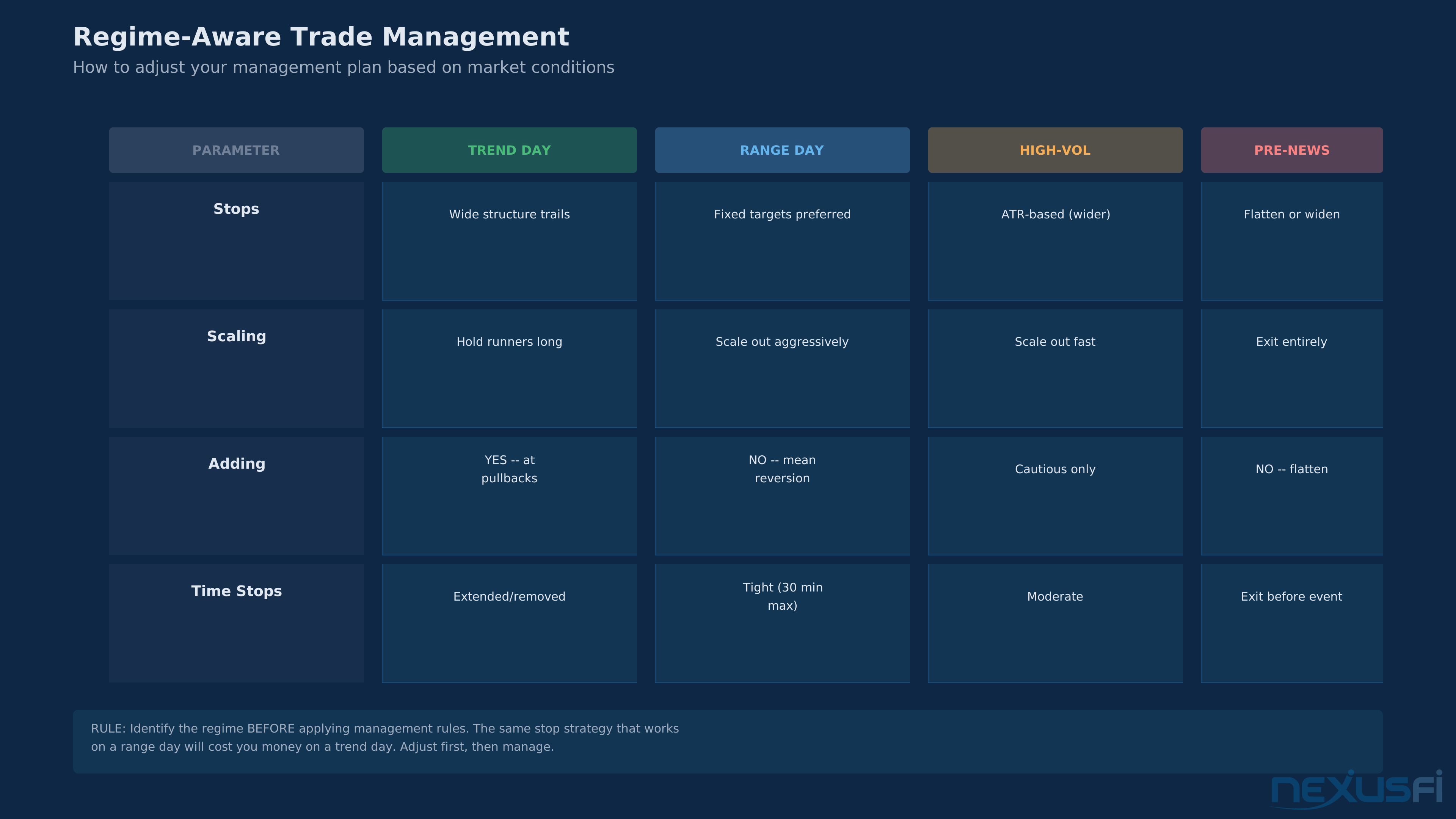
Trend Days
Characteristics: strong directional move, internals confirming (TICK consistently above/below zero), limited mean reversion, expanding range. These happen roughly 15-20% of trading days but account for 80%+ of monthly P&L for many traders.
Management adjustments:
- Widen trailing stops
- Add to winners at pullbacks (this is the regime for pyramiding)
- Don't scale out early
- Extend time stops or remove them entirely
- Breakeven moves should be delayed
As @tigertrader notes, "Part of being a good trader is recognizing what kind of day it is. Range days and trend days are traded differently, and days like today are special days which must be taken advantage of." [8]
Range/Rotation Days
Characteristics: price oscillates within defined boundaries, mean reversion works, breakout attempts fail and reverse, TICK oscillates around zero. About 60-70% of trading days.
Management adjustments:
- Use fixed targets rather than trailing stops
- Scale out aggressively at the first target
- Don't add to winners
- Tighten time stops
- Breakeven moves are more appropriate here since extensions are limited
High-Volatility Days
Characteristics: wide ranges, fast moves in both directions, expanded ATR, often news-driven. Management must account for the increased noise.
Management adjustments:
- Widen initial stops (and reduce position size proportionally)
- Scale out faster
- Use volatility-based trailing stops (ATR multiples) rather than fixed ticks
- Consider time stops more aggressively
Pre-News/Event Windows
Major economic releases (FOMC, NFP, CPI) create a specific management challenge: liquidity evaporates before the release and explodes after it. If you're holding a position into a scheduled release, you have three options: exit beforehand and re-enter after, hedge with an opposing position or options, or widen your stop to accommodate the expected volatility. For most traders, the first option is correct. Playing FOMC isn't trade management
Execution Mechanics: Getting Your Orders Right #
Trade management decisions are only as good as the orders that execute them. In futures, order type selection matters because markets can move fast
Stop-market orders guarantee execution but not price. On ES, slippage on a stop-market is usually 0-1 tick in normal conditions but can be 2-5+ ticks during fast markets. For stop losses, stop-market is almost always the correct choice
Stop-limit orders guarantee price but not execution. If ES gaps through your stop-limit level, your order sits unfilled while the market moves against you. Use stop-limits for profit targets and scaling entries, not protective stops.
Bracket orders (OCO) link your stop and target together
Partial fill management matters when scaling. If you're trying to take 2 of 4 contracts off at a limit price and only 1 fills before the market reverses, you now have an unplanned position size. Your platform's order management should handle this
Risk Controls During the Trade #
Individual trade management operates within a broader risk framework. These controls are the guardrails that prevent a single bad management decision from damaging your account.
Maximum Adverse Excursion (MAE) monitoring. If you've analyzed your historical trades (see MAE), you know the typical drawdown profile of your winners vs. losers. When a live trade exceeds the adverse excursion that 90% of your historical winners stayed within, the probability of recovery drops sharply. That's not a guarantee of failure, but it's information worth acting on
Daily loss limits. Define a maximum daily loss before you sit down. When you hit it, you stop trading. Period. This isn't trade management per se
Maximum position size. Define the absolute maximum number of contracts you'll hold at any point, including all adds. If your max is 6 ES contracts, that's the ceiling
Correlated exposure. If you're long ES and long NQ simultaneously, you don't have two separate positions
Practical Application: Putting It Together #
Trade management isn't a checklist
Pre-Trade (Before Entry)
Before clicking buy or sell:
- What regime am I in? (trend/range/high-vol/pre-event)
- Where is my stop? (structural level, not arbitrary ticks)
- What is my target framework? (fixed R, structural, trailing)
- How many contracts am I entering? (leave room for adds if trending)
- Where do I scale out? (if applicable)
- What is my time stop? (maximum holding period)
Trade Active: The Management Loop
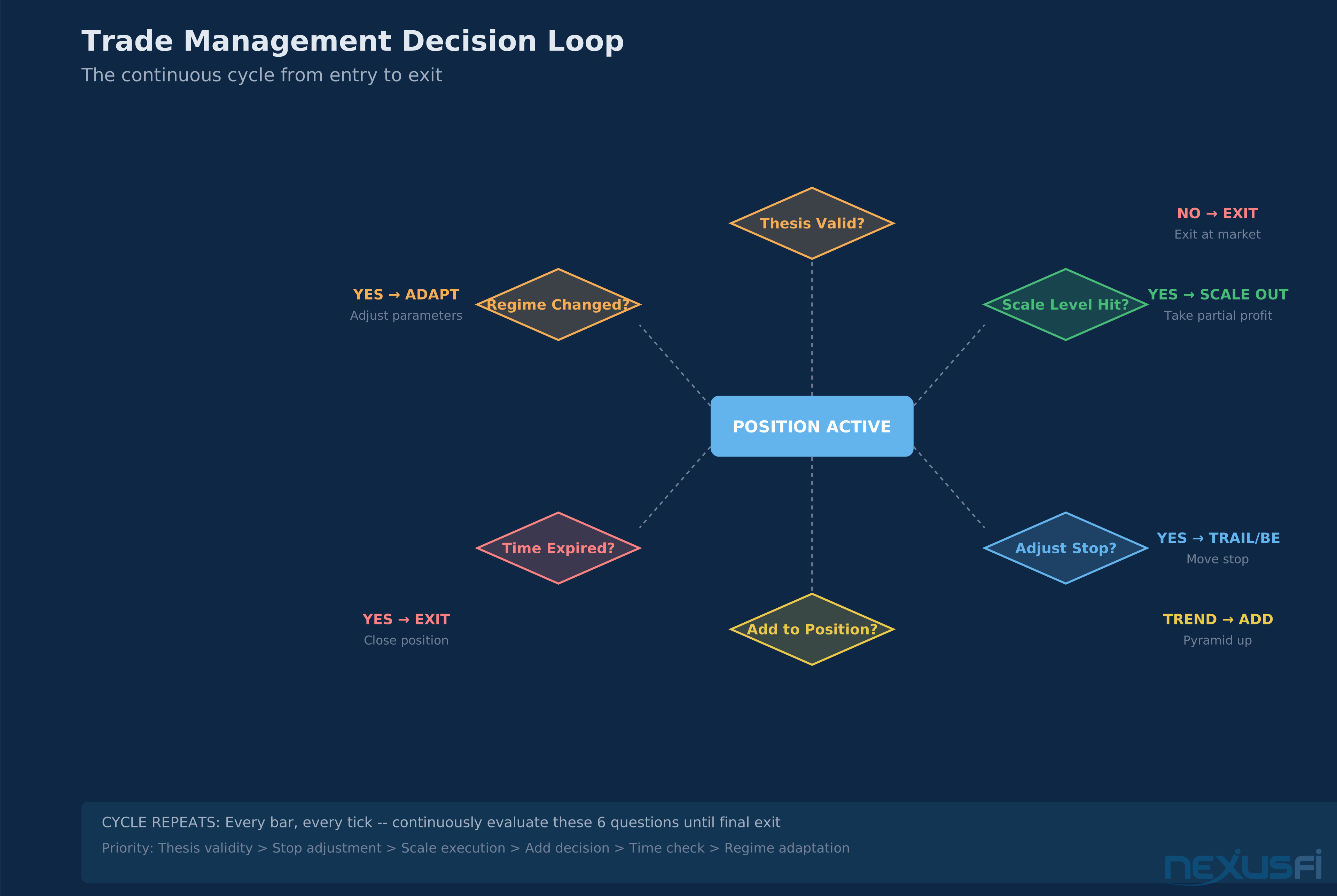
Once filled, you're cycling through these questions continuously:
Is my thesis still valid? If the reason you entered no longer applies
Has the trade reached a scaling level? If your first target is hit, execute the partial exit. Don't negotiate with yourself. Don't think "maybe it'll go higher." Take the scale. The plan exists for this moment.
Should I adjust my stop? Only if one of three conditions is met: (1) price has formed new structure that makes your original stop too loose, (2) you've taken a partial exit that changes your risk profile, or (3) the regime has shifted in a way that requires wider/tighter protection.
Should I add? Only on trend days, only at levels you'd enter fresh, only in decreasing size, and only if the add doesn't exceed your maximum position or maximum dollar risk.
Is my time window expiring? Check the clock against your time stop. Check your progress metrics
A Failed Trade Example
You enter long ES at 5810 with a stop at 5802 (8 points, $400 per contract). You have 4 contracts, total risk $1,600. The trade moves to 5815 and you feel great. Then it stalls. For 15 minutes, price chops between 5812 and 5816. You're up $200-$600 per contract but going nowhere.
A less disciplined trader holds. "It's still in profit." But your progress metric says the trade should be at +12 by now based on the setup type. It's only at +2 to +6. Meanwhile, the A/D line is diverging. TICK is weakening.
The management decision: scale out 2 contracts at 5815 (booking $1,000), move the stop on the remaining 2 to 5810 (breakeven), and set a 10-minute time stop. If nothing happens, exit the remaining contracts at market.
Price drops to 5808. Your breakeven stop executes on the 2 remaining contracts. Final result: +$1,000 on the first 2 contracts, $0 on the remaining 2. Total: +$1,000 instead of -$1,600. That's trade management.
Knowledge Map
Prerequisites
Understand these firstGo Deeper
Build on this knowledgeReferences This Article
Articles that build on this topicCitations
- — AMA: FuturesTrader71 (FT71) / Morad Askar - Ask Me Anything (2015) 👍 8“If every once in a while you are able to allow a runner to go... your expectancy looks like 3.5 ticks or a 40% improvement.”
- — Webinar: FuturesTrader71 (FT71) on Risk, Sizing, Scaling and Trade Management (2012) 👍 1“I prefer all-in/scale-out for most of my trades.”
- — Scaling in and scaling out...when the total is NOT the sum of its parts (2011) 👍 18“The reduction in drawdown can easily overcome the reduced netprofit/contract by the benefits of compounding.”
- — The Beast Slayer, Lance's NQ Trading Journal (2021) 👍 7“I have used various forms of trailing stops over the years with mixed results.”
- — Spoo-nalysis ES e-mini futures S&P 500 (2020) 👍 5“A mechanical limit order target fill will provide much better results than a trailing stop.”
- — Current Thoughts on the old Break Even Move (2013) 👍 7“I have not yet seen a backtest where the breakeven stop did do any good.”
- — Current Thoughts on the old Break Even Move (2013) 👍 7“Moving a stop to breakeven just because you're up X ticks makes no sense.”
- — NYSE $TICK AND $ADD (2011) 👍 14“The frequency of my winners went down, but the size of my winners grew by a lot, and so did my year ends.”
- — Spoo-nalysis ES e-mini futures S&P 500 (2022) 👍 17“+5 figure trade with 1 lots; and money was left on the table.”
- — Spoo-nalysis ES e-mini futures S&P 500 (2020) 👍 29“You want to have on as little as possible when wrong, and as much size as possible when right.”