



Trade Management for Futures Traders: Stop Placement, Sizing, and the Art of Managing Open Positions
Overview #
Trade Management for Futures Traders: Stop Placement, Sizing, and the Art of Managing Open Positions
The entry gets all the credit. Traders obsess over setups, signals, confirmations, and entries. They share entry methods, argue about them, refine them. But the research — and the experience of thousands of traders in NexusFi's 17-year practitioner community — points somewhere else entirely.
As veteran NexusFi member @choke35 observed in the legendary Spoo-nalysis thread after years of trading the ES:
That's the uncomfortable truth. A mediocre entry with excellent management beats a perfect entry with poor management, almost every time. Trade management is where edge compounds or evaporates. It's where discipline translates to dollars, or where emotional reactions turn winners into breakeven trades and breakeven trades into losses.
This guide covers the complete trade management framework for ES, NQ, and CL futures: stop placement, position sizing, partial profits, trailing stops, the breakeven trap, scaling mechanics, and the psychology of an open position.
The Foundation: Build Around Invalidation, Not Price #
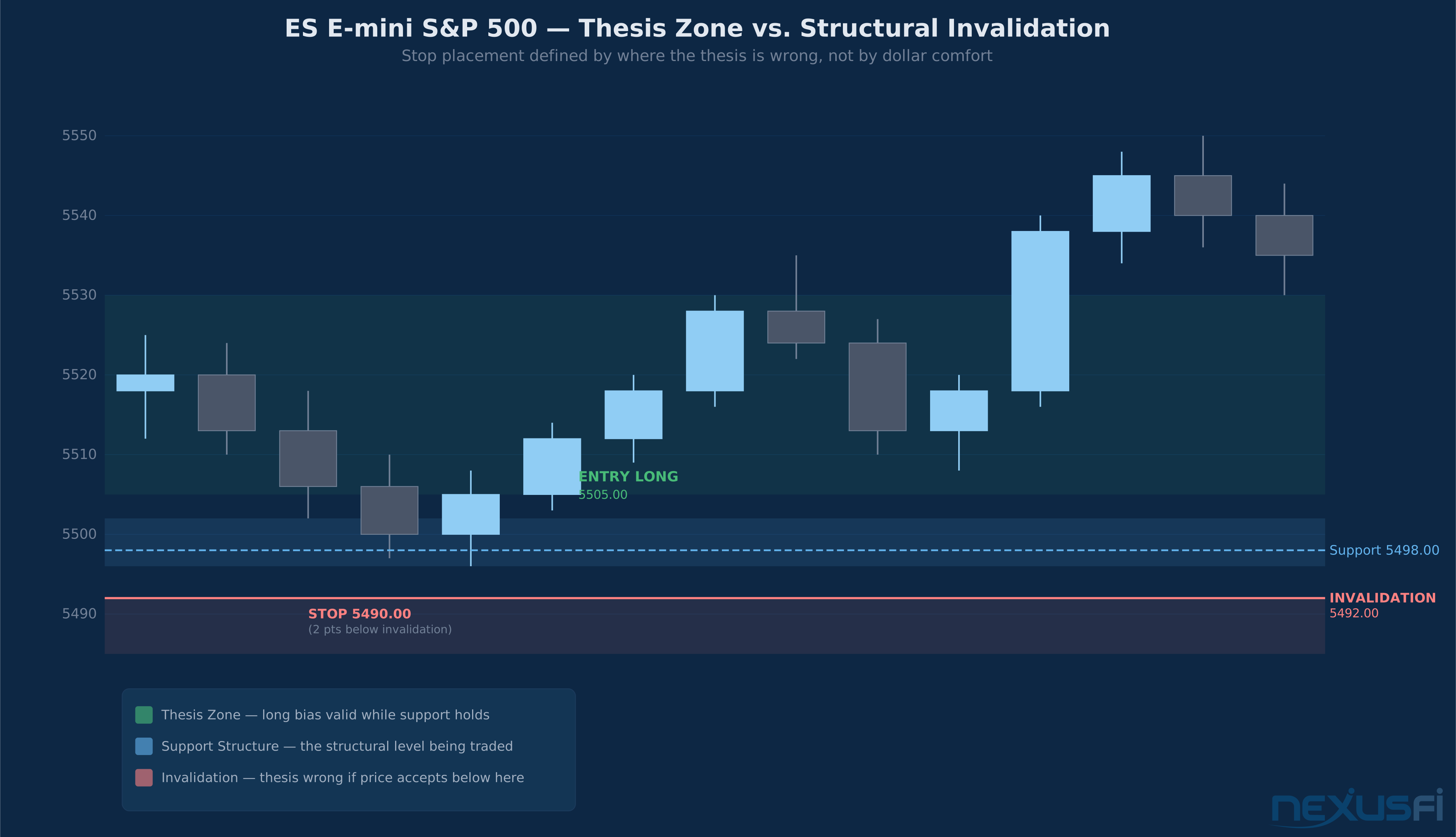
Before any discussion of stops, targets, or trailing methods, there's one question every trade plan must answer: Where is my thesis wrong?
This is the invalidation point — the price or condition at which your reason for being in the trade no longer exists. A long thesis based on support holding becomes invalid when price closes decisively below that support. A short thesis based on resistance rejecting price is wrong when price breaks above and accepts above that level.
The stop is not a pain threshold. It's not a dollar amount that "feels right." It's not arbitrary. As @Big Mike explained in the Spoo-nalysis thread, responding to a question about stop placement: "A stop is where you are wrong about a trade. It has nothing to do with your profit or your comfort level."
This framing changes everything. Once you define invalidation first, the rest of trade management becomes a mechanical exercise: how wide is the stop to protect against normal volatility while still honoring the thesis? How many contracts can that risk accommodate? How will you manage the trade if price moves in your favor?
Initial Stop Placement: The Three Methods #
Effective initial stop placement balances three competing needs: placing the stop beyond noise, honoring the thesis invalidation, and keeping dollar risk manageable. Three methods work in futures — and the most strong approach combines all three.
Method 1: Structure-Based Stops #
Structure-based stops place the stop beyond a logical market structure level:
- Swing high or swing low from the relevant timeframe
- Prior day high or prior day low
- Opening range extreme
- Consolidation boundary
- Breakout or retest level
This method works because it ties the stop to market meaning. When price breaks below the relevant swing low (for a long), the auction has voted against your position. The stop isn't arbitrary — it reflects a real change in market context.
ES: Most traders add 4-8 ticks of buffer beyond obvious structure levels in ES, because these levels are widely watched and frequently tested before price continues. Tight structure stops at obvious levels are vulnerable to stop hunts.
NQ: Wider buffer required — 8-15 ticks — due to higher beta and faster price movement. NQ tends to overshoot levels more aggressively than ES before confirming direction.
CL: Structure levels in crude oil can be noisy around scheduled events (EIA inventory reports, OPEC announcements, macroeconomic data). The buffer needs to respect the instrument's news sensitivity.
The limitation of pure structure stops: in fast or volatile markets, structure can be too tight. A 10-tick structure stop that made sense in a 12-point ATR day is dangerously thin on a 25-point ATR day.
Method 2: ATR-Based Stops #
ATR (Average True Range) measures recent volatility and provides a dynamic stop distance that adapts to current market conditions.
Standard ATR multipliers: ES uses 1.5-2.5x ATR(14) intraday, NQ requires 2.0-3.0x due to higher beta, CL uses 1.5-2.0x with tightening before EIA/API inventory reports. See the ATR indicator guide for complete product-specific tables.
ATR-based stops prevent the mistake of using the same absolute stop width in different volatility environments.
The limitation: ATR is backward-looking — it reflects past volatility, not future. Transitioning markets can overwhelm ATR-calibrated stops.
Method 3: The Hybrid Approach #
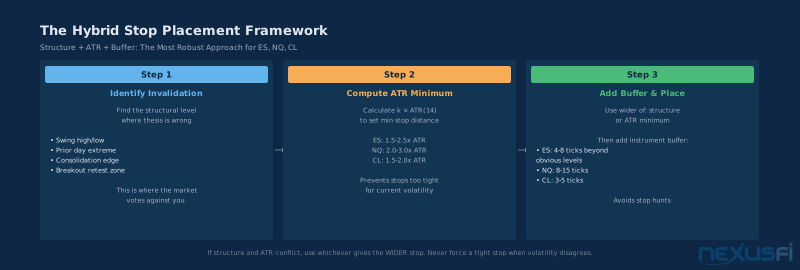
The most strong stop placement combines structure and ATR:
- Identify the structural invalidation point (where the thesis is wrong)
- Compute the ATR-based minimum distance
- Use whichever is wider — structure or ATR minimum
- Add instrument-appropriate buffer for stop-hunting
This hybrid ensures stops are always at least ATR-calibrated (not too tight for current volatility) while also respecting the technical context that defines your trade.
Regime adaptation: In elevated-volatility environments, the hybrid method may produce stops that are too wide for your account risk tolerance. In that case, reduce position size or skip the trade.
Position Sizing: The Real Risk Control #
The stop defines how much you lose per contract. Position sizing determines whether that loss is survivable or catastrophic. Most trading books discuss entries and stops extensively while treating sizing as an afterthought. This is backwards. As Dr. Van Tharp detailed in Trade Your Way to Financial Freedom (1998), position sizing — specifically the percent risk model — is the primary mechanism that determines whether a trading system produces long-term survival or eventual ruin.
The Core Formula #
**Contracts = Dollar Risk Per Trade
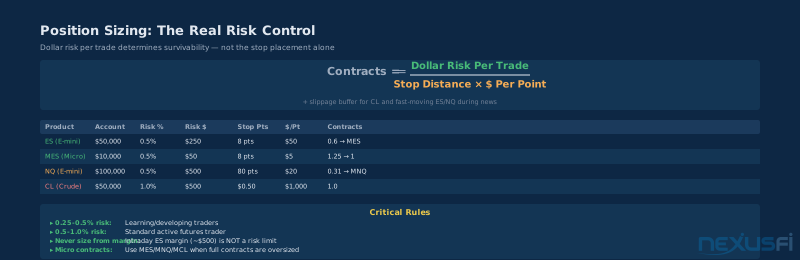
Worked example for ES:
- Account size: $50,000
- Risk per trade: 0.5% = $250
- Stop distance: 8 points = $400 per contract (ES = $50/point)
- Contracts: $250 ÷ $400 = 0.625 → trade micro ES or skip
The same setup in micro ES (MES, $5/point):
- $250 ÷ $40 = 6.25 → 6 MES contracts
This math reveals an important truth: many setups with legitimate technical merit are simply too large for a given account size. The right response is to scale down to micro contracts or skip the trade — not to force a tighter stop that doesn't match the market structure.
Risk Parameters by Trading Approach #
The standard risk-per-trade percentages used by experienced futures traders:
- Conservative (learning phase): 0.25-0.5% per trade
- Standard active trader: 0.5-1.0% per trade
- Experienced professional: 1.0-2.0% (maximum, not target)
Higher risk percentages require proportionally lower variance in the edge — a strategy must be well-proven before tolerating 2% risk per trade without blowup risk.
Product-Specific Notes #
ES: Tick size is $12.50; deep market means stops typically execute near stated prices. NQ: $5/point with high point volatility — a 150-point NQ stop is $750/contract, so never size NQ like ES. Always compute dollar risk explicitly. CL: $1,000/point multiplier; prone to shock moves around news events. Include a $0.15-0.30 slippage buffer in fast markets.
Never size based on margin availability. Intraday margin for ES ($500-1,500 depending on broker) is a deposit requirement, not a risk limit.
Partial Profits and Multiple Targets #
The "all in, all out" trade management approach has clean math: either the full position reaches the target or the full position stops out. The expectancy calculation is simple.
But @PandaWarrior put his finger on the tradeoff in his Trading Journal: "I know scaling out makes sense emotionally but from a math standpoint, it's inferior. Scaling out requires large runners to make up for the positions you take off early."
He's not wrong about the math. Scaling out reduces the upside on winners. But it also has real advantages that the pure expectancy view misses:
Psychological pressure reduction: Once the first target is hit and partial profits are locked, emotional urgency drops. The trade can breathe. Many traders make better management decisions with a partial profit off than with a full position open.
Risk reduction: After the first partial, the remaining position has lower dollar exposure. If the stop doesn't move, the net loss on the trade is now smaller.
Session viability: Taking partial profits allows a trader to have a profitable session even when runners fail to develop — which is common in range-bound markets.
The key is that partials must be planned before entry, not executed reactively when price reaches a round number and the trader gets nervous.
The Three-Tier Target Structure #
For traders using three or more contracts, a tiered exit structure provides the optimal balance between locking profits and allowing winners to develop:
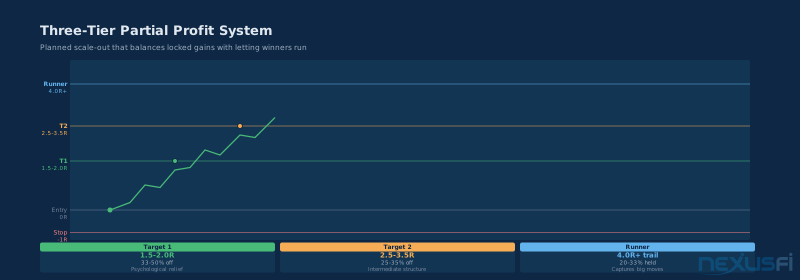
Target 1 (33-50% of position) — 1.5 to 2.0R This is the near-term structure objective — the first logical resistance (for longs) or support (for shorts) based on the chart. Taking 33-50% off at this level locks in a partial gain and reduces psychological pressure for the remainder of the trade. ES examples: 75-100 points above a breakout entry; NQ: 200-300 points; CL: $1.50-2.00.
Target 2 (25-35% of position) — 2.5 to 3.5R The intermediate objective, usually at a larger structure level or measured move from the entry. This target requires the trade to develop further — it rewards patience when the initial thesis was correct. ES: 125-175 points; NQ: 350-500 points; CL: $2.50-3.50.
Runner (20-33% of position) — 4.0R+ or trailing stop The final position is managed with a trailing stop aimed at capturing larger trend moves. Runners lose money more often than not — they get stopped out before reaching their potential. But when a true trending move develops, the runner captures the majority of the gain. Over time, the occasional large runner much improves the strategy's overall expectancy.
Practical execution: Place limit orders at Target 1 and Target 2 in the DOM before the trade develops. Pre-placed orders eliminate real-time decisions at maximum emotional intensity — manually placed orders during fast markets get missed or filled at suboptimal prices.
Moving the Stop to Breakeven: The Trap #
Of all trade management techniques, moving the stop to breakeven is the most frequently misused. The appeal is obvious: lock in a "free trade" by guaranteeing you can't lose money.
The problem is timing. @DarkPoolTrading documented the cost of premature breakeven stops in a controlled comparison that he shared in a thread on Psychology and Money Management. Running the same trades with a mechanical breakeven stop versus a price-action-based trailing stop, he found he made "almost 10 times the profit" using the price action approach.
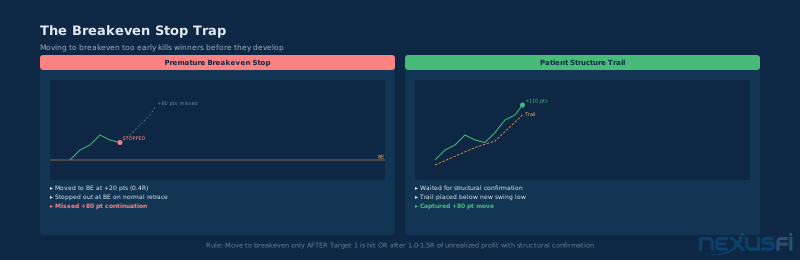
The math explains why. In ES and NQ, prices routinely retrace 20-50% of a move before continuing. A trade that moves 75 points in your favor before pulling back 40 points has done nothing wrong from a technical standpoint — it's a normal retracement. But if you moved your stop to breakeven at +75 points, you've been stopped out of a trade that hadn't been invalidated.
When Breakeven Works vs. When It Hurts #
Move to breakeven after Target 1 is hit (thesis validated), after 1.0-1.5R of unrealized profit, or when a structural shift confirms. Avoid moving it too early (ES: 15-20 point retracements in a 50-point ATR session are noise), when driven by fear of giving back gains, or when applied automatically without regard for structure.
Better Alternative: The Buffer Stop #
Add a buffer beyond exact breakeven — ES: entry +8-12 ticks, NQ: entry +15-20 ticks, CL: entry +5-8 ticks. This protects against turning winners into full losses while giving the trade room to operate. An alternative is the reduced-risk stop: move to entry -0.5R instead of exact breakeven, cutting potential loss in half without eliminating the wiggle room a developing trade needs.
Trailing Stops: How and When to Trail #
Trailing stops do two things simultaneously: protect accumulated profit and allow winners to continue developing. The challenge is that doing both at once is naturally in tension — the tighter the trail, the more profit is protected but the less room the trade has to continue.
The Most Important Rule #
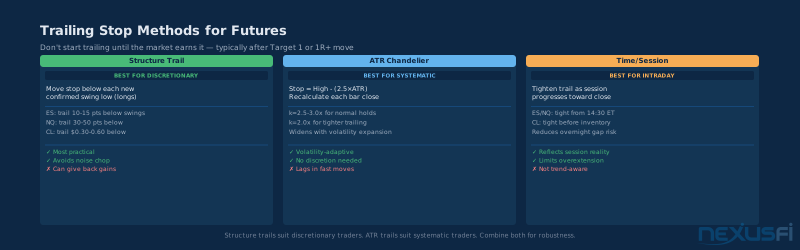
Don't start trailing until the market has earned it.
In ES and NQ, beginning a trail immediately after entry or after a 10-point move almost always results in the stop being hit before the real move develops. The normal structure of a developing trend includes pullbacks, consolidations, and measured retests. Trailing stops that are too tight during these phases eliminate the runner before the thesis has been fully expressed.
Structure-Based Trailing (Most Practical) #
For discretionary futures traders, structure-based trailing is the most effective method:
- For longs: Move the stop below each new higher swing low as they form
- For shorts: Move the stop above each new lower swing high as they form
The key: only ratchet the stop when a new confirmed swing forms — not on every bar. ES typically forms meaningful swing lows every 8-15 points in trending conditions; NQ every 30-50 points; CL every $0.30-$0.60.
Structure trails have a natural disadvantage: they can allow large drawdowns from peak if the trend is extended. But they avoid the most common trailing stop failure — being stopped out during the first pullback of a trend and watching price continue to the original target without you.
ATR-Based Trailing (Chandelier Stop) #
The Chandelier Exit, developed by Charles LeBeau and featured in Alexander Elder's Come Into My Trading Room (2002), trails by a multiple of ATR from the highest high (for longs) or lowest low (for shorts). StockCharts' ChartSchool provides a complete reference for the original calculation:
- Long: Stop = Highest High - (k × ATR)
- Short: Stop = Lowest Low + (k × ATR)
Typical k values: 2.5-3.0x ATR for longer holds; 2.0x for tighter trailing.
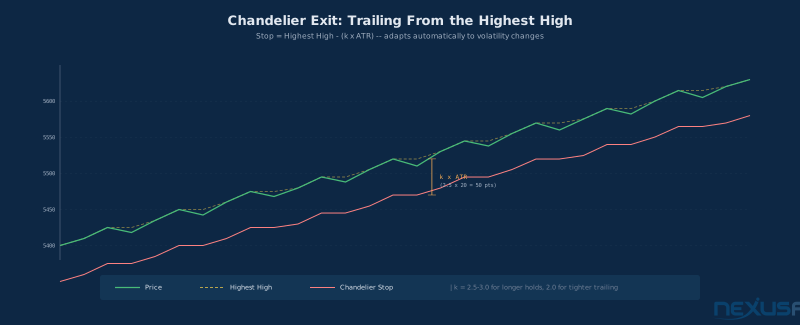
The ATR trail adapts automatically to volatility changes — wider during expansion, narrower during compression — which aligns with the idea that trailing tightness should reflect current market conditions.
Time-Based Trailing #
For intraday traders, tighten trail parameters as the session approaches key closes — 10:00 CT and 15:00 CT are the primary checkpoints for ES/NQ. Less time remaining means less tolerance for giving back unrealized gains to the trail.
Scaling In vs. Adding to Losers #
The rule is simple and almost universally agreed upon by experienced futures traders: add to winners, not to losers.
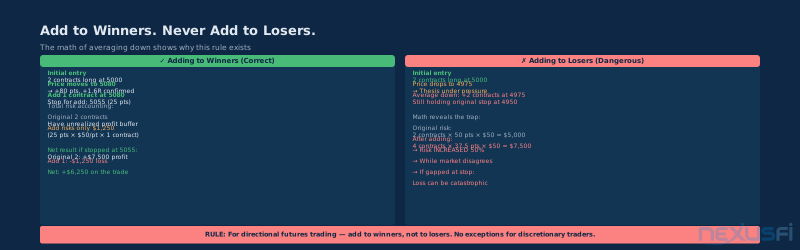
@tigertrader, one of the most respected voices in the NexusFi Spoo-nalysis thread, stated it plainly: "I scale into and out of my trades. I don't add when they go against me as a rule. The old saying holds, 'only losers add to losers.'"
Adding to Winners (Scaling In) #
Scaling into a winning position increases size when the trade has demonstrated its merit. Done correctly, this technique amplifies the return on high-confidence, trending situations without increasing the initial risk:
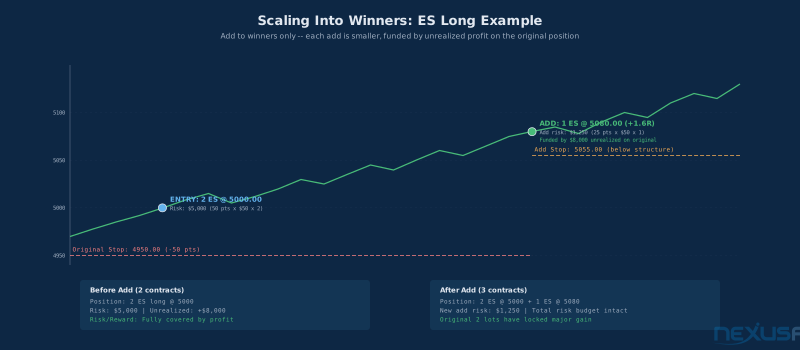
Proper methodology: Initial entry at full risk sizing → wait for 1.5-2.0R unrealized profit → each add is smaller (initial → 50% → 33% → 25% of original size) → new stop at the addition's breakeven point → total combined risk stays within the original risk budget.
Example in ES: Long at 5000, 2 contracts, stop at 4950 (50 points). Price reaches 5080 (+80 points, 1.6R). Add 1 contract at 5080, stop at 5055 (25 points below structure). Now: the original 2 contracts have locked significant profit; the new contract risks $25 points × $50 = $1,250 — but this is funded by unrealized profit on the original position.
Best conditions for adding: Strong trending sessions with clear directional order flow and multiple timeframe alignment.
Adding to Losers (Averaging Down) #
For discretionary directional futures trading, averaging into a losing position is structurally dangerous and should be avoided as a regular practice.
The math makes the problem clear: entering 2 contracts long at ES 5000, stop at 4950 ($5,000 risk), then adding 2 at 4975 creates 4 contracts risking 37.5 points = $7,500 — 50% more risk without the trade improving. And you're adding precisely where the market has demonstrated it disagrees with your thesis. Each bar closing below your original entry is evidence against your position. Adding at that point increases the position when the edge supporting the original thesis is most in question.
The narrow exception: pre-planned, rules-based mean reversion strategies with hard position caps and defined add levels — structurally different from directional trading, and requiring strict hard stops at the maximum planned exposure.
The Psychology of Managing Open Positions #
A well-designed trade management plan is not primarily a technical document — it's a psychological one. Its purpose is to eliminate emotional decision-making at the moment of maximum emotional intensity: while money is at stake, the market is moving, and the primitive brain wants to avoid pain.
Pre-Trade: Make Decisions When You're Calm #
Experienced futures traders write down the complete management plan before placing the entry order:
- Entry price and setup rationale
- Stop price and structural reason
- Target 1, Target 2, and runner plan
- Breakeven trigger (what specific condition, not just a price)
- Trailing method and start condition
- Add criteria (if applicable)
FuturesTrader71 (Morad Askar), in an AMA discussion on NexusFi, explained his scaling approach as highly systematic: "...I scale out. This assumes that you move your stop to entry once the scale happens at 8 ticks and so your loss figures remain the same." The precision here is the point — these decisions were not made while watching the trade; they were built into the system.
Decisions made with a position open are subject to emotional distortion that decisions made beforehand are not. Pre-trade planning shifts the management from reactive to procedural.
The Common Psychological Traps #
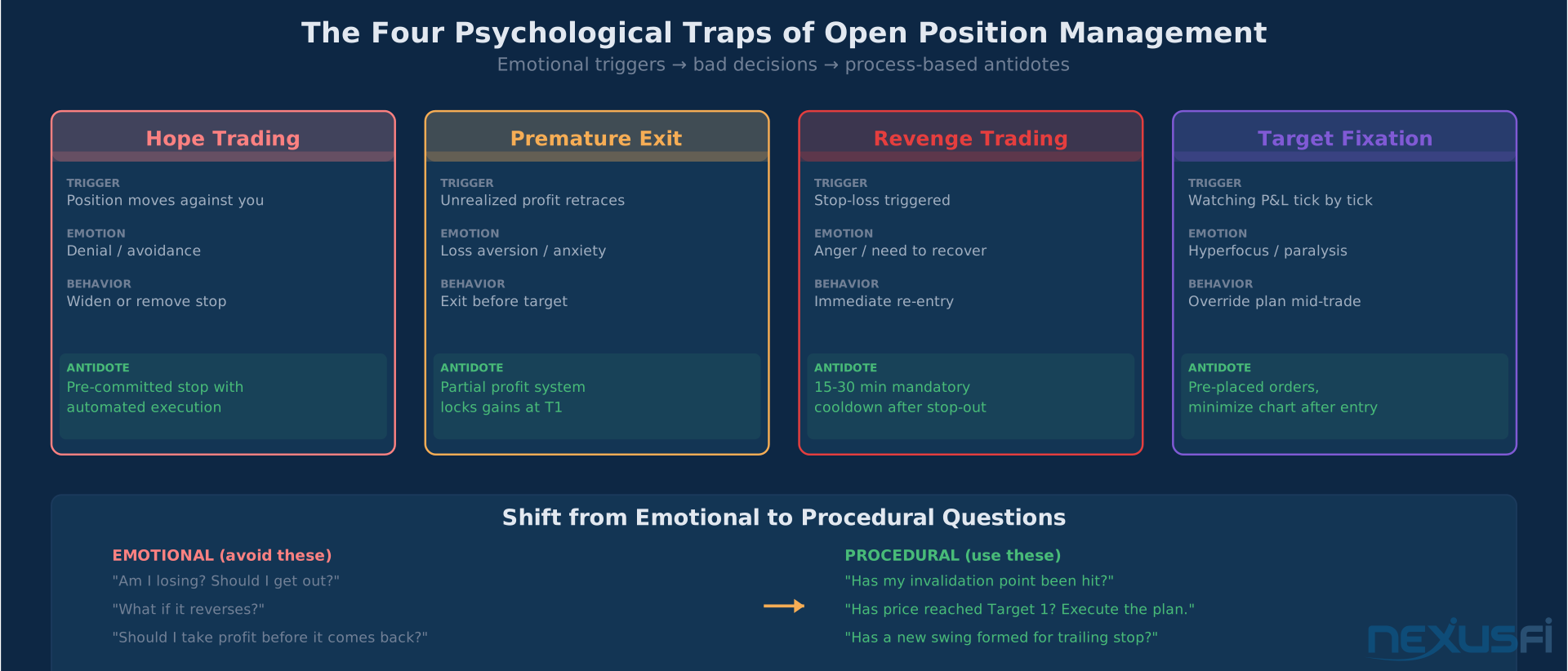
Hope trading: When a position moves against you, the temptation is to widen the stop or simply remove it, hoping price reverses. The technical term for this trade management approach is "hoping." It works until it catastrophically doesn't. Pre-committed stop placement — ideally with automated execution — removes the ability to widen stops in the moment. @bobwest, responding to a discussion on managing losses in the NexusFi Emini forum, put it plainly:
Premature profit-taking: The anxiety of watching unrealized profit "evaporate" during a normal retracement drives early exits. Many traders track the statistics on this and find that their most regretted exits occur before the trade reaches its original target. The cure is a partial profit system: taking one-third off at Target 1 eliminates the urgency to exit completely, because some gains are already locked.
Revenge trading after stop-outs: The impulse to immediately re-enter after a losing trade to "get it back" is one of the most reliable paths to an accelerating loss. Experienced traders impose mandatory waiting periods after stops — 15-30 minutes, or a maximum of 2-3 trades per session in ES and NQ.
Target fixation: Staring at the P&L ticker during a trade produces anxiety that drives bad decisions. Setting pre-placed limit orders and alerts, then minimizing the chart or platform, removes the stimulus that triggers anxiety-based management. CL traders in particular report this as a significant challenge during inventory report releases, when tick-by-tick watching of a volatile move leads to early exits or stop-widening.
Ask Process Questions, Not Outcome Questions #
The shift from emotional to procedural management means changing the question you ask while a trade is open. Emotional questions ("Should I get out? What if it reverses?") are anxiety-loops without resolution. Procedural questions have defined answers: Has my structural invalidation point been hit? Has price reached Target 1? Has a new swing formed that should update the trailing stop? Building the management checklist around process-focused questions is one of the highest-leverage improvements most traders can make.
Session-Specific Awareness #
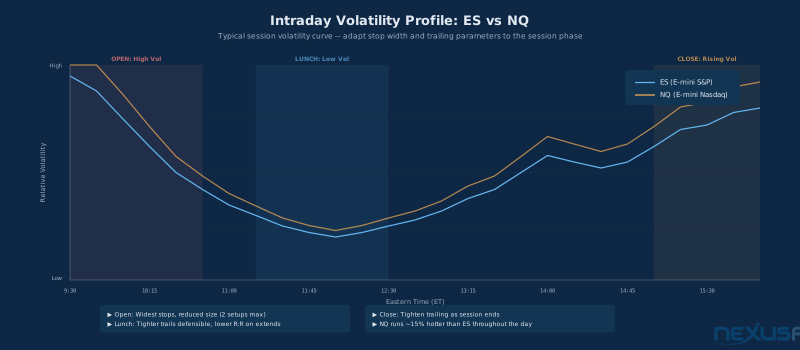
ES/NQ — First 90 minutes (9:30-11:00 ET): Highest volatility of the session, widest spreads at the open, greatest emotional intensity. This is also where overtrading is most common. Experienced traders limit themselves to 2 high-quality setups in this window.
ES/NQ — Lunch session (11:30-13:00 ET): Volume compresses, price action becomes choppy, and "textbook" setups fail more frequently. Many intraday traders reduce size or stop trading entirely in this window. Breakeven stops are more defensible here because the reward-to-risk on extends is generally lower.
CL — Around Scheduled Reports: EIA crude inventory reports (typically Wednesday 10:30 ET), API reports (typically Tuesday 16:30 ET), and OPEC headlines create sudden spike risk that exceeds any reasonable stop distance. The choice before a scheduled report is either to flatten the position or much reduce size and accept that the stop may be gapped.
A Practical Implementation Framework #
The Pre-Trade Checklist #
Before placing any futures trade, complete this inventory:
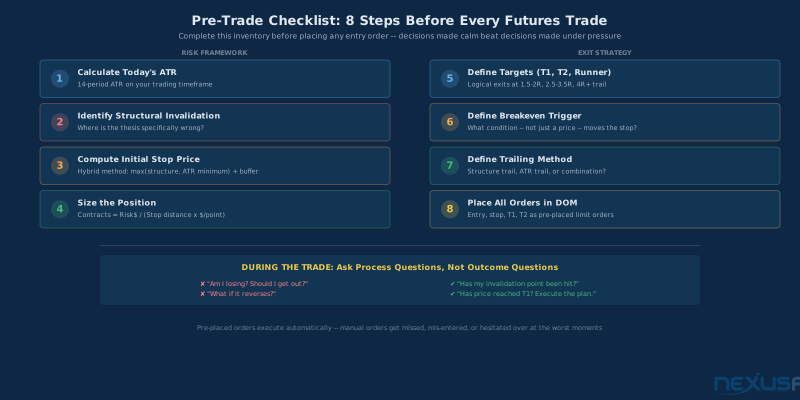
- Calculate today's ATR for the product you're trading (use 14-period ATR on the relevant timeframe)
- Identify structural invalidation: where is the thesis specifically wrong?
- Compute the initial stop price using the hybrid method (structure + ATR minimum)
- Size the position: Contracts = Risk$ ÷ (Stop distance × $/point)
- Define Target 1, Target 2, and runner: where are the logical exits?
- Define the breakeven trigger: what condition (not just a price) causes the stop to move?
- Define the trailing method: structure trail, ATR trail, or combination?
- Place all orders in the DOM: entry, stop, Target 1, Target 2 (as limit orders)
The Management Hierarchy #
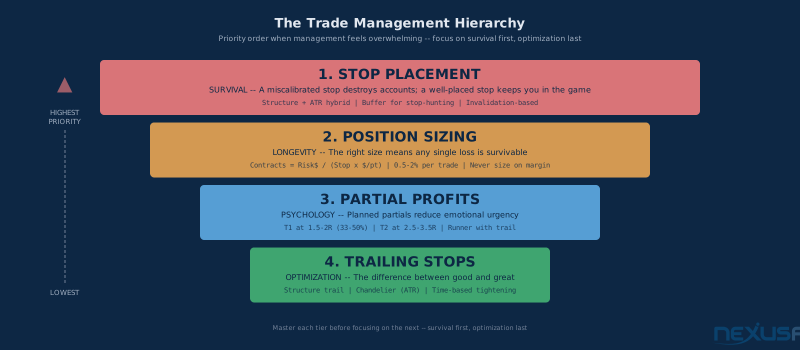
When trade management feels overwhelming, remember the hierarchy of importance:
- Stop placement — Survival. A miscalibrated stop destroys accounts; a well-placed stop keeps you in the game.
- Position sizing — Longevity. The right size means any single loss is survivable.
- Partial profits — Psychology. Planned partials reduce emotional urgency and keep decision quality high.
- Trailing stops — Optimization. The difference between a good result and a great result when the trade works.
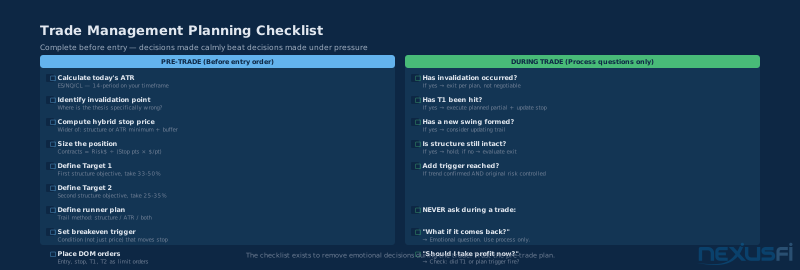
Post-Trade Review #
After each trade, record process answers (the complete trading journal guide covers the full system): Was the stop appropriate? Did partials improve the outcome? Was the plan followed? A well-executed trade that stops out is a process success — the goal is identifying patterns in where discipline breaks down, not second-guessing results.
Connecting Management to Edge #
Trade management does not create edge that doesn't exist in the underlying strategy. A strategy with a negative expectancy cannot be saved by excellent management. But a strategy with a genuine edge can be substantially enhanced or degraded by management quality.
The underlying mathematics are significant. A strategy with a 45% win rate, 2:1 reward-to-risk ratio has positive expectancy: (0.45 × 2) - (0.55 × 1) = +0.35R per trade. Adding a partial profit system that takes 50% off at 1R and lets the remainder run to 2R changes the effective calculation in ways that depend on how often runners develop.
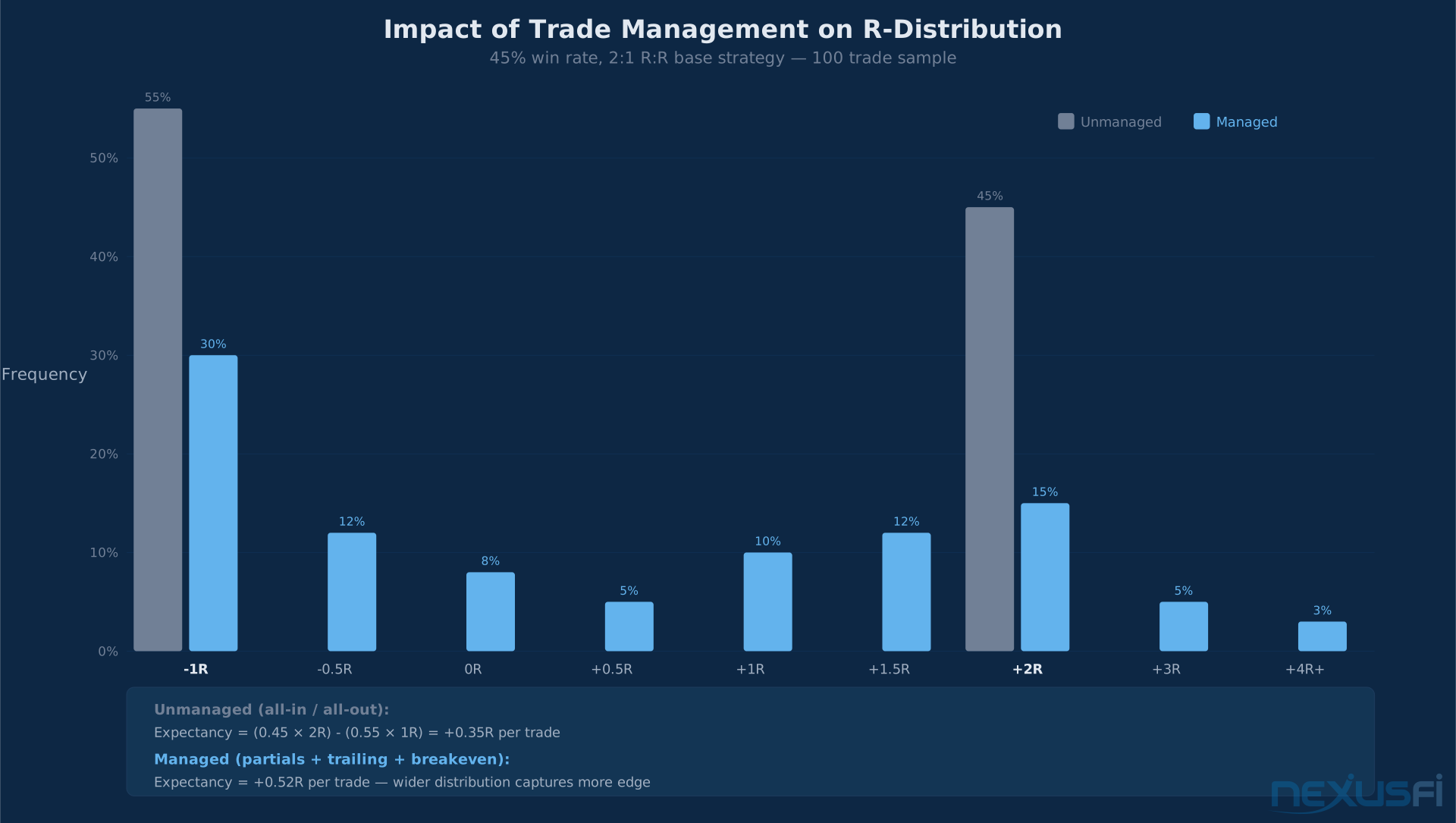
More practically: trading a live market means the management execution quality matters as much as the plan. Pre-placed orders execute; manual orders get missed, mis-entered, or hesitated over at the worst moments.
The traders who sustain profitability in futures markets over multi-year periods share a common thread in how they describe their management approach. @TropicalTrader, describing the turning point in his trading development in the NexusFi Psychology forum: "One huge step for me has been automating my trade process... I'm using Visual Trading Console to execute for me."
Automation is the extreme version, but the principle applies broadly: reduce the number of real-time decisions required during a trade. The management plan should specify most outcomes in advance. The trader's job during the trade is to verify that the plan's conditions have or haven't been met — not to improvise under pressure.
Trade management is the difference between traders who have an edge and traders who extract it consistently. The entry is just the beginning.
See Also
- Stop Loss Strategies for Futures Trading — The deep dive on stop placement methods, ATR calibration, and structure-based stop logic
- Position Sizing Methods for Futures Trading — Fixed fractional, volatility-adjusted, and Kelly-based approaches to determining how many contracts to trade
- R-Multiples — Van Tharp's framework for measuring trade outcomes in units of initial risk
- Scaling In and Out of Futures Trades — The complete playbook for adding to winners and managing partial exits
- Maximum Adverse Excursion (MAE) — Using historical trade data to calibrate stop placement based on how far winning trades move against you
- Expectancy — The single number that tells you whether your management approach produces positive results over time
- Drawdown Management for Futures Trading — Protocols for surviving and recovering from losing streaks
- Loss Aversion in Trading — Why your brain fights every stop-loss and how to override the instinct
- Process-Focused Trading — Building management discipline around process questions instead of outcome anxiety
- How to Build a Trading Journal — The post-trade review system that turns management decisions into measurable improvement
Knowledge Map
Go Deeper
Build on this knowledgeReferences This Article
Articles that build on this topicCitations
- — Spoo-nalysis ES e-mini futures S&P 500 (2020) 👍 13
- — Spoo-nalysis ES e-mini futures S&P 500 (2016) 👍 16
- — Spoo-nalysis ES e-mini futures S&P 500 (2014) 👍 18
- — AMA: FuturesTrader71 (FT71) / Morad Askar - Ask Me Anything (2015) 👍 8
- — The PandaWarrior Chronicles (2012) 👍 17
- — Current Thoughts on the old Break Even Move (2013) 👍 7
- — Finally Turning the Corner (2021) 👍 7
- — Taking loss cutting losers managing positions HOW? (2021) 👍 7
- Charles LeBeau / Alexander Elder — Chartschool.stockcharts.com (2002)
- Van K. Tharp — Amazon.com (1998)
- — STOPS are Frustrating (SL) ...to take or not to take (2010) 👍 33