



Trend Following Strategies for Futures
Overview #
Trend following is the oldest and most studied approach in futures trading — and the most psychologically demanding. The premise is deceptively simple: identify the direction of a sustained price move, get on board, and stay on until the trend exhausts itself. No prediction required. No calling tops or bottoms. Just follow.
The catch? Markets trend roughly 20% of the time. The other 80%, they chop sideways, and every trend-following signal you take will get stopped out. As @tigertrader puts it, "Adopting a trend following methodology is a severely restrictive trading strategy" — you're deliberately sitting out the majority of market conditions to capture the minority that pays. [1]
That math creates a brutal reality: most trend-following systems have win rates between 35-45%. You lose more often than you win. The edge isn't in frequency — it's in magnitude. When you catch a real trend, the payoff dwarfs the accumulated small losses from the chop. The fundamental tradeoff, as @tigertrader explains elsewhere, is that "in order to deliver a high payoff ratio they must sacrifice a high win rate. If you try to increase the fraction of winning trades, the payoff ratio will suffer." [2]
This article covers how to build a trend-following framework for futures — from identifying trends, to timing entries, to managing the inevitable whipsaw periods that test every trend trader's resolve.
The Framework: Trend vs. Range -- The Binary That Drives Everything #
Before any setup, any indicator, any entry rule — you need to answer one question: is this market trending or not?
Every decision downstream flows from that answer. A trending strategy will "make you millions of (sim) dollars, except when it doesn't — then it will lose all those dollars in up-and-down whipsaws in a range," as @bobwest observes. "The reverse is true for a range-trading, non-trending strategy: great success in non-trending markets, total disaster in a trend." [3]
This isn't a theoretical distinction. It's the single most important filter in your trading plan. Get it right and a simple moving average crossover is profitable. Get it wrong and the most sophisticated entry signal will bleed you dry.
Defining a Trend #
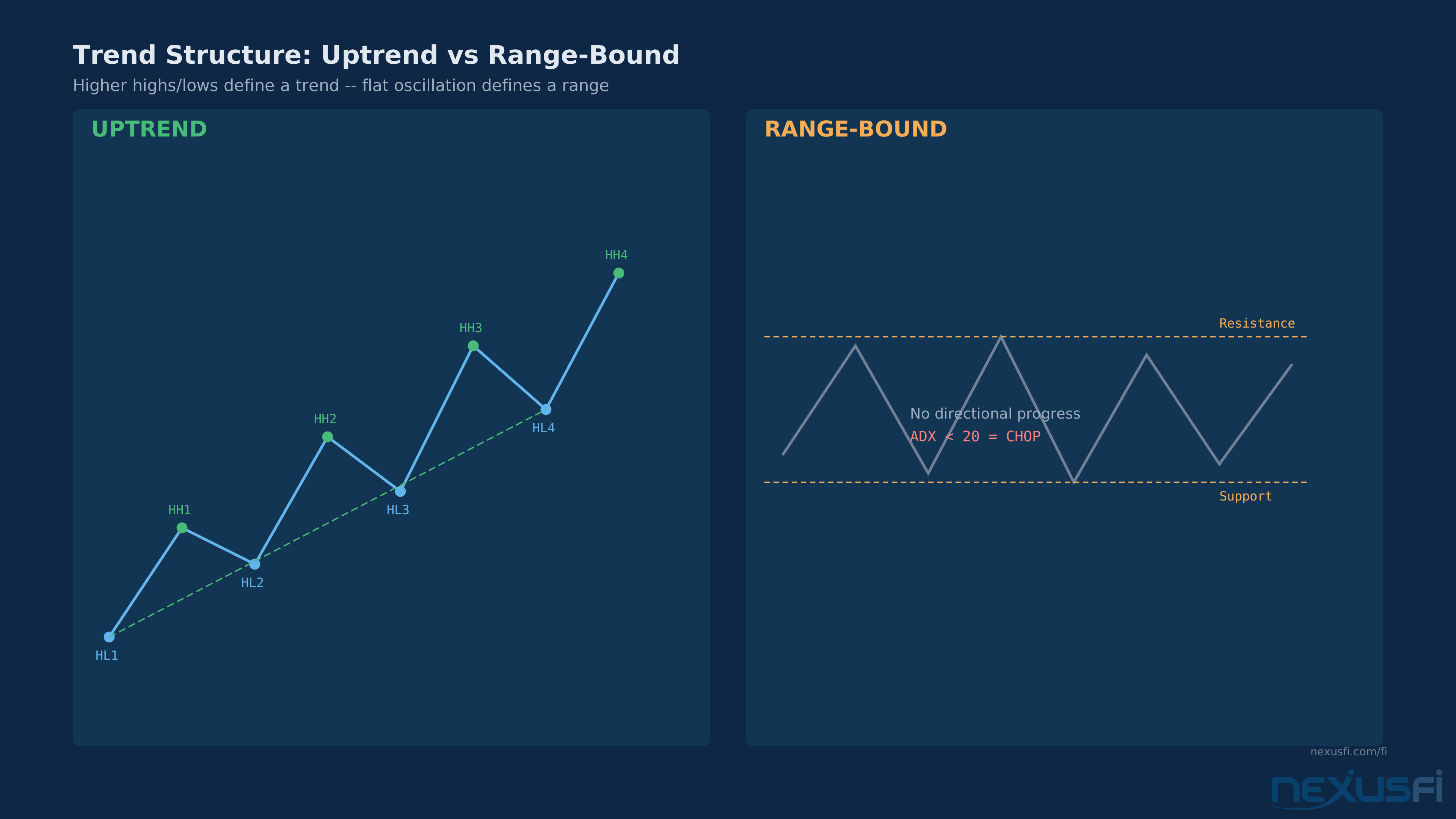
A trend exists when price makes a sustained directional move characterized by:
- Higher highs and higher lows (uptrend) or lower highs and lower lows (downtrend)
- Separation between short and long-term moving averages — the greater the spread, the stronger the trend
- Directional momentum measurable through ADX, slope of moving averages, or rate of change
- Reduced mean reversion — pullbacks are shallow relative to the impulse moves
A market is NOT trending when price oscillates around a central value with roughly equal moves in both directions, moving averages flatten and converge, and pullbacks retrace most of the prior impulse.
Key Concepts #
Trend Identification Methods #
There are three primary approaches to identifying trends, each with different lag and reliability characteristics.
Moving Average Crossovers — The simplest and most widely used trend filter. When a faster MA crosses above a slower MA, the trend is up. When it crosses below, the trend is down. @Jeff65 tested a straightforward system using a single 50-period SMA on daily charts — go long when price closes above the MA, exit when it closes below — and found that currency futures (especially the Euro) exhibited far stronger trending behavior than stock index futures. [4] For more on moving average mechanics and selection, see Moving Averages for Futures Trading.
ADX / Directional Movement System — J. Welles Wilder's directional movement system goes beyond direction to measure trend strength. As @Fat Tails explains, the system "detects a shift in value in the ongoing auction process" through range expansion — it's a discrete method that captures the fractal structure of markets. The key threshold: "Best trending conditions are found if both the ADX and ADXR stay above 25." [5]
[6]
Price Structure (Higher Highs/Lows) — The most raw form of trend identification. Draw swing points on a 30-minute or hourly chart. If each successive swing high exceeds the prior one and each pullback low stays above the prior low, you have an uptrend. This approach has zero lag but requires discretionary judgment about what constitutes a "swing point."
Entry Timing: Breakouts vs. Pullbacks #
Once a trend is identified, the question becomes when to enter. Two schools:
Breakout entries join the trend at the moment of range expansion — buying new highs in an uptrend, selling new lows in a downtrend. The advantage is certainty: you're entering in the direction of confirmed momentum. The disadvantage is that breakout entries often have wider initial stops and worse risk/reward because you're buying at the extended point of the move. For a complete treatment, see Breakout Trading Strategies for Futures.
Pullback entries wait for a retracement within the established trend and enter when the pullback shows signs of exhaustion.
In his example, the pullback retraced to the Value Area High, which acted as resistance for a short entry with a 15-tick stop. [7] Pullback entries offer better risk/reward because the stop is tighter, but they carry the risk that the "pullback" is actually a trend reversal.
The practical answer: most experienced trend traders use a combination. They enter an initial position on the breakout confirmation, then add to the position on the first quality pullback. This gives them exposure early while improving their average entry price.
Regime Identification: When to Trade and When to Sit #
The regime question — trending or ranging — is the make-or-break filter. Several tools help:
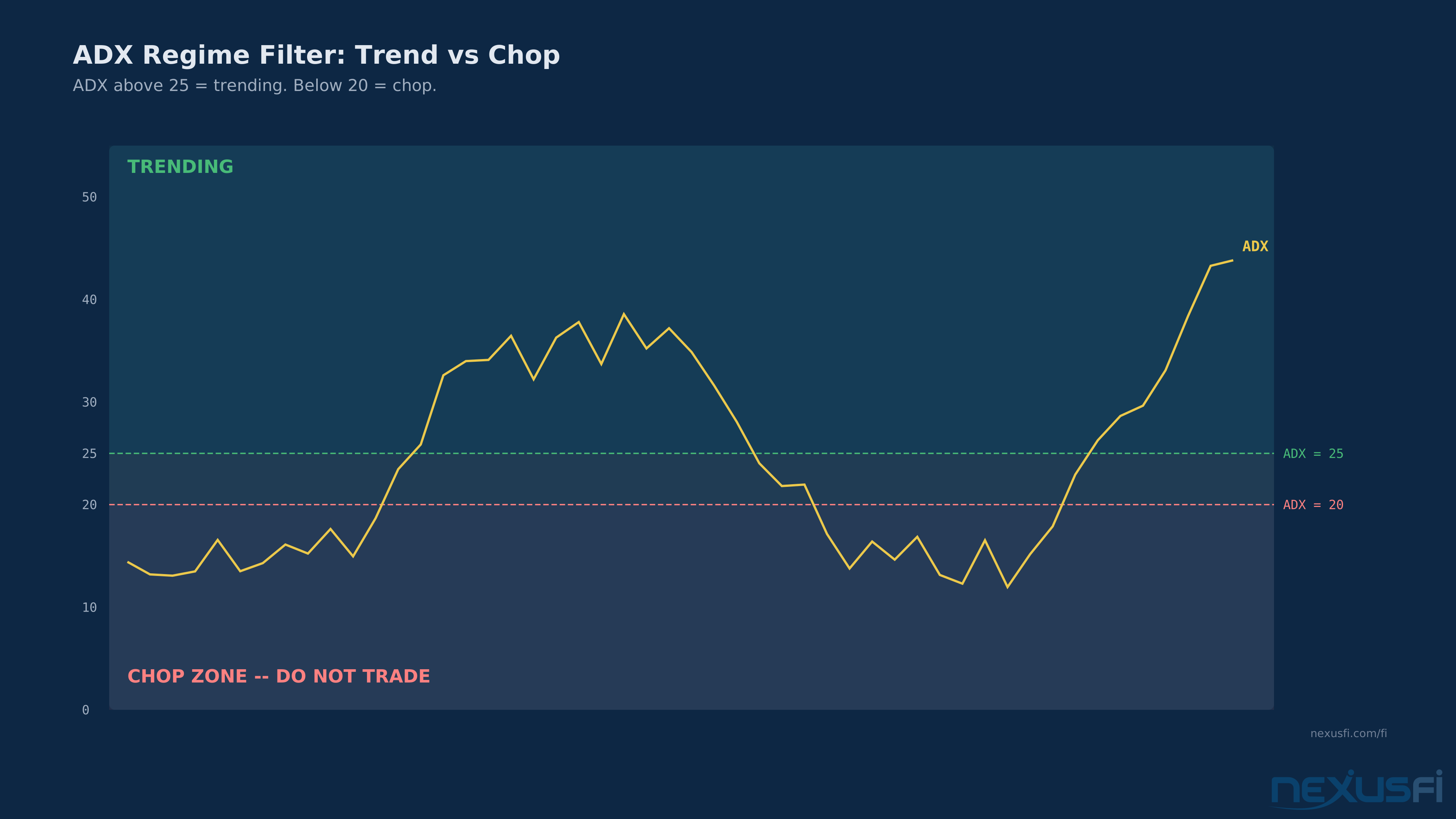
ADX level — ADX above 25 indicates a trending environment. Below 20, the market is ranging. Between 20-25 is ambiguous. As @perryg emphasizes, when ADX is below both DI lines, "we are in CHOP LAND. DO NOT TRADE." [6]
Moving average slope and separation — Flat, converging MAs signal range. Diverging MAs with strong slope signal trend. A 20 EMA pulling away from a 50 EMA is your visual confirmation.
ATR expansion — Rising ATR suggests trend conditions (volatility expanding directionally). Falling ATR suggests consolidation. See Average True Range (ATR) for implementation details.
Volume Profile context — A market trading away from the Point of Control into new value suggests trending. A market rotating around the POC suggests balance.
The honest truth? No single filter is perfect.
[8] The goal isn't perfect regime identification — it's being "not too wrong for too long."
Trade Setups #
This is where trend following becomes a specific, actionable trading plan. Three core setups, each with defined entry, stop, target, and invalidation.
Setup 1: Moving Average Pullback Entry #
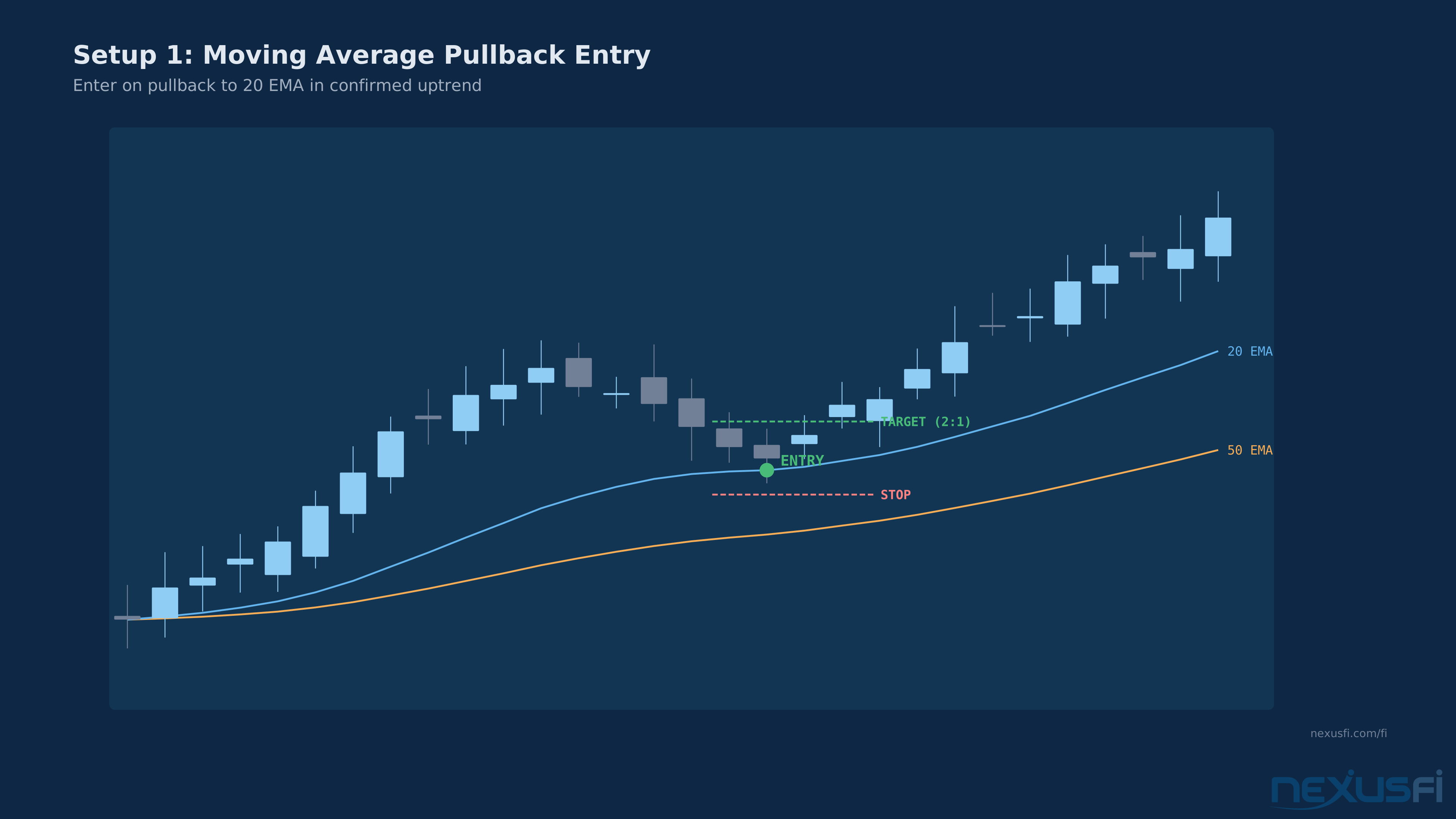
Context: Market is in a confirmed uptrend (20 EMA above 50 EMA, both rising; ADX > 25). You're waiting for a pullback to enter with the trend.
Entry: Price pulls back to the 20 EMA zone (within 2-3 ticks). Wait for a bullish reversal bar — a bar that closes in the upper third of its range and above the 20 EMA. Enter on the close of that bar or one tick above its high.
Stop: Below the pullback low, or 1.5x ATR below entry — whichever is tighter. On ES, this typically translates to 4-8 points depending on volatility.
Target: Minimum 2:1 reward-to-risk. In a strong trend, use a trailing stop instead of a fixed target (see Position Management below).
Invalidation: If the pullback breaks below the 50 EMA AND closes below it, the trend structure is damaged. Exit the position. Don't wait for your stop — the setup premise is gone.
When this fails: In a late-stage trend where momentum is fading. The pullback to the 20 EMA looks normal, but it's actually the beginning of a reversal. ADX rolling over from above 40 is your warning sign. Also fails when volatility compresses suddenly (ATR drops 30%+ from recent average) — the market is shifting regime.
Setup 2: Breakout Continuation #
Context: Market has been consolidating within a 2-5 day range after a prior trending move. ADX has been declining but remains above 20. You're betting the consolidation resolves in the direction of the prior trend.
Entry: A bar closes beyond the range boundary in the direction of the prior trend on above-average volume. Enter at the close or on a limit order during the first 15-minute pullback.
Stop: Below the consolidation range midpoint (not the far edge — that's too wide). This gives you a tighter stop while still respecting the structure.
Target: Measured move equal to the prior trending leg before consolidation. Or trail with a 2x ATR trailing stop once in profit.
Invalidation: If the breakout fails to follow through within 2-3 bars, it's a false breakout. Close at market. Don't give a failed breakout room to become a losing trend trade.
When this fails: When the consolidation is actually distribution (uptrend) or accumulation (downtrend) — the big players are offloading, not resting. Watch for unusually high volume during the consolidation without price progress. Also fails when the breakout happens on thin volume (holiday sessions, after-hours).
Setup 3: Trend Reversal Early Entry #
Context: An established downtrend shows exhaustion. ADX is above 40 and starting to roll over. Price makes a new low but momentum indicators diverge (higher low on RSI, MACD histogram). This is the most aggressive of the three setups.
Entry: After the divergence, wait for a close above the most recent lower high. This confirms the downtrend structure has broken. Enter long on the close or one tick above.
Stop: Below the most recent swing low (the divergent low). This is typically a wider stop, so position size must be reduced so.
Target: The point of control of the prior downtrend range. In a successful reversal, price often retraces 50-61.8% of the prior trending move before the new trend asserts itself.
Invalidation: If price makes a new low after your divergence signal, the divergence has failed. Exit immediately — don't average down on a "better divergence."
When this fails: Divergences can persist for much longer than expected. A market in a strong downtrend can show divergence for 5-10 bars before either resolving or continuing lower. The ADX rolling over is critical confirmation — without it, divergence alone is unreliable. This setup also has the lowest win rate of the three (~35%) but the highest payoff ratio when correct.
Position Management #
Scaling and Pyramiding #
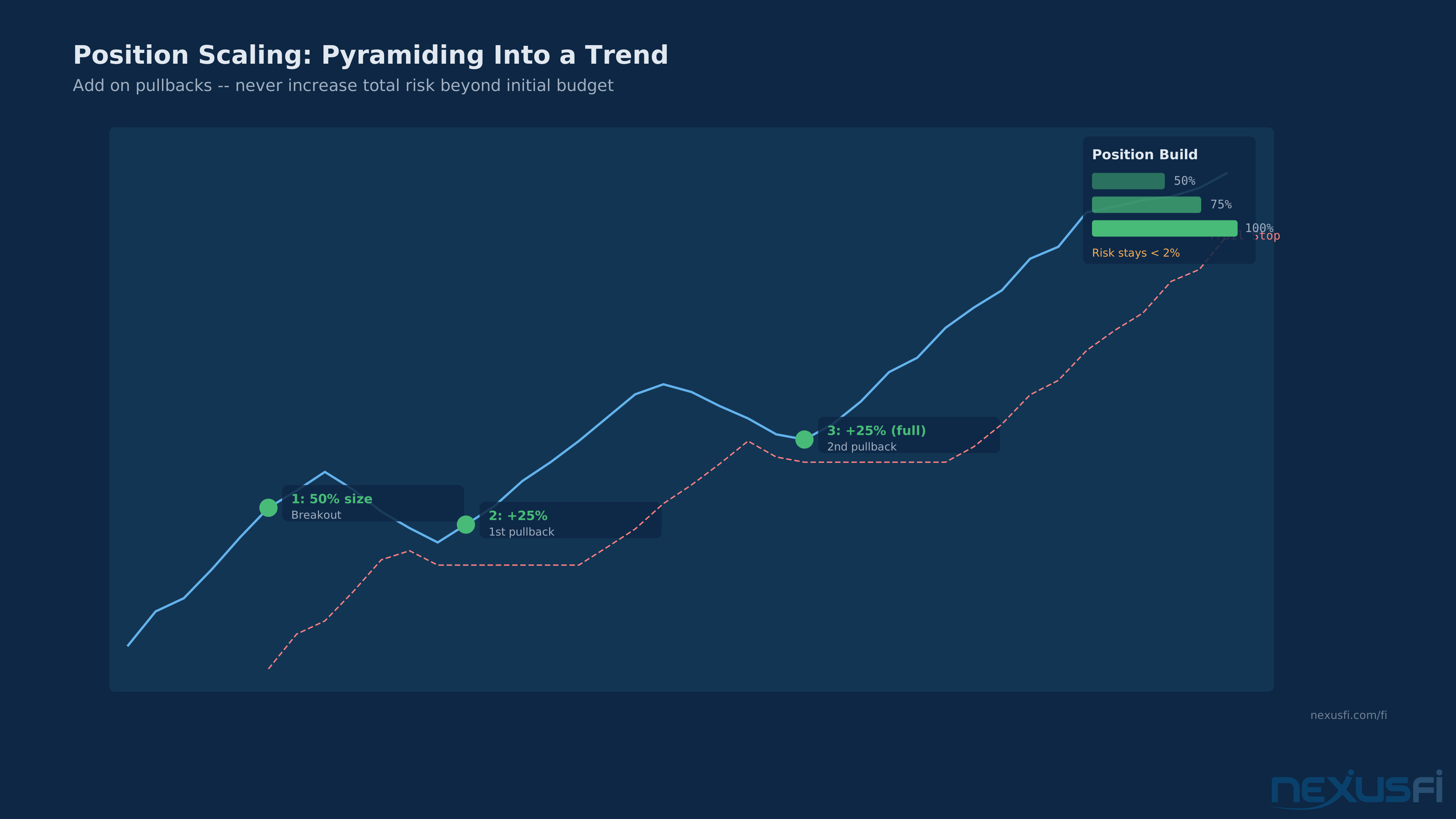
Professional trend followers rarely go all-in at once. A common approach:
- Initial position: 50% of intended size on the first setup trigger
- First add: 25% on the first quality pullback (setup 1) within the new trend
- Second add: 25% on the second pullback or breakout continuation
Each addition should maintain or improve your average entry, and your total risk should never exceed your initial risk budget. If adding a position means your total risk exceeds 2% of account equity, the add is too late — the trend has moved too far from your stops.
Trailing Stops vs. Fixed Targets #
The defining tension of trend following: how do you let winners run without giving back too much profit?
ATR-based trailing stops work well in practice. Trail your stop at 2-3x ATR below the highest close (for longs). This gives the trend room to breathe through normal pullbacks while protecting against trend failure. As @bobwest notes, "most platforms will have a built-in trailing ATR stop, or some variation on Super Trend, and those work fine... if you can tell whether you're in a trend or not." [9]
Structural trailing — trail your stop below the most recent swing low in an uptrend. This gives more room than ATR but keeps you aligned with market structure. Exit only when the trend structure breaks.
Hybrid approach (recommended): Use a fixed target for half the position (2:1 reward-to-risk minimum) and trail the other half. This locks in profit on part of the trade while maintaining exposure to extended moves.
[10]
Fixed targets alone defeat the purpose of trend following. If you're capping your upside at 2:1 or 3:1, you're not letting trends pay for the whipsaw losses. The whole edge comes from the occasional 5:1 or 10:1 winner.
When Trend Following Fails #
Trend following fails in specific, identifiable conditions. Knowing these conditions won't prevent all losses, but it prevents the catastrophic ones — the sustained drawdowns where you keep applying a trending strategy to a ranging market.
Whipsaw / Choppy Markets #
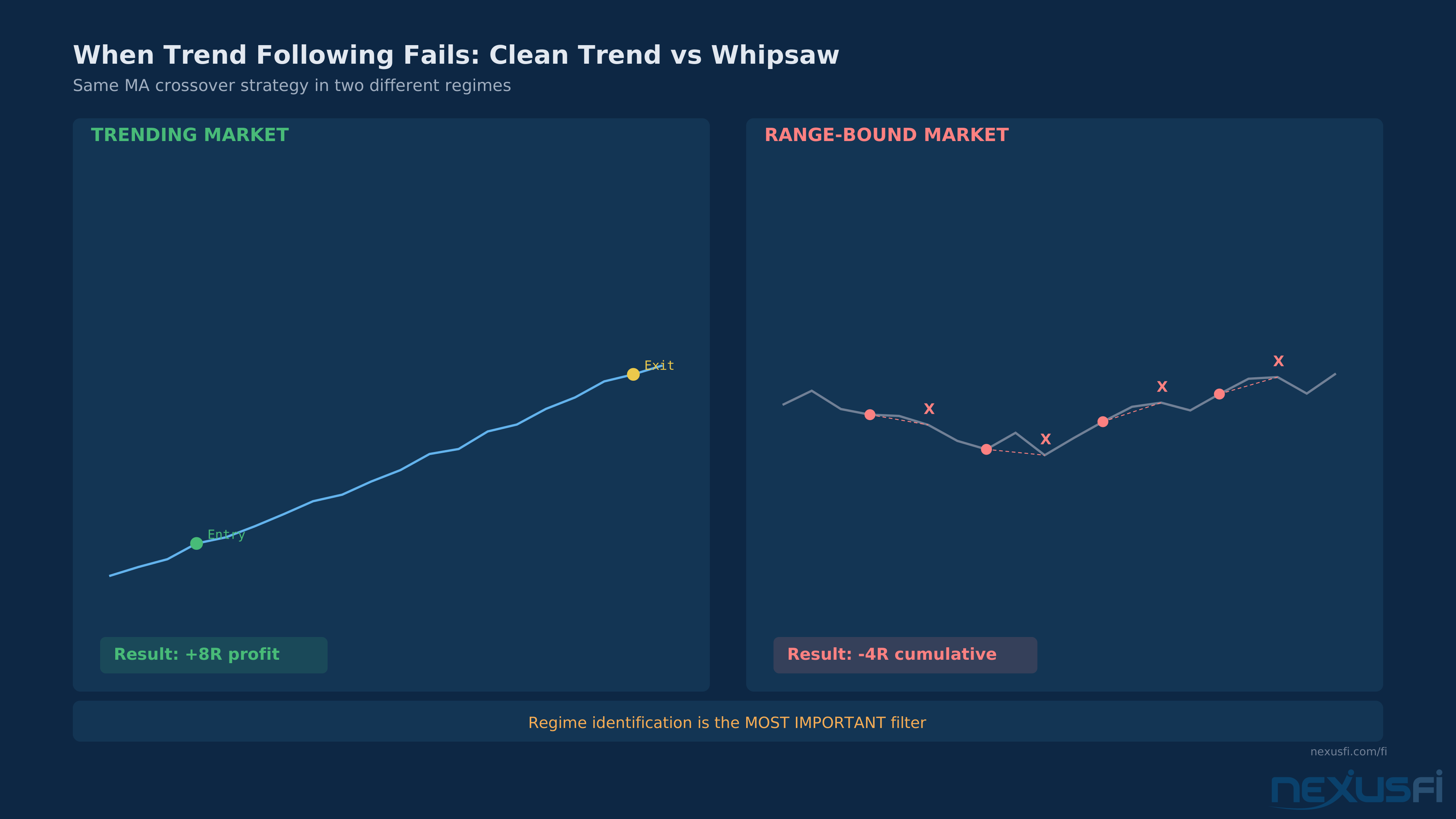
Range-bound conditions generate false trend signals at a rapid pace. Your MA crossover triggers, you enter, the market reverses, stops you out, reverses again, triggers another signal.
[8]
Defense: Reduce position size or stop trading entirely when ADX is below 20. Accept that you'll miss the start of some trends. That's cheaper than bleeding in the chop.
Late-Stage Trend Exhaustion #
A trend that's been running for weeks or months eventually attracts too many participants. The final extension is often the steepest — and the reversal the most violent. ADX above 50, parabolic price acceleration, and news coverage of the trend are all warning signs.
Defense: Don't add new positions when ADX exceeds 45. Tighten trailing stops on existing positions. Consider taking partial profits on extensions beyond 2 standard deviations from the 20 EMA.
News-Driven Regime Shifts #
FOMC announcements, economic data releases, and geopolitical events can instantly shift the trend. A market trending cleanly for two weeks can gap against you on a surprise Fed statement.
Defense: Reduce position size ahead of known catalysts. Know the economic calendar. Widen stops slightly around events or flatten entirely — the choice depends on your conviction in the trend's underlying fundamentals.
Instrument Selection Matters #
Not all futures trend equally. @Jeff65's research demonstrated this empirically — his simple 50 SMA trend system performed dramatically better on currency futures than stock index futures. "I think this provides some evidence that the stock index markets do not have nearly the trending characteristics of the currency futures markets." [4]
In general:
- Commodities and currencies tend to exhibit stronger, more persistent trends due to fundamental supply/demand dynamics
- Stock index futures (ES, NQ) tend toward mean-reverting behavior on intraday timeframes but can trend strongly on daily/weekly timeframes
- Bonds trend well during monetary policy shifts and chop during uncertainty
Pick instruments that suit your timeframe and trend-following style.
Practical Application #
Pre-Market Preparation for Trend Traders #
Before the session:
- Check the trend on the daily chart — is the market above or below key MAs? What's the ADX reading?
- Identify key levels — where are the swing highs/lows that define the trend structure? Where would the trend be "invalidated"?
- Check the economic calendar — any events that could disrupt the trend?
- Define your three scenarios: trend continues (how you'll enter), trend pulls back (where you'll add), trend reverses (where you'll exit)
Combining Trend Following with Other Tools #
No serious trader uses trend following in isolation. @tigertrader makes this explicit: "You have to mitigate the negative effects by combining a trend following strategy with a short-term trading system that would compensate for the negative trend following performance when markets are range-bound." [2]
Practical integration:
- Volume Profile — Use the Value Area and POC to identify where pullback entries have structural support. A pullback to the prior session's VAH in an uptrend is a higher-probability entry than a pullback to a random MA level.
- Order Flow — Confirm trend strength by watching for aggressive buying on pullbacks (delta staying positive during pullback). If delta flips negative during what should be a buyable pullback, the trend may be dying.
- VWAP — In an uptrend, price should stay above VWAP for most of the session. A sustained move below VWAP suggests the intraday trend has shifted. See VWAP for Futures Trading for details.
- Market Internals — For index futures, check breadth and TICK. A trending ES session with deteriorating breadth is a warning sign. See Market Internals.
Risk Management Framework #
The math of trend following demands strict risk management:
- Per-trade risk: 0.5-1% of account equity. Trend-following's low win rate means you need to survive long losing streaks.
- Maximum daily loss: 2-3% of account equity. If three trend setups fail in a day, the market is probably ranging — stop trading.
- Drawdown limit: 10-15% from equity peak before reducing size by 50%. Trend-following drawdowns are normal — 15-25% drawdowns happen even in profitable systems. But unchecked drawdowns destroy capital and psychology.
- Win rate expectation: Plan for 35-45% wins. If you can't stomach losing more than you win, trend following isn't for you. The edge is entirely in the payoff ratio — winners averaging 2-3x the size of losers.
For a deeper treatment of position sizing and risk math, see Position Sizing and Risk of Ruin and Risk of Ruin.
Knowledge Map
Prerequisites
Understand these firstGo Deeper
Build on this knowledgeReferences This Article
Articles that build on this topicCitations
- — The PandaWarrior Chronicles (2011) 👍 26“Markets "trend" only 20% of the time, which of course means they are range-bound or in equilibrium, with little or no serial correlation, the other 80% of the time.”
- — I have no "edge" - Should I throw in the towel? (2020) 👍 4“True, most trend following systems have average win rates because of high draw-downs during whipsaw periods. The fundamental problem of most trend-following systems is that in order to deliver a high payoff ratio they must sacrifice a high win rate.”
- — Trailer Park Capitol (2021) 👍 5“Good thinking. There are in fact two kinds of markets, or market phases or periods: trending and not-trending.”
- — Trend Trading Stock Index or Currency Futures? (2010) 👍 7“This is a little study I did back in January of 2010 when I was interested in demonstrating which popular futures markets exhibit more trending behavior. Maybe a few readers on this forum will find it interesting.”
- — Building Blocks of a Trading System (1) - Trend Filter (2010) 👍 19“One of the best known trendfilters is the directional movement system. This was presented in 1978 by J. Welles Wilder Jr.”
- — Perrys Trading Platform (2010) 👍 24“Hi Beth, For the jtRangeMarket go to https://nexusfi.com/free_downloads/ninjatrader/indicators/179-download.html?action=jump on this forum. OK. You have jumped the guns, so I will start explaining how to look at the ADX panel at the bottom.”
- — Trading Futures with Context (2014) 👍 8“Same procedure as everytime in a trend setup. Waiting for pullback and then enter in the direction of the trend. One of the simplest setups that I know. Short 102.72 with 15 tick sl. Out at 102.04 due to possivle volume exhaustion bar.”
- — 2020 vision st. (2020) 👍 3“This is an issue with every trend-following method or system: there are both trends and not-trends, and the not-trends will kill you, when your objective is to get into a trend and hold it.”
- — Taking loss cutting losers managing positions HOW? (2021) 👍 7“I trail a stop based on a simple ATR stop. The settings are not that critical, but I use 1 or 1.5 ATR from a moving median. I would not emphasize the exact settings, which have to do with your risk tolerance and are pretty individual.”
- — Exiting Trend following winners. (2018) 👍 1“Mwenga using the donchain mid-line is my preferred method for trailing my runners. I use 2 targets (50% of position at target 1, at least 25% of position at target 2) plus a runner.”