



Trading Plan Development for Futures Traders: The Complete System Design Framework
Overview #
Most traders fail not because they picked the wrong indicator or missed a setup. They fail because they never built a system for making decisions under pressure. The trading plan is that system — not a wish list, not a set of vague intentions, but a written operational framework that removes the need for in-the-moment judgment when your judgment is least reliable.
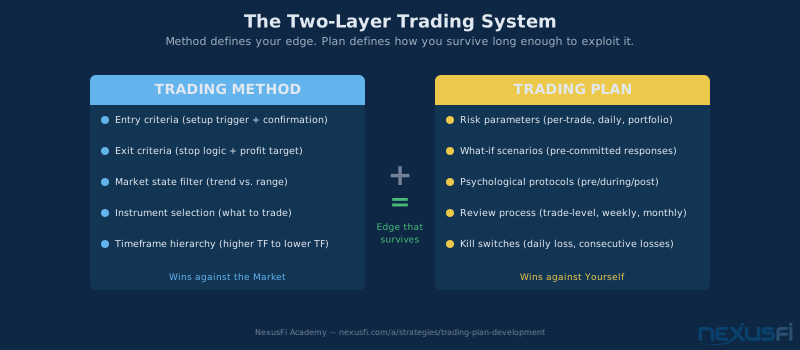
@Big Mike put it cleanly in a post that's been read tens of thousands of times on NexusFi: a trading method defines your edge in the market (where to enter, where to exit, how to filter). A trading plan is much wider — it encompasses the method but adds the psychological and operational architecture that tells you how to win against yourself, not just the market. Defining when NOT to trade, what to do after a string of losses, how to handle a windfall win — those are trading plan questions, not method questions.[1]
That distinction matters. The market is actually the easier problem. Consistent execution over time, with an account that survives the inevitable losing streaks, is the harder problem. The plan addresses the harder problem.
Trading plan essentials: Define your edge in measurable terms before writing a single rule. Build kill switches for daily loss, consecutive losses, and drawdown — decided in advance, not in the moment. Separate plan performance from trader performance in review. The plan that works is short enough to read in 90 seconds during a live session.
Research on trader behavior consistently shows that traders with written, specific plans outperform those trading from memory or instinct. Van Tharp's research across thousands of traders over three decades found that most traders fail because they invert the success hierarchy — obsessing over entries (which contribute roughly 10% to system performance) while ignoring position sizing (30%) and psychology (60%). The written plan is the tool that corrects this inversion.[13] The mechanism isn't mysterious: written rules force clarity about what you actually believe, create accountability to your past reasoning, and give you something to review when things go wrong.
This article builds the complete framework — from market selection through psychological protocols — with specific guidance calibrated for futures traders. The edge in most futures markets is thin relative to variance, which means the operational and behavioral elements of your plan matter at least as much as the entry signal.
The Plan vs. The Method -- A Critical Distinction #
Before diving into the framework, get clear on what a trading plan is and isn't.
Your method answers: What is my edge? Which setups do I trade? What are my entry and exit criteria? This is the technical layer — the part that defines how you interact with price.
Your plan answers: How do I manage myself? When do I stop trading for the day? How do I handle a 5-lot loss at 9:45am? What's the protocol after three consecutive losers? What do I do if my fill is 4 ticks worse than expected? This is the operational and psychological layer.
Most traders obsess over method and neglect plan. The result: they find an edge that works in backtesting, then watch it fall apart in live trading because they abandoned the rules when the market moved against them, or sized up after a big win, or refused to cut a losing position because they "knew" it would come back. The plan is what prevents those behavioral failures.
@Big Mike again: "Creating a plan and method and following it are two entirely separate things. You can have the best trading plan and trading method in the world, but if you don't follow it, what does it matter?"[2]
Key Concepts #
Edge: A measurable advantage in a specific market situation — a scenario where your expected value is positive when accounting for all costs. Edge must be falsifiable: if you can't describe it in testable terms, you don't have one, you have a hypothesis. Statistical Edge in Futures Trading covers the full framework for defining and measuring edge rigorously.
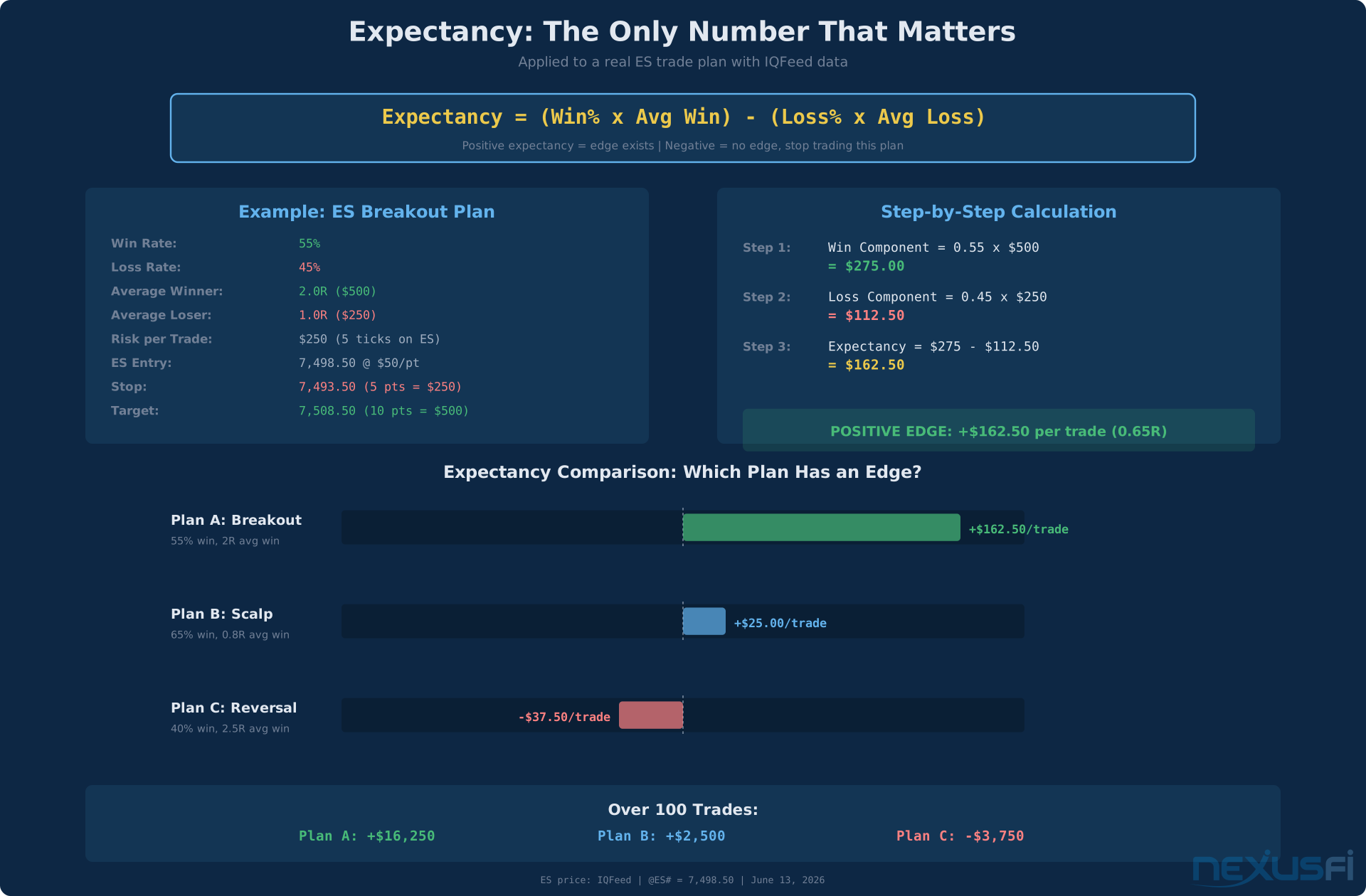
Expectancy: The average dollar outcome per trade across a sample of trades. Expectancy = (Win Rate × Average Win) - (Loss Rate × Average Loss). This is the number that determines whether a strategy survives at scale.
R-multiple: Trade outcome expressed as a multiple of initial risk. A trade that loses exactly your planned stop loss = -1R. A trade that hits twice your stop distance in profit = +2R. Thinking in R removes the distortion of position size from performance analysis.
Kill switch: A pre-defined threshold at which you stop trading entirely — for the day, week, or session. Daily loss limits, consecutive-loss rules, and drawdown thresholds are all kill switches. The key word is "pre-defined" — kill switches decided in real time, during a drawdown, are worthless because that's exactly when judgment is compromised.
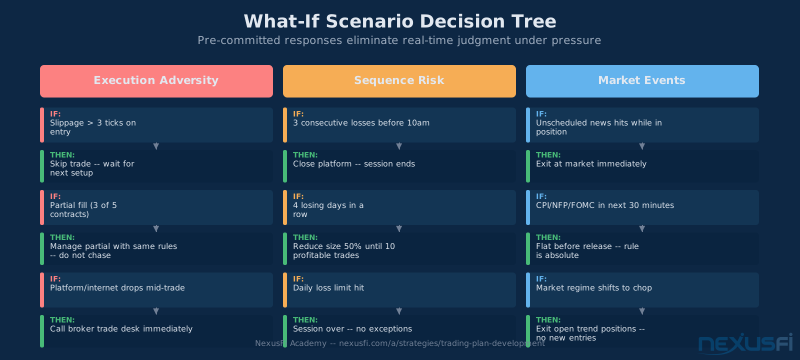
What-if scenario: A pre-committed decision for a specific adverse situation. "If I take 3 consecutive losses before 10am, I close the platform and don't trade for the rest of the session." Documented in advance, not decided under pressure.
Invalidation: The specific condition that proves your trade thesis wrong. Defining invalidation before entering the trade converts your stop loss from an arbitrary tick distance into a logical exit based on what the market is telling you.
MAE (Maximum Adverse Excursion): The worst intrabar adverse move experienced by winning trades. Tracking MAE across your sample reveals whether your stop placement is rational or arbitrary — if winning trades rarely go more than 4 ticks against you, a 12-tick stop is probably too wide and a 3-tick stop is probably too tight.
The Eight-Part Framework #
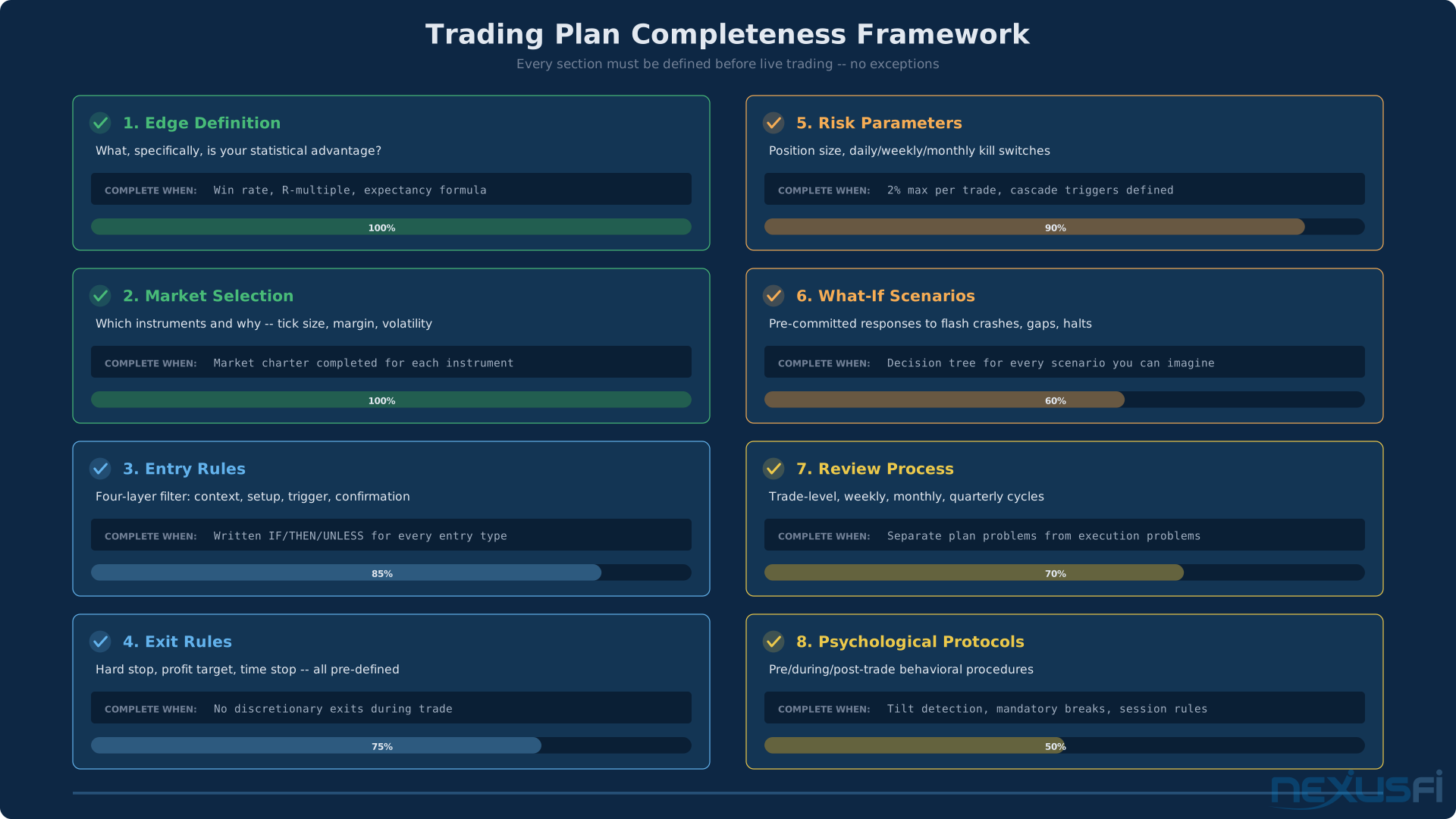
1. Market Selection — Trade Where Your Edge Can Express #
Market selection is often treated as a preference ("I like ES") rather than a strategic decision. That's a mistake. Your edge must match the microstructure of the market you're trading.
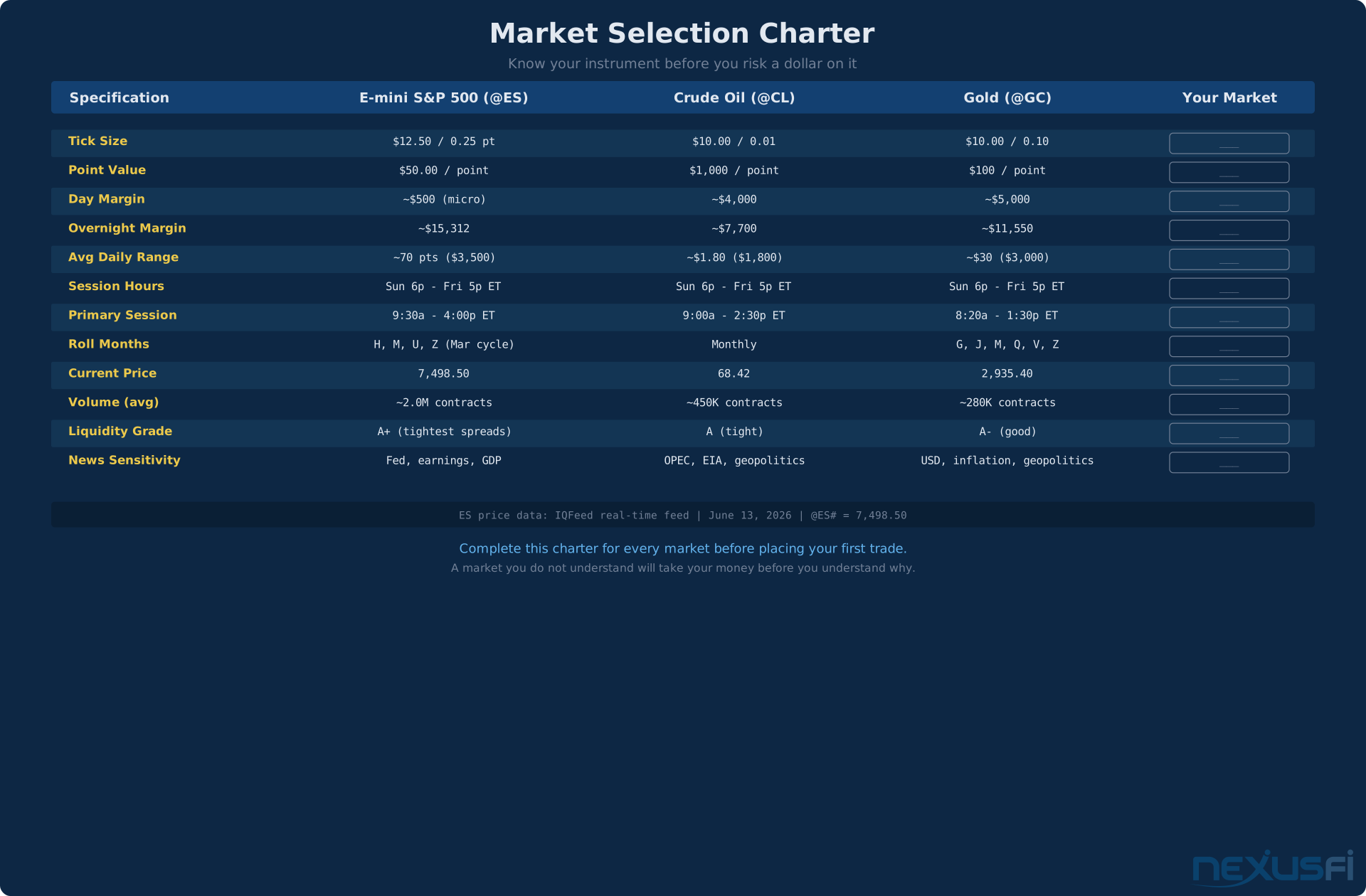
For each contract you plan to trade, document a market charter covering:
- Contract specs: Tick size and dollar value, margin requirements, typical daily range (ATR)
- Liquidity profile: Typical bid/ask spread, depth at the top of book, execution quality during your target session
- Session behavior: How does the contract behave at the open, mid-day, and close? Where is liquidity concentrated?
- Cost structure: Commissions, exchange fees, and realistic slippage expectations — total round-trip cost expressed in ticks or R
- Regime characteristics: Does this market trend strongly on FOMC days? Does it go dead at 1pm? Understanding behavior patterns is part of market selection, not an afterthought
The practical filter: can you consistently get fills within your slippage tolerance during your target session? If you're trading CL but you can only trade between 7pm and 8am, the answer is often no.
Futures-specific requirements:
Roll mechanics: Define exactly when you switch to the next contract. The front month's liquidity transfers during roll week — if your strategy depends on tight spreads and a deep DOM, trading the expiring front month into its final days is a different proposition than trading the active front. Write the rule: "I roll to the next contract when front-month volume drops below 50% of active-month volume."
Event-risk windows: Define your protocol around scheduled economic releases — CPI, NFP, FOMC, inventory reports for energy contracts. Are you flat before? Do you reduce size? Do you only trade directional breakouts after the dust settles? Write it down. Improvising around a 50-point ES move driven by a hotter-than-expected CPI print is not where you want to discover you didn't have a protocol.
Correlation awareness: Long ES, long NQ, and long YM simultaneously isn't three positions — it's one directional bet with three margin requirements. Account for correlation in your total portfolio risk.
2. Edge Definition — Make It Testable, Not Poetic #
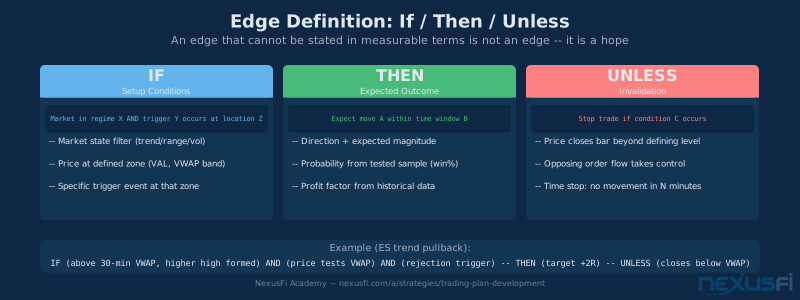
The most important section of your plan, and the one traders most often write badly. "I trade with-trend pullbacks to key levels." That's a sentence, not an edge definition. An edge definition tells you exactly when to fire.
The format that works for futures traders is an if/then/unless structure:
If (market is in trend state X) and (price reaches zone Z) and (setup trigger Y occurs) — then I have a valid entry — unless (invalidation condition).
Every component must be concrete. "Trend state X" needs an objective definition: above the 20-period EMA on the 30-minute chart with a positive slope, for example. "Zone Z" needs a specific level: the VAL from the prior day's session, a VWAP band, a prior swing high/low. "Setup trigger Y" needs a specific event: a rejection candle, a DOM absorption pattern, a failed breakout. "Invalidation condition" needs a price level or behavior: "trade is invalid if price closes a 5-minute bar below the key level."
@Datum describes his edge framework as the marriage of three elements — pattern, key level, and context. Patterns include failed breakouts, double tops/bottoms, and breakout pullbacks. Key levels include overnight highs/lows, EMAs, and prior support/resistance. Context is the market regime — narrow range vs. wide range vs. trend. "In my experience, the marriage of these 3 aspects gives the strongest edge. I could trade 2 of these, but the edge is thinner."[3]
That's the right structure. Each element of the three-part definition removes false signals. Edge without all three components has lower win rate or lower profit factor than edge with all three combined.
Measure your edge before you trade it live. The metrics that matter:
- Win rate conditional on setup quality (not just overall win rate — separate your A setups from B setups)
- Expectancy: (Win Rate × Avg Win in R) - (Loss Rate × Avg Loss in R)
- Profit factor: gross profit / gross loss (a minimum of 1.5 is worth pursuing live, above 2.0 suggests a genuinely strong edge)
- MAE distribution: the typical worst intrabar adverse move for winning trades — this calibrates stop distance
- Hold time: does your edge degrade if you hold for 30 minutes? 2 hours? Overnight?
One week of data tells you almost nothing. Systems with higher reward-to-risk ratios often perform well in small samples and blow up on outlier statistics that don't appear until you have 200+ trades.[4]
Minimum viable sample: 50 trades with good notes. Enough to see the tails.
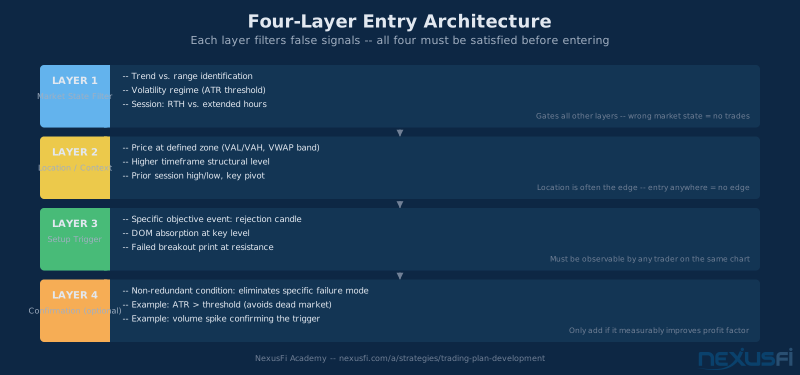
3. Entry Rules — Four Layers That Eliminate Guessing #
The purpose of explicit entry rules is repeatability. Every time you enter a trade, the decision should be the same process — not the same intuition, but the same documented checklist.
The four-layer architecture that produces consistent execution:
Layer 1 — Market State Filter: Before any individual setup matters, the overall market state must be compatible with your strategy. A trend-following setup in a clearly mean-reverting market is a strategy-regime mismatch. Define your filters objectively: above or below key VWAP, ADX above or below a threshold, market profile open type classification, RTH vs. Globex session.
Layer 2 — Location/Context: Price must be at a meaningful level to give your setup context. "I'll trade a bullish reversal anywhere" is not a trading plan — that's hope. Require price to reach a defined zone: value area boundary, prior session high/low, major VWAP deviation band, a structure level identifiable before the session begins. Location is often the single biggest differentiator between traders who have an edge and traders who think they do.
Layer 3 — Trigger: The specific observable event that initiates the trade. A candle close pattern, a DOM absorption signal, a failed breakout print at a key level, a order flow divergence. This must be objective enough that two traders watching the same chart would agree on whether it occurred.
Layer 4 — Confirmation (optional but powerful): An additional condition that reduces false signals. Not redundant with the trigger — something that screens out a specific common failure mode. If your edge tends to fail when the market is in a low-volatility compression, a confirmation condition might be "ATR must be above N during the entry bar."
Execution specifications — often ignored, often the difference between a good system and an unprofitable one:
- Order type: are you using limit orders, stop orders, or market orders? For each setup type, this should be specified.
- Slippage tolerance: if you're aiming to enter at 5072.25 and the market moves through that level so fast you'd get filled at 5073.75, do you chase? The answer should be in your plan: "If slippage exceeds 2 ticks on entry, I do not take the trade."
- Queue position: for limit orders in liquid futures, queue position matters. If you're 800 contracts back in line at the bid in ES, filling your limit at a key support level depends on factors outside your control.
- Re-entry rules: if your limit order misses and the market moves without you, when (if ever) do you re-enter? The answer cannot be "when it feels right."
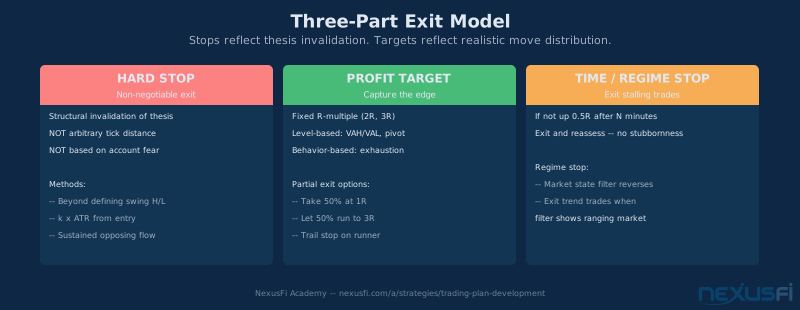
4. Exit Rules — The Part Most Plans Get Wrong #
Traders spend 90% of their planning time on entries and 10% on exits. Exits are where actual edge gets captured or leaked. A poor entry with a great exit process often beats a great entry with poor exits.
Hard stop (non-negotiable): Your stop loss must derive from your thesis, not your fear or your account size. "I don't want to lose more than $200 on this trade" is not a stop logic. "My thesis is invalid if price closes a 5-minute bar below the prior low at 5068.00" is a stop logic.
Three valid methods for futures:
- Structural invalidation: Beyond the swing high/low, key level, or zone that defines why the trade exists
- Volatility-based: A multiple of ATR calculated before entry (1.5× ATR is common for intraday setups in ES, but calibrate to your edge's MAE distribution)
- Order flow invalidation: Sustained directional pressure by the opposing side — the DOM showing persistent absorption when you needed to see exhaustion
Profit targets: Have a rule. "I'll see how it goes" is not a rule — it's how you turn winning trades into scratch trades. Options that work:
- Fixed R-multiple targets: take full profit at 2R, or partial at 1R with runner to 3R
- Level-based targets: scale out into known liquidity zones — prior session VAH/VAL, weekly pivot, major VWAP band
- Behavior-based: trail to a break-even stop once price moves 1R in your favor, then move the stop on each successive structure break
Time stops: Powerful and underused. If your trade thesis says price should move within 15 minutes and it doesn't, something is wrong with the read. Exiting on time prevents slow bleeds that tie up capital and mental bandwidth. Define it: "If the position is not up at least 0.5R after 20 minutes, I exit at market."
Regime exits: The market state filter from your entry rules cuts both ways. If your trend-following system's filter says the market has shifted to a ranging environment, that's an exit signal for existing trend positions — not just a stop signal for new entries.
5. Risk Parameters — The Math That Keeps You Alive #
Risk parameters are where discipline is tested most. They're also where the math is clearest, which helps.
Per-trade risk: 0.25% to 1% of account equity per trade is the standard range for futures day traders with strong edges. The specific percentage depends on your profit factor and drawdown tolerance — lower profit factor requires lower risk per trade to survive the losing streaks.
Position size calculation, made explicit:
Max risk per trade = Account equity × Risk %
Stop distance in dollars = Stop distance in ticks × Dollar value per tick
Contracts = floor(Max risk per trade / Stop distance in dollars)
Example for an ES trade: Account = $50,000, Risk = 0.5%, Stop = 6 ticks (1.5 points).
- Max risk: $50,000 × 0.005 = $250
- Stop distance in dollars: 6 ticks × $12.50 per tick = $75 per contract
- Contracts: floor($250 / $75) = 3 contracts
This gives you 3 contracts with $225 at risk on the trade — within your 0.5% limit. For a deeper dive into the math behind these calculations, see Position Sizing Methods for Futures Trading.
@jamiej83 describes his risk architecture: daily loss limit of 1%, weekly of 3%, monthly of 6%, with a ruin point defined as 20% drawdown — at which point he stops live trading for the remainder of the year. He also knows that 2 consecutive losses means his read is off, and he stops for the day.[5]
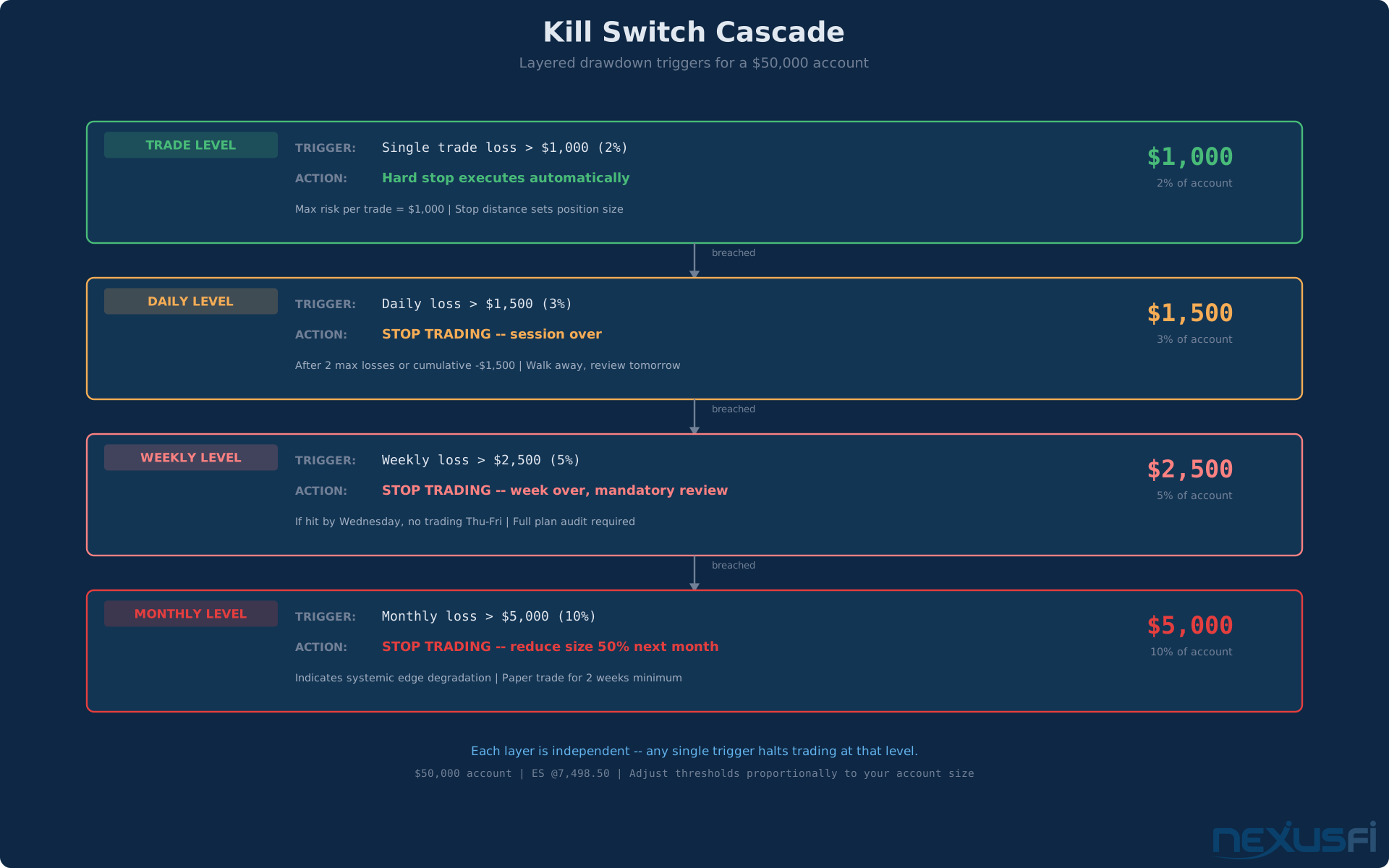
Layered limits:
Trade level: Per-trade risk as a percentage of account equity. Calculated before entry, not estimated.
Daily level: Maximum daily loss. Common values range from 1R to 3R or 1-2% of account. When this limit is hit, the platform closes. Not "I'll trade lighter." The session ends.
Consecutive loss trigger: A separate limit based on losing streak, not just dollar amount. Three consecutive losses triggers a mandatory review before resuming — even if the daily dollar limit isn't reached.
Weekly/monthly drawdown: A longer-term kill switch. If you're down 5% in a week, something structural may be wrong with market conditions or your execution. A mandatory pause and review protects against compounding small problems into account-threatening problems.
Portfolio-level: Total aggregate open risk across all positions has a limit. Correlated contracts (ES, NQ, YM) stack risk — treat them as one bet, not three.
6. What-If Scenarios — Pre-Commit to Behavior Under Stress #
The what-if section converts your plan from a fair-weather document into something that works when it's hard.
The structure: trigger condition → pre-committed response → rationale.
Build your scenario table around the highest-probability failure modes in futures trading:
Execution adversity:
- "If my entry slippage exceeds 3 ticks, I do not take the trade — I wait for the next setup."
- "If I get a partial fill (entered 3 of 5 contracts), I manage the partial position using the same rules and do not try to add to reach full size at a worse price."
- "If my internet connection drops while in a position, I immediately call my broker's trade desk and close the position. Broker number is [X]. Account number is [Y]." (This one — the emergency contact protocol — is in @matthew28's checklist for going live and gets skipped more often than any other practical preparation.)[6]
Regime shift:
- "If my trend filter shows the market has transitioned to a ranging state mid-session, I close any open trend positions and stand aside until the market structure clarifies."
- "If my win rate drops below 40% over 10 consecutive trades, I reduce size by 50% and conduct a manual review of the last 10 trades before resuming full size."
News and event risk:
- "I am flat before CPI, NFP, and FOMC announcements. No exceptions. If I'm in a position when a surprise release happens — 'surprise' defined as any unscheduled report or news event — I exit at market immediately regardless of P&L."
- "For scheduled releases, I resume trading 5 minutes after the initial spike if price has found a stable range. I do not try to trade the initial reaction."
Sequence risk:
- "If I have 4 consecutive losses before 10am, I close the platform for the day."
- "If I'm up more than 3R before noon, I bank 2R of that gain by reducing size to half for the remainder of the session."
Performance degradation:
- "If my expectancy calculated over rolling 20 trades drops below 0R, I move to simulation until I understand what changed. I don't trade live with an unproven edge."
@rubyslippage describes the habit she calls "advance planning" — before placing an order, thinking through what she'll do if stopped out. "That last one is really important to me because it helps prevent me from carrying emotional baggage regarding a trade that's over. Planning in advance what to do if stopped out of a trade makes it easier to shake the Etch-A-Sketch and be ready to start fresh."[7]
That's what the what-if section accomplishes at scale. Every scenario you've thought through in advance is one less decision you have to make under pressure.
7. Review Process — The Feedback Loop That Builds Edge Over Time #
A trading plan without a review process is a static document. Markets change, your skill develops, your understanding deepens — the plan must evolve with it.
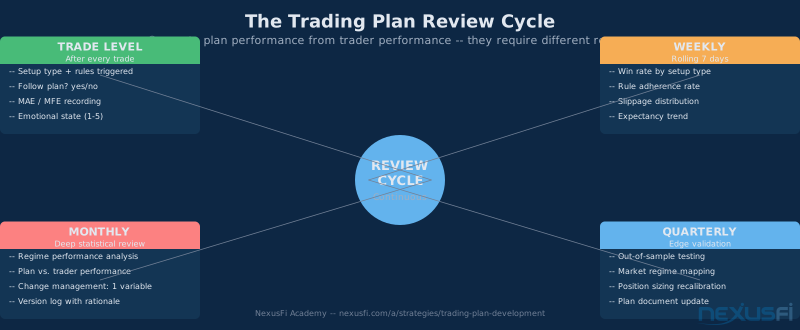
The review process operates at three levels:
Trade-level (immediate): After every trade, record:
- Setup name and which specific rules triggered
- Market state at entry (trend/range/volatile)
- Whether you followed the plan exactly — if not, what changed and why
- MAE and MFE (maximum adverse and favorable excursion)
- Execution quality: fill price vs. target, any slippage
- Brief emotional state note: calm, frustrated, anxious, confident
This takes 2-3 minutes. Do it before your next trade. The emotional state note is not optional — research on trader behavior consistently shows that emotional state is correlated with execution quality in ways that the trade outcome alone doesn't reveal.
Weekly review: Win rate by setup type, expectancy trend, rule adherence rate (below 85% means the plan or your discipline needs work), slippage analysis, MAE distribution.
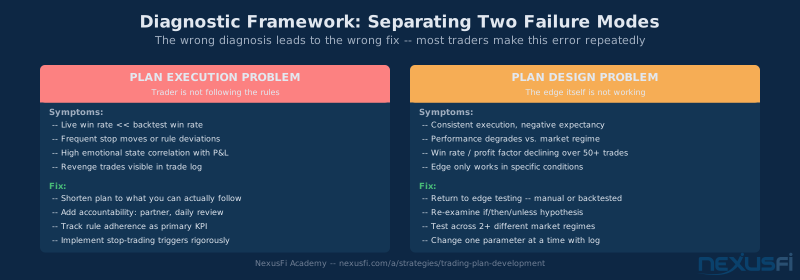
Monthly/quarterly deep review: Separate plan performance (does the edge work?) from trader performance (did you execute correctly?). These require different responses — a plan execution problem calls for discipline work, a plan design problem calls for rule changes. Change one variable at a time, minimum 20 forward trades before evaluating — Backtesting Trading Strategies covers the complete methodology for testing changes quantitatively before committing capital — and document every change with expected effect.
@xplorer uses the PDCA cycle (Plan-Do-Check-Adjust) applied specifically to trading: define the edge, execute with data recording, analyze the results, then adjust based on evidence. "All of the work done in deliberate practice must be logged for analysis... log any trading errors, and perform statistical analysis on the trade samples."[8]
Brett Steenbarger's work in The Daily Trading Coach reinforces this structured approach — treating trading as a performance discipline where deliberate practice, systematic journaling, and constant feedback loops are the mechanisms that convert raw experience into genuine skill. His research with hedge fund and prop firm traders shows that the traders who improve fastest are those who journal not just outcomes but process adherence and emotional states, then share findings with peers to multiply the learning rate.[14]
The critical discipline: never change plan parameters during a drawdown. Drawdowns produce motivated reasoning — the urge to find justifications for the changes you already want to make. Change management must happen during stable periods, using statistical evidence.
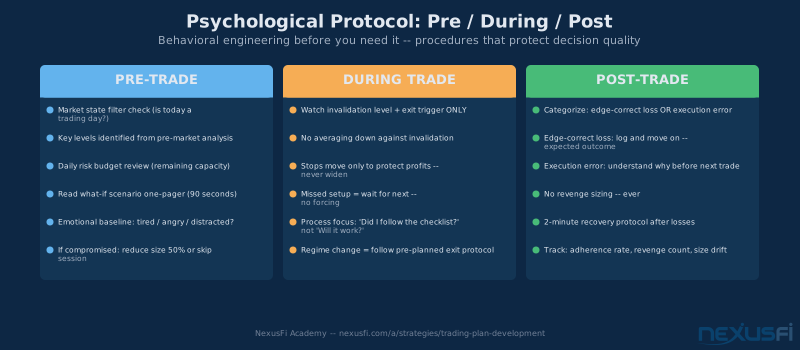
8. Psychological Protocols — Behavioral Engineering Before You Need It #
The plan's psychological section is not motivational content. It's operational protocol. Same structure as the what-if section: specific trigger, specific response, documented in advance.
Pre-trade ritual (2-10 minutes, before the session begins):
- Confirm market state meets your filter criteria: is today a trading day?
- Review key levels identified in pre-market analysis
- Check your remaining daily risk budget: how much capacity do you have left?
- Read through your what-if scenario summary (the one-page version)
- Emotional baseline check: tired? Angry? Coming off a bad week? If yes, reduce size by 50% for the first 30 minutes or skip the session. Trading Psychology covers the full behavioral framework for managing these states before they manage you
The emotional baseline check is worth expanding. @rubyslippage found that the profitably trading she observed in consistent traders shared two traits: following a specific plan without deviation, and the ability to "shake the Etch-A-Sketch" completely after each trade. "Something I've seen common to all the profitable traders I've met is a sense of detachment once a trade is done, followed by anticipation of the next opportunity."[9]
That detachment is trainable, but it requires pre-session preparation. If you come to the keyboard carrying yesterday's losses or last week's bad week, the detachment is harder to achieve.
During-trade discipline:
Your attention has one job: monitor the invalidation level and the exit trigger. That's it. You are not predicting where price will go — you already made that prediction when you entered. You are monitoring the conditions that prove your prediction wrong.
Explicit rules for during-trade:
- No averaging down against your invalidation level. Ever.
- If price approaches your stop, you don't move the stop to "give it more room." Moving a stop is only allowed in one direction — to lock in profits.
- Missed setup = no forced entry. The market will offer another setup.
- If a trade is working well and you feel the urge to "let it ride" past your target, refer to your exit rules. The rules exist exactly for this moment.
Post-trade reset:
After a loss: categorize it before moving on. Was it an edge-correct loss (you followed the rules and the trade didn't work — this is expected and fine) or an execution error (you deviated from the plan)? These require different responses. An edge-correct loss requires nothing except logging. An execution error requires understanding why the deviation happened.
After a win: don't increase size. Don't interpret a single win as confirmation that you should loosen your rules. The impulse to "trade what's working" by pressing after winners is a direct path to giving back the gain.
Recovery protocol after losses: some traders find a 5-minute walk helpful. Some do a full reset of their charts. Some read their plan summary. The specific method matters less than having one and using it consistently.
Stop-trading triggers:
Define specific conditions that end your trading session:
- Daily loss limit reached: platform closes, you don't return until tomorrow
- [X] consecutive losses: mandatory 30-minute break minimum before considering another trade
- Any rule violation: 15-minute break, review of what happened, before resuming
- Physical/emotional state indicators: significant fatigue, anger, or distraction that you notice before taking a trade — step away
@shodson shares Tim Morge's framework, which he calls the "penalty box" — if you violate any trading rule, you take a break from trading. "If you love trading, having to be away from it should feel terrible. You will avoid being put 'in the penalty box' at all costs."[10]
The mechanism is behavioral conditioning. Pre-defined consequences for rule violations create an incentive to follow the rules that doesn't depend on willpower alone.
Track your psychology, not just your P&L:
Three metrics that reveal behavioral patterns standard P&L analysis misses:
- Rule adherence rate: what percentage of your trades followed the plan exactly?
- Revenge/late-entry count: how many times did you chase a missed setup or re-enter immediately after a stop?
- Size changes correlated with P&L: are you sizing up after wins and sizing down after losses (correct), or the reverse (a common behavioral leak)?
These metrics are often more diagnostic than win rate. A trader with a 45% win rate and perfect rule adherence is on a better trajectory than a trader with a 55% win rate achieved through constant rule violations that won't be consistently repeatable.
What Makes a Plan Work #
Five characteristics that separate useful plans from shelf documents:
Specific enough to test. "I trade with-trend pullbacks to key levels" is not specific. "I enter long when price pulls back to the 30-minute VWAP after a valid higher high, with a trigger bar closing above VWAP on the 5-minute chart, and a stop below the prior 5-minute swing low" is specific.
Written down and visible during trading. The plan in your head doesn't count. When a position is moving against you, you need to read the rule, not remember it under pressure.
Short enough to actually use. The operational part — the part you consult during trading — should fit on a single page readable in 90 seconds. The longer reference document exists, but the one-pager is what you use.
Includes what-if scenarios. A plan that only covers normal market behavior is a fair-weather document. Pre-committed responses to adverse situations are what make it useful.
Has a review process. A static document that never updates isn't a plan — it's a historical record. The review process converts experience into edge.
@rubyslippage's plan is "a little more than 20 pages" of document, supported by a 420-page trading journal and 150+ statistical analyses. "This took an enormous amount of work, but it took me from a financial and psychological 'bottom' to trading for a living and looking forward to it every trading day."[11] The plan is the distilled output of that research — not the research itself.
When Plans Fail #
Plans fail in three specific ways, and each has a different fix:
Failure mode 1: The plan is written but not followed. Symptoms: win rate in backtesting is higher than live performance, you feel like you "knew" the right thing to do but did something else. Fix: shorten the plan to what you can actually execute, add accountability mechanisms (a trading partner, a daily review requirement), track rule adherence as a primary metric.
Failure mode 2: The plan is followed but doesn't work. Symptoms: consistent execution but negative expectancy over 50+ trades. Fix: return to edge testing — re-examine the core hypothesis, not random parameters. What conditions does your setup actually need? Has the market regime shifted?
Failure mode 3: The plan works but can't survive normal variance. Symptoms: the strategy is profitable in small samples but a normal drawdown triggers a psychological breakdown. Fix: risk parameters are wrong. Either position sizing is too large, daily limits are set too tight, or the account size doesn't support the naturally expected losing streaks.
For the third failure mode, the math is worth checking explicitly. With a 55% win rate, a 5-loss streak has probability 0.45^5 ≈ 1.8% per sequence, occurring roughly every 55 trades in expectation. Kahneman and Tversky's prospect theory explains why these mathematically routine events trigger plan abandonment: losses feel roughly twice as painful as equivalent gains feel good (loss aversion), and people shift to risk-seeking behavior in the domain of losses — meaning after a string of losses, the natural psychological response is to increase risk to recover, which is exactly the opposite of what the plan prescribes.[15] A trader who defines "5 consecutive losses" as a kill switch will trigger that switch multiple times per 300-trade sample — even with a profitable system. The risk parameters must be calibrated to your edge's natural variance — see Risk of Ruin for the full mathematics of how losing streaks interact with position sizing and account survival.
Knowledge Map
Prerequisites
Understand these firstGo Deeper
Build on this knowledgeReferences This Article
Articles that build on this topicCitations
- — Big Mike's day trading method and advice (2009) 👍 15
- — Big Mike's day trading method and advice (2009) 👍 10
- — What Is the Source of Your Edge?? (2020) 👍 6
- — Do I have an edge? (2018) 👍 2
- — Concerning risk per trade sizing (2012) 👍 18
- — Am I ready to go live? (2017) 👍 5
- — Dear Ruby (2013) 👍 17
- — The rabbit hole and the process (2019) 👍 11
- — Dear Ruby (2013) 👍 10
- — Everything You Needed To Know About Trading You Learned In Kindergarten (2010) 👍 14
- — TST Combine Journal (2013) 👍 19
- — U.S. Yield Curve 2018 Play (FYT Strategy Giveaway) (2018) 👍 15
- Van K. Tharp — Trade Your Way to Financial Freedom (2007)
- Brett N. Steenbarger — The Daily Trading Coach: 101 Lessons for Becoming Your Own Trading Psychologist (2009)
- Daniel Kahneman and Amos Tversky — Prospect Theory: An Analysis of Decision under Risk (1979)