



Market Internals: Reading the Broad Market to Trade Index Futures
Overview #
Market Internals: Reading the Broad Market to Trade Index Futures
Every candlestick on your ES chart is a vote from one corner of the market. Market internals show you the whole election. While you're watching one contract tick by tick, 2,800+ NYSE-listed stocks are simultaneously telling you whether buyers or sellers control the broader tape. That information — the aggregate behavior of thousands of stocks — gives you a genuine edge over traders stuck reacting to price tick by tick.
Market internals are breadth indicators derived from NYSE stock-level data: how many stocks are ticking up versus down, how many are advancing versus declining, and where the volume is concentrated. They're not calculated from futures price data. That's the key. They provide genuinely independent confirmation (or contradiction) of what you're seeing on your index futures chart.
"I think that watching market breadth indicators in parallel with index futures produces a real edge. Unlike the usual bunch of indicators, which is derived from price, the TICK, ADD and TRIN use information from a different source."
-- [Fat Tails, NYSE $TICK AND $ADD] [1]
Most indicators are derivatives of the same price data you're already watching — moving averages, RSI, Bollinger Bands all just repackage price. Market internals tap a completely different data stream.
The Four Core Internals #
NYSE TICK ($TICK) #
The TICK is the number of NYSE stocks trading on an uptick minus those on a downtick at any given moment. It captures short-term sentiment in real time — the degree to which the broad market reflects aggressive buying (lifting offers) versus aggressive selling (hitting bids) across thousands of stocks simultaneously.
Statistical Baselines:
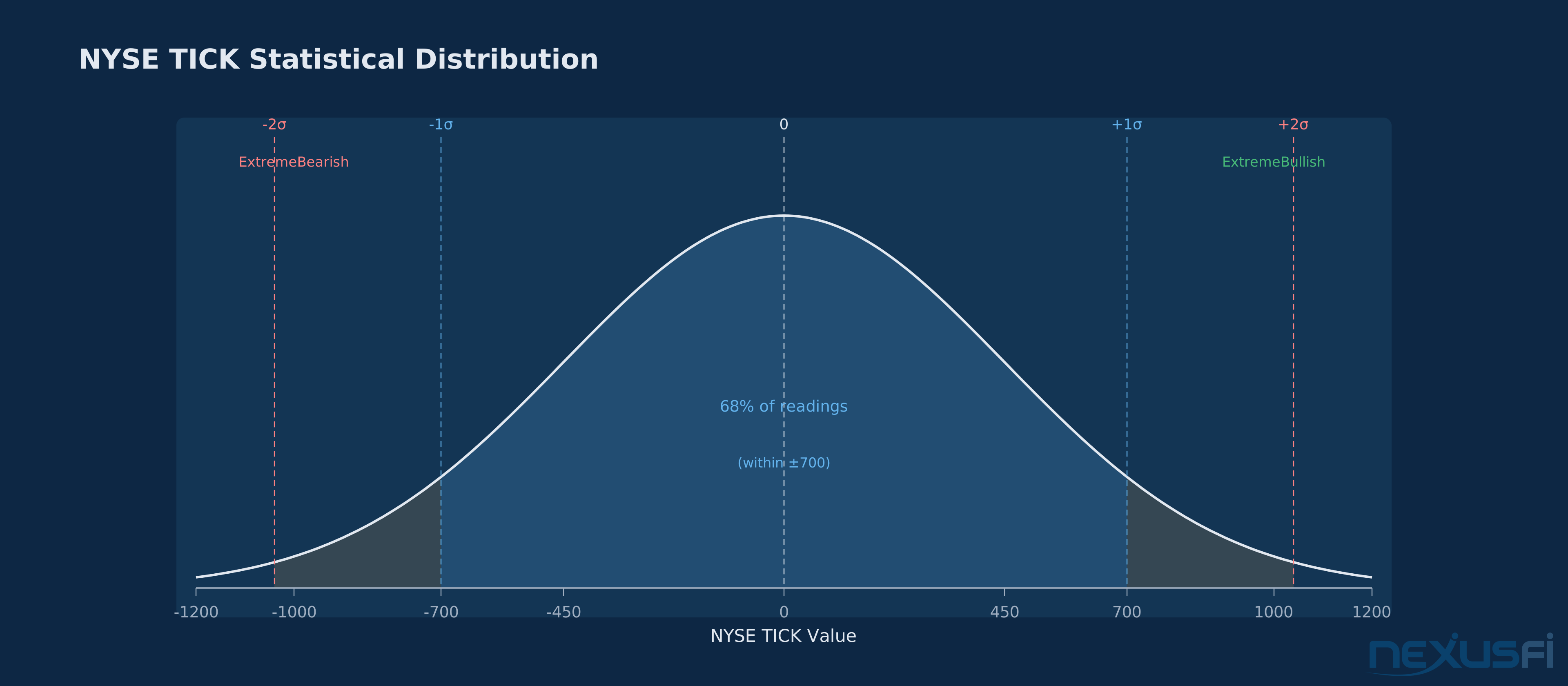
The average one-minute high TICK value is around +250 and the average low is around -250. The standard deviation is approximately 450. That puts the normal range:
- One standard deviation: +700 to -700 (captures ~68% of all readings)
- Two standard deviations: +1,040 to -1,040 (captures ~95% of all readings)
- Extreme readings: Anything beyond +/-1,000 is statistically uncommon
"The NYSE TICK tells us how many stocks are trading at their offer price minus those trading at their bid. It is a great measure of very short-term sentiment, because it captures the degree to which the broad market reflects aggressiveness of bulls (lifting offers) vs. bears (hitting bids)."
-- [tigertrader, NYSE $TICK AND $ADD] [2]
Reading the TICK:
A 10-13 period moving average of the TICK strips out noise from raw one-minute values. The smoothed TICK reveals:
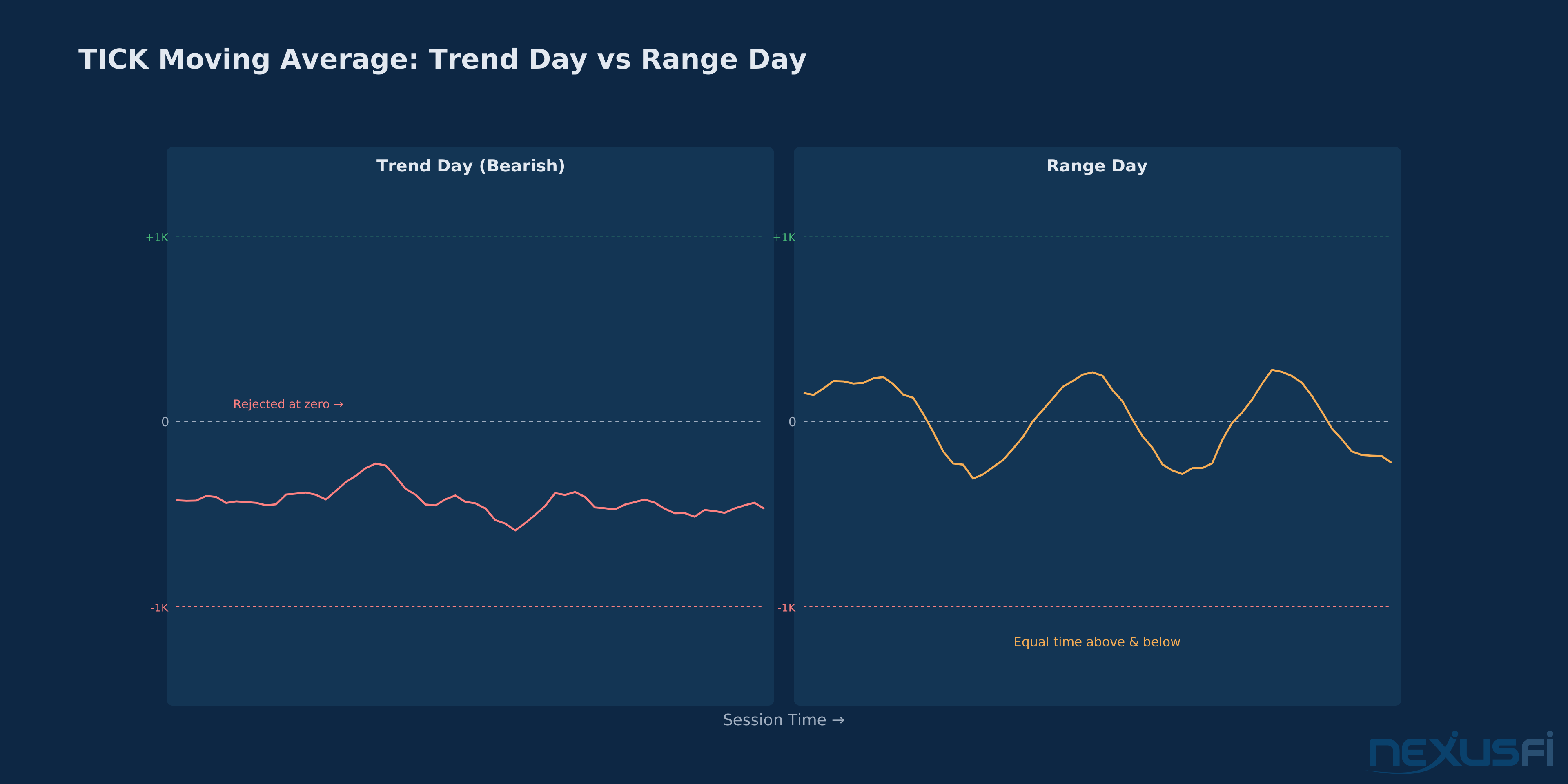
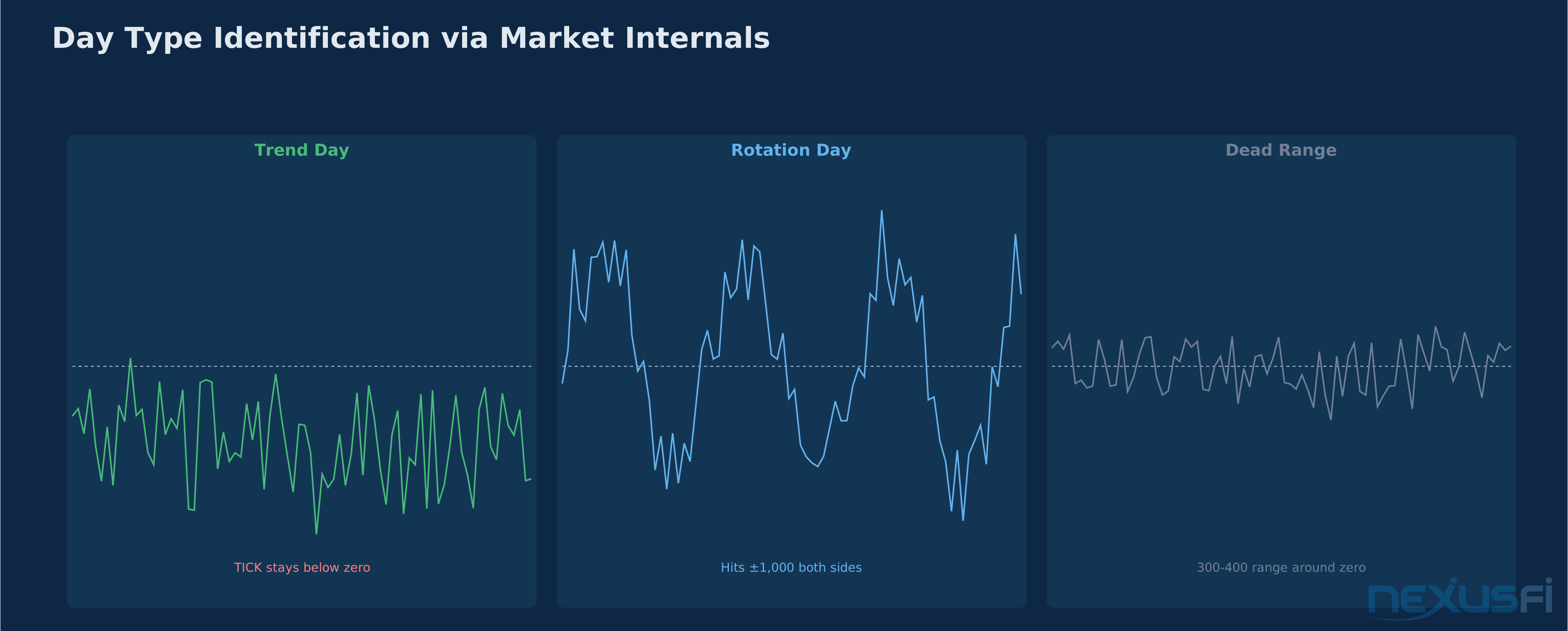
- Trending days: When the TICK MA spends sustained time above or below zero — and pullbacks can't even cross the zero line — you're in a trend day.
- Trend changes: When the MA shifts from predominantly above zero to predominantly below (or vice versa), an intraday trend reversal may be forming.
- Range days: When the TICK MA oscillates fairly evenly around zero, with balanced time above and below, you're in a range day.
"You can often identify strong days to the upside and downside when the first hour's TICK is persistently positive or negative. When TICK MA pullbacks can't even go into positive or negative territory you know that the sentiment is quite negative or positive. That's a hallmark of a trending day."
-- [tigertrader, NYSE $TICK AND $ADD] [2]
The SMA(20-30) Trend Filter:
A widely-used approach applies a 20 or 30-period simple moving average to the TICK on a 1-minute chart. When TICK stays above its SMA, the tape favors longs. When it stays below, the tape favors shorts. The SMA crossovers help separate noisy spikes from genuine shifts in aggression.
"I use the $Tick in the following ways: SMA(30) as a trendfilter on a 1 min chart. This is the most important application of $Tick. It is a second judgement of trend based on market depth. I do not use the traditional +1000/-1000 indication for overbought or underbought. I have replaced this with a fixed channel around the moving average."
-- [Fat Tails, Market Internals] [3]
The key detail: Fat Tails uses asymmetric bands around the SMA rather than fixed +/-1,000 levels. If the trend is up and the SMA sits at +300, a TICK reading of -600/-700 represents a with-trend entry opportunity — not a neutral reading. This dynamic approach adapts to the day's actual behavior rather than imposing static thresholds.
"The TICK is my most important tool when scalping the ES. It can give me a bias, as well as giving a clear picture of how strong each push up or down is... On strong trend days, say down, you will often see price being sold hard every time TICK tries to crawl above 0. With price being sold, TICK is also smacked down hard."
-- [veggen, Spoo-nalysis ES e-mini futures S&P 500] [4]
Advance-Decline Line ($ADD) #
The $ADD tracks the cumulative difference between advancing and declining NYSE stocks throughout the day. Unlike the TICK (which resets with every trade), the $ADD builds throughout the session — it's cumulative.
The 30-Minute Rule:
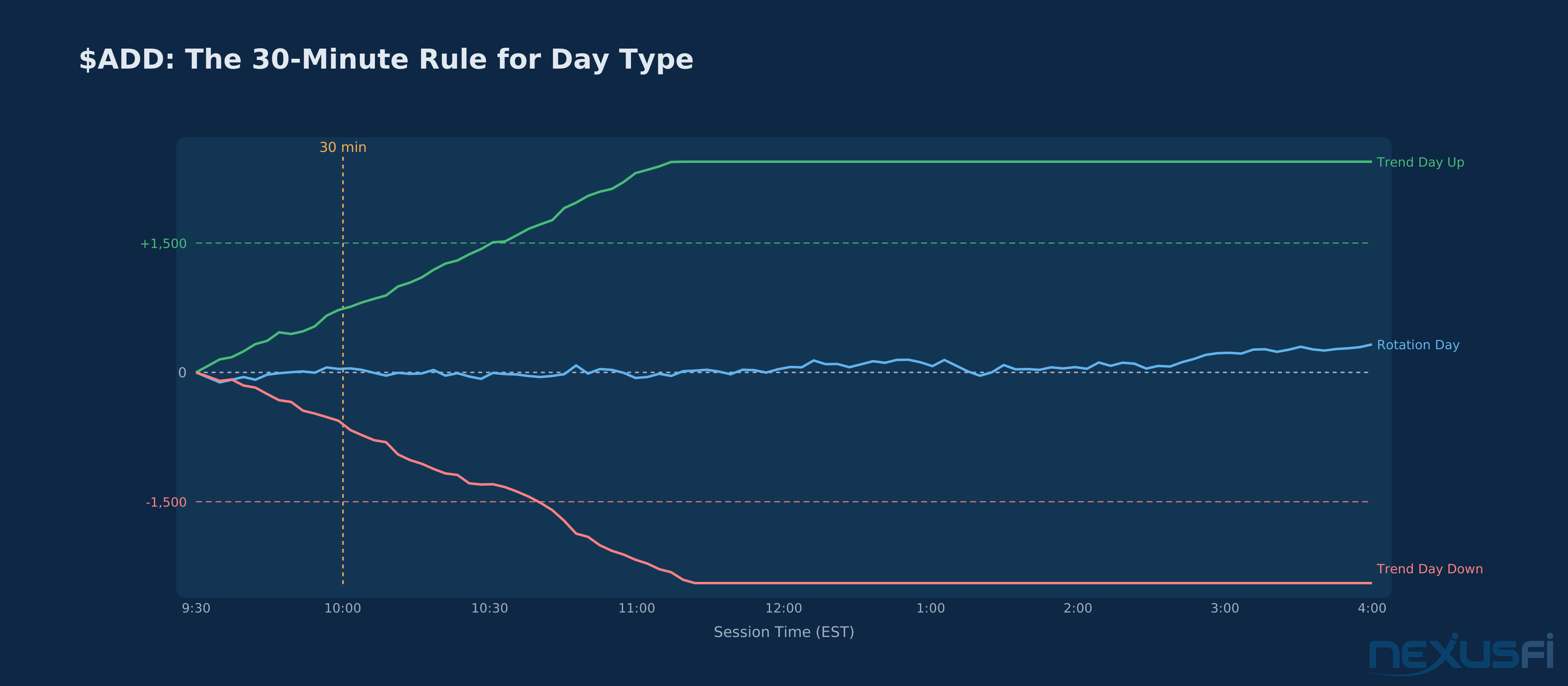
By the end of the first 30 minutes, readings of +1,500 or more (or -1,500 or more negative) strongly suggest a trend day. The opening value for $ADD correlates with the 30-minute value by 0.56. When you see $ADD open at +150 or greater (or -150 or less), that's an early signal of directional commitment.
"Within the first 30 minutes of trading, we should have a pretty good idea of what kind of trading day is ahead of us. If we're seeing $ADD with readings of +1500 or more or -1500 or more (negative), then there is a high probability of a trend day."
-- [tigertrader, NYSE $TICK AND $ADD] [2]
TRIN (Arms Index) #
The TRIN divides the advance/decline ratio by the advancing volume/declining volume ratio:
TRIN = (Advancing Issues / Declining Issues) / (Advancing Volume / Declining Volume)
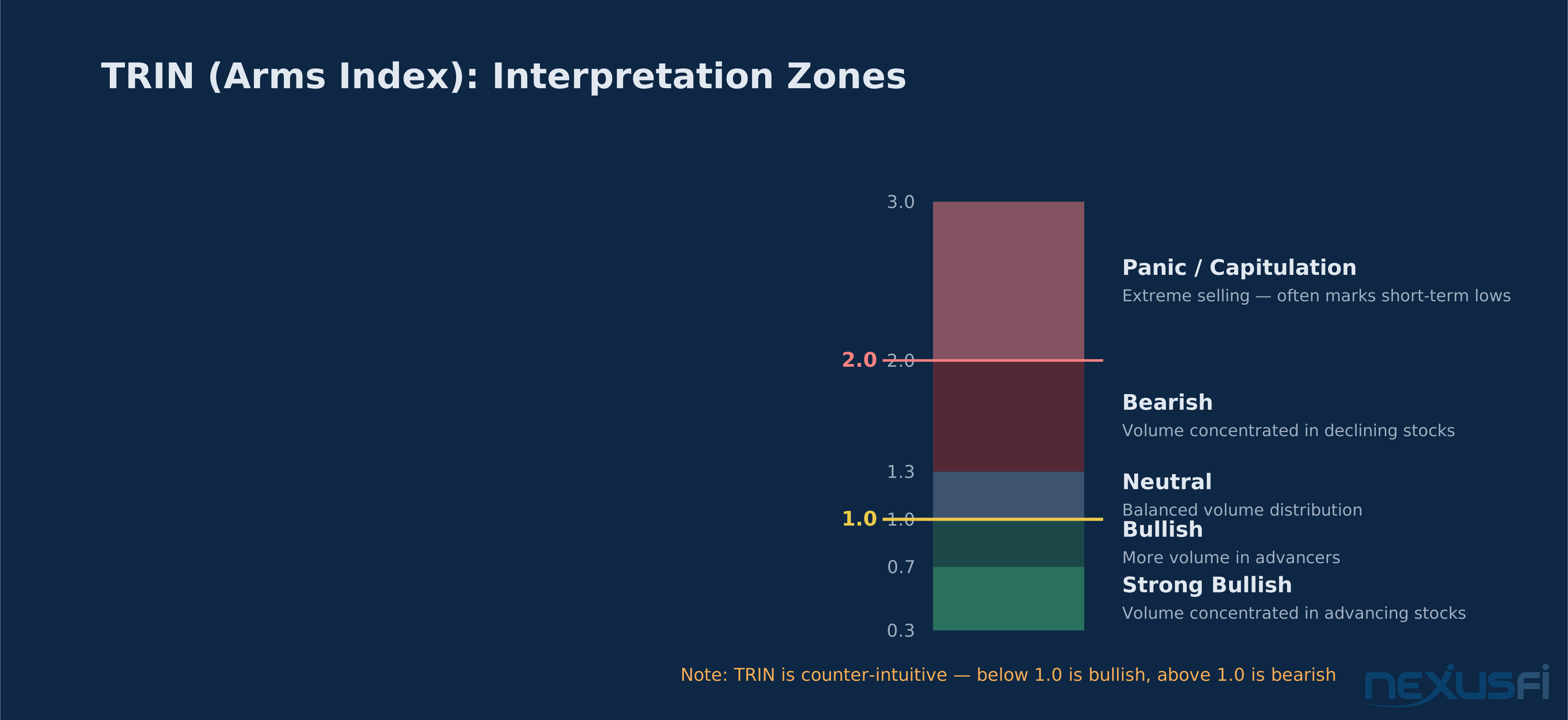
Interpretation runs counterintuitively:
- TRIN below 1.0: Volume concentrated in advancing issues — bullish
- TRIN above 1.0: Volume concentrated in declining issues — bearish
- TRIN at 2.0+: Extreme bearish — selling has reached panic levels, often marks short-term lows
The velocity matters as much as the absolute level — rapidly accelerating TRIN changes indicate intensifying panic or euphoria.
Volume Breadth ($VOLD) #
$VOLD is the net difference between up volume and down volume on the NYSE. Where $ADD tells you how many stocks are moving in each direction, $VOLD tells you where the money is flowing.
The volume spread is calculated as UVOL (volume of advancing issues) minus DVOL (volume of declining issues). Traders watch this for divergence at highs and lows to gauge whether price moves have genuine volume commitment behind them.
"The volume spread I use is from UVOL (volume of advancing issues) - DVOL (volume of declining issues). I usually look for divergence at highs and lows to gauge strength."
-- [rahulgopi, Spoo-nalysis ES e-mini futures S&P 500] [7]
You can have more stocks declining than advancing (negative $ADD) while volume breadth is actually positive — meaning a smaller number of advancing stocks are attracting disproportionate volume. This kind of divergence often occurs when institutional buyers selectively accumulate large-cap names while the broader market sells off.
The Day-Type Decision Tree #
The most powerful application of market internals is day-type identification in the first 30-60 minutes. Knowing whether you're in a trend day, rotation day, or dead range changes everything — your playbook, your sizing, and whether you should be trading at all.
Wait until 10:00 AM ET minimum. The first 10-15 minutes of breadth data are unreliable due to opening auction prints and index rebalancing flows. Internals during this window can show false extremes that mean-revert within minutes.
Step 1: Check $ADD magnitude after 30 minutes.
- $ADD beyond +/-1,500 → High probability trend day. Go to Step 2a.
- $ADD between +/-500 and +/-1,500 → Moderate directional bias. Go to Step 2b.
- $ADD within +/-500 → No directional commitment. Go to Step 2c.
Step 2a: Trend Day Confirmation (strong $ADD)
Verify with TICK behavior:
- TICK MA persistently one-sided (above or below zero) → Confirmed Trend Day. Trade only in the trend direction. Do not fade TICK extremes — they're confirming momentum, not exhaustion. Use pullbacks to the TICK zero line as entry opportunities.
- TICK oscillating despite strong $ADD → Possible rotation developing from an initial push. Wait for TICK to confirm before committing to trend playbook.
Step 2b: Moderate Bias (moderate $ADD)
Check TICK pattern:
- TICK making higher highs and higher lows → Upward rotation day. Favor long entries at structural support levels when TICK pulls back toward zero.
- TICK oscillating between +/-800-1,000 with no persistent bias → Rotation Day. Fade extremes at structural levels. Use TICK +/-1,000 as entry zones with structural confirmation.
Step 2c: No Commitment (weak $ADD)
Check TICK range:
- TICK confined to 300-400 point range around zero for more than two hours → Dead Range. Reduce position size dramatically or stop trading. Directional plays will get chopped.
- TICK making occasional pushes to +/-700 but quickly reverting → Narrow Range. Small-size rotational trades only, tight stops.
"If TICKS are trading in a 300-400 range around the zero line for more than two hours, STOP trading. You will only get chopped up."
-- [hotdog, Market Internals] [8]
The TICK Extreme Context Rule #
Not all TICK extremes are created equal. The same +1,000 reading means completely different things depending on the session's prevailing direction. This is one of the most important nuances in internals trading.
"Fading a tick extreme is usually done best when the extreme is in the prevailing direction. For example, it's been weak all day, tick has been below 0, and there is a 'pukish' tick extreme of -1100. This is usually indicative of a short term capitulation, and can be faded. But when tick is < 0 all day, with a high of about 250, and then makes a new high of ~800 or so, it is almost never a situation you want to jump in short. It usually signals a change in sentiment/trend, and is rarely something to fade."
-- [josh, Spoo-nalysis ES e-mini futures S&P 500] [5]
The rule: fade TICK extremes that go with the prevailing trend (exhaustion in the current direction). Don't fade TICK extremes that go against the prevailing trend (potential regime change). A +800 reading after TICK has been negative all day is the tape telling you something fundamental is shifting. Fighting that is expensive.
"Understanding and determining the Day Type early on is critical to use TICKS effectively. On a Range Day, extreme TICKS usually implies exhaustion and one may attempt to fade. On a Trend day, extreme TICK usually means continuation in the same direction."
-- [rahulgopi, Spoo-nalysis ES e-mini futures S&P 500] [6]
This connects back to the day-type decision tree: classify the day first, then interpret TICK extremes through that lens. Range day extremes are fading opportunities. Trend day extremes are continuation fuel.
ES vs NQ: Which Internals Matter #
ES and NQ respond to different internal data because their underlying baskets differ at the core.
ES (S&P 500 futures) tracks 500 stocks across all sectors. NYSE breadth — TICK, $ADD, $VOLD — provides direct, broad-based confirmation. When NYSE breadth confirms an ES move, the move has genuine participation behind it.
NQ (Nasdaq-100 futures) is concentrated in mega-cap tech. NYSE breadth can diverge from NQ because NQ doesn't need broad participation to move — a handful of AAPL, MSFT, NVDA, AMZN moves can drive the index while 90% of NYSE stocks go nowhere.
The practical rule: use NYSE internals for ES and NASDAQ-specific internals for NQ when your data feed supports it (symbols like TICK-NASDAQ, NISS-NASDAQ). Cross-market confirmation — when both NYSE and NASDAQ internals align — provides the highest conviction signals.
When they diverge, the market is being selective. NQ can rally on tech leadership while NYSE breadth deteriorates — that's a fragile rally. ES can grind higher on broad breadth while NQ underperforms — that's a rotation out of growth.
Trading with Internals: Three Scenarios #
Scenario A: Trend Day Follow #
Setup: 10:05 AM. ES opened at 5,680, moved to 5,695 in the first 30 minutes. $ADD reads +1,800. TICK MA has been above zero since the open, with pullbacks stopping at +100. TRIN at 0.72 (volume concentrated in advancers). $VOLD strongly positive.
Classification: Trend day up. All four internals confirm.
Trade logic: Wait for TICK pullback toward zero line. At 10:20 AM, TICK pulls back to +50 while ES dips to 5,688 (near the Initial Balance high). Enter long. Stop below the IB low (5,675). Target: hold as long as $ADD continues rising and TICK pullbacks don't cross below zero. Trail stop below each higher swing low.
Exit signal: TICK crosses and stays below zero for 10+ minutes, OR $ADD flattens and starts declining. That's the trend losing its engine.
Scenario B: Rotation Day Fade at TICK Extreme #
Setup: 11:30 AM on a rotation day. $ADD hovering near +200, oscillating. TICK has been cycling between +700 and -800 all morning. ES is approaching yesterday's Value Area High at 5,720. TICK spikes to +1,050.
Classification: Rotation day confirmed by oscillating $ADD and balanced TICK cycles. The +1,050 TICK reading at a structural resistance level creates a fade opportunity.
Trade logic: Short ES at 5,718 as TICK begins curling down from +1,050 and ES prints a rejection wick at the VAH. Stop above 5,725 (above the structural level). Target: VWAP or previous session POC, whichever is closer.
Invalidation: If the second TICK extreme exceeds the first (TICK hits +1,150 on the next push), the rotation may be transitioning to trend. Exit immediately — don't hold a fade against a developing trend.
"1000 is a magic number, primarily due to a self fulfilling prophecy. If you watch closely, you will see that if TICK hits +964 for example, there will be no where near the reaction to one of +1005."
-- [hotdog, Market Internals] [8]
Scenario C: The Trap — When Internals Lie #
Setup: 9:45 AM on FOMC day. $ADD opened at +1,200, suggesting possible trend day up. TICK surged to +950 in the first 10 minutes. A trader enters long, expecting trend day conditions.
What happens: At 10:15 AM, $ADD reverses sharply from +1,200 to -400 in 20 minutes. TICK collapses to -600. The initial breadth surge was driven by overnight positioning being unwound and pre-FOMC jockeying — not genuine directional commitment.
Lesson: This is why the 10:00 AM minimum applies, and why FOMC days, NFP releases, and major earnings clusters require modified thresholds. The first 30-minute $ADD reading on event-driven days reflects anticipatory positioning, not organic market sentiment. On high-impact news days, either wait until after the event to classify or discount internals readings by requiring stronger confirmation (e.g., $ADD must hold above +1,500 for 20+ minutes, not just hit it briefly).
When Internals Disagree #
Internals won't always align. Knowing what conflicts mean is as important as knowing what alignment means.
TICK bullish, $ADD flat or declining. Short-term bursts of buying (TICK spikes) without cumulative participation ($ADD not building). Often means a small number of heavily weighted stocks are pushing the index while the broader market isn't following. Low confidence for trend continuation — treat as rotation.
$ADD strongly positive, TRIN above 1.0. More stocks advancing, but volume concentrated in decliners. Possible scenario: many stocks gently rising on light volume while a few are being sold aggressively. Check $VOLD — if volume breadth is negative despite positive $ADD, the weight of money disagrees with the count. Lean toward $VOLD and TRIN over $ADD in this case.
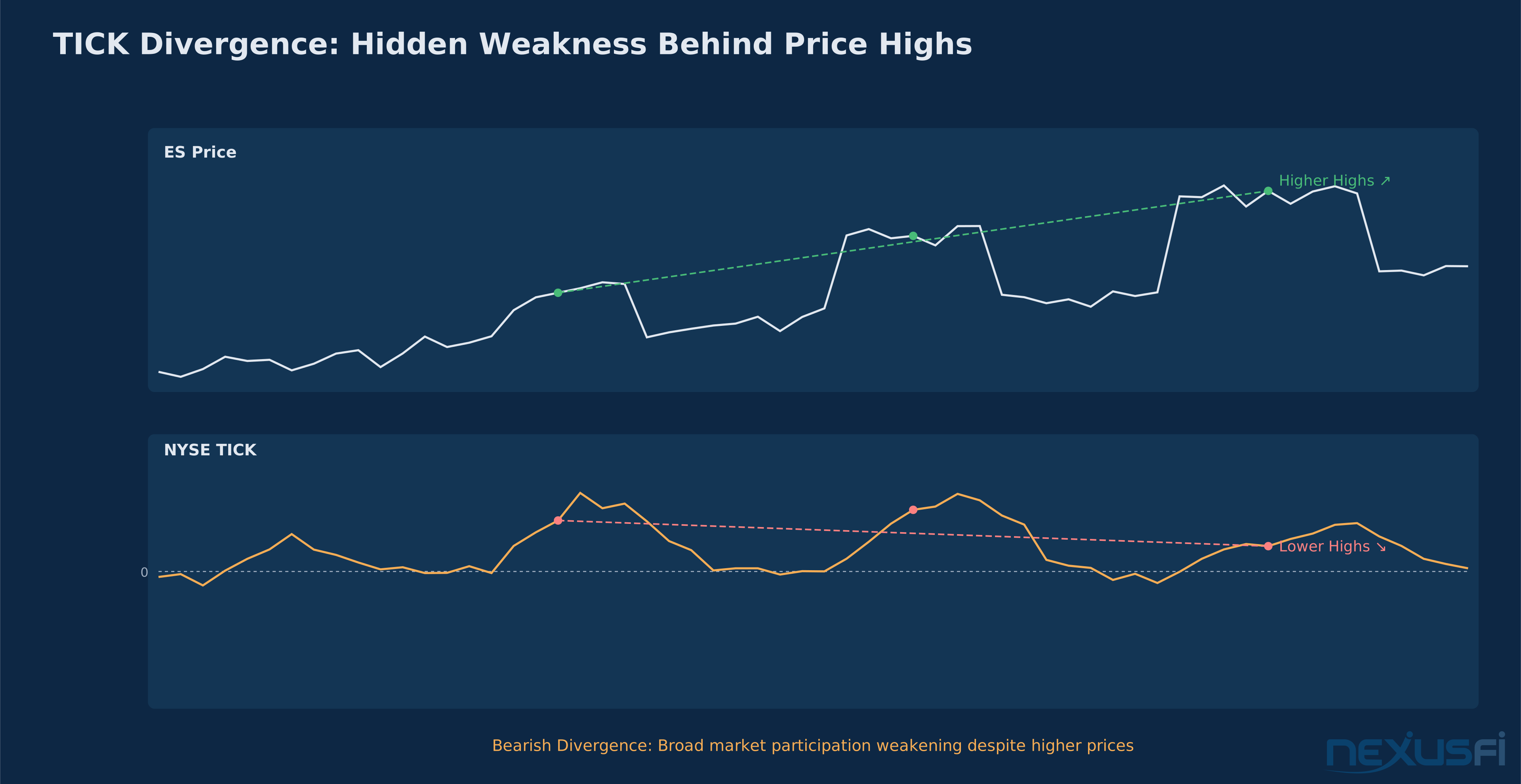
TICK making lower highs, price making higher highs. The classic bearish divergence. Broad market participation is weakening even as the index pushes to new highs. This is most significant when it occurs at structural resistance (VAH, prior POC, round numbers). Tighten stops or take partial profits.
Resolution hierarchy: When internals conflict, volume-based measures ($VOLD, TRIN) generally outweigh count-based measures ($ADD, TICK). Money talks louder than head counts. But context still matters — in thin markets, $VOLD can be distorted by a single large block trade.
The 50-Period MA Framework #
A 50-period moving average applied to the TICK provides a slower, more reliable trend filter:
- Trend change signal: If the 50MA falls below zero for more than an hour, or drops very far below, the trend has probably changed.
- Confirmation signal: If the 50MA falls below zero, rises back above, then falls below again within about two hours, the trend change is confirmed.
- Divergences: The TICK making 3-4 higher lows while price continues making lower lows. Something is changing beneath the surface.
- Pivot points: As the 50MA approaches zero during an established trend, watch for bounces — the zero line often acts as a pivot for TICK-based swing entries.
"Plot a 50MA of TICK and watch the trend of it. If the MA falls below zero for more than an hour, or falls very far below, the trend has probably just changed — an early warning sign."
-- [hotdog, Market Internals] [8]
Internals and Market Structure #
Market internals become even more powerful when combined with structural tools from Volume Profile and Market Profile analysis.
The structural tools tell you where significant levels exist — the Point of Control, Value Area boundaries, High Volume Nodes and Low Volume Nodes. Market internals tell you what's happening at those levels across the entire market.
When ES reaches the prior day's Value Area High and TICK curls from an extreme, the combination of structural resistance plus breadth reversal creates a higher-probability fade entry — see Value Area for level identification mechanics. When the same level test occurs with all four internals confirming the breakout, the structural level becomes a launchpad rather than a wall.
This cross-referencing works at any structural level — Initial Balance extensions, failed auction setups, balance/imbalance transitions.
Failure Modes and Regime Sensitivity #
Opening auction distortion. The first 10-15 minutes of breadth data are noisy. Opening prints, index rebalancing, and overnight order execution create false extremes. Don't classify day type until after 10:00 AM ET at the earliest. A +1,200 TICK reading at 9:32 is not the same signal as a +1,200 reading at 10:15.
Event-driven sessions. FOMC days, Non-Farm Payrolls, CPI releases, and earnings-dense weeks create breadth distortions that don't reflect organic market sentiment. On these days, internals before the event are positioning noise, and internals immediately after are reaction noise. Either wait 15-30 minutes after the event to classify or require sustained readings (not just momentary spikes).
Algorithmic noise at extremes. Modern markets generate brief TICK spikes from algorithmic activity that don't represent genuine breadth shifts. A single one-minute print of +1,050 that immediately reverts is very different from a sustained 5-minute push above +800. Use smoothed readings (10-13 period MA) and require persistence before acting.
Persistent fading on trend days. The most dangerous failure mode. A trader identifies a TICK extreme (-1,100) and fades it expecting mean reversion. But the day is a genuine trend day — five consecutive -1,200 readings in 15 minutes means every +/-1,000 fader just got stopped out and is now fueling the move.
"Avoid playing TICKS against the trend unless you are very experienced. You will get killed. I have seen five -1200 readings in a row (15 minutes) in a very strong downtrend."
-- [hotdog, Market Internals] [8]
NYSE composition drift. The basket of stocks comprising the NYSE changes over time. Dual-listed names, ETF proliferation, and sector rotation alter breadth behavior. Historical baselines (the +250/-250 average, 450 SD) are guidelines, not constants. Recalibrate your thresholds periodically.
Your Workspace #
For effective internals monitoring, set up dedicated panels alongside your trading chart:
- Primary: ES chart with volume profile and key levels
- TICK chart: 1-minute bars with 13-period MA and horizontal lines at 0, +700, -700, +1,000, -1,000
- $ADD chart: Line chart, cumulative from 9:30 AM
- Optional: TRIN and $VOLD if screen space permits
Major data providers for market internals include DTN IQFeed, which offers a complete set of breadth symbols: TICK.Z for NYSE TICK, TRIN.Z for the Arms Index, and separate advance/decline and volume breadth symbols for NYSE, NASDAQ, and AMEX. TICK readings vary between data feeds by 50-100 points — pick one feed, learn its behavior, and develop your interpretation around that specific data stream.
Knowledge Map
Prerequisites
Understand these firstReferences This Article
Articles that build on this topicCitations
- — NYSE $TICK AND $ADD (2011) 👍 21“Thank you for this post. I think that watching market breadth indicators in parallel with index futures produces a real edge.”
- — NYSE $TICK AND $ADD (2011) 👍 47“TICK - First Panel The NYSE TICK tells us how many stocks are trading at their offer price minus those trading at their bid. It is now available on NT with a live Kinetick feed, and goes under the symbol ^TICK.”
- — Market Internals (2010) 👍 8“The Tick is an additional source of information, so it adds a new dimension to trading index futures. Rather I like to use the tick than other price based indicators.”
- — Spoo-nalysis ES e-mini futures S&P 500 (2014) 👍 15“Anna, I am a scalper myself, and the TICK is my most important tool when scalping the ES. It can give me a bias, as well as giving a clear picture of how strong each push up or down is.”
- — Spoo-nalysis ES e-mini futures S&P 500 (2015) 👍 20“Fading a tick extreme is usually done best when the extreme is in the prevailing direction. For example, it's been weak all day, tick has been below 0, and there is a "pukish" tick extreme of -1100.”
- — Spoo-nalysis ES e-mini futures S&P 500 (2015) 👍 11“Understanding and determining the Day Type early on is critical to use TICKS effectively. For e.g on a Range Day, extreme TICKS usually implies exhaustion and one may attempt to fade.”
- — Spoo-nalysis ES e-mini futures S&P 500 (2016) 👍 8“I am no expert but the volume spread I use is from UVOL ( volume of advancing issues ) - DVOL (volume of declining issues ). You may calculate this for S&P (UVOLSP - DVOLSP ), YM etc. Here is the chart for last few days.”
- — Market Internals (2010) 👍 20“$TICK and TRIN are very useful indicators, if used correctly. Unfortunately, IMO, Senters and Carter give people information that can lead to big trouble in attempting to trade these internals, especially on the TICK.”
- — $5,000 Live trading account challenge (2017) 👍 2“I thought, I'll also share my approach to ES trades, especially a potential reversal. I haven't really traded ES much lately but my general approach these days is that in the morning I'll put some alarms on important levels and then it just gets hit...”