



Algorithmic Trading in Futures: From Signal to Execution to Survival
Overview #
Algorithmic trading in futures is the automation of trading decisions — when to trade, what size, how to execute, and how to manage risk — using software that operates without human intervention on every order. It's not just "letting the computer click the button." It's building a complete system where signal generation, order routing, risk enforcement, and performance monitoring all run inside a closed loop that repeats at whatever cadence your strategy demands.
The futures market is where algorithmic trading gets real. Unlike equities, you're dealing with leveraged contracts that expire, roll cycles that change liquidity overnight, tick sizes that constrain your pricing, and margin requirements that can force you flat at the worst possible moment. Every one of those constraints has to be modeled in your system, or your backtest is fiction.
Here's the taxonomy that matters:
Execution algorithms control how orders reach the market. They take a pre-defined intent — "buy 50 ES contracts over the next 20 minutes" — and break it into child orders designed to minimize market impact. They don't predict anything. They manage cost.
Trading algorithms decide when and how much to trade. They run a signal model, generate a target position, and fire orders when conditions trigger. A 5-minute mean-reversion strategy on NQ that opens a position when RSI drops below 30 is a trading algo.
Portfolio algorithms orchestrate across multiple instruments and strategies. They allocate capital, enforce global risk limits, and handle rebalancing. A system running an ES momentum strategy alongside a CL calendar spread with a net-beta cap of 0.4 — that's portfolio-level orchestration.
In practice, these layers stack. A portfolio algo calls a trading algo which fires an execution algo. The boundaries between them are where your architecture either holds together or falls apart.
The Algorithmic Trading Loop #
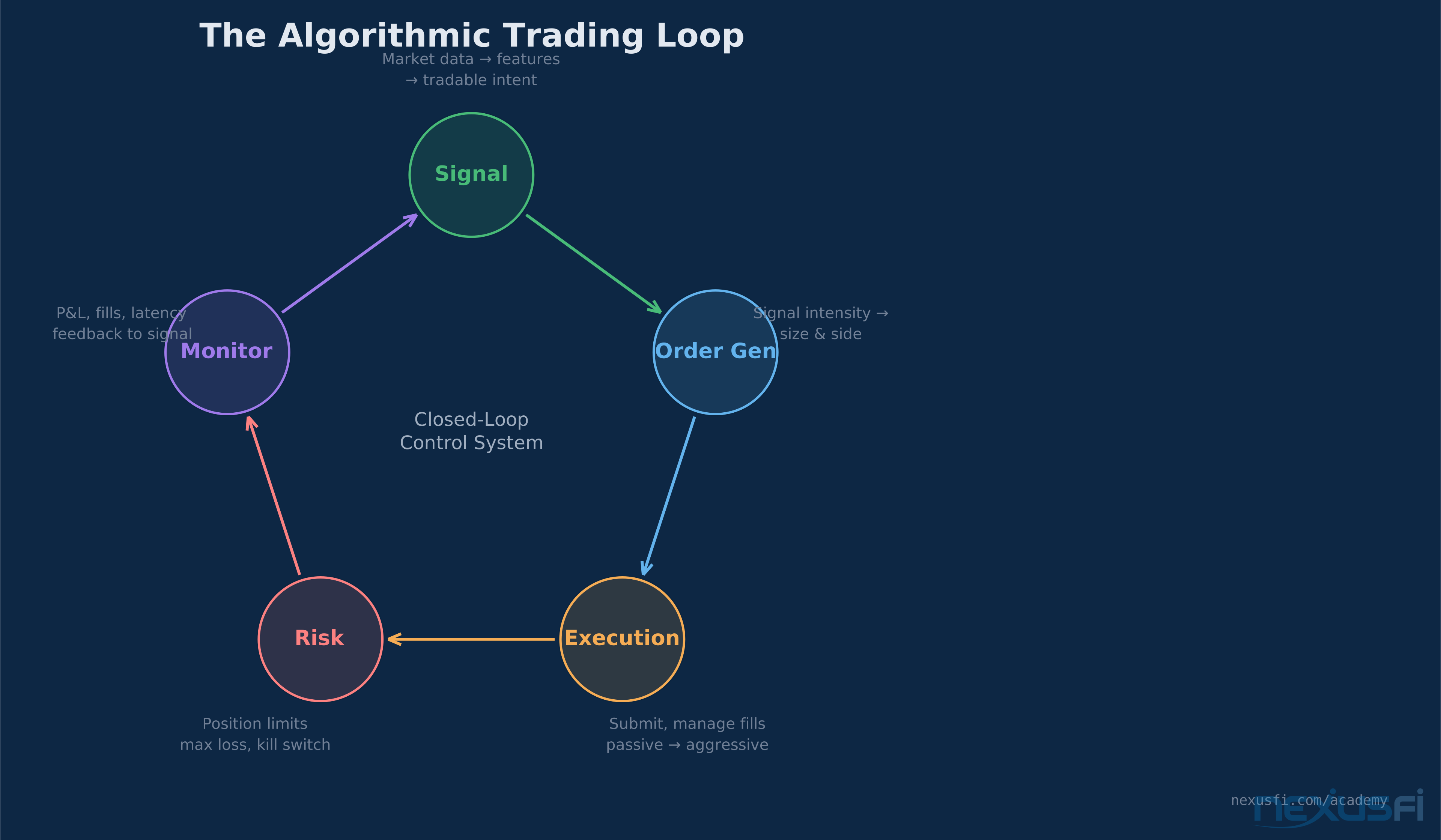
Every algorithmic system runs the same core loop:
Signal → Order Generation → Execution → Risk → Monitoring
It's a closed-loop control system, not a one-shot process. Each cycle evaluates market conditions, decides whether to act, places orders, checks that nothing has blown up, and feeds results back into the next iteration.
Signal generation computes a tradable intent. This might be a z-score, a trend signal, a spread deviation, or a regime classification. Update frequency depends on your strategy — sub-second for microstructure features, every few seconds for intraday models, once per bar for swing strategies.
Order generation maps signal intensity to size and side. A z-score of 2.1 might map to "buy 3 ES contracts" after applying volatility scaling and position-limit checks.
Execution handles the mechanics of getting filled. Submit orders, manage acknowledgements and rejects, handle partial fills, escalate from passive to aggressive if time is running out.
Risk checks run pre-trade and post-trade. Before each order: verify position limits, margin headroom, exposure caps, and order rate limits. After each fill: update P&L, recalculate drawdown, check kill-switch conditions.
Monitoring tracks execution quality, system health, and strategy performance in real time. If slippage exceeds your model by more than 1.5 standard deviations, something is wrong — pause and investigate.
As @MWinfrey emphasized in the Battle of the Bots competition on NexusFi, successful algorithmic development requires treating the entire lifecycle as interconnected — you don't build a signal and then bolt on risk management as an afterthought. The risk controls shape the signal's expression from day one.
Futures Microstructure and Execution Constraints #
Futures execution is defined by constraints that don't exist in equities:
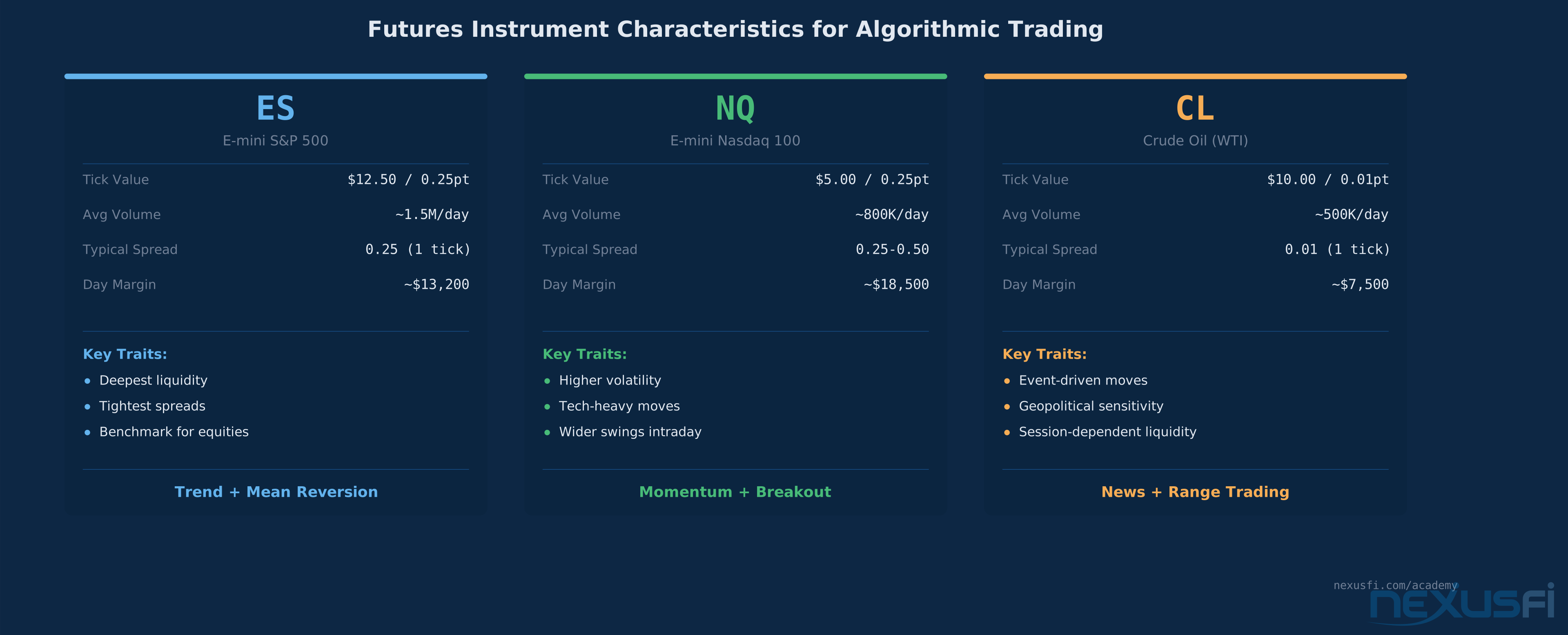
Tick sizes quantize every price you can quote. ES trades in 0.25-point increments ($12.50 per tick). NQ uses the same 0.25-point increment but at $5.00 per tick. CL trades in $0.01 increments ($10.00 per tick). Your order generation must round to valid tick prices — submit a price between ticks and the exchange rejects it.
Order book dynamics determine fill quality. ES typically shows 500+ contracts at the top of book during liquid hours, but that depth evaporates during news events. CL depth is thinner and varies much by trading session. Queue position matters — posting a limit order at the best bid doesn't mean you'll get filled. You're behind everyone who posted before you.
Roll cycles create liquidity discontinuities. ES and NQ roll quarterly (March, June, September, December). CL rolls monthly. Near expiration, spread between front and next month can widen to 5-10 ticks in ES. Rolling rule for most systematic traders: close positions at least 30 minutes before CME final settlement, hedge with the next contract using a calendar-spread limit order.
Slippage is the difference between where you intended to execute and where you actually filled. In liquid ES trading, implementation shortfall runs 0.1-0.3 ticks for passive orders. During news events with aggressive market orders, slippage can exceed a full tick. A realistic slippage budget: 0.3 ticks or less per trade for ES, 0.1 ticks for CL.
As @SMCJB noted from years of professional futures trading, roughly 99% of institutional systematic work is automated, with energy contracts (like CL) presenting especially different microstructure challenges compared to equity index futures.
Signal Engineering for Futures #
Building signals for futures requires handling three problems that kill systems built for equities: non-stationarity, continuous contract construction, and regime shifts.
Feature sourcing draws from multiple data families. Price and return features — log returns, realized volatility, range, drawdown from high. Order book features — bid/ask imbalance, depth at the top level, slope of the book. Trade flow features — aggressor imbalance, buy/sell volume ratio. Term structure features — front/back month spreads, carry measures, roll-adjusted spread dynamics.
Non-stationarity means your features drift. A signal that worked during low-volatility grinding markets will blow up during a vol expansion. The standard defense is rolling normalization:
- Compute rolling z-scores with a 20-60 day lookback:
z(t) = (value - rolling_mean) / rolling_std - Apply volatility scaling to position sizing:
contracts = floor(risk_budget / (ATR * dollars_per_point)) - Use regime filters — only trade when realized volatility falls within a defined band
For ES, a typical intraday signal might use a 5-minute return normalized by 30-day rolling volatility to detect opening-gap patterns. For CL, a calendar spread z-score using 90-day rolling standard deviation captures term structure mean reversion.
Continuous contract pitfalls are where backtests go to lie. A naively stitched continuous series creates artificial price jumps at roll dates, distorts return calculations, and can leak look-ahead information. The fix: backtest on individual contract months and explicitly simulate your roll policy. When @vmodus built the "Attack of the Robots" system, the walk-forward and backtesting methodology emphasized testing each component in isolation before combining — the same principle applies to contract stitching.
Order Generation and Execution Tactics #
Converting a signal into filled orders is where theoretical edge meets market reality.
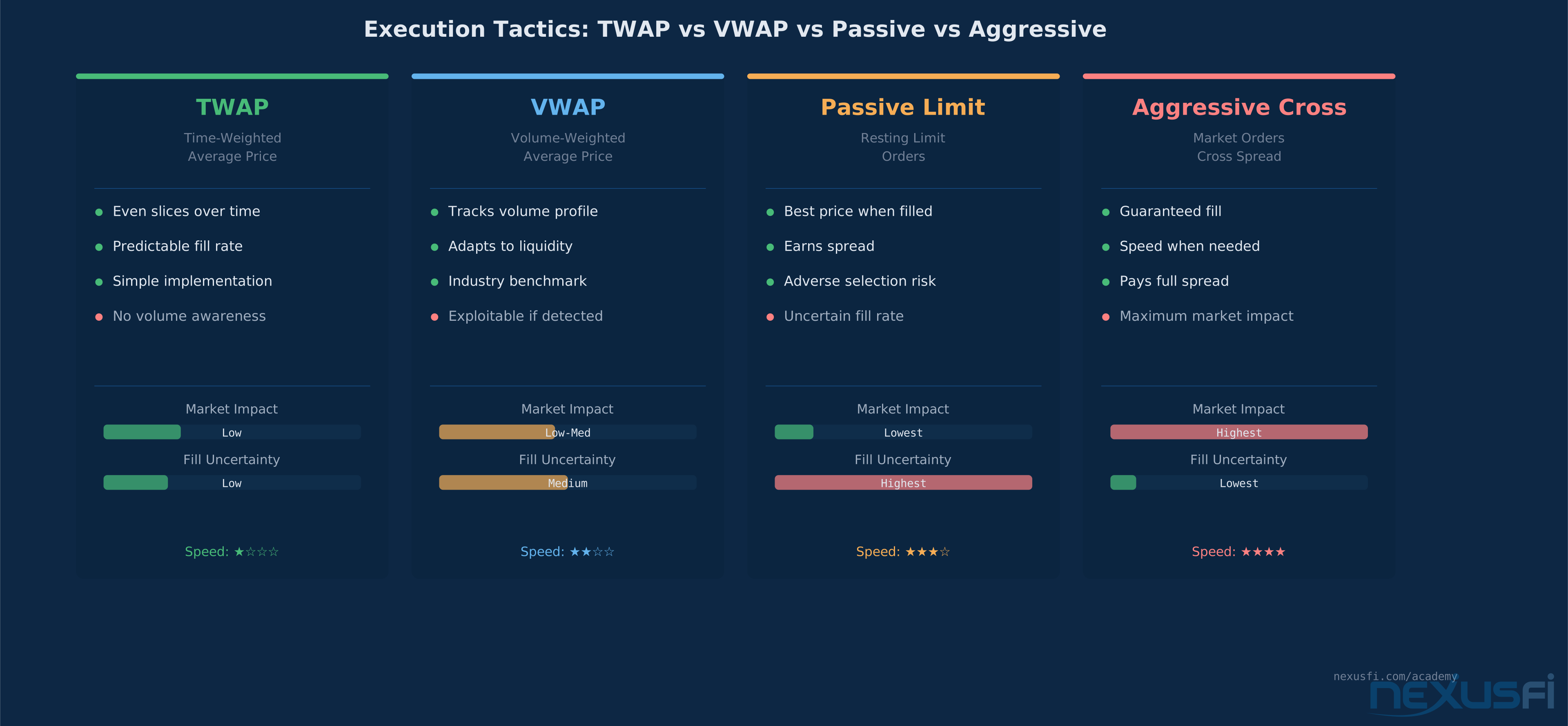
TWAP (Time-Weighted Average Price) splits your total quantity evenly over a fixed interval. Buying 300 ES contracts over 20 minutes means sending 3 contracts every 12 seconds. The adaptation for futures: pause child orders if the spread widens beyond 1.5 ticks, and use minimum slice sizes of 1 contract with bucketed timing.
VWAP (Volume-Weighted Average Price) allocates proportionally to real-time market volume. Set a target participation rate — 8% of observed volume for ES, updated every 5 seconds. If volume spikes above 2x the 5-minute average, accelerate to capture the move. If depth drops below your minimum threshold, pause.
Passive vs. aggressive execution is a continuous tradeoff. Passive: post limit orders at the best bid (for buys) to capture the spread — saves $12.50 per contract on ES. Aggressive: cross the spread with marketable limit orders when urgency exceeds patience. The switching rule most systematic traders use: start passive, escalate to aggressive if unfilled after 30 seconds or if remaining time drops below 20% of the execution window.
Spread execution for calendar or inter-commodity trades requires coordinating two legs simultaneously. For a CL calendar spread (sell December, buy January), target the mid-price limit at the average of the two legs' markets. Enforce a maximum leg imbalance time — if one leg fills and the other doesn't within 20-30 seconds, hedge the exposed leg temporarily or pause.
As @jeffman shared after years of development work, the breakthrough came from developing a successful automated futures strategy with clearly defined rules — the execution layer was just as important as the signal logic itself.
Risk Management by Design #
Risk management isn't a feature you add after the strategy works. It's embedded architecture that shapes every decision the system makes.
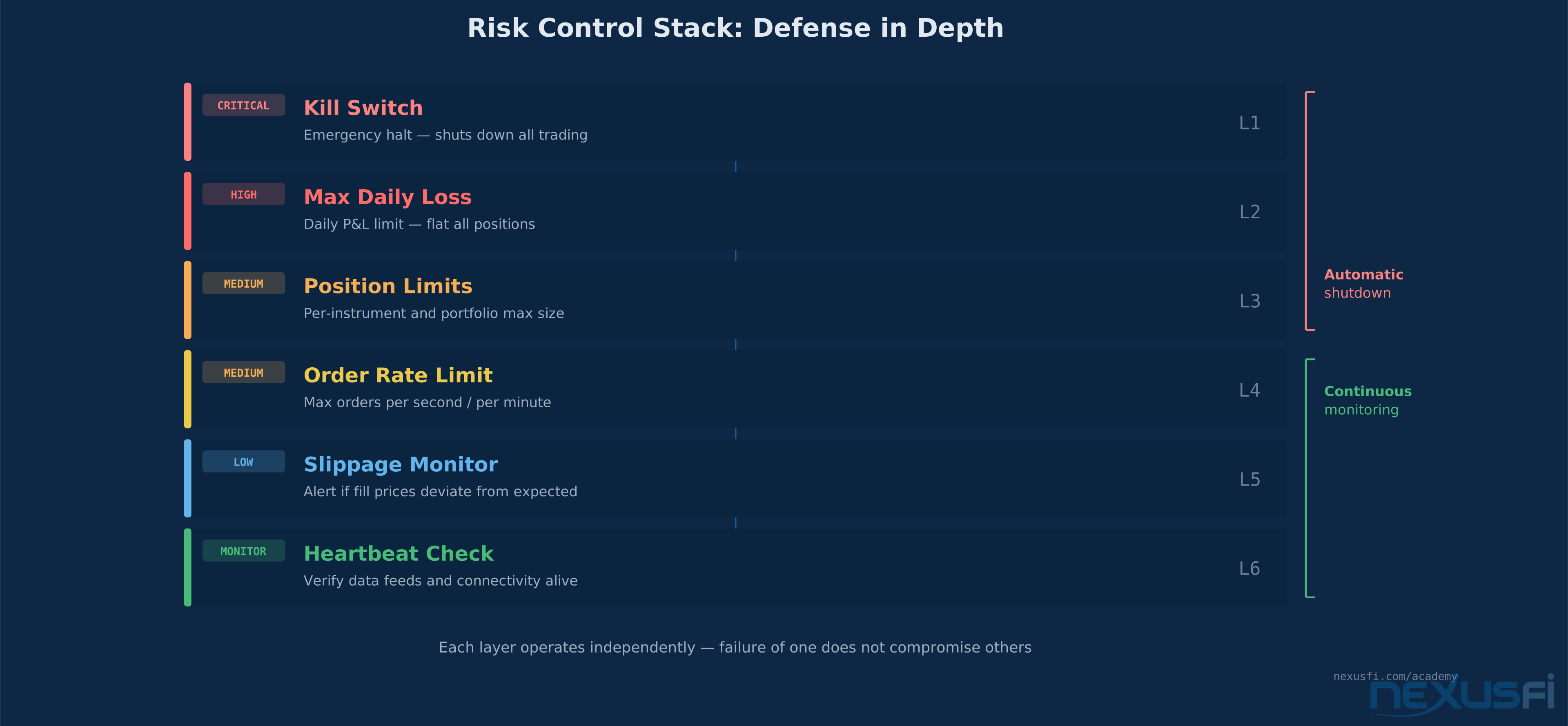
Position limits set hard caps. Per-instrument: maximum 6-30 ES contracts per strategy depending on capital. Portfolio-level: net-beta exposure bounded, correlated exposure across ES and NQ combined within tolerance. These checks run pre-trade — an order that would breach a limit never reaches the exchange.
Margin-aware sizing accounts for the leverage reality of futures. Compute available margin: (Equity - Used Margin) / Initial Margin per contract. Apply a safety buffer of 20% below theoretical maximum. For CL with initial margin around $5,000 per contract and $200K equity, theoretical max is 40 contracts — with the buffer, you cap at 32. In volatile conditions, use stress margin assumptions (add 20% to required margin) to avoid margin calls.
Kill switches are non-negotiable. Auto-cancel all orders and flatten positions if: daily P&L loss exceeds your threshold (commonly $3,000-$10,000 depending on capital), latency spikes above 200ms, order error rate exceeds your limit per minute, or connectivity drops for more than a defined interval. As @Massive l demonstrated across 1,200+ posts in the IchibomB journal, sustained algorithmic profitability requires strict risk parameters — a working strategy means nothing if one bad day wipes out months of gains.
Drawdown controls manage the psychological and capital impact of losing streaks. Common implementations: reduce position size by 50% after 3 consecutive losses. Enforce a rolling 5-day maximum drawdown of 4% of capital — if breached, the system pauses for a cooling-off period before re-evaluating. Scale back to 10-20% of normal sizing after hitting a drawdown trigger, and only ramp back up when equity recovers above a threshold.
Backtesting: Where Most Alpha Dies #
Most strategies that look profitable in backtesting are actually measuring how poorly you modeled execution. The gap between "this works on historical data" and "this makes money live" is where most traders' alpha dies.
Fill modeling is the #1 backtest killer. A naive backtest assumes your limit order fills whenever price touches your limit level. Reality: you're in a queue behind hundreds of other orders, your fill probability depends on depth, volatility, and momentum direction, and aggressive orders create market impact that the backtest ignores entirely.
A realistic fill model:
- Limit orders fill only if price trades through your level, with a queue-position penalty
- Market orders fill at best available with size-dependent slippage:
slippage = half_spread + k volatility participation_rate - Partial fills reduce your effective position size and require handling logic
- Include all fees: exchange, clearing, NFA, and broker commissions (ES is roughly $0.50 per side per contract)
Overfitting is the second killer. If your strategy has 27 filters and 9 hyperparameters and it performs spectacularly in-sample — congratulations, you've built a curve-fitting machine. Constrain tunable parameters to 3 or fewer. Use 10+ years of data when available. If your in-sample Sharpe is 4.0 but your out-of-sample Sharpe is 0.3, the strategy doesn't work.
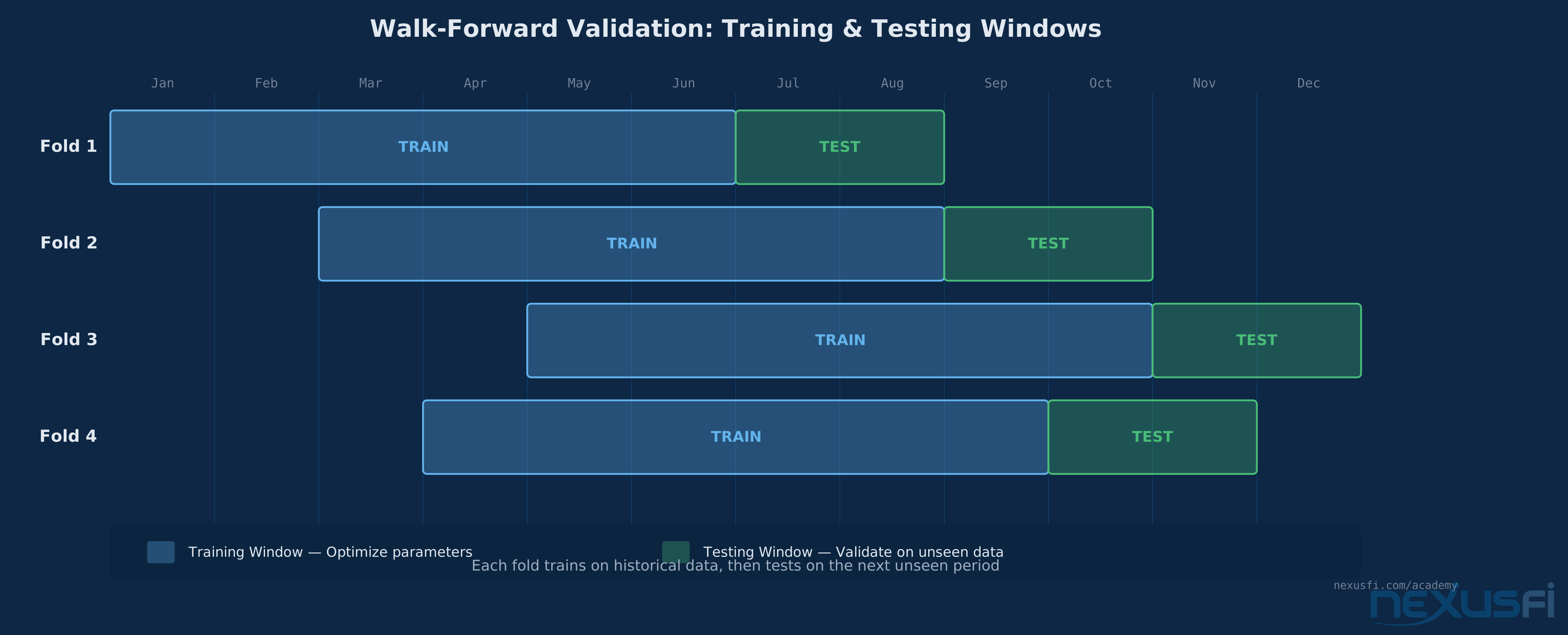
Walk-forward validation is the standard antidote. Train on 252 trading days, test on the next 63 days, roll forward, and repeat 4-5 times. Only strategies that achieve an annualized Sharpe ratio above 1.5 and average slippage within 0.2 ticks across all out-of-sample folds deserve live capital. The NexusFi community has long emphasized this — as @treydog999 documented in the algorithmic development journal, systematic validation through walk-forward testing separates strategies that work from strategies that happened to fit the past. For a complete walkthrough of the methodology, see the Walk-Forward Analysis Academy article.
Related Academy resources:
- Backtesting Trading Strategies — from hypothesis to validated edge
- Monte Carlo Simulation — stress-testing your edge before risking capital
Going Live: Deployment and Monitoring #
The transition from simulation to live trading is where systems thinking matters most. Every assumption your backtest made about fills, latency, and data quality gets tested against reality.
Sim-to-live gaps are expected — plan for them. Start at 10-20% of backtested position size for the first 2-5 trading sessions. Compare simulated fill rates to actual fill rates for the first 100 trades. If the deviation exceeds 5%, something fundamental is different between your model and reality — investigate before scaling up.
Operational controls prevent catastrophic failures:
- Separate development and production environments completely
- Use deterministic strategy IDs with full logging for every decision
- Implement order-type whitelists — only allow the order types your strategy actually uses
- Build auto-cancel triggers for latency spikes: if end-to-end latency exceeds 200ms for NQ or 300ms for CL, degrade to conservative mode or halt
Monitoring KPIs run across three tiers:
Execution quality: Average slippage vs. model expectation. Fill rate vs. target. Adverse selection proxy — how much does price move against you after each fill.
System health: Latency percentiles (50th, 95th, 99th). Order ACK/reject rates. Data feed heartbeat checks. Message queue depth.
Risk metrics: Live P&L vs. backtest expectations. Margin utilization (target: stay below 65%). Net exposure vs. limits. Rolling drawdown.
Escalation protocol: If slippage exceeds your model by more than 1.5 standard deviations, pause and recalibrate. If fill rate drops below 50% of expected within 2 minutes, switch execution mode or halt entirely.
For the complete deployment playbook, see Algo Trading Live Deployment.
The bottom line: Algorithmic trading in futures is a systems engineering problem disguised as a finance problem. The signal is maybe 20% of the work. Execution, risk controls, monitoring, and the discipline to shut down when something is wrong — that's the other 80%. As @Big Mike established with the QuadTrend Algo Strategy Journal, tracking live performance against model expectations is what separates sustainable systematic trading from expensive data analysis.
Key Numbers by Instrument #
| Parameter | ES (E-mini S&P) | NQ (E-mini Nasdaq) | CL (Crude Oil) |
|---|
|
| Tick size | 0.25 pts ($12.50) | 0.25 pts ($5.00) | $0.01 ($10.00) |
|---|---|---|---|
| Participation rate range | 5-15% | 5-12% | 8-20% |
| Initial margin (approx.) | $12-15K | $11K | $5K |
| Max slippage budget | 0.3 ticks | 0.25 ticks | 0.1 ticks |
| Typical intraday stop | ~10 pts | ~8 pts | ~$0.06 |
What to Read Next #
- Backtesting Trading Strategies — Build and validate a strategy from hypothesis to edge confirmation
- Walk-Forward Analysis — The stress test that separates strong strategies from curve-fit miracles
- Monte Carlo Simulation — Test your strategy against thousands of randomized scenarios
- Algo Trading Live Deployment — Take your strategy from backtest to real capital
Knowledge Map
Prerequisites
Understand these firstGo Deeper
Build on this knowledgeReferences This Article
Articles that build on this topicCitations
- — Battle of the Bots - NinjaTrader Algorithmic Strategy Development (2012) 👍 10“Battle of the Bots - algorithmic development as interconnected lifecycle”
- — Retail Trading As An Industry (2024) 👍 9“99% of institutional systematic work is automated, energy contracts present unique microstructure challenges”
- — Attack of the Robots - An Algo Journal (2022) 👍 5“Attack of the Robots - testing components in isolation before combining”
- — Success with Automation....Finally (2016) 👍 12“Successful automated futures strategy development with clearly defined rules”
- — IchibomB Futures Trading (2019) 👍 15“IchibomB journal - sustained profitability requires strict risk parameters”
- — Treydog's Algorithmitic Development Journal (2012) 👍 6“Algorithmic development journal - walk-forward testing separates strategies that work from those that fit the past”
- — QuadTrend Algo Strategy Journal (2010) 👍 7“QuadTrend Algo Strategy Journal - tracking live performance against model expectations”