



Point of Control (POC): The Complete Guide to Volume's Gravitational Center
The single price where more contracts traded than any other — and everything that follows from that fact
Overview #
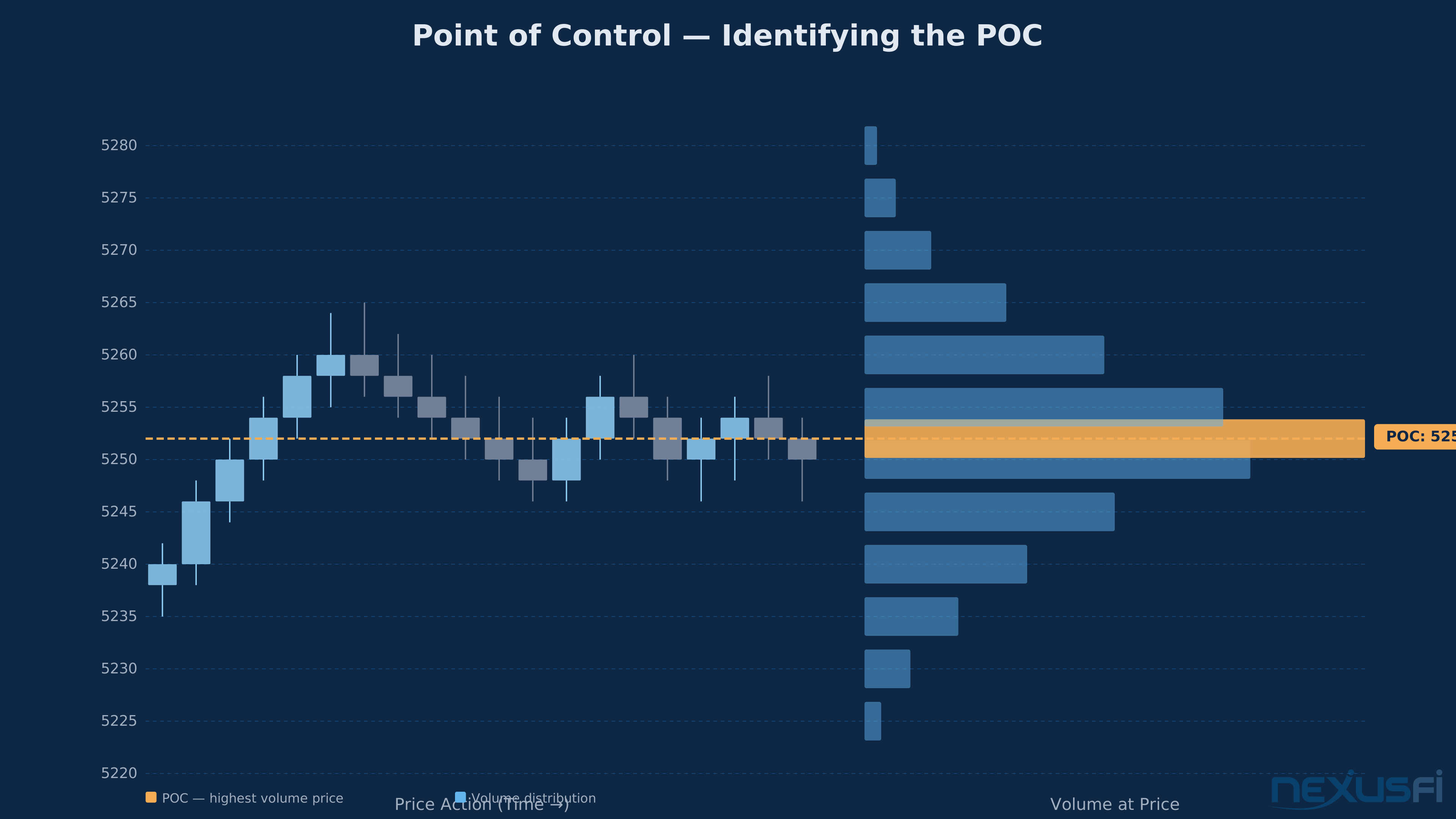
The Point of Control is the price level where the most volume traded within a profile window. It's the statistical mode of the volume distribution — the single price where more contracts changed hands than any other. In practice, the POC acts as a gravitational center. Price pulls back toward it during balanced sessions and uses it as a pivot during rotational days.
This article covers how the POC is calculated, the critical distinction between TPOC and VPOC, how session POC differs from developing VPOC and composite POC, the mechanics of high volume nodes and low volume nodes, how the POC shifts during the day and what that shift signals, POC acceptance versus rejection patterns, multiple timeframe POC analysis, naked POCs, overnight gap behavior, and a complete entry and risk framework for trading around POC levels. For the broader framework that POC fits into, see Volume Profile Trading.
What the POC Is #
[3] That's the right way to think about it. The POC isn't an indicator or a calculated oscillator. It's a descriptive statistic — the price where the most contracts transacted.
The calculation is straightforward. Take the volume profile for your session window. Each price level (bin) accumulates the total contracts traded at that price. The bin with the highest total is the POC. If two bins tie, the one closer to the center of the profile is typically selected, though this varies by platform.
[1] Why does it matter? Because the POC represents the price of maximum agreement between buyers and sellers. It's where the most business got done — and that makes it a reference point for everything else in the profile.
The POC is the price of maximum agreement. It tells you where the market found the most two-sided activity — which is different from where it found the best price or the highest conviction.
TPOC vs VPOC: Two Ways to Measure the Mode #
There are two distinct ways to calculate the Point of Control, and confusing them leads to mistakes — especially in fast markets.
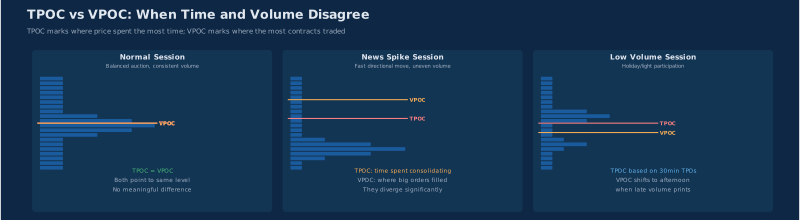
TPOC (Time Point of Control) measures where price spent the most time. In traditional Market Profile, this means the price level where the most 30-minute TPO letters printed. A price that traded for 6 out of 8 half-hour periods gets 6 TPOs. The TPOC is the level with the most TPOs.
VPOC (Volume Point of Control) measures where the most volume traded. It weights each period by actual contracts, not just time presence. A price that traded for 2 periods but did 100,000 contracts gets weighted more than one that appeared in 5 periods with 20,000 total.
The difference matters most in two types of sessions:
News-driven sessions: When a data release drives a fast directional move, price may spend significant time in the consolidation zone before the release (high TPO count) but most volume concentrates at the release levels (high VPOC weight). TPOC points to the pre-news quiet zone; VPOC points to where the real activity happened.
Low-volume days: On holiday sessions or pre-FOMC quiet days, TPOs distribute relatively evenly because price drifts. VPOC captures where whatever volume there was concentrated, which is often different from where price spent time.
For practical day trading, VPOC is the more useful number. Volume-weighted information captures institutional participation better than pure time distribution. When platforms say "VPOC," verify whether they mean true volume-at-price or time-weighted volume — implementations vary.
Session POC vs Developing VPOC vs Composite POC #
These three terms describe the same concept at different stages and timeframes. Confusing them leads to bad trade decisions.
Session POC is the final POC after the session closes. It's fixed and doesn't change. Yesterday's session POC at 5250 stays at 5250 permanently.
[3] Use session POCs as reference levels for the following session — they mark where yesterday's business concentrated.
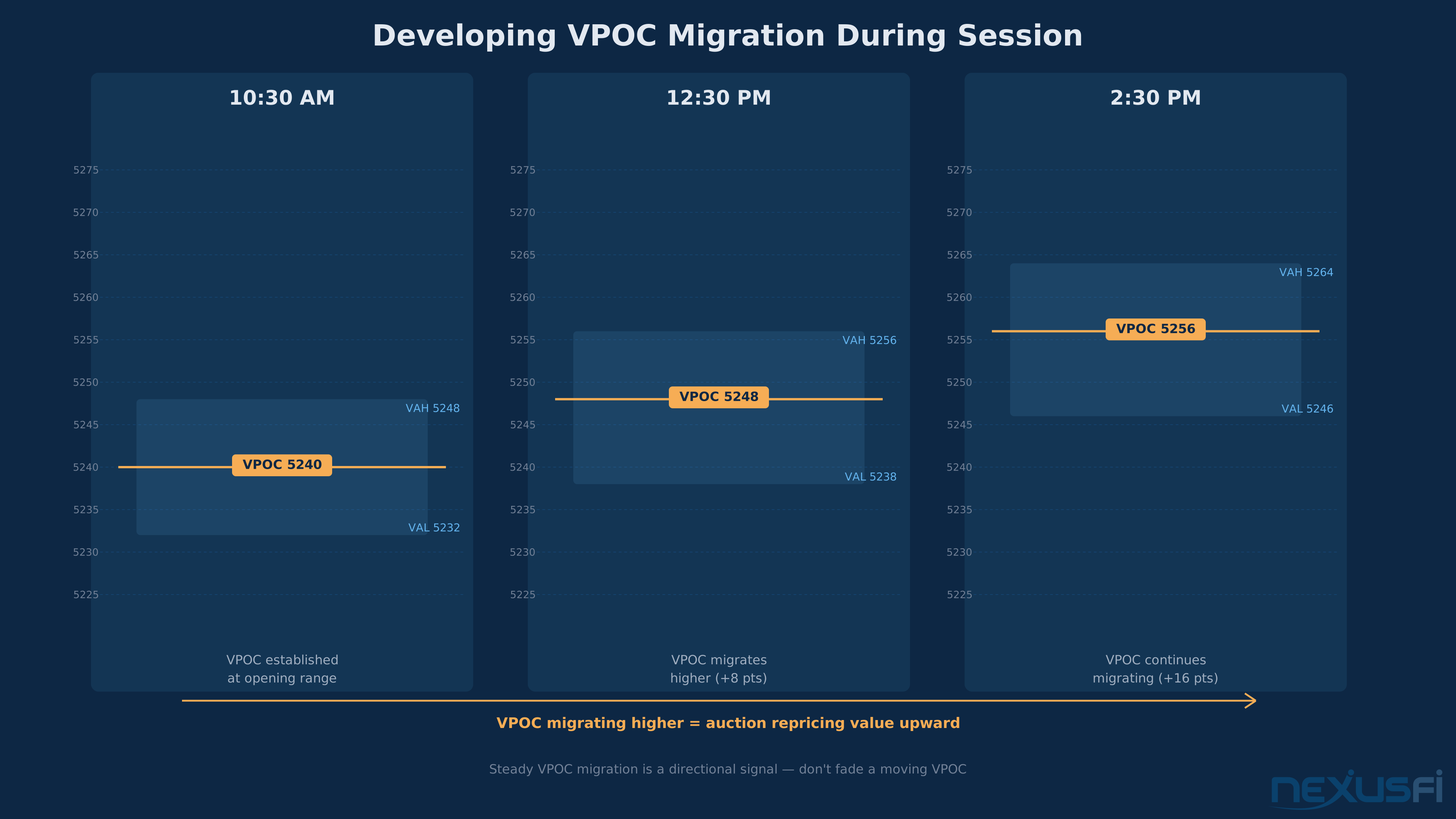
Developing VPOC is the POC of the current, still-building profile. It moves throughout the day as new volume prints. This is the one to watch in real time.
The developing VPOC's behavior during the session is a directional signal. If it migrates steadily higher — shifting from 5240 to 5248 to 5255 over two hours — the auction is actively repricing. Value is moving.
[10] A static VPOC that hasn't moved in two hours means the market is balanced around that level. When the developing VPOC and prior session POC are far apart, one of them is going to act as a magnet.
Composite POC spans multiple sessions and reflects longer-term value acceptance. A 5-day composite POC tells you where the market found the most agreement over that entire week. Composite POCs carry more weight than single-session POCs because they represent sustained acceptance rather than one day's activity.
Watch the developing VPOC during the session. Directional migration = the auction is repricing. Static VPOC = balanced market. The developing VPOC is your real-time compass.
High Volume Nodes and Low Volume Nodes #
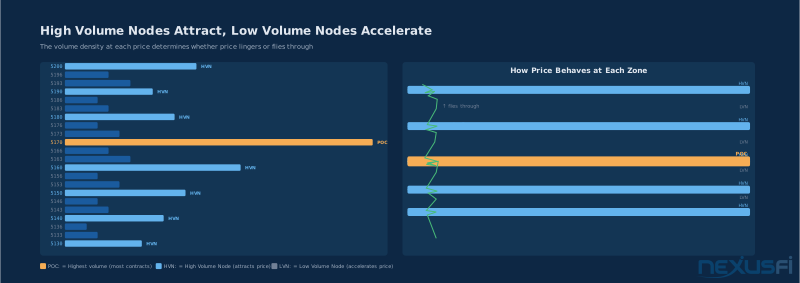
The POC doesn't exist in isolation. Around it, the profile reveals a pattern of high volume nodes (HVNs) and low volume nodes (LVNs) that are as important as the POC itself.
High Volume Nodes (HVNs) are price areas where significant volume accumulated — wide, fat sections of the profile. They represent zones of historical agreement and two-sided trade. HVNs act as magnets: when price approaches an HVN, it tends to slow down, rotate, and help two-way activity. The POC is the highest HVN. Breakouts from HVNs often fail initially — the market pulls back to accept the new price before continuing.
Low Volume Nodes (LVNs) are thin sections of the profile where minimal volume traded. They're not areas of disagreement so much as areas that were quickly transited — price moved through them without pausing to find two-sided participation. LVNs act as acceleration corridors: when price enters an LVN, there's little resting liquidity to slow it down, and it tends to move rapidly toward the next HVN.
The trading implication is direct:
- Entering HVN: Expect chop and rotation. Two-sided trade means your stop may get tested. Size so.
- Entering LVN: Expect fast movement. Limit orders may not get filled. Targets need to be at the next HVN.
- Stop placement: Never place stops inside an LVN above an HVN — the stop will likely get run as price accelerates through the thin zone. Place stops beyond the HVN boundary on the other side.
The HVN/LVN framework also predicts behavior in trending sessions. When price breaks out of an HVN range and enters an LVN corridor, that acceleration is not a reason to chase — it's telling you how far the move will run before reaching the next HVN where rotation risk increases.
In trends, LVNs tell you how far the move has to run before hitting resistance. In ranges, HVNs define the arena. Map both before you decide where to enter.
How the POC Shifts -- and What It Means #
The POC shift during a session is one of the most useful real-time signals in volume profile analysis.
[2] He adds that once the POC has shifted — often toward the end of the lunch session — it presents an opportunity, because "we will push away from the POC into the close." [2]
When price starts to leave the value area and the POC, @Big Mike looks at the context: "Did we just touch on support from prior VAH or VPOC? How did price react at that level? Lots of aggressive buyers? If so, then it seems likely we may indeed move further outside of the value area and continue a trend higher." [5] The POC's relationship to the value area edge tells you whether you're looking at a balanced rotation or the start of a trend.
[4] In other words, the POC's location within the price bar tells you about positioning — whether the heaviest activity favors your side of the trade.
POC migration patterns and what they signal:
A POC that migrates steadily in one direction throughout the day indicates the auction is actively repricing — value is moving. This is a trend confirmation signal. Old POCs from prior sessions may become support or resistance as price migrates away.
A POC that stays static, with price oscillating around it, indicates a balanced session. The market has found fair value and is facilitating two-sided trade. These are the ideal conditions for fade trades from value area edges.
A POC that shifts abruptly — jumping several price levels in a short period — indicates a structural change: a large order flow imbalance pushed volume concentration to a new level. These shifts often coincide with major support/resistance levels being broken.
POC Acceptance vs Rejection #
Not all tests of the POC are equal. The most important skill in POC trading is distinguishing acceptance from rejection — because they call for opposite responses.
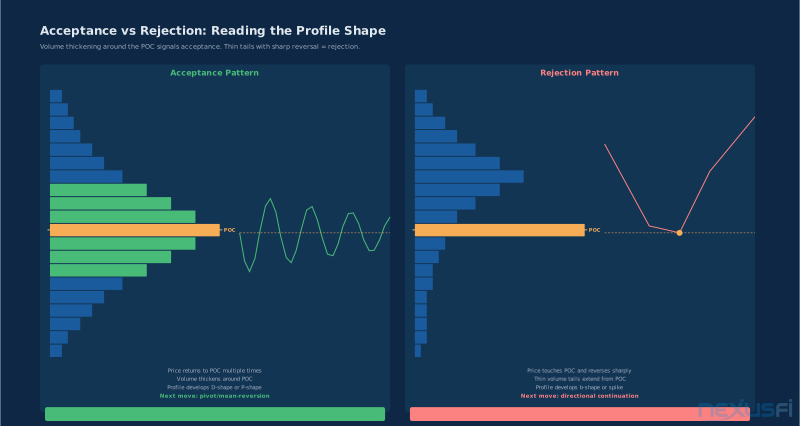
Acceptance occurs when price trades at or through the POC and volume builds around it. The profile "fattens" at the POC level. Price returns to the POC multiple times with lower volatility each visit. Rotational, two-sided activity develops. The POC becomes a pivot: price bounces off it, returns, bounces again. In acceptance, the POC is where the market wants to be — use it as a target from value area edges, and expect rallies or declines to pause and rotate at this level.
Signs of acceptance building:
- Volume accumulates across multiple bins around the POC (not just the exact tick)
- Price approaches the POC and consolidates rather than rejecting
- Developing VPOC stays stable or migrates only slightly
- Delta (bid minus ask volume) stays balanced near the POC
Rejection occurs when price touches or briefly trades through the POC but fails to build volume there. The profile shows a thin spike through the level, with long tails. Price reverses sharply from the POC with increased velocity. Rejection means the current participants view the POC's price as unfavorable — it's a launchpad, not a landing zone.
[11] Prior acceptance above the VPOC was the trade qualifier. Without that acceptance, the setup didn't exist.
Key rule: The second touch of the POC is more informative than the first. If the first test rejects and the second test also rejects with less momentum, the market is confirming departure from that value level. If the second test shows acceptance where the first showed rejection, the market is telling you it's reconsidering.
Don't confuse "price touched the POC" with "price accepted the POC." Touching is just a coordinate. What happens in the 10-15 minutes after the touch — whether volume builds or the market reverses — is the actual signal.
Multiple Timeframe POC Analysis #
Most traders use only the daily session POC. The more sophisticated approach is layering multiple timeframe POCs to identify confluence zones where gravitational pull is amplified.
Daily POC is the most actionable for intraday trading. It updates each session and tells you where yesterday's (or today's developing) value center was. For day traders, this is the primary reference.
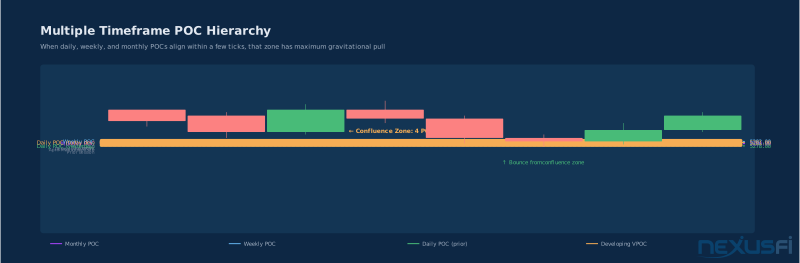
Weekly POC represents 5-day composite value. It smooths out single-day outliers and identifies the zone where the week's auction concentrated. When the weekly POC aligns with a prior day's POC, that zone has both short-term and medium-term significance.
Monthly POC is the macro anchor. It represents extended value acceptance over 20+ trading days. Monthly POC levels often coincide with major structural levels, VWAP ranges, and institutional positioning zones. They don't come into play every session, but when price approaches a monthly POC, expect strong rotational behavior.
How to use the hierarchy:
Alignment is the key signal. When daily, weekly, and monthly POCs converge within a few ticks of each other, that zone has maximum gravitational pull. Confluence POC zones are where the highest-probability mean-reversion trades occur — the market has agreed at this level across multiple timeframes, and price pulling back to that zone has a structural reason to find buyers or sellers.
Conflict is equally informative. When the daily POC points toward 5280 but the weekly POC sits at 5310, you have competing value anchors. The daily session will likely oscillate between them. The one that "wins" (where price spends more time and builds acceptance) reveals the dominant timeframe's bias.
Practical morning checklist:
- Mark yesterday's session POC
- Mark the weekly POC (if available on your platform)
- Note whether they align or diverge
- If aligned: expect strong rotation at the confluence zone
- If diverged: the gap between them is likely to be "filled" by the day's range
Naked POC #
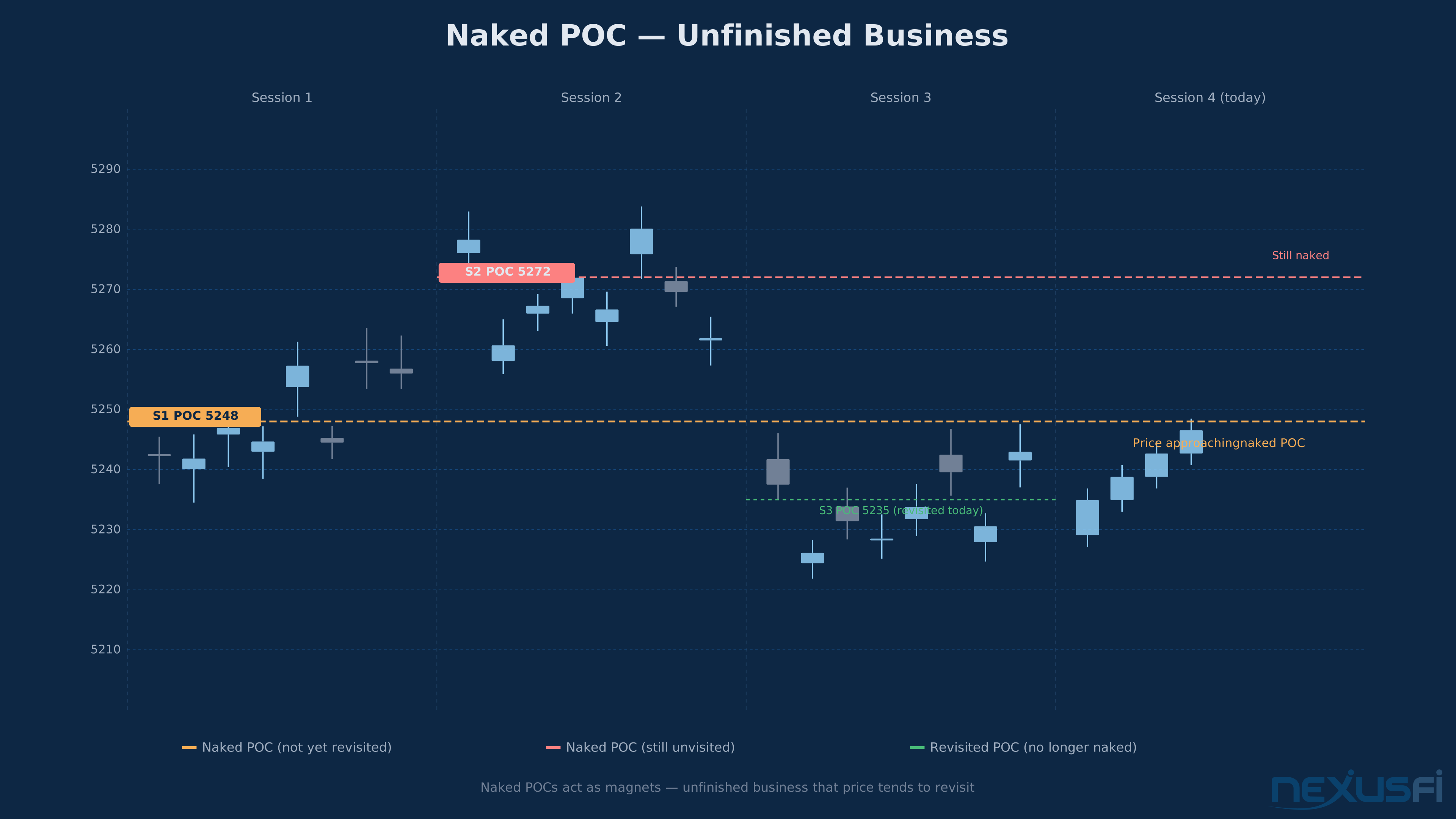
A naked POC is a prior session's POC that hasn't been revisited by price.
Naked POCs function as reference levels — unfinished business that price tends to revisit.
They're high-probability zones of interest, not guaranteed targets.
[6] Nine out of ten is strong, but that tenth day illustrates that naked POCs are probabilities, not certainties.
Their weight decays with time and distance. A two-day-old naked POC 10 points away on ES is a strong magnet — recent, nearby, and likely still relevant to current participants. A three-week-old naked POC 200 points away has lost most of its pull. New inventory and changed conditions have made the original price acceptance less relevant.
Stacking naked POCs: When two or three consecutive sessions leave naked POCs clustered within a tight range, that cluster acts as a strong magnet. The market has consistently found value in that zone and left it. Each naked POC adds gravitational weight.
When naked POCs fail: Trend days are the primary failure mode. When the market is in a strong directional move with committed order flow, naked POCs from below (in an uptrend) simply get run through without generating the expected rotation. Before fading a naked POC, assess the broader context: is the market in balance or in a trend day structure? Fading POCs in trend days is a fast way to lose.
Naked POC relevance decays. As a rough guide, after three sessions a naked POC's predictive relevance drops much, especially if volatility has increased since the level was established. Don't treat a stale naked POC the same as a fresh one.
Overnight Gap Patterns and the POC #
Overnight sessions create a structural challenge: the electronic market runs when participation is thin, establishing its own volume distribution. When the regular session opens, it either accepts the overnight's value or rejects it — and the prior session's POC plays a central role in how that plays out.
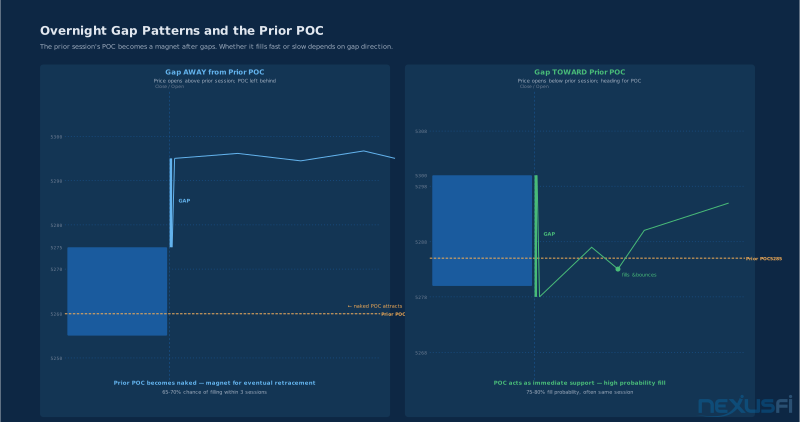
Gap away from prior POC: When price gaps much away from the prior session's POC (opening well above it in an upward gap, or below it in a downward gap), the POC becomes a naked level. The gap leaves unfinished business. Historical data on ES shows that large gaps (more than 1 ATR) from the prior POC tend to fill within 1-3 sessions in about 65-70% of cases, though timing varies widely.
The practical playbook: When price gaps up away from a prior POC, mark that POC on your chart as a naked level. It's not necessarily a same-session fade target (gaps can extend before reversing), but it will act as a magnet during the inevitable rotation. The key question is whether the overnight session built its own acceptance — a well-developed overnight profile suggests more confidence in the new value level and less urgency to fill the gap immediately.
Gap toward prior POC: When price gaps down toward the prior session's POC (or toward a multi-day composite POC), the POC becomes an immediate target and potential support zone. These setups have higher short-term fill probability (75-80% in ES) because price is heading toward established value, not away from it.
Overnight POC versus regular session POC: Platforms that display overnight volume create a second POC from electronic trading. When the overnight POC and the prior regular session POC align within a few ticks, that zone has amplified support/resistance. When they diverge much, the session will often test both levels as it works to establish current fair value.
First-hour resolution: The first 30-90 minutes of the regular session reveal whether overnight value is accepted. If price establishes a new developing VPOC near the overnight POC and stops revisiting lower levels, the overnight price range is being accepted. If price repeatedly rejects the overnight POC and returns toward prior regular session levels, the overnight value is being rejected and the market wants to return to familiar territory.
Trading Around the POC #
The POC's role in your trading depends on the regime.
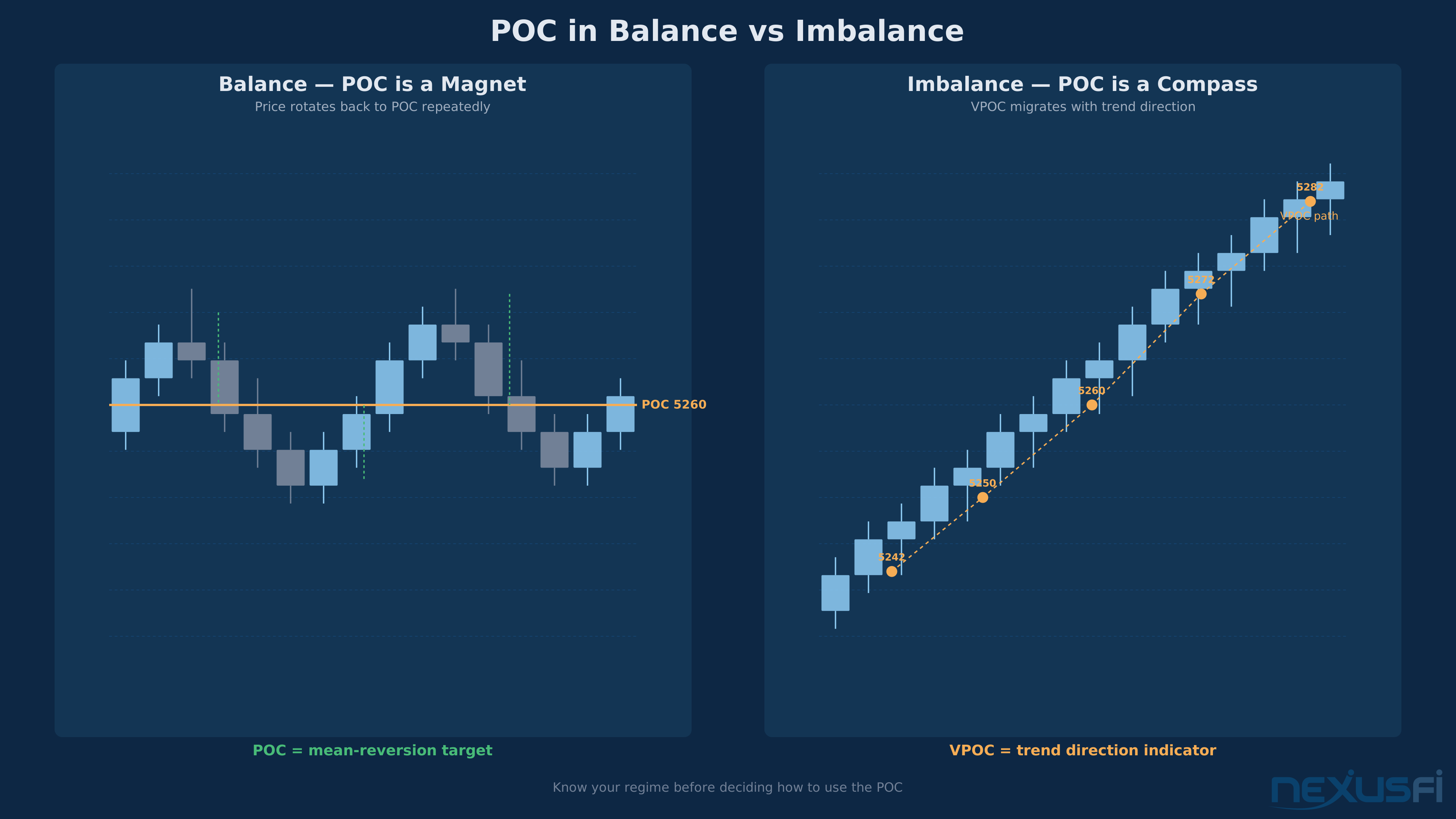
In balanced sessions, the POC is a magnet. Price rotates away from the POC toward value area edges and gets pulled back. Fade trades from VAH or VAL target the POC as the first objective. The POC is where the market wants to be — it's the equilibrium price.
In imbalanced sessions, the POC is a directional marker. If the developing VPOC migrates steadily in one direction, that migration IS the trend signal. Don't fade a migrating POC. Instead, use pullbacks to the developing VPOC as entry opportunities in the direction of migration.
For level identification, @sstheo demonstrates how daily POCs create a map of key levels: he marks the daily POC on each bar to identify confluence zones where multiple sessions' reference levels cluster. [7] When you find a price level where a prior session's POC aligns with other structural levels (highs, lows, closes), that confluence zone carries extra weight.
Execution at the POC: When trading at the POC, use limit orders. The POC is by definition the highest-activity price level — there's liquidity there. Market orders at the POC give away edge in a zone where you should be providing liquidity, not consuming it.
The relationship between VWAP and POC is worth noting.
[10] VWAP and POC near the same price creates a double magnet. When they're near the day's midpoint as well, the gravitational pull is significant enough to fade aggressively from value area extremes.
Balance regime: the POC is your target. Imbalance regime: the POC is your compass. Know which regime you're in before you decide how to use the POC.
Entry, Stop, and Target Framework #
Knowing that the POC matters is table stakes. The edge comes from executing against it with precision.
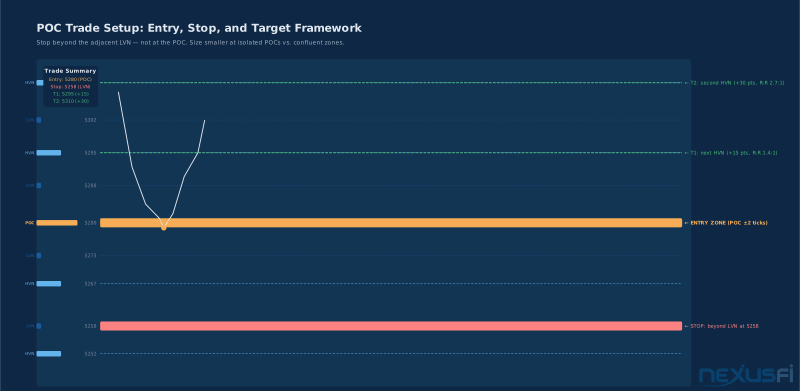
Entry zone: The POC itself ± 2-3 ticks. Not wider. If you're entering 10 ticks from the POC, you're not trading the POC — you're trading a level near it. The entry conviction at the POC comes from its liquidity density. Entering too far away means you're entering in a less liquid zone with worse fill quality.
Stop placement: Never place stops at or just below the POC. The POC is liquid and frequently tested — your stop will be hit by normal rotation and you'll be out before the real move. Stops go beyond the adjacent LVN on the other side of the POC. The LVN defines the "if I'm wrong" level: if price blows through the LVN and starts accepting at the next HVN, the trade thesis is invalid.
Concretely: If the POC is at 5280 and the nearest LVN below is at 5273-5275, stop goes below 5273. If the next HVN is at 5267, that's where your stop sits — just below 5267, where acceptance of failure is confirmed.
Target hierarchy:
- T1: The first HVN above (or below) the POC, in the direction of your trade. In a long from POC at 5280, if the next HVN is at 5295, that's T1. Scale out 50-75% here.
- T2: The value area high (or low) and second HVN. This is a full-position hold only if the first target confirms momentum and developing VPOC is migrating in your direction.
- T3 (runners only): The prior session high (or low) or naked POC cluster above. Hold runners only in clearly trending sessions.
Position sizing at POC:
- At confluence POC (daily + weekly aligned): Full size
- At isolated daily POC (no higher timeframe alignment): 50-75% of full size
- At developing VPOC (still forming): 25-50% of full size — the level is still moving
Stop management after entry: Once price clears the first LVN above your entry and reaches T1, trail your stop to the POC. You're now risk-free or better on remaining position. The developing VPOC often migrates toward the winner's side as the session develops — use that migration to confirm hold or exit decisions.
Common Mistakes #
Treating the POC as a precise line. The POC is the peak of a distribution, not an exact support/resistance level. Think of it as a zone — the bin with the highest volume and the bins immediately adjacent. Don't set limit orders at the exact POC tick and expect a one-tick bounce.
Ignoring session context. A session POC from a low-volume holiday session doesn't carry the same weight as a POC from a 2-million-contract ES session. Consider the volume behind the POC, not just its price.
Using the developing VPOC too early. The developing profile needs data to be meaningful. A VPOC calculated from 15 minutes of trading is noise. Wait for at least the first hour (the Initial Balance) before trusting the developing VPOC as a reference level.
Confusing POC types. The session POC, developing VPOC, and composite POC are different tools for different questions. Session POC = where was yesterday's value center? Developing VPOC = where is today's value migrating? Composite POC = where is multi-day value? Don't mix them.
Fading naked POCs in trending sessions. The naked POC probability (9-for-9 type streaks) applies in balanced, rotational markets. In trend days — D-shaped profiles, strong directional migration, high delta imbalance — naked POCs fail regularly. Context determines whether the magnet applies.
Overweighting isolated POCs. A POC that has no other confluence (no nearby VWAP, no prior session levels, no weekly POC alignment) is a weaker reference. The highest probability POC trades come from confluence — multiple timeframe alignment, VWAP proximity, prior session overlap. Single-timeframe, isolated POCs are lower probability setups.
Mixing up HVN and POC. The POC is a specific HVN — the highest one. But other HVNs in the profile also have gravitational properties. Don't fixate on the POC and ignore a nearby HVN that may be a more relevant structural reference for a particular trade.
Knowledge Map
Prerequisites
Understand these firstReferences This Article
Articles that build on this topicCitations
- — Volume Profile and Footprint discussion (2012) 👍 118“POC = Point of Control, the price where the most volume of the session traded.”
- — Volume Profile and Footprint discussion (2012) 👍 22“Most days you will see the POC shift.”
- — VPOC indicator where can I find please? (2011) 👍 5“The POC is basically mode of the session. The mode is the peak of the volume profile.”
- — Volume Profile and Footprint discussion (2012) 👍 19“I want to see the POC be at the upper or lower end of the bar.”
- — Volume Profile and Footprint discussion (2012) 👍 8“Did we just touch on support from prior VAH or VPOC? How did price react at that level?”
- — Spoo-nalysis ES e-mini futures S&P 500 (2016) 👍 3“I went something like 9 for 9 days fading naked POCs as the key S/R levels.”
- — Making a Living with the Micros (2021) 👍 4“I looked at my daily chart with the daily POC marked on each bar.”
- — Best trading strategy and methodology for 2019 (2019) 👍 6“I draw a dynamic volume profile everyday. This keeps track of the moving Point of Control.”
- — Volume Profile and Footprint discussion (2012) 👍 2“TPOC = Point of control from TPOs. VPOC = Point of control from volume weighted TPOs.”
- — ES vs NQ/YM (2021) 👍 2“When price unwinds it regresses to between vwap and 50% of range and pulls POC there too.”
- — Spoo-nalysis ES e-mini futures S&P 500 (2020) 👍 25“We did rotate above the VPOC for quite some time; this establishes buyers have ability to take it higher.”