



Treasury Futures (ZB/ZN): The Complete Trading Guide
Overview #
Treasury futures are the most actively traded interest rate derivatives in the world. The CME's Treasury complex — ZT, ZF, ZN, ZB, and UB — spans the entire yield curve from 2-year notes to 30-year ultra bonds, giving traders direct exposure to U.S. interest rate movements. For futures traders, Treasuries aren't just "the bond market" — they're the single most important macro instrument on the planet, driving pricing across every other asset class.
What makes Treasury futures distinct from equity index futures? Three things: they're driven by macro narratives rather than earnings, they have an inverse relationship between price and yield that trips up new traders, and their liquidity characteristics change dramatically around economic data releases. As @TheDude puts it: professional bond traders "trade the curve. Period. Just like professional commodity traders trade the oil curve, gas curve, etc via spreads, flys, ratios." [1]
This guide covers contract specifications, price drivers, yield curve dynamics, practical strategies, and the characteristics that make bonds both rewarding and unforgiving.
Key Concepts #
- ZT — 2-Year Treasury Note Futures (CME/CBOT)
- ZF — 5-Year Treasury Note Futures (CME/CBOT)
- ZN — 10-Year Treasury Note Futures (CME/CBOT, the benchmark)
- ZB — 30-Year Treasury Bond Futures (CME/CBOT)
- UB — Ultra Treasury Bond Futures (CME/CBOT, longest duration)
- 32nds — The fractional pricing system used for Treasury futures (1 point = 32 thirty-seconds)
- DV01 — Dollar Value of 01 (one basis point yield change), the key risk metric
- CTD — Cheapest-to-Deliver, the specific Treasury security a short position holder would deliver
- Yield Curve — The relationship between yields across maturities, from short-term to long-term
- NOB Spread — Notes Over Bonds, the ZN-ZB spread trade used to express curve views
- Duration — Sensitivity of price to yield changes; longer duration = larger price moves per basis point
Contract Specifications #
Quoting Convention: Points and 32nds #
Treasury futures don't quote in decimals like ES or CL. They use points and fractions of a point, where each point = 32 thirty-seconds.
A ZB quote of 118-16 means 118 points and 16/32nds = 118.50 in decimal. A ZN quote of 110-240 means 110 points and 24.0/32nds = 110.750. The trailing digit after the dash in ZN/ZF/ZT represents half-ticks (0 = 0/4, 2 = 1/4, 5 = 2/4, 7 = 3/4 of a 32nd).
This quoting convention trips up traders coming from other markets. Get comfortable converting mentally: each 32nd = $31.25 for ZB ($1,000 / 32), and each half-32nd (1/64) = $15.625 for ZN.
The Contract Lineup #
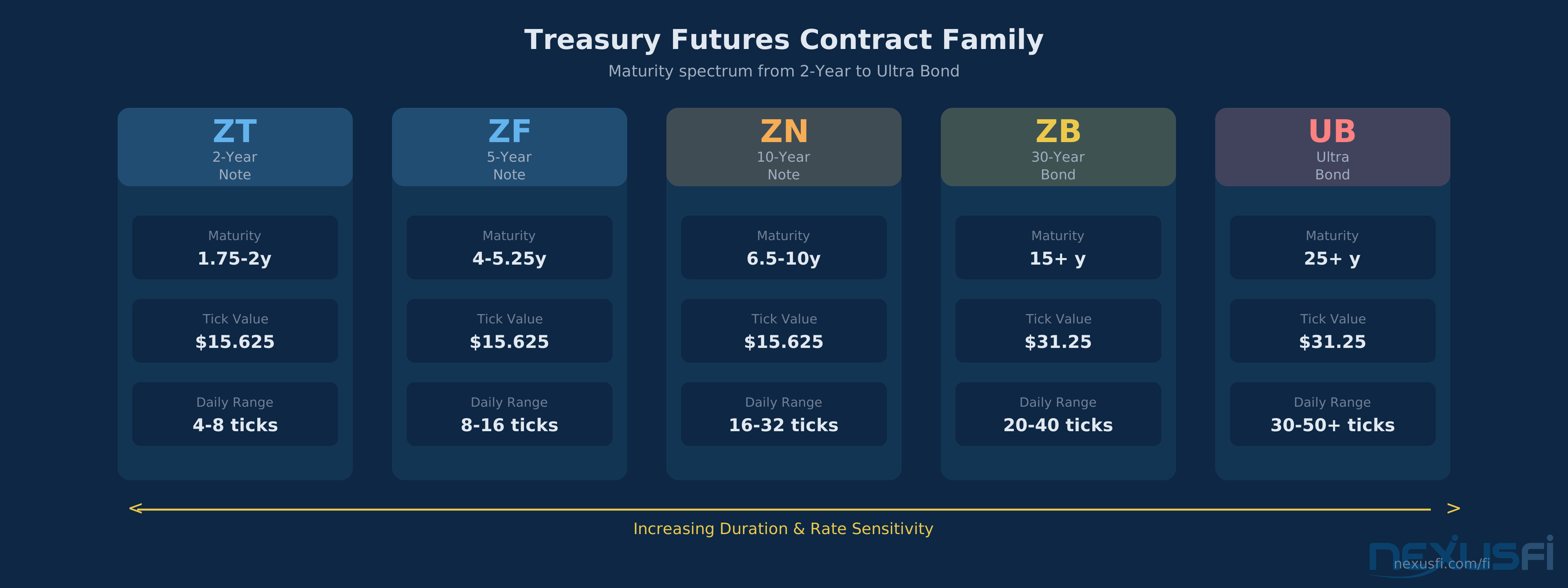
ZN (10-Year Note) is the benchmark. It's the most liquid Treasury future, consistently trading 1.5-2 million contracts daily. The deliverable basket accepts Treasury notes with 6.5 to 10 years remaining maturity. Tick size is 1/64 of a point ($15.625).
ZB (30-Year Bond) is the volatility king. With roughly twice ZN's daily range, it's the contract of choice for directional traders who want maximum P&L per tick of yield change. Tick size is 1/32 of a point ($31.25).
in terms of average daily range — a direct function of duration differences across the curve. [2]
ZF (5-Year Note) sits in the belly of the curve. It's heavily influenced by near-term Fed policy expectations — more responsive to FOMC meetings than ZB but less sensitive to long-term inflation narratives. Tick size is 1/128 of a point ($15.625).
ZT (2-Year Note) is the pure Fed policy instrument. It moves almost exclusively on rate expectations. Lower volatility but extremely responsive to monetary policy signals.
UB (Ultra Bond) delivers the highest duration in the complex. When you want maximum interest rate exposure, UB provides the most price movement per basis point of yield change.
Price-Yield Relationship #
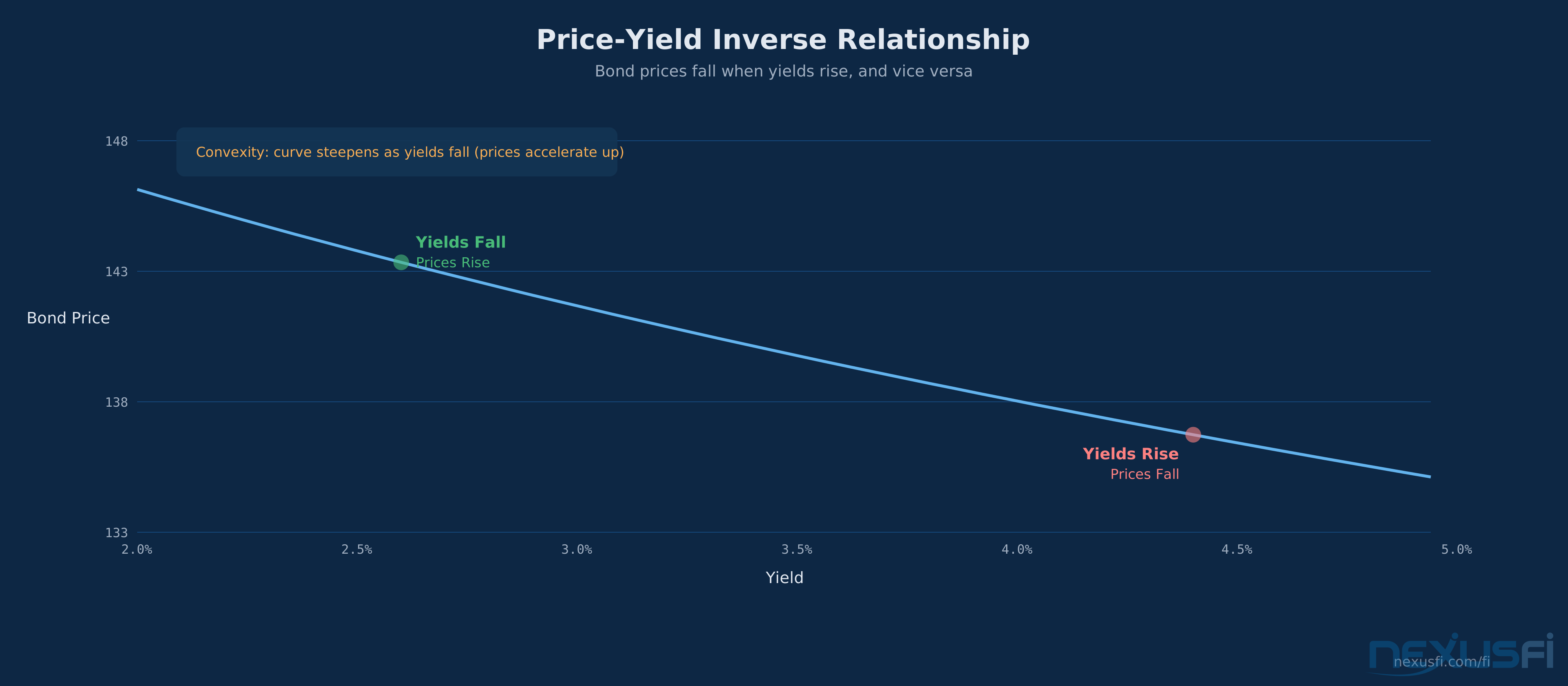
The single most important concept in Treasury futures: price moves inversely to yield. When yields rise (rates go up), bond prices fall. When yields fall (rates go down), bond prices rise.
This inverse relationship creates specific dynamics:
- Duration effect: Longer-maturity contracts move more for the same yield change. ZB moves roughly 2x what ZN moves for an equivalent basis point shift.
- Convexity: The price-yield relationship isn't linear. As yields fall, bonds accelerate upward; as yields rise, bonds decelerate downward. This matters for large moves.
- DV01 (Dollar Value of 01): The dollar change in contract value for a 1 basis point yield change. Critical for properly sizing curve trades. @Schnook describes building "a simple spreadsheet using DV01 data straight from the CME" to properly ratio yield spread trades. [3]
Cheapest-to-Deliver (CTD) Mechanics #
Treasury futures are physically deliverable, but the short position chooses which specific Treasury security to deliver from a basket of eligible issues. Each eligible security has a conversion factor that adjusts for its coupon and maturity relative to the contract's notional 6% coupon.
The CTD bond is the one that's cheapest for the short to deliver — it has the highest implied repo rate. For most traders, CTD matters because it determines the effective duration of the contract. When the CTD shifts (which happens when yields cross certain thresholds), the contract's price behavior changes.
Price Drivers #
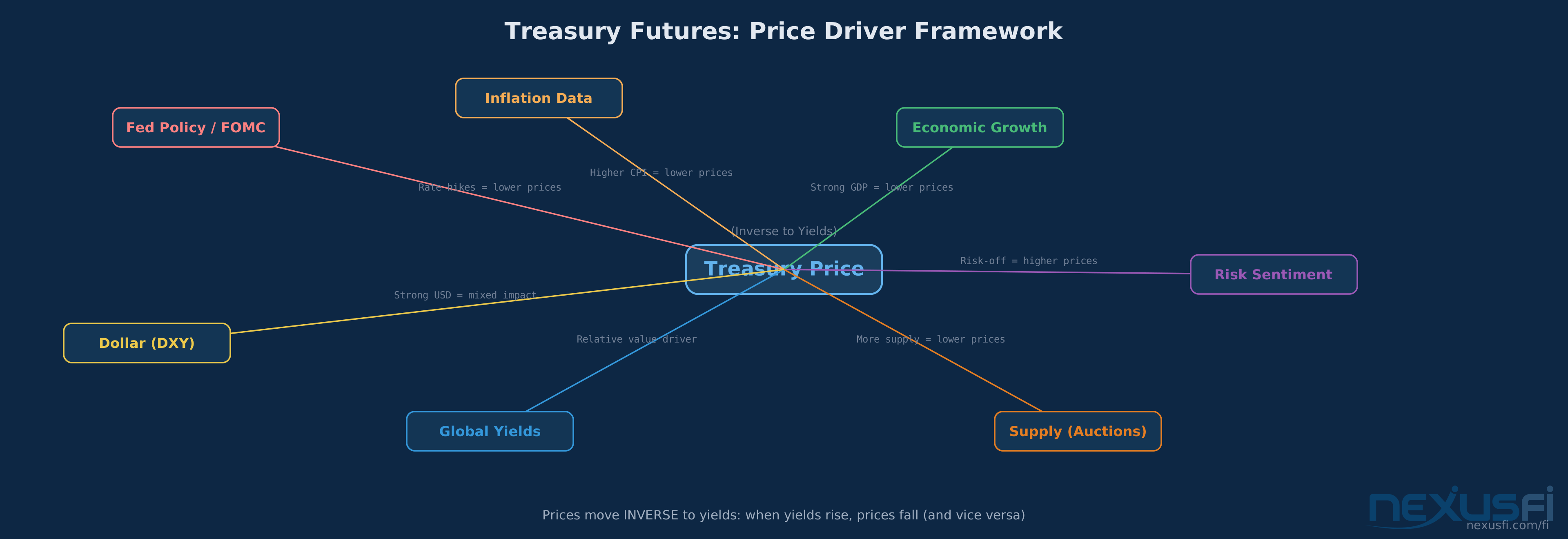
Critical reminder: Treasury prices move inverse to yields. When yields rise, prices fall. When people say "bonds sold off," they mean prices dropped (yields rose).
Fed Policy (FOMC) #
The single most important driver. The Federal Reserve sets the federal funds rate, which directly influences the short end of the curve (ZT, ZF). The long end (ZB, UB) responds to expectations about the Fed's entire rate path — not just the next meeting, but the terminal rate and how long it stays there.
FOMC days produce the largest Treasury moves. The 2:00 PM ET statement release and 2:30 PM press conference can move ZN 20-40+ ticks in minutes. The "dot plot" (quarterly Summary of Economic Projections) often matters more than the rate decision itself.
Inflation Data #
CPI and PCE releases are the second-most impactful events. Higher inflation forces the Fed to keep rates elevated (bearish for Treasury prices). Lower inflation gives the Fed room to cut (bullish for prices).
Core CPI is the key number. A +0.1% deviation from consensus can move ZN 8-15 ticks immediately. The month-over-month number matters more than year-over-year for market reaction.
Economic Growth and Employment #
NFP (Non-Farm Payrolls), GDP, ISM, and retail sales all move Treasuries. Strong economic data is bearish for prices (implies the Fed stays tight). Weak data is bullish (implies the Fed will need to ease).
NFP is the largest non-FOMC mover. The headline number, unemployment rate, and average hourly earnings each matter. A payroll miss of 100K+ from consensus can move ZN 15-25 ticks.
Treasury Supply (Auctions) #
The U.S. Treasury conducts regular auctions: 2-year and 5-year monthly, 10-year and 30-year quarterly (with reopenings). Auction results — especially the bid-to-cover ratio and tail — signal demand. A strong auction (low tail, high bid-to-cover) typically pushes prices higher. A weak auction (high tail, low demand) pushes prices lower. As @Symple analyzed: "Going long ZN or ZB using technical levels or macroeconomic catalysts as entry points" is the standard approach, with inflation data and Fed communications as the primary reversal signals. [4]
Risk Sentiment and Flights to Quality #
Treasuries are the ultimate safe-haven asset. During equity selloffs, financial crises, and geopolitical shocks, money flows into Treasuries (prices rise, yields fall). During the March 2020 COVID crash, ZN rallied 6+ points in a week.
The correlation between equities and Treasuries is regime-dependent. In "normal" environments, they're inversely correlated. During liquidity crises, correlations can flip — everything sells together as leveraged positions unwind.
Yield Curve Dynamics #
Understanding the Curve #
The yield curve is the most information-dense chart in all of finance. It tells you what the market collectively expects about growth, inflation, and monetary policy across time horizons.
Normal (Steep) Curve: Long-term yields above short-term yields. Investors demand more compensation for longer time horizons. A steepening curve signals expectations of economic recovery or looser monetary policy.
Flat Curve: Short and long yields converge. This typically happens late in tightening cycles when the Fed has raised short rates near long-term equilibrium levels. Signals uncertainty.
Inverted Curve: Short-term yields above long-term yields. Every U.S. recession since 1970 has been preceded by a yield curve inversion, though the lead time varies from 6-24 months. When the 2s10s inverts, it signals the market expects rate cuts — which typically means economic weakness.
Spread Trading Across the Curve #
Spread trading is the professional approach to bonds. Rather than betting on direction, you trade the shape of the yield curve. @TheDude reinforces this: "The aim is to understand the yield curve and ratio the spread properly so you are trading yield changes, not price changes." [5]
Common spreads:
- NOB (Notes Over Bonds): ZN vs ZB — trades the 10s/30s slope
- FIT (Fives vs Tens): ZF vs ZN — trades the 5s/10s slope
- TUT (Twos vs Tens): ZT vs ZN — trades the 2s/10s slope
Critical requirement: Proper DV01 ratioing. @jstnbrg, who traded in the pit for 16 years, explains: "The position sizing of the relative contracts is determined by the dollar value of a basis point change in the underlying cheapest to deliver cash instruments." [6] A 1:1 ZN:ZB spread is not duration-neutral. As @CSC1 noted: "The NOB uses a 2ZN to 1ZB ratio. You can use TOS to chart yield spreads by punching in 2*/ZN-/ZB for a steepener." [7]
Duration and Risk #
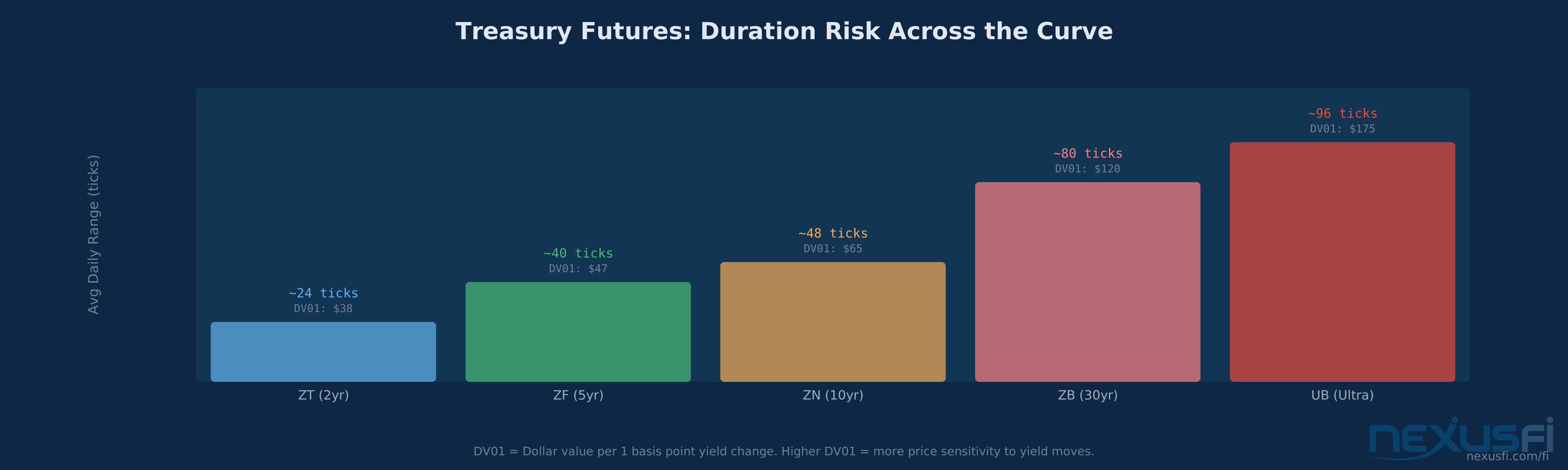
Duration risk increases dramatically across the curve. A 1 basis point yield change moves ZT about $38 (DV01) but moves UB approximately $175. This means:
- ZT: Smallest moves. Pure Fed policy views with lower P&L variance
- ZF: Moderate. The belly where monetary policy meets growth expectations
- ZN: The benchmark. Most liquid, balanced between policy and inflation narratives
- ZB: High duration. Directional traders' weapon of choice. As @addchild explains: "The farther out on the yield curve the greater the volatility, and with it, a larger trading range. UB will over-extend almost every single move relative to ZN." [8]
- UB: Highest duration. Maximum price sensitivity, most volatile per contract
Position Sizing Across the Curve #
You can't size ZB and ZT the same way. If your risk tolerance is $500 per trade, that might be 32 ticks on ZT ($15.625/tick) but only 16 ticks on ZB ($31.25/tick) — and ZB's typical daily range is 3-4x larger than ZT's. Always calibrate position size to the specific contract's DV01 and current volatility.
Trading Sessions and Liquidity #
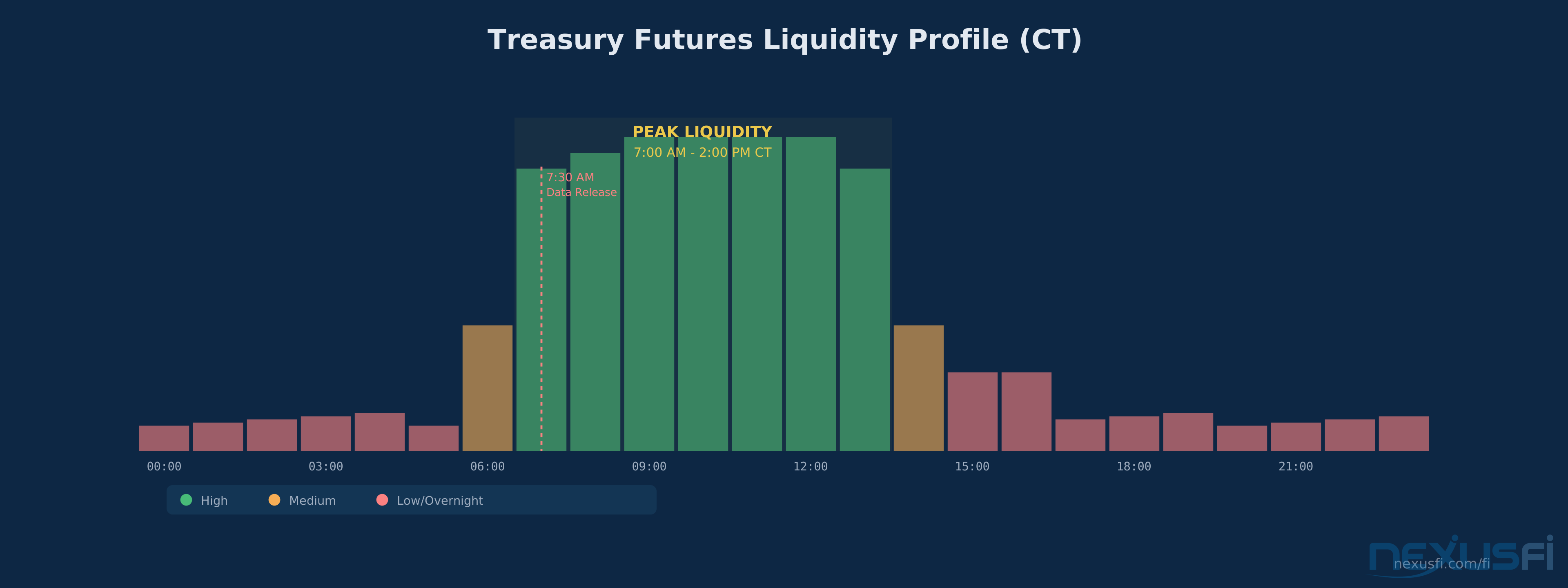
Treasury futures trade on CME Globex from Sunday 6:00 PM to Friday 5:00 PM ET, with a daily 60-minute maintenance break.
Peak liquidity: 8:20 AM - 3:00 PM ET. ZN regularly shows 2,000-5,000 contracts of visible depth at the inside market. Spreads are typically 1 tick.
Key event windows: FOMC (2:00 PM ET), CPI/PPI (8:30 AM ET), NFP (8:30 AM ET first Friday), Treasury auctions (1:00 PM ET typically). Liquidity can evaporate in the seconds before major releases — spreads widen to 2-3 ticks and depth drops to a fraction of normal.
A structural reality worth noting: @choke35 highlights that "average trade sizes are falling deeper and deeper — ZN ~10 contracts per trade, ZB ~3 con/tr at the moment during the prime time — which is ridiculously low compared with historical levels." [9] This reflects algorithmic fragmentation of modern bond markets.
[10] The "wildness" of ZN reflects its extreme sensitivity to rate expectations during volatile policy environments.
Practical Trading Considerations #
Event-Driven Trading #
Treasury futures are the most event-sensitive instruments in futures markets. For event-driven trades:
- Be in position or be out. The first 5-10 seconds after a release are algorithm-dominated
- Size down 50-75% compared to your normal position
- Use bracket orders with wider stops than normal — false moves of 10-15 ticks before the real direction are common
- The press conference matters. The 2:30 PM Fed chair press conference regularly reverses or extends the initial reaction
Cross-Market Confirmation #
[11] If ZB moves but ZN doesn't confirm, the move is suspect. If all durations move together, conviction is higher.
The Fixed Income Learning Curve #
[13] Treasury futures demand macro literacy that equity index traders can sometimes avoid.
Roll and Delivery #
Treasury futures follow a quarterly cycle (H, M, U, Z). Volume migrates to the next contract about 2-3 weeks before expiration. For most traders, delivery is never a concern — simply roll when the new contract becomes more liquid. But understand: CTD mechanics mean the contract's effective duration shifts as yields change, which can cause basis risk near expiration.
Knowledge Map
Prerequisites
Understand these firstGo Deeper
Build on this knowledgeReferences This Article
Articles that build on this topicCitations
- — Trading treasuries... what do I need to know? (2013) 👍 13“Professionals trade the curve. Period.”
- — ZB ZN (NOB) (2011) 👍 4“ZB daily range roughly twice ZN, about 50% larger than ZF”
- — 2s vs 10s (2022) 👍 3“DV01 spreadsheet from CME for yield spread ratios”
- — Is the WH trying to engineer a recession? (2025) 👍 2“Going long ZN or ZB using technical levels or macro catalysts”
- — Outright or Spreads? (2013) 👍 3“Trade yield changes, not price changes”
- — How I Trade For a Living (2016) 👍 7“Position sizing by dollar value of basis point change in CTD”
- — anyone scalping the NOB futures spread (2014) 👍 4“NOB uses 2*ZN to 1*ZB ratio, TOS yield spread charting”
- — bond future trading question (2013) 👍 2“Farther out on yield curve = greater volatility and trading range”
- — When to trade ZB/ZN? (2017) 👍 7“Average trade sizes falling - ZN ~10 con/tr, ZB ~3 con/tr”
- — 30 Year Treasury Bond Futures /ZB (2022) 👍 2“I trade the ZB and ZN - more recently ZB as ZN is too wild”
- — ZN vs. ES (2015) 👍 11“UB and ZB traded by big players using algos based on ZN movement”
- — Learning about Bonds fundamentals (2021) 👍 4“When the whole curve is pressing highs or lows, moves get cleaner”
- — ZN_Requesting feedback_Chart type and learning books/resources for ZB (2021) 👍 10“Fixed income = yield curves and auctions, not charts and indicators”