



Trading Journal for Self-Awareness: Building the Observation Habit That Changes Everything
The most profitable tool in your trading arsenal costs nothing, takes 5 minutes per trade, and most traders abandon it within two weeks.
Overview #
Every experienced trader will tell you the same thing: keep a journal. And almost every developing trader will nod, try it for a week, then quietly stop. The journal sits empty while the same mistakes repeat on a loop
A trading journal isn't a trade log. Your broker already gives you that. A trading journal is a decision-quality feedback system
@PandaWarrior nailed the distinction in his NexusFi journal: "Knowing yourself is the hardest part, the next hardest bit is acknowledging the truth of that awareness... Knowing yourself and doing something about it are two distinctly different things
This article covers what to track, how to track it, the specific frameworks professional traders use, and how to turn raw journal data into the pattern recognition that actually moves the needle on your P&L.
Why Most Trading Journals Fail #
Before getting into what works, here's why most journals don't.
Problem 1: Too much friction. If your journal requires 20 minutes per trade and a detailed essay, you'll do it for three days. The journal needs to be 2-5 minutes per trade with a structured template. Dropdowns and checkboxes beat free text for the fields you'll analyze later.
Problem 2: Tracking outcomes instead of process. A P&L log isn't a journal. Recording "bought ES at 5420, sold at 5425, made $250" tells you nothing about decision quality. A winning trade with broken rules is more dangerous than a losing trade with perfect execution
Problem 3: No review cadence. Writing entries without reviewing them is data collection without analysis. The entries are raw material. The weekly review is where pattern recognition happens.
Problem 4: Trying to fix everything at once. Your journal will surface a dozen problems. Trying to fix all of them simultaneously fixes none of them. Pick your top 3 process leaks and work those. Everything else waits.
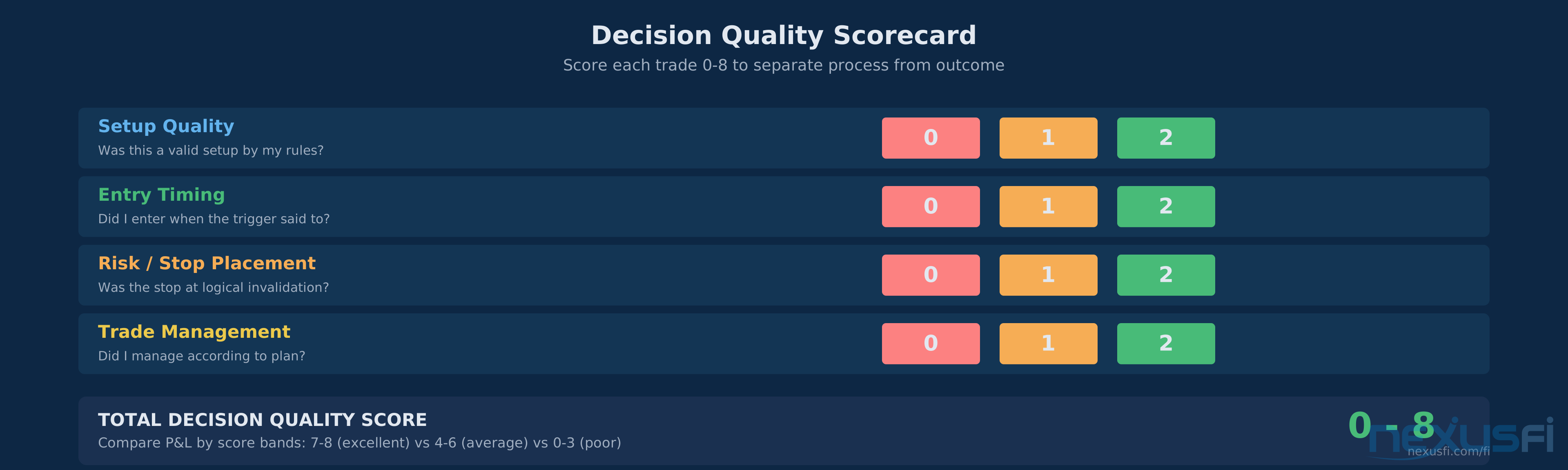
What to Track: The Three Layers #
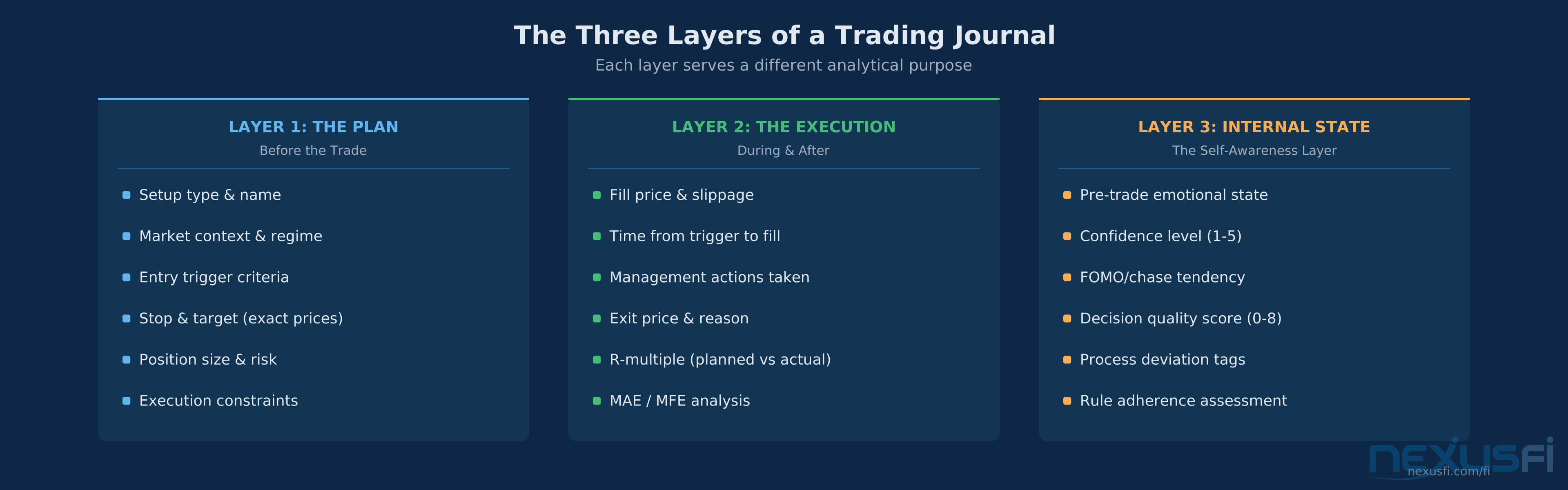
The Review Cadence: Where Patterns Emerge #
Individual entries are raw data. The review process is where that data becomes insight.
Daily Review (5 minutes, end of session) #
Quick scan of today's trades:
- Which trades followed the plan? Which deviated?
- What was my average decision quality score?
- Did any emotional state correlate with rule breaks?
- One sentence: what's the single most important thing to carry into tomorrow?
Weekly Review (30 minutes, end of week) #
Statistical analysis across the week's trades:
- Win rate by setup type (are your "plays" actually working?)
- Average decision quality score by day (fatigue patterns?)
- Correlation between emotional states and execution quality
- Process deviation frequency (which tags show up most?)
- MAE/MFE analysis (are you cutting winners or letting losers run?)
- P&L grouped by decision score bands (high-quality vs. low-quality decisions)
Monthly Deep Dive (1 hour) #
Pattern analysis across 4 weeks of data:
- Top 3 process leaks identified and ranked by P&L impact
- Regime-specific performance (how do you trade differently in trends vs. ranges?)
- Session-specific performance (morning vs. afternoon, RTH vs. Globex)
- Are your circuit breakers firing? What triggers them?
- Set 1-3 specific improvement targets for next month
That discovery
Professional Journaling Frameworks #
Five frameworks professional traders use, each emphasizing different aspects of self-awareness. Pick one that fits your trading style, or combine elements from multiple frameworks.
1. The Playbook Method #
Define a small set of high-probability setups
Self-awareness angle: Forces you to distinguish between "this play doesn't work" and "I'm not executing this play correctly." Over time, your playbook gets refined to your actual edge
2. Plan vs. Actual with Process Leak Tags #
Four columns per trade:
- Plan: Setup, entry, stop, target
- Actual: Fill, slippage, management actions
- Variance: What changed and why
- Process leak tag: chase / tilt / news impact / conflict / fear exit
Self-awareness angle: The variance column is where the truth lives. When you see "widened stop because I was afraid of getting stopped out" written down 15 times in a month, the pattern is undeniable.
3. R-Multiple + MAE/MFE Postmortem #
Focus on three numbers per trade: intended R, realized R, and the MAE/MFE ratio. Then categorize the exit reason against the plan.
Self-awareness angle: MAE patterns reveal whether you place stops where they should be vs. where feels comfortable. MFE patterns reveal whether you systematically leave money on the table. Both are behavioral fingerprints that don't lie.
4. The Three Questions #
Post-session, evaluate each trade through three lenses:
- Was my thesis correct? (market analysis)
- Was my management correct? (risk and trade management)
- Was my process correct? (psychology and discipline)
Self-awareness angle: Separating these three domains prevents the common trap of blaming psychology for what was actually a bad setup, or blaming the market for what was actually poor risk management.
5. Decision Scorecard #
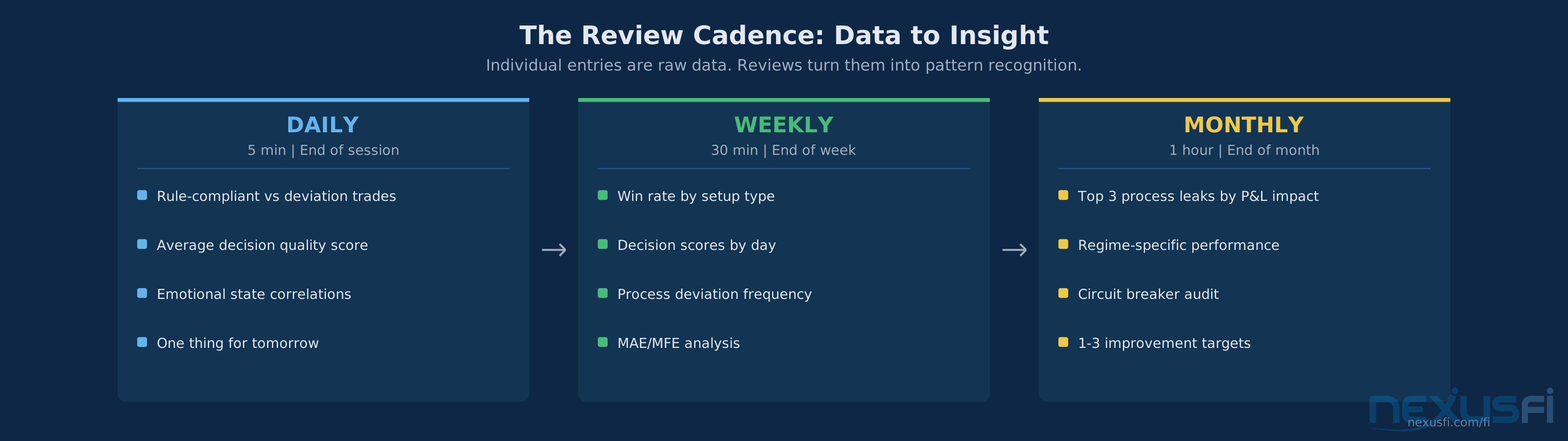
Score each trade 0-2 across four categories (setup quality, entry timing, risk/stops, trade management) for a total decision quality score of 0-8. Track P&L by score bands.
Self-awareness angle: When high-score trades consistently outperform low-score trades, you have mathematical proof that process matters more than outcome. That insight restructures your relationship with individual losses.
The Public Journal: Accountability Through Community #
NexusFi's trading journal forums
@David_R started his public journal after working with trading psychologist Jared Tendler, who encouraged him to "really pay attention to the emotions and thoughts that come my way while trading." The public format added a layer: "I asked Jared if a public journal with my comments would be acceptable/useful and he felt it was a good approach."
@bobwest, whose Trade Journal on NexusFi spans thousands of posts, described a breakthrough in self-awareness that came directly from the journaling process: He identified an "unconscious tendency" to enter late after large moves, and realized his task was "to become and stay aware of that as I trade; not to fight the tendency, but to understand it, be responsible for it, and act deliberately based on my conscious trading plan, not my unconscious tendencies."
The emphasis is critical: not to fight the pattern, but to become aware of it. Self-awareness doesn't mean self-correction. It means self-observation
Pattern Recognition: Turning Data Into Edge #
After 4-6 weeks of consistent journaling, your data set is large enough to start finding patterns. Here's what to look for.
Emotional Correlations #
Cross-reference your pre-trade emotional state with execution quality and outcomes:
- Do trades entered when frustrated have worse slippage?
- Does high confidence correlate with better or worse outcomes? (Overconfidence is a common pattern.)
- Does anxious trading lead to tighter stops (getting stopped out more)?
Time-Based Patterns #
- Performance by session open vs. mid-day vs. close
- Degradation after a certain number of trades (fatigue threshold)
- Day-of-week effects (many traders perform differently on Mondays and Fridays)
- Performance after winning streaks vs. losing streaks
Setup-Specific Insights #
- Which setup types have the highest decision quality scores?
- Which setups do you deviate from most often?
- R-multiple distribution by setup type (is one setup carrying all the profit?)
The Hypothesis Engine #
The most powerful use of journal data is generating testable hypotheses:
- "When volatility is high AND I enter late, my average slippage increases 3x and rule adherence drops below 3/8."
- "In range-bound markets, my trend setups lose an average of 0.6R more than expected."
- "After 3 consecutive losers, my next trade has a 70% probability of being a rule deviation."
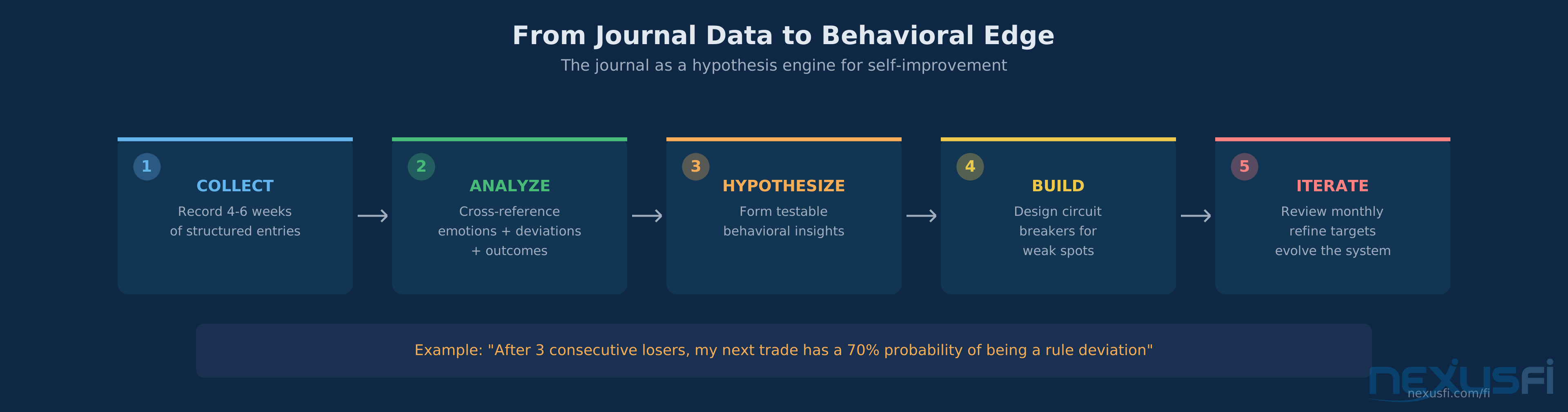
These hypotheses aren't backtested strategies
Getting Started: The Minimum Viable Journal #
Don't build the perfect journal. Build the journal you'll actually use. Here's the minimum viable template that produces results within 4 weeks:
Per trade (2-3 minutes):
| Field | Example |
|---|
|
| Date/Session | Mar 28, RTH |
|---|---|
| Setup | IB Range Extension |
| Pre-trade state | Alert, Confidence 4/5 |
| Plan: Entry/Stop/Target | Long 5420 / Stop 5415 / Target 5435 |
| Actual: Fill/Exit | Filled 5421 / Exited 5432 |
| R-Multiple | Planned 3R / Realized 2.2R |
| Decision Score | Setup 2 + Entry 1 + Risk 2 + Mgmt 1 = 6/8 |
| Deviation Tags | Late entry |
| One Learning | Hesitated 30 seconds on trigger, cost 1 tick |
Daily (2 minutes, end of session):
- Average decision score today
- Dominant emotional state
- One thing to carry into tomorrow
Weekly (30 minutes):
- Stats by setup type
- Decision score trends
- Process leak frequency
- Top improvement target for next week
That's it. Start here. Add complexity only when you've maintained this for a full month. The journal that exists beats the perfect journal that doesn't.
Knowledge Map
Prerequisites
Understand these firstGo Deeper
Build on this knowledgeReferences This Article
Articles that build on this topicCitations
- — IT7 Journal (2014) 👍 5“I couldn't agree more. Knowing yourself is the hardest part, the next hardest bit is acknowledging the truth of that awareness. Here's a quote from my journal today.... 6:30AM "This trade should have gone a bit faster after that large impulse bar.”
- — Catching Big Waves (2012) 👍 5“I have recently added a daily and weekly evaluation sheet to my trading routine. On it, I ask questions like "How well did I identify the type of day and mood of the market?" and "Did I keep my losses contained and my risk managed?" and one of the la...”
- — SoftSoap's NQ Journey (2016) 👍 7“I want to give you an inside look at what happened in my head today, and how I think a lot differently now because I understand myself better. I can thank my journaling at NexusFi a lot for that.”
- — David's Trading Journal Chapter 2 (2021) 👍 7“Hello Everyone, I've been a member of Futures.io for quite some time, going back to when the forum was called Big Mike's. I used to be fairly active until I got tired of blowing out accounts. Unfortunately, my interest in posting dwindled.”
- — Trade Journal (2014) 👍 10“Another quick day: 3 trades and out. However, a pretty good day in terms of psychological self-awareness (assuming I'm not simply delusional in thinking that.... :sarcastic:) Trades first.”