



Backtesting Trading Strategies: From Hypothesis to Validated Edge
Overview #
Every algo trader's career has the same inflection point — the moment they realize a beautiful backtest and a profitable strategy aren't the same thing. The gap between historical simulation and live execution has destroyed more accounts than bad entries ever will.
Backtesting is the process of running a trading strategy against historical market data to evaluate whether it would have been profitable. Done right, it's the closest thing to a scientific method that trading offers — a structured way to test hypotheses before risking capital. Done wrong, it's an elaborate exercise in self-deception that produces strategies perfectly tuned to the past and worthless going forward.
The difference between the two comes down to methodology. Backtesting isn't an optimization problem — it's a validation problem. You're not trying to find the best-performing parameters. You're trying to determine whether a specific market hypothesis produces a reliable edge under realistic conditions. That distinction changes everything about how you build, test, and evaluate strategies.
This article covers the complete backtesting pipeline for futures traders: from forming a testable hypothesis through data requirements, execution modeling, validation techniques, and the go/no-go decision that separates strong strategies from curve-fitted garbage.
The Hypothesis-Driven Framework #
Here's where most algo traders go off the rails before they even start: they open an optimizer, throw a pile of indicators at historical data, and let the computer find the "best" settings. That's not backtesting. That's data mining — and the results are almost guaranteed to fail in live trading.
The correct approach starts with a hypothesis. A testable, specific statement about market behavior that you believe creates an exploitable edge. "Markets tend to mean-revert to the prior session's POC during balanced conditions" is a hypothesis. "What combination of moving average crossovers produces the highest Sharpe ratio on ES" is not — that's a fishing expedition.
As @Fat Tails explains, "even as a discretionary trader I follow a method that supposedly provides an edge in the markets. To be sure that this edge exists, I need to backtest this method over a large number of trades." [1] The backtest validates the hypothesis — it doesn't generate it.
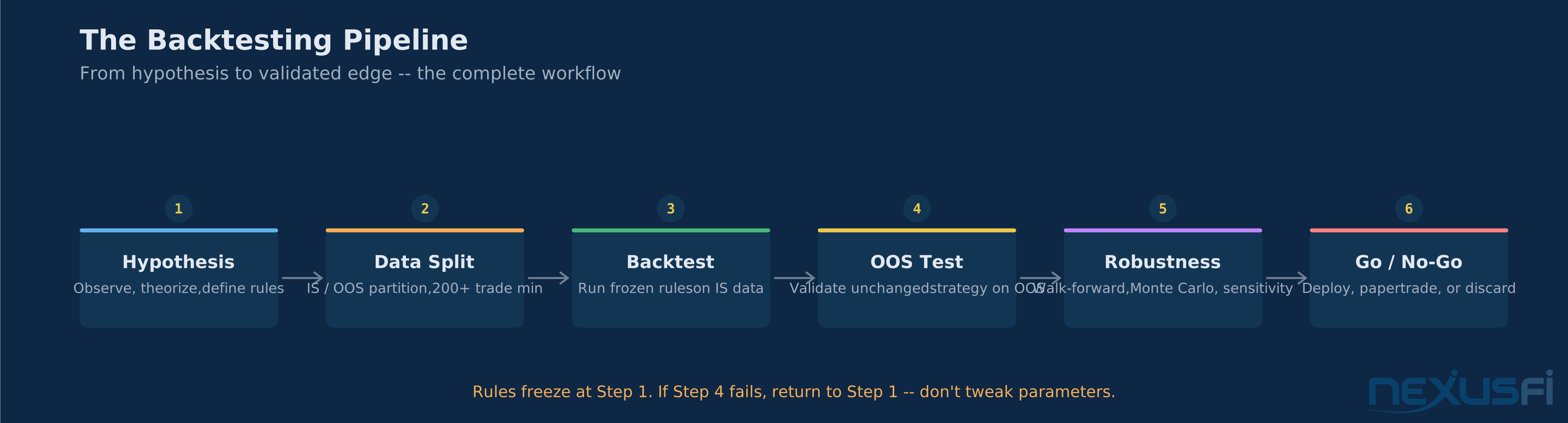
The hypothesis-first workflow:
- Observe a repeatable market behavior (e.g., price rejection at naked POC levels)
- Hypothesize a mechanism (responsive buyers/sellers defend prior value)
- Define specific rules (entry, stop, target, filters)
- Test against historical data you haven't seen yet
- Validate with out-of-sample data and robustness checks
The key constraint: you don't change the rules after step 3. If the backtest shows poor results, you go back to step 1 with a new hypothesis — you don't tweak parameters until the equity curve looks good. That's the line between science and self-delusion.
Key Concepts #
Historical Data Quality #
Your backtest is only as good as your data. For futures, this means tick-level or 1-minute bar data with accurate timestamps, proper session breaks, and correct contract rollover handling. Continuous contracts need careful construction — a back-adjusted contract that preserves price gaps differently from a ratio-adjusted one will produce materially different results on the same strategy.
Critical data requirements: sufficient history for statistical significance (minimum 200+ trades in-sample), correct handling of overnight/Globex sessions, and inclusion of low-liquidity periods where your fills wouldn't have been realistic. For more on data infrastructure, see Market Data for Futures Trading.
In-Sample vs Out-of-Sample #
The most fundamental concept in backtesting. In-sample (IS) data is what you develop and tune your strategy on. Out-of-sample (OOS) data is what you test the finished strategy on — data the strategy has never seen. As @Big Mike puts it, "Out of sample data is critical for a meaningful backtest, yet most traders don't do it." [2]
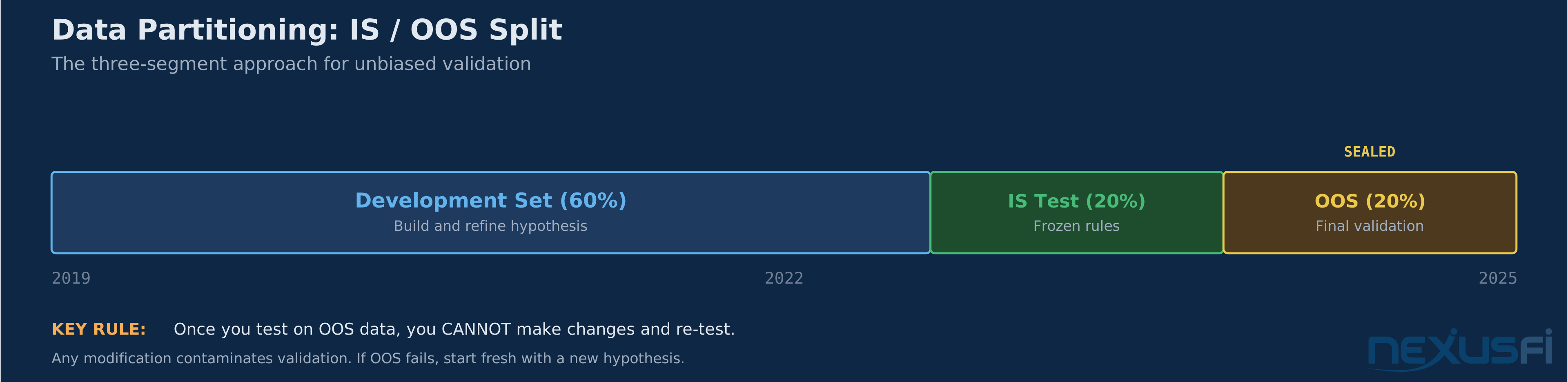
The rule is absolute: once you test on OOS data, you cannot make changes and re-test. "Once you have tested your strategy on out of sample data, you cannot make changes to your strategy and re-test it on that data. It is no longer out of sample." [2] Break this rule and you've contaminated your validation.
Curve Fitting #
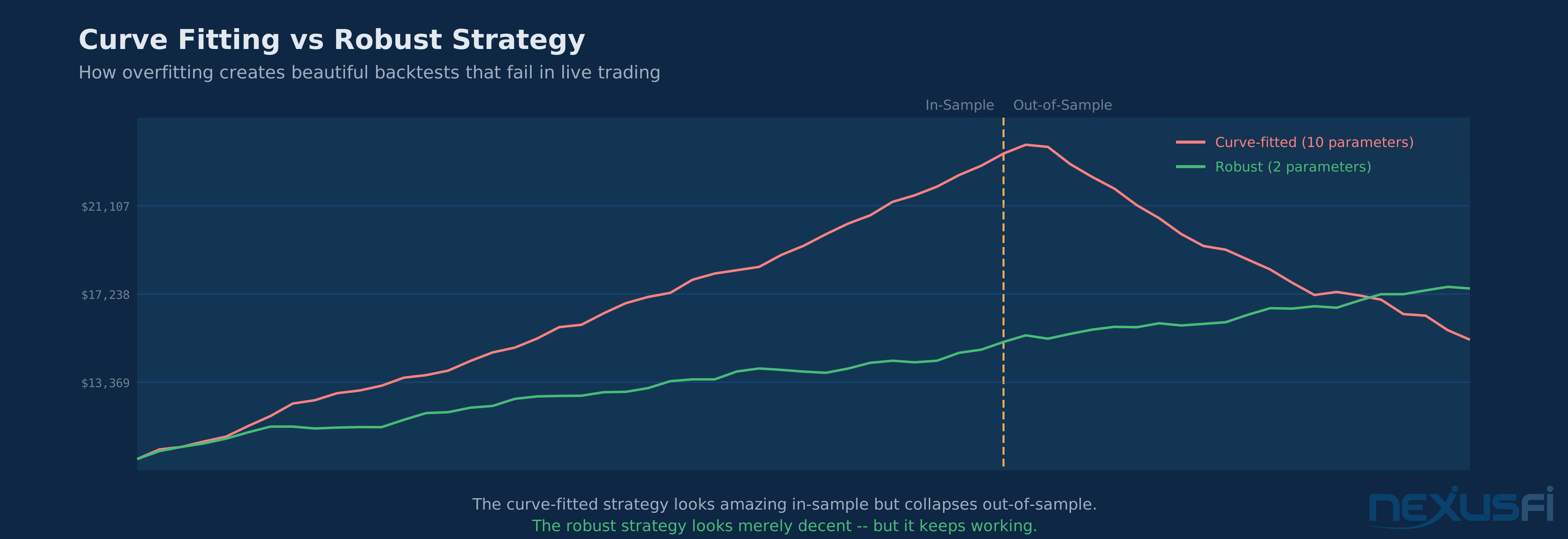
Curve fitting is the backtester's original sin — optimizing a strategy until it perfectly matches historical data at the expense of future performance. Every additional parameter you improve, every filter you add, every tweak you make to improve the backtest is a step toward curve fitting.
@kevinkdog nails the counterintuitive truth: "The algo model should be 'fit' as little as possible, and should be as simple as possible. Ideally, this means the algo may tease out the 'signal' part instead of the noise." [3] A simple strategy with a decent backtest will almost always outperform a complex strategy with a great backtest.
Academic research confirms the magnitude of this problem — Bailey et al. (2014) demonstrated that with sufficient parameter searches, any dataset can be made to look profitable with zero predictive validity. Their Probability of Backtest Overfitting (PBO) framework showed that as the number of strategy configurations tested increases, the probability that the selected "best" strategy is actually overfit approaches certainty. [11]
Walk-Forward Analysis #
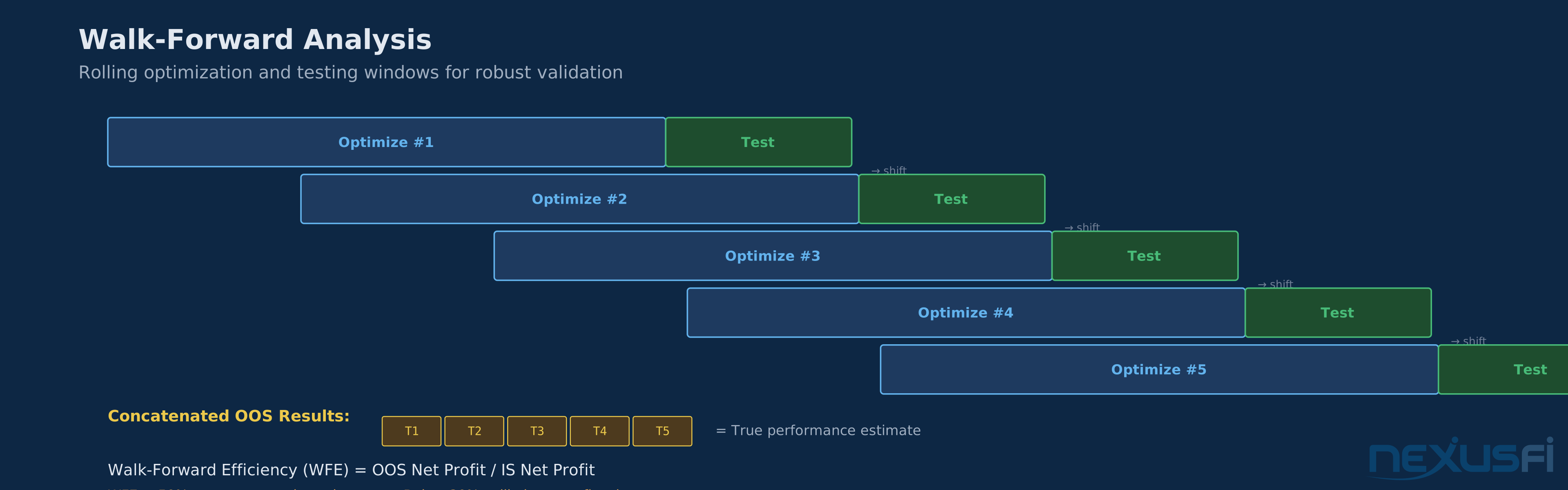
Walk-forward analysis (WFA) is the industry standard for validating strategy robustness. Instead of a single IS/OOS split, you divide your data into rolling windows: improve on window 1, test on window 2, shift forward, improve on window 3, test on window 4, and so on. The concatenated OOS results form your true performance estimate.
Kevin Davey's Building Winning Algorithmic Trading Systems (Wiley, 2014) provides the practitioner's blueprint for walk-forward testing — including the methods behind his three consecutive World Cup Trading Championship wins using algorithmic systems. His core argument: walk-forward isn't just a robustness check, it's the mechanism that forces your system to prove it can adapt to changing market conditions while maintaining its edge. [12]
Monte Carlo Simulation #
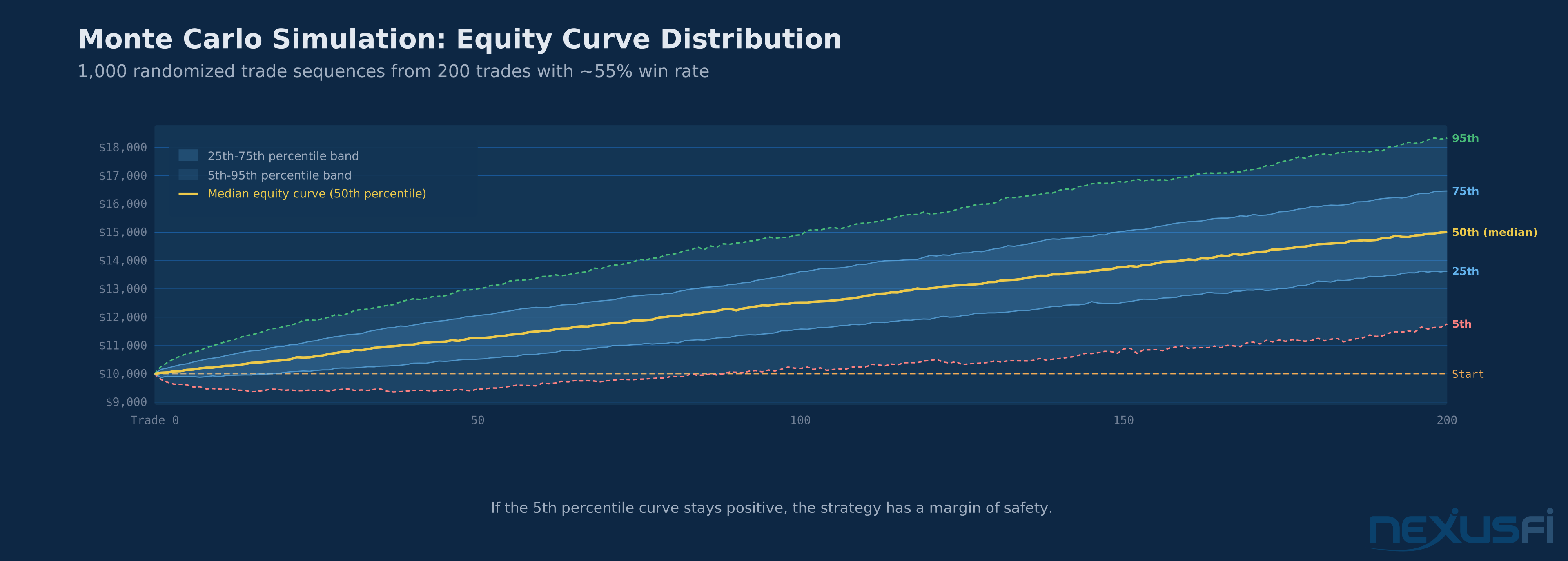
Monte Carlo analysis tests robustness by randomizing the order of your trades. As @Fat Tails explains, "If your strategy is curve-fitted, it is likely that it will not pass the Monte-Carlo-Simulation very well, as some of the N equity curves will not include the (probably few large) trades that the strategy has been fitted to." [4]
Performance Metrics #
Raw P&L is noise. What matters: Sharpe ratio (risk-adjusted return — above 1.0 is decent, above 2.0 is strong), profit factor (gross profit / gross loss — above 1.5 suggests a real edge), maximum drawdown (worst peak-to-trough — determines if you can psychologically survive trading it), and number of trades (below 100 and your statistics are unreliable).
The Validation Pipeline #
This is the core methodology — the step-by-step process that separates validated strategies from curve-fitted fantasies.
Step 1: Define and Freeze Your Rules #
Write out every rule: entry conditions, exit conditions, stop placement, position sizing, time filters, market filters. Be specific. "Go long when price touches the prior day's POC with positive delta divergence" is specific. "Go long on support" is not.
Once written, these rules are frozen. You don't change them during testing.
Step 2: Partition Your Data #
Split your historical data into three segments:
- Development set (60%): Where you develop and refine the hypothesis (before freezing rules)
- In-sample validation (20%): Where you run the frozen strategy to verify basic viability
- Out-of-sample test (20%): Held in reserve, never seen until final validation
For futures with clear regime changes, consider time-based splits that include different volatility environments (e.g., 2019 low-vol, 2020 crash, 2021 trending, 2022-2023 rate cycle).
Step 3: Run the Backtest with Realistic Assumptions #
This is where most backtests lie. Your simulation must account for:
Slippage: @kevinkdog reports that "slippage varies from a tick or two on markets like ES to multiple ticks on markets like HO and KC" and has seen "as much as $2000+ slippage on a single contract" on gold during thin sessions. [5] Budget at least 1 tick of slippage per side on liquid markets (ES, NQ), 2+ ticks on thinner contracts.
Commissions: Include full round-turn costs. At $4-5 per round turn for most retail futures brokers, a strategy averaging 10 trades per day faces $40-50 daily in fixed costs before slippage.
Fill assumptions: Market orders get filled at the ask (for longs) plus slippage. Limit orders only fill if price trades through your level — sitting on the bid doesn't guarantee a fill, especially in fast markets. The conservative approach: assume limit fills only when price moves at least 1 tick past your order level.
Step 4: Evaluate In-Sample Results #
Run the frozen strategy on your IS data. Look for:
- Profit factor above 1.3 (not 2.0+ — suspiciously good IS results suggest curve fitting)
- Minimum 100 trades for statistical reliability
- Consistent performance across sub-periods (a strategy that made all its money in one month and bled the other 11 is not strong)
- Drawdown survivability — could you actually trade through the worst drawdown without abandoning the strategy?
If IS results are poor, the hypothesis failed. Go back to step 1. Don't start tweaking.
Step 5: Out-of-Sample Validation #
Run the identical, unchanged strategy on your OOS data. Compare key metrics:
- Win rate within 10% of IS win rate
- Average trade size within 20% of IS average
- Maximum drawdown within 1.5x of IS drawdown
- Profit factor within 30% of IS profit factor
If OOS performance degrades much, the strategy is likely curve-fitted. As @Big Mike warns, "If your MAE, MFE, average length of time in trades, consecutive winners/losers, win percentage, expectancy, etc are all much different from the IS vs OOS then you know your strategy is curve fitted garbage and will not perform well in the future." [2]
Step 6: Walk-Forward Confirmation #
Run a full walk-forward analysis across the entire dataset. The standard approach: 6-month optimization window, 1-month out-of-sample window, rolling monthly. If the walk-forward efficiency (WFE = OOS net profit / IS net profit) exceeds 50%, the strategy shows genuine robustness.
Step 7: Robustness Testing #
Before deploying capital, stress-test the strategy:
Monte Carlo (trade reordering): Run 1,000 simulations with randomized trade sequences. If the 5th percentile equity curve still shows positive expectancy, you have a margin of safety.
Parameter sensitivity: As @Big Mike advises, "Whatever time frame you are using, slightly change it. For example if using 5 minute bars change it to 3 minute bars and re-run the test." [6] Also try correlated instruments — "Switch to a highly correlated instrument. For example if trading ES then switch to YM or NQ." [6] If results collapse with minor parameter changes, the strategy is brittle.
When Backtesting Fails #
Backtesting has structural limitations that no methodology can fully overcome. Knowing these prevents false confidence.
Regime change: Markets aren't stationary. As @FGBL07 observes, "markets are not static, they change. And this does not mean mere price changes but the way markets behave changes. In statistical language: the underlying distribution changes." [8] A strategy optimized for 2019's low-volatility grind will get demolished by a regime like March 2020. Walk-forward analysis helps but doesn't solve this — it just tells you faster when a strategy has stopped working.
Survivorship bias in data: Continuous futures contracts can obscure important events. Contract rollovers, limit-up/limit-down days, and exchange outages all create data artifacts that your backtest may trade through as if nothing happened.
Market impact: Your backtest assumes zero market impact. In reality, your orders move the market — especially on thinner contracts or during low-volume periods. A strategy that trades 50 lots of ES at the open will face materially different fills than the single-contract simulation suggests.
The data snooping problem:
Strategy decay: Even validated strategies degrade over time. Edge erodes as more participants discover similar signals, as market microstructure evolves, and as volatility regimes shift. Plan for it: monitor live performance against backtest benchmarks and have a kill switch.
@Big Mike learned this firsthand with his QuadTrend algo: "The hardest lessons to learn with automation have to do with curve fitting, and with having patience and discipline. Too many people find a strategy that they get comfortable with and then every day, or multiple times a day even, they keep tweaking this strategy, over and over. The strategy gets more and more 'filters' added, until either the strategy takes so few trades it would take many months of live testing to prove, or the strategy is so overly curve fitted that its future results will be garbage." [10]
Practical Application #
The Go/No-Go Decision Framework #
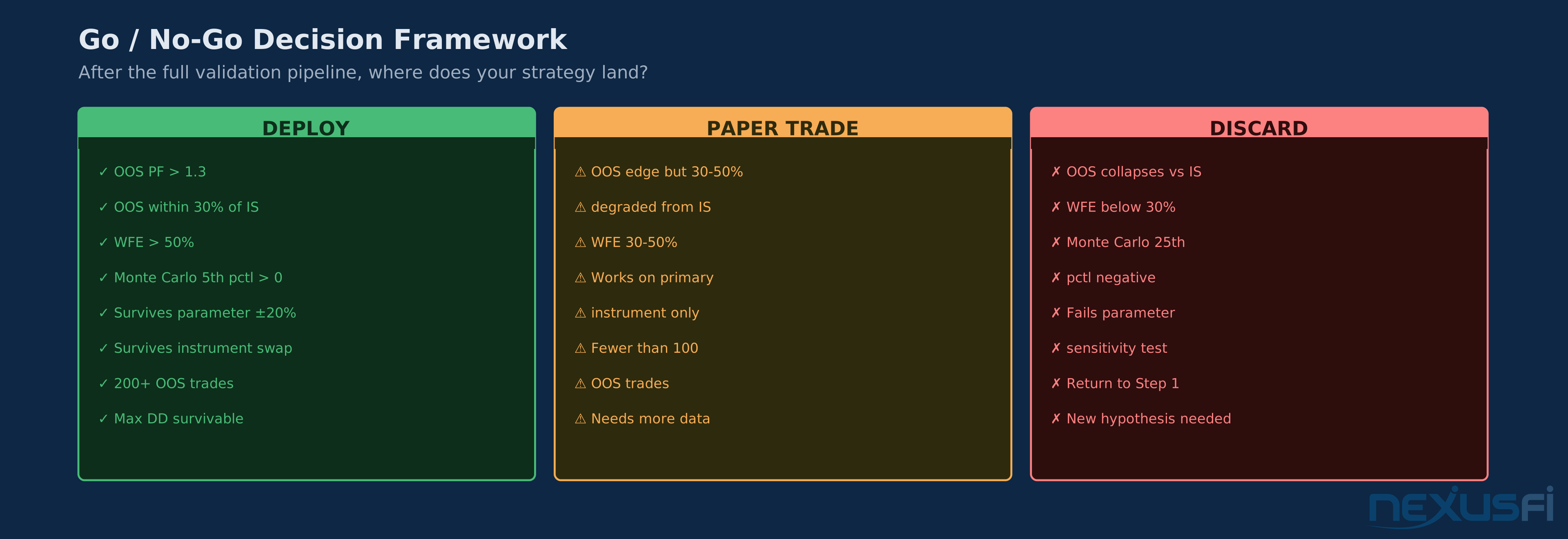
After running the full validation pipeline, use this checklist:
GREEN (deploy with capital):
- OOS profit factor > 1.3 and within 30% of IS
- Walk-forward efficiency > 50%
- Monte Carlo 5th percentile still profitable
- Strategy survives parameter variation (±20%) and instrument substitution
- Maximum drawdown survivable at planned position size
- Minimum 200 OOS trades with consistent monthly distribution
YELLOW (paper trade / sim only):
- OOS shows edge but much degraded from IS (30-50% decline)
- Walk-forward efficiency 30-50%
- Strategy works on primary instrument but fails on correlated instruments
- Fewer than 100 OOS trades
RED (discard or return to hypothesis):
- OOS performance collapses vs IS
- Walk-forward efficiency below 30%
- Monte Carlo shows negative expectancy at 25th percentile
- Strategy fails with minor parameter changes
Integration with Risk Management #
Even a validated strategy requires proper risk management. Size positions using the strategy's maximum historical drawdown multiplied by 1.5x as your worst-case planning number. Never allocate more than 2% of account equity to a single trade's risk.
For a deeper understanding of position sizing methods, see Position Sizing. For stop loss design integrated with backtesting, see Stop Loss Strategies.
Platform Considerations #
Most futures traders backtest on NinjaTrader, TradeStation, or Sierra Chart. Each has its own backtesting engine with different fill assumptions and optimization capabilities. NinjaTrader 8's Strategy Analyzer includes built-in walk-forward optimization. TradeStation has a mature optimization suite. Sierra Chart offers detailed replay with real tick data. The specific platform matters less than the methodology — apply this validation pipeline regardless of your tools.
Knowledge Map
Prerequisites
Understand these firstGo Deeper
Build on this knowledgeReferences This Article
Articles that build on this topicCitations
- — An experiment on curve fitting (2010) 👍 3“Even as a discretionary trader I follow a method that supposedly provides an edge in the markets. To be sure that this edge exists, I need to backtest this method over a large number of trades.”
- — Does backtesting work? (2011) 👍 2“Out of sample data is critical for a meaningful backtest, yet most traders don't do it. Once you have tested your strategy on out of sample data, you cannot make changes and re-test it on that data.”
- — Sustained success with an algo (2022) 👍 3“The algo model should be 'fit' as little as possible, and should be as simple as possible. Ideally, this means the algo may tease out the 'signal' part instead of the noise.”
- — Ninja Trader Monte Carlo (2011) 👍 7“If your strategy is curve-fitted, it is likely that it will not pass the Monte-Carlo-Simulation very well, as some of the N equity curves will not include the (probably few large) trades that the strategy has been fitted to.”
- — Slippage Now 2023 vs Past (2023) 👍 6“Slippage varies from a tick or two on markets like ES to multiple ticks on markets like HO and KC. I have had as much as $2000+ slippage on a single contract.”
- — Benchmarks for a good automated ES trading system (2014) 👍 3“Whatever time frame you are using, slightly change it. Switch to a highly correlated instrument. In both cases, your final results should be highly correlated with the originals.”
- — Strategy Optimization and trusting the results (2011) 👍 5“A strategy is considered robust if it's able to survive variation. Hints it's not robust: only works on a very specific chart, only works on a particular instrument, or slight input changes cause large performance swings.”
- — Common sense trading decisions (2011) 👍 6“Markets are not static, they change. And this does not mean mere price changes but the way markets behave changes. In statistical language: the underlying distribution changes.”
- — How quickly do algos go bad? (2021) 👍 5“You grab the last years data, run a backtest, fix coding errors, change a MA to 30 instead of 20, then run optimization. Boom - profit factor of 3. But you have also just curve fitted your results to that moment in time.”
- — QuadTrend Algo Strategy Journal (2010) 👍 4“The hardest lessons to learn with automation have to do with curve fitting. Too many people keep tweaking until the strategy is so overly curve fitted that its future results will be garbage.”
- Bailey, Borwein, Lopez de Prado & Zhu — The Probability of Backtest Overfitting (2014)
- Kevin J. Davey — Building Winning Algorithmic Trading Systems (2014)