



Position Sizing Methods for Futures Trading
Overview #
Position sizing is the single most powerful lever in your trading operation. Get entries right but sizing wrong and you'll still blow up. Get entries mediocre but sizing right and you'll survive long enough to improve everything else.
This article covers the three primary position sizing methods used by futures traders — fixed fractional, ATR-based (volatility-adjusted), and Kelly criterion — with the math, worked examples, and practical guidance on when each method fits. This is a component of the broader Risk Management for Futures Trading framework.
The Core Formula #
Every position sizing method boils down to the same fundamental equation:
Contracts = Dollar Risk / Risk Per ContractWhere:
- Dollar Risk = Account Equity x Risk Percentage
- Risk Per Contract = Stop Distance x Point Value
Every position sizing method boils down to the same fundamental equation: ```` @Nicolas11 laid out the framework comprehensively on NexusFi, examining multiple objectives — maximizing expected capital, minimizing risk of ruin, and maximizing gain while keeping risk reasonable — showing that "there is no unique answer.
The methods differ in how they determine the inputs — especially stop distance and risk percentage. But the formula itself never changes.
Fixed Fractional Position Sizing #
The most widely used method in futures trading. You risk a fixed percentage of your current account balance on every trade.
The formula:
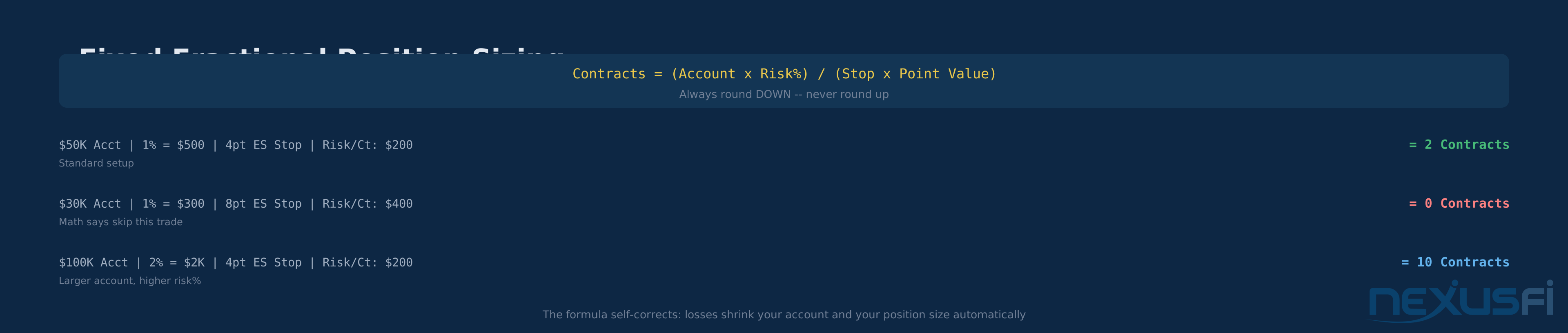
Contracts = (Account x Risk%) / (Stop Distance x Point Value)Worked example on ES:
- Account: $50,000
- Risk per trade: 1% = $500
- Stop distance: 4 points
- Point value: $50/point (ES)
- Dollar risk per contract: 4 x $50 = $200
- Contracts: $500 / $200 = 2.5 -> round down to 2 contracts
Always round down. Rounding up means you're risking more than your stated percentage. This isn't a suggestion — it's a rule.
As @tigertrader explained on NexusFi: "You can always adopt a fixed fractional trading strategy where you determine the number of contracts you trade for a defined level of risk. So, if you are willing to risk 2% of your $100,000 trading account on a trade where your stop is set at 4 points ($200 per contract), you could trade 10 contracts and still remain risk-prudent."
Why Fixed Fractional Works #
The beauty is self-correction. After losses, your account shrinks and so does your position size — automatically reducing exposure when you can least afford risk. After wins, account grows and size increases — compounding returns when the system is performing.
As @sdonahue demonstrated on NexusFi, comparing fixed fractional sizing at 2% risk per trade versus fixed contract sizing across the same NQ setups — the fixed fractional approach produced meaningfully better risk-adjusted returns because it naturally scaled exposure to account health.
The Stop-Size Relationship #
Here's the critical connection most traders miss: your stop distance directly determines your position size. A tighter stop means more contracts within the same dollar risk. A wider stop means fewer contracts.
| Stop Distance | Risk/Contract | Contracts |
|---|---|---|
| 2 points | $100 | 5 |
| 4 points | $200 | 2 |
| 8 points | $400 | 1 |
| 12 points | $600 | 0 (skip) |
At 12 points, the math says don't take the trade. That's the formula working correctly — it told you this setup doesn't fit your risk parameters. Don't force it by widening your risk percentage.
Risk Percentage Guidelines #
- Conservative: 0.5% per trade (capital preservation focus)
- Standard: 1% per trade (most common among professional traders)
- Aggressive: 2% per trade (maximum for sustained trading)
- Reckless: 3%+ per trade (drawdown math works against you fast)
At 2% risk per trade with a 55% win rate, the probability of a 10-trade losing streak is about 0.03%. But that 10-trade streak takes 18.3% off your account. At 3% risk, the same streak takes 26.3% off — requiring a 35.6% gain to recover. The math gets ugly fast above 2%.
ATR-Based Position Sizing #
Instead of using a fixed-tick stop, you let the market's current volatility determine your stop distance. The ATR (Average True Range) measures how much an instrument moves in a given period — and your stop adapts so.
The formula:
Stop Distance = ATR(N) x Multiplier
Contracts = (Account x Risk%) / (Stop Distance x Point Value)
@Fat Tails developed a complete approach to this on NexusFi, using "ATR(36) plus Spread" on the 5-minute chart as the money management stop-loss. The process: measure the ATR range over the past week's RTH sessions, calculate stop loss from the mean ATR plus spread, then derive contract count from the dollar risk allowance.
The key insight from @Fat Tails: "The advantage of doing this manually is that a change informs me about different market conditions, in case that I did not realize it during the week."
How ATR Sizing Self-Adjusts #
Low volatility (ATR contracts): Stops tighten, more contracts, same dollar risk. High volatility (ATR expands): Stops widen, fewer contracts, same dollar risk.
This is the opposite of what most traders do instinctively. When markets get volatile, the natural impulse is to trade bigger. ATR sizing forces you to trade smaller — which is exactly right because the per-tick risk just increased.
As @tigertrader noted on NexusFi: his stops are "placed within the context of a volatility-based, position sizing algorithm, which is quite simply, 2% of equity risk, based on a 1.5 ATR stop."
Worked example on CL:
- Account: $30,000, Risk: 1% = $300
- 14-period ATR on 15-min chart: 0.35 points
- Stop = ATR x 2 = 0.70 points
- Dollar risk/contract: 0.70 x $1,000 = $700
- Contracts: $300 / $700 = 0.43 -> 0 contracts
That's ATR sizing working correctly. It told you this trade doesn't fit your risk parameters at current volatility. The correct response is to skip the trade or wait for the ATR to contract — not to override the math.
Common ATR Multipliers #
| Trading Style | ATR Period | Multiplier |
|---|---|---|
| Scalping | ATR(14) 5-min | 1.0-1.5x |
| Day trading | ATR(14) 15-min | 1.5-2.0x |
| Swing | ATR(14) Daily | 2.0-3.0x |
The multiplier exists because ATR represents average movement — your stop needs to sit outside normal noise. A 1x ATR stop will get clipped by routine price action roughly half the time.

Kelly Criterion #
The Kelly Criterion calculates the theoretically optimal fraction of your bankroll to risk for maximum long-term geometric growth. It comes from information theory and the math is elegant.
The formula:
Kelly% = W - [(1-W) / R]
Where: W = win rate, R = average win / average loss
@Nicolas11 laid out the framework comprehensively on NexusFi, examining multiple objectives — maximizing expected capital, minimizing risk of ruin, and maximizing gain while keeping risk reasonable — showing that "there is no unique answer. It depends on what we want to improve."
Example with a typical scalping system:
- Win rate: 60% (W = 0.60)
- Win/Loss ratio: 0.833 (R = 0.833)
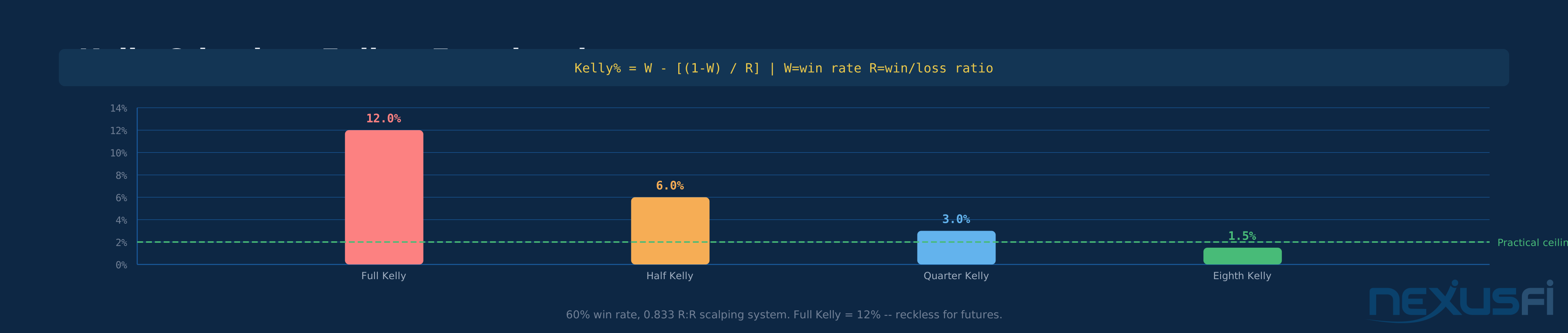
- Kelly% = 0.60 - (0.40 / 0.833) = 0.60 - 0.48 = 12%
Full Kelly at 12% is reckless for futures. The standard practice is fractional Kelly:
| Fraction | Risk % | Use Case |
|---|---|---|
| Full Kelly | 12% | Never in futures |
| Half Kelly | 6% | Aggressive systems traders |
| Quarter Kelly | 3% | Most practical ceiling |
| Eighth Kelly | 1.5% | Common in practice |
As @Fat Tails analyzed on NexusFi: "I would rather bet half-Kelly than full-Kelly. Provided you use a fixed fractional betting system and adjust your bet size according to the Kelly Formula, the risk of ruin does not depend on the expectancy, as the Kelly Formula already accounts for the expectancy."
Kelly's Limitations #
Kelly assumes you know your exact win rate and payoff ratio. You don't. Your historical stats are estimates with confidence intervals, and the market's regime shifts over time.
As @Small Dog pointed out on NexusFi: "Lack of accounting for utility is, in my opinion, one of the big drawbacks of Kelly and Optimal F." The Kelly formula optimizes for geometric growth rate — not for your psychological ability to withstand the drawdowns that come with it.
In practice, most futures traders who reference Kelly end up at quarter-Kelly or less, which lands them right back in the 1-2% fixed fractional range. Kelly is useful as a theoretical ceiling — "don't ever risk more than this" — rather than as a practical daily sizing tool.
Choosing Your Method #
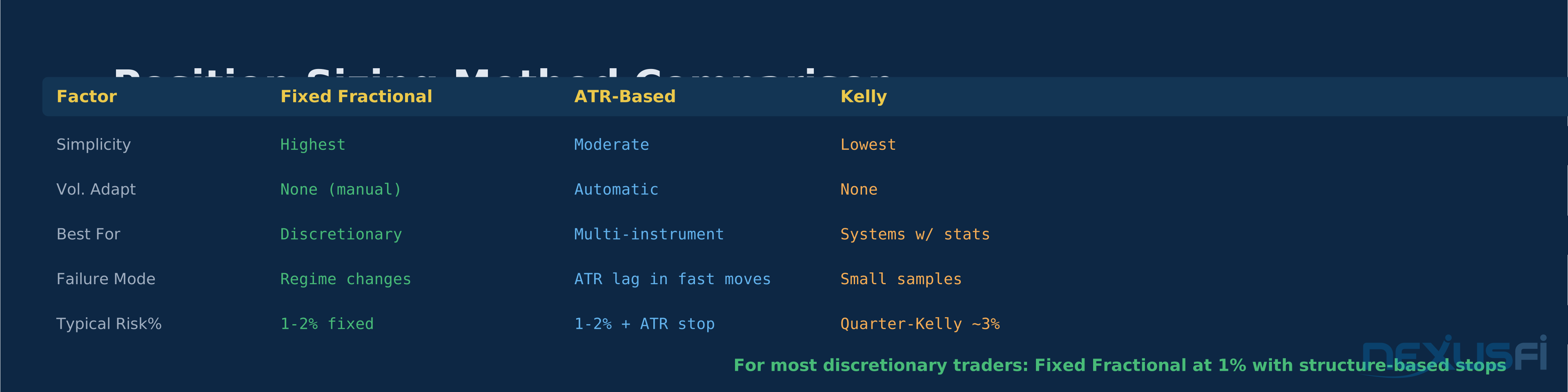
For most discretionary futures traders, fixed fractional at 1% with structure-based stops is the right starting point. If you trade multiple instruments with different volatility profiles, ATR-based sizing normalizes risk across them automatically. Kelly is a theoretical reference point — useful for knowing your upper bound, dangerous as an actual sizing rule.
| Factor | Fixed Fractional | ATR-Based | Kelly |
|---|---|---|---|
| Simplicity | Highest | Moderate | Lowest |
| Vol. Adaptation | None (manual) | Automatic | None |
| Best For | Discretionary | Multi-instrument | Systems with stable stats |
| Risk of Overfit | Low | Low | High |
| Failure Mode | Regime changes | ATR lag in fast moves | Small samples |
The Compounding Effect #
Position sizing's real power shows up over sequences of trades, not individual ones. Consider two traders with identical entries over 100 trades:
Trader A (fixed 2 contracts): Wins and losses hit equally regardless of account state. After a 30% drawdown, still trading the same size — meaning each loss is now a larger percentage of the reduced account.
Trader B (1% fixed fractional): After a 30% drawdown, position size has automatically shrunk. Each loss is still 1% of the current (smaller) account. Recovery requires the same percentage gain, not a larger one.
As @wldman described on NexusFi, this "volatility based constant percentage risk position sizing algorithm" that "normalizes the dollar volatility by adjusting position" was implemented by successful systematic traders as early as the 1980s. The principle hasn't changed because the math hasn't changed.
Practical Implementation #
The Pre-Trade Sizing Checklist #
- Current account equity (not yesterday's — recalculate after each session)
- Risk percentage (1% standard, 0.5% for lower-conviction setups)
- Stop placement (from market structure, not from comfort level)
- Contract calculation (formula: dollar risk / per-contract risk, round down)
- Sanity check — does this position size feel reasonable for the instrument?
Scaling Into Positions #
As @tigertrader advised: "When you are pressing a trade and adding to it, you should be scaling in a pyramid fashion, adding progressively smaller units. The advantage of scaling into your maximum position is that it keeps risk lowest early in the trade, when its outcome is most in question."
Pyramid scaling example (4-contract maximum):
- Entry: 2 contracts at initial level
- Add 1: 1 contract after confirming move
- Add 2: 1 contract at extended target
- Total risk never exceeds initial 1% calculation
Multi-Instrument Normalization #
If you trade ES, CL, and NQ — all with different point values and volatility profiles — ATR-based sizing normalizes risk across instruments. One contract of CL isn't the same risk as one contract of ES. ATR sizing makes that comparison automatic.
As @Fat Tails showed in his spreadsheet approach: calculating position size per instrument based on its specific ATR, tick value, and exchange rate, then updating weekly as conditions shift.
Sources & Citations #
This article draws on research and community discussion from NexusFi's trading forums, including contributions from @Fat Tails (ATR-based sizing, Kelly analysis, risk of ruin calculations), @tigertrader (fixed fractional strategy, volatility-based sizing, pyramid scaling), @Nicolas11 (complete Kelly criterion analysis), @MXASJ (Van Tharp position sizing methods), @Small Dog (Kelly criterion limitations), @sdonahue (fixed fractional vs fixed contract comparison), and @wldman (volatility-normalized position sizing history).
Knowledge Map
Go Deeper
Build on this knowledgeReferences This Article
Articles that build on this topicCitations
- — Killer Instinct and the Home Run Mentality“You can always adopt a fixed fractional trading strategy where you determine the number of contracts you trade for a defined level of risk.”
- — Why position sizing matters“Two different variations - one using fixed fractional position sizing with 2% risk per trade, and the other using a fixed contract size.”
- — PositionSizer for NinjaTrader“ATR(36) plus Spread on the 5 minute chart as the money management stop-loss.”
- — Concerning risk per trade sizing“2% of equity risk, based on a 1.5 ATR stop.”
- — Optimal position sizing strategy (including considerations on Kelly criterion)“There is no unique answer. It depends on what we want to optimize.”
- — Risk of Ruin“I would rather bet half-Kelly than full-Kelly.”
- — Optimal position sizing strategy“Lack of accounting for utility is one of the big drawbacks of Kelly and Optimal F.”
- — Minimum starting funds to learn to trade“Volatility based constant percentage risk position sizing algorithm.”
- — Killer Instinct and the Home Run Mentality“Scaling in a pyramid fashion, adding progressively smaller units.”